
IPL 2026 & Cricket Match Viewing: Best Ways to Watch With Friends at a Villa
IPL 2026 is running from March through May — and the best way to watch the big matches isn’t always at the stadium. It’s at a private villa with your squad, a large screen or projector, a swimming pool for between-overs cooling off, and no queuing for overpriced stadium beer.
Villa cricket watch parties have become one of the most popular ways to follow IPL in India. Book a property near a host city, attend one match live at the stadium, and watch the rest on a private outdoor screen with the people who actually make sports watching fun. This guide covers how to set it up, which villas to pick near each IPL city, and what’s coming up in Indian cricket for the rest of 2026.
[stayvista_cta text=”Find villas near IPL 2026 host cities on StayVista”]
In this Blog
IPL 2026: Dates, Venues, and the Villa Party Opportunity
IPL 2026 runs from late March through May, with the playoff phase and final in late May. The tournament features eight home venues across India:
- Mumbai — Wankhede Stadium (capacity 33,108)
- Chennai — MA Chidambaram Stadium (50,000)
- Bangalore — M. Chinnaswamy Stadium (40,000)
- Kolkata — Eden Gardens (68,000) — largest IPL venue
- Hyderabad — Rajiv Gandhi International Stadium (55,000)
- Delhi — Arun Jaitley Stadium (41,820)
- Jaipur — SMS Stadium (30,000)
- Lucknow — Ekana Cricket Stadium (50,000)
Match tickets sell out quickly for the top fixtures (especially Mumbai vs. Chennai, Bangalore vs. Kolkata, and any playoff matches). For most fans, getting tickets to even one match per IPL season is an achievement. The real tournament experience — across all matches over two months — happens on screens.
A private villa takes that screen experience to a different level. Instead of a living room, you have a terrace, a lawn, or a poolside setup. Instead of seven people on one sofa, you have a property that’s been booked for your group alone. The villa format works especially well for IPL because the matches are evening affairs (typically 7:30 PM IST) — giving you a full day for activities before the main event.
How to Set Up the Perfect IPL Villa Screening
The Screen Setup
The screen is the centrepiece. Options, ranked by quality:
- Outdoor projector + screen (best): A 100–120 inch screen setup is the gold standard for a villa watch party. Rent a projector (3,500–5,000 lumens minimum for any ambient light) and a motorised or fixed-frame screen for ₹2,000–5,000/day from AV rental companies in most major cities. The image at 100+ inches on a dark terrace is genuinely cinematic.
- Large-screen LED TV (good): Many StayVista properties come with 55–75 inch TVs that can be moved to a covered outdoor terrace. A 65-inch screen for 10 people is adequate for a living room or covered outdoor area.
- Portable projector (budget option): Decent portable projectors (1,500–2,500 lumens) cost ₹8,000–15,000 to buy or ₹800–1,500/day to rent. Fine for a covered or fully dark outdoor setup.
Sound matters as much as picture: A good Bluetooth speaker or a 2.1 soundbar completely transforms the experience. The commentary, the crowd noise, and the boundary music hit differently with proper sound. Most villa kitchens have them — ask your StayVista host in advance.
The Food and Drinks Setup
IPL watch parties run 4–5 hours when you include the full 20 overs, break, and 20 more. Plan food in phases rather than one big sit-down meal:
- Pre-match (6:30–7:30 PM): Starters and drinks. Chicken tikka, paneer tikka, nachos with salsa, peanuts and papad. Keep it light and finger-friendly.
- First innings (7:30–9:30 PM): The main meal. A DIY taco or wrap setup, biryani served in the break, or a one-pot dish (dal makhani + rotis) that doesn’t require leaving the screen for long.
- Second innings (9:30–11:30 PM): Dessert and snacks — ice cream, fruit, or a simple cake if it’s someone’s birthday. Keep drinks flowing.
- Drinks planning: A 12-person group needs a well-stocked cooler set up before the match. Don’t rely on running to a shop mid-game.
Villa catering: StayVista properties offer caretaker cooking on advance request. Brief the caretaker before the match day with your food plan — they can handle prep, setup, and serving so you’re not missing over boundaries while cooking.
The Pool-and-Watch Setup
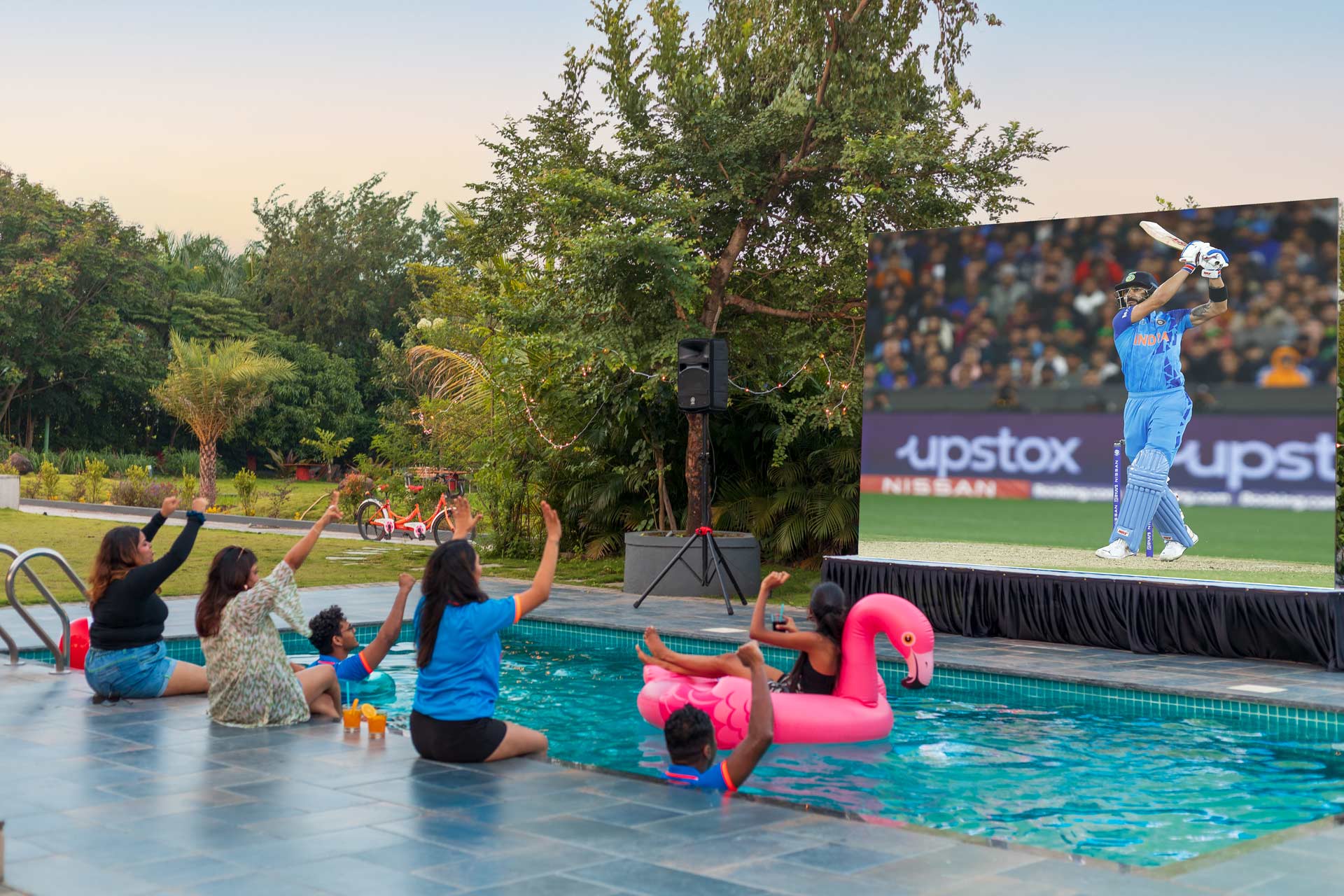
IPL April–May matches happen when the evening temperature is still 28–32°C across most of India. A villa with a pool lets you structure the day differently: play in the pool all afternoon, barbecue at sunset, set up the screen poolside, and watch the match from sunloungers. This is the highest-quality cricket viewing experience available outside a stadium.
For poolside screenings, you’ll need a weatherproof projector or a poolside TV with a cover arrangement. Most AV rental companies in metro cities now offer “poolside screening setups” as a specific package.
Villa Picks Near Each IPL 2026 Host City
Near Mumbai (Wankhede Stadium)
Mumbai’s home matches at Wankhede are among the hardest tickets to get. The alternative: book a villa in Alibaug or Karjat, watch all Mumbai’s away matches on screen at the villa, and plan one day trip to attend a match live at Wankhede if you get tickets.
- Alibaug (90 km / ferry: 60 min from Gateway of India): Coastal villas with sea-facing pools. The ferry commute to attend a Wankhede match is a genuinely fun experience — take the 4 PM ferry, watch the match, return on the last ferry or next morning. Browse Alibaug villas on StayVista.
- Karjat (90 km / 2 hours from Mumbai): Riverside villas with large lawns — excellent for a group of 8–12. The flat terrain makes outdoor screen setups easy. Browse Karjat villas on StayVista.
- Igatpuri / Nashik (180 km / 3 hours): For a longer IPL weekend getaway from Mumbai. Vineyard stays near Nashik with pool villas are excellent for a 3-night IPL watch party weekend.
Near Bangalore (M. Chinnaswamy Stadium)
Bangalore’s home matches sell out in hours. Book a villa in the Nandi Hills area for an IPL long weekend — close enough to drive into Bangalore for a match, far enough to escape the city for the rest of the days.
- Nandi Hills area (60 km from Bangalore): Pool villas with cool evening temperatures ideal for an outdoor screening. The drive back after a night match is 90 minutes — manageable. Browse Nandi Hills stays on StayVista.
- Coorg (5 hours): For a longer IPL escape — stay in Coorg for 3–4 nights, watch matches on the villa screen each evening, and spend days exploring coffee estates. The connection is usually strong enough for streaming.
Near Delhi (Arun Jaitley Stadium)
Delhi’s IPL home matches are at Arun Jaitley in central Delhi. For a villa base within day-trip distance:
- Karnal (130 km / 2.5 hours): Farmhouses and countryside properties north of Delhi with large lawns. Good for a group that wants open outdoor space.
- Meerut area (70 km / 1.5–2 hours): Close enough for a quick return. Farmhouse properties with pools near Meerut work for a weekend base during Delhi home games.
- Gurugram/Faridabad outskirts (30–40 km): For IPL watch parties without wanting to travel far — private farmhouses on Delhi’s outskirts are ideal for after-work Friday gatherings around a match.
Near Jaipur (SMS Stadium)
Jaipur’s IPL home matches are a unique experience — the city has a genuine cricketing culture. The adjacent areas offer interesting getaway options:
- Pushkar (145 km / 3 hours): Desert villas and tented camps near Pushkar are spectacular for an IPL getaway — sundowner in the desert, match on screen at the camp, stars overhead.
- Ajmer (135 km / 2.5 hours): Heritage havelis with modern amenities. A Jaipur–Pushkar–Ajmer triangle works for a 3-night IPL weekend.
- Jaipur outskirts: Heritage villas within 30–40 km of Jaipur for quick match-day trips into the city.
The Combine Strategy: Stadium + Villa
The best IPL experience for a group is the combine approach:
- Book tickets to one home match at whichever IPL venue is nearest to your city
- Book a villa nearby for a 3-night stay over that match weekend
- Watch all other matches on the villa screen — creating a continuous IPL experience rather than a one-off stadium visit
This approach gives you the stadium atmosphere for at least one match, while the villa gives you the best environment for the marathon experience of following a whole tournament. It’s also significantly cheaper than booking premium stadium seats for multiple matches.
Looking Ahead: ICC Champions Trophy and Cricket in 2026
IPL 2026 isn’t the only cricket event worth planning around this year. The ICC calendar for 2026 includes:
- ICC Men’s T20 World Cup 2026: Scheduled to be hosted across India and Sri Lanka in October–November 2026. If confirmed, this will be the biggest cricket event on Indian soil in years — villa parties for T20 World Cup matches will be in extremely high demand. Start planning now if you want good availability at villas near host cities.
- India bilateral series (2026): India’s home series schedule for the June–September window typically includes England, West Indies, or other major Test and ODI opponents. These series generate exceptional living-room and villa watch party viewership, particularly for Test matches over 5 days.
For World Cup matches, book villa accommodation the moment the host city schedule is confirmed — demand spikes within hours of fixture announcements. Cities like Mumbai (Wankhede), Bangalore (Chinnaswamy), Kolkata (Eden Gardens), and Chennai (Chepauk) will see accommodation fill within days for marquee matches.
What Makes a Villa the Best Place to Watch Cricket
The stadium experience is irreplaceable for atmosphere. But for a group following an entire tournament — through group stages, knockouts, and finals — the private villa is categorically better:
- Sound system: Proper speakers in a private space mean you can actually hear commentary clearly — impossible in most bars or stadiums
- Pause and replay: Miss a wicket or a boundary while getting a drink? Rewind. You can’t do that at a stadium or a bar with a packed crowd
- Your group, your reactions: There’s a special energy in watching with people who genuinely care about the same team. A shared private space amplifies that
- No overpriced food and drink: A well-stocked villa bar and a good spread of match-day snacks costs a fraction of stadium or sports bar pricing
- The pool: Between innings, six-hit celebrations, and post-match wind-downs — the pool is the variable that stadiums and bars cannot compete with
Frequently Asked Questions
IPL 2026 runs from late March through late May 2026. The group stage runs over approximately 8 weeks, with the playoff knockout stage and final in May. The exact schedule and dates are confirmed on the BCCI website at bcci.tv.
The simplest setup: a portable projector (2,500+ lumens) connected to a streaming device (Fire Stick, Apple TV) pointed at a white wall or projection screen, with a good Bluetooth speaker or soundbar. For a more polished setup, rent a 100-inch screen and a 4,000-lumen projector from an AV rental company in your nearest city. Budget ₹2,000–5,000 for a one-day professional rental.
Alibaug and Karjat are the top choices near Mumbai. Alibaug’s coastal pool villas are ideal for the April–May season, and the ferry from Gateway of India makes it easy to attend a Wankhede match and return to the villa the same evening. Karjat’s riverside farmhouses offer more outdoor space for large groups of 8–15 people.
StayVista properties require minimum 1-night bookings (some have minimum 2-night requirements on weekends). A single-night Friday or Saturday booking works well for an IPL watch party — you arrive, set up, watch the evening match, and check out the next morning. Browse StayVista’s properties near your city and filter for 1-night availability.
Most StayVista villas that are listed for 6–12 guests have enough indoor and outdoor space for a comfortable watch party. For a group of 10–15, look for villas with a large covered terrace or lawn, and consider bringing or renting a projector for a bigger screen. Check the property’s guest capacity on the StayVista listing and confirm with the host if you’re adding catering or external equipment.
The ICC Men’s T20 World Cup 2026 is scheduled to be co-hosted by India and Sri Lanka in October–November 2026. This will be one of the biggest cricket events in India in years. For villa bookings near host cities (Mumbai, Bangalore, Kolkata, Chennai, Hyderabad, Delhi), we strongly recommend booking as soon as the venue schedule is confirmed — typically 2–3 months before the tournament begins.