
Dry Days in India 2026: Complete Month-by-Month Calendar with State-Wise Dates, Election Bans & Travel Tips
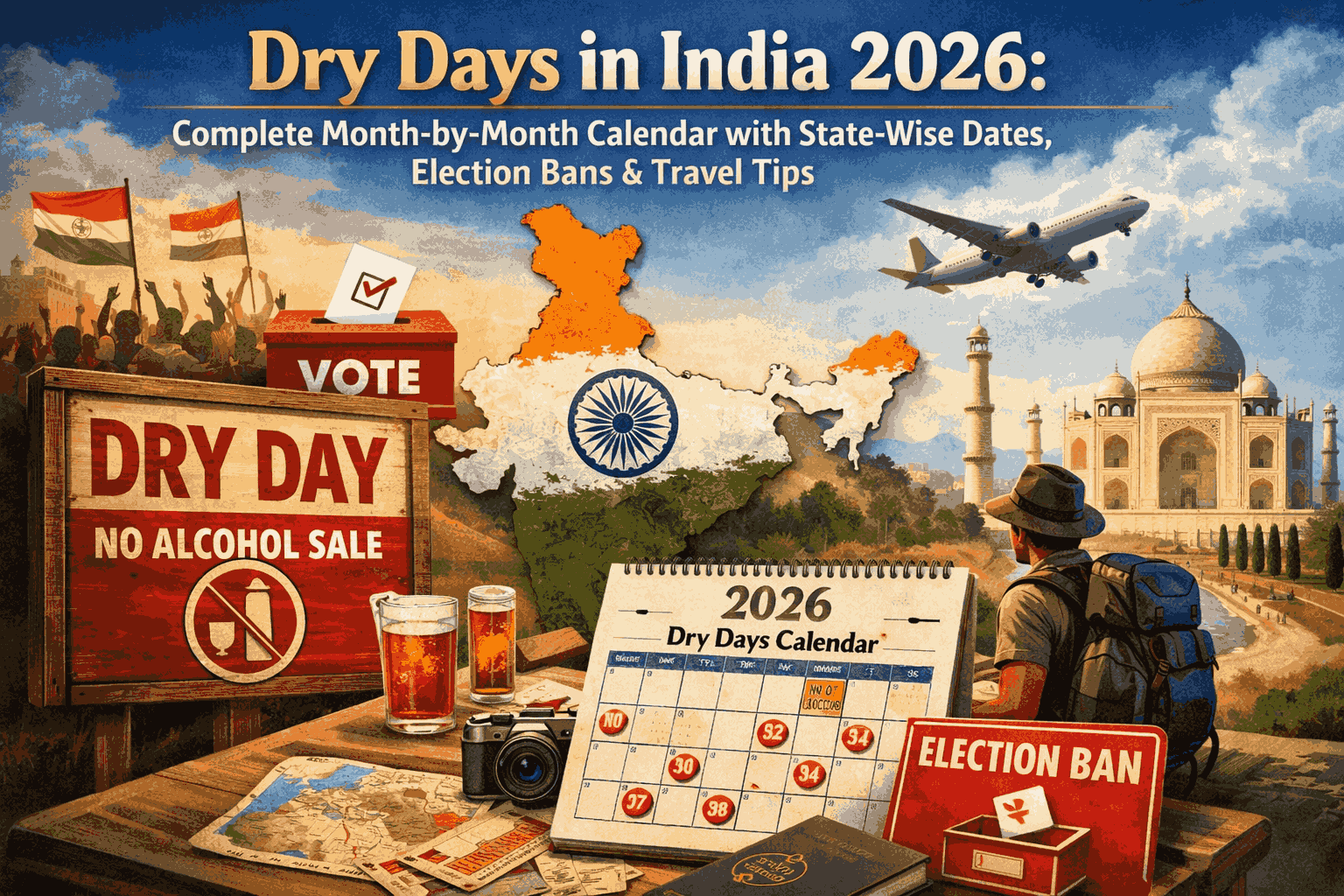
India observes approximately 21–26 national and state-level dry days in 2026, during which alcohol sale is legally prohibited. These include national holidays (Republic Day, Independence Day, Gandhi Jayanti), major festivals (Holi, Diwali, Eid ul-Fitr, Ganesh Chaturthi), regional events, and election polling days across states. Maharashtra alone observes 16–18 dry days, including Mumbai-specific bans around Ambedkar Jayanti on 14 April.
In this Blog
What are Dry Days in India and How Does the Law Work?
A dry day in India is a legally mandated date on which the retail sale and, in many cases, the service of alcohol is prohibited. Liquor shops remain shut, and licensed restaurants or bars cannot sell alcoholic beverages. The prohibition does not typically apply to sealed bottles already purchased or to private consumption at home.
The authority to declare dry days is split between the central government and individual states. The Ministry of Home Affairs issues a list of national-level dry days tied to gazetted public holidays. State excise departments then layer additional dates on top — covering regional festivals, polling days, and religious occasions that carry local significance. This is why Mumbai’s dry day count differs from, say, Goa’s or Kolkata’s.
Penalties for illegal sale on dry days can include licence cancellation, fines, and criminal prosecution under the respective state’s excise act. Enforcement is generally stricter around national holidays and election days than on minor state occasions.
Key distinction
Dry days apply to sale, not possession or consumption. A sealed bottle of wine in your hotel minibar is legal. Ordering a drink at the hotel bar typically is not, unless the establishment holds a special permit.
National Dry Days in 2026: The Full List
The following dates are observed as dry days across all states that follow central government guidelines. Most states observe all of these; a few (notably Goa and some North-East states with more liberal excise rules) may vary.
| Date | Day | Occasion | Type |
| 26 January | Monday | Republic Day | National |
| 20 March | Friday | Holi | National |
| 31 March | Tuesday | Id-ul-Fitr (Eid) | National |
| 14 April | Tuesday | Dr. Ambedkar Jayanti / Tamil New Year | National |
| 14 April | Tuesday | Good Friday (same date in 2026) | National |
| 1 May | Friday | Maharashtra Day / May Day | State |
| 26 June | Friday | Id-ul-Zuha (Bakrid) | National |
| 15 August | Saturday | Independence Day | National |
| 25 August | Tuesday | Janmashtami | National |
| 2 October | Friday | Gandhi Jayanti / Dussehra (approx.) | National |
| 20 October | Tuesday | Dussehra (Vijaya Dashami) | National |
| 20 October | Tuesday | Muharram | National |
| 8 November | Sunday | Diwali (Lakshmi Puja) | National |
| 5 November | Thursday | Diwali Eve / Narak Chaturdashi | State |
| 24 November | Tuesday | Guru Nanak Jayanti | National |
| 25 December | Friday | Christmas Day | National |
Note on Islamic dates
Eid ul-Fitr, Bakrid, and Muharram follow the lunar calendar. The dates above are based on expected moon sighting for India in 2026 and may shift by one day depending on the official announcement.
Month-by-Month Dry day Calendar 2026
Here is a consolidated month-wise view of expected dry days across India, covering national holidays, major festivals, and states with notable additional restrictions.
January
- 26 Jan — Republic Day
February
- 26 Feb — Maha Shivratri
March
- 20 Mar — Holi
- 31 Mar — Eid ul-Fitr
April
- 3 Apr — Good Friday (MH, many states)
- 14 Apr — Ambedkar Jayanti
- 14 Apr — Tamil New Year (TN)
- 15 Apr — Baisakhi (Punjab, HP)
May
- 1 May — Maharashtra Day / May Day
June
- 26 Jun — Bakrid (Eid ul-Adha)
July
- 17 Jul — Muharram
August
- 15 Aug — Independence Day
- 25 Aug — Janmashtami
September
- 16–25 Sep — Ganesh Chaturthi period (MH ban)
October
- 2 Oct — Gandhi Jayanti
- 20 Oct — Dussehra
- 22 Oct — Milad-un-Nabi
November
- 5 Nov — Diwali Eve (many states)
- 6 Nov — Diwali (Lakshmi Puja)
- 7 Nov — Govardhan Puja (UP, MH)
- 24 Nov — Guru Nanak Jayanti
December
- 25 Dec — Christmas Day
Maharashtra & Mumbai Dry Days 2026: Detailed List
Maharashtra has one of the most detailed excise notification systems in India. The state publishes its official dry day list through the Maharashtra State Excise Department, typically before the start of each calendar year. Mumbai, as the state capital, follows the full state list with a few municipal additions.
Maharashtra generally observes the following categories of dry days:
- All central government–notified national holidays
- State-specific festivals and religious occasions
- Maharashtra Day (1 May)
- Ganesh Chaturthi and Ganesh Visarjan (typically 2–3 dry days)
- Polling days during state assembly elections
- By-election polling days in affected constituencies
Key Maharashtra dry days in 2026
| Date | Occasion | Notes |
| 26 Jan | Republic Day | All India |
| 26 Feb | Maha Shivratri | State-wide ban |
| 20 Mar | Holi | All India |
| 31 Mar | Eid ul-Fitr | All India |
| 3 Apr | Good Friday | Maharashtra includes this |
| 14 Apr | Dr. Ambedkar Jayanti | Mumbai & Pune strictly enforced |
| 1 May | Maharashtra Day | State holiday; dry day |
| 26 Jun | Bakrid | All India |
| 15 Aug | Independence Day | All India |
| 25 Aug | Janmashtami | All India |
| 16–17 Sep | Ganesh Chaturthi (install & visarjan) | Multiple dry days; Pune very strict |
| 25 Sep | Ganesh Visarjan | MH state dry day |
| 2 Oct | Gandhi Jayanti | All India |
| 20 Oct | Dussehra | All India |
| 6 Nov | Diwali | All India; 5–7 Nov often MH dry days |
| 24 Nov | Guru Nanak Jayanti | All India |
| 25 Dec | Christmas | All India |
Mumbai tip: Ambedkar Jayanti (14 April) sees exceptionally strict enforcement in Mumbai, Pune, and Nagpur. Hotels and bars close alcohol service. Even premium hotel bars may refuse service. If you are travelling to Mumbai in mid-April, plan accordingly.
Ganesh Chaturthi Liquor Ban in Pune
Pune applies its strictest alcohol restrictions of the year during Ganesh Chaturthi. In 2026, the festival runs from 16 September (Chaturthi) to 25 September (Anant Chaturdashi). Pune city may enforce bans on the installation day, the final day (Visarjan), and in certain zones throughout the ten-day festival. Bars and restaurants in core festival zones are often asked to suspend service even on non-official dry days. Travellers visiting Pune during this window should not rely on hotel bars and should check individual property policies.
Kerala Election Dry Days 2026: What Travellers and Event Planners Need to Know
Kerala assembly elections are scheduled in 2026, and election-related dry days are among the most comprehensive bans in the country. The Election Commission of India mandates a dry day on the polling date itself, and Kerala typically extends this by 48 hours — meaning alcohol sale ceases 48 hours before polling closes.
Kerala election dry day rules (general pattern)
- Sale prohibited from 48 hours before poll closing time
- Complete ban on polling day
- Kerala State Beverages Corporation (Bevco) outlets, bars, and restaurants all affected
- Resorts and homestays must comply; no on-premise service permitted
Kerala’s election dry period typically affects the entire state, not just the constituency going to polls. For travellers planning stays in Munnar, Alleppey, Kovalam, or Wayanad during election season, this means resort bars and Ayurvedic retreat centres that serve wine will be closed for at least two to three consecutive days. The exact polling dates for 2026 will be announced by the Election Commission and should be cross-referenced with official gazette notifications.
Local body by-elections, panchayat polls, and Rajya Sabha voting can also trigger state-level dry day notifications in Kerala. Travellers booking event packages or wedding venues in Kerala for 2026 are advised to build in a buffer and confirm dates with their hosts after the election schedule is finalised.
State-wise Dry Day Overview for 2026
Alcohol regulation in India is a state subject, meaning each state maintains its own excise policy. The table below summarises the general posture of key states.
| State | Dry day count (approx.) | Notable extras |
| Maharashtra | 16–18 | Ganesh Chaturthi, Ambedkar Jayanti, state elections |
| Kerala | 18–22 (election year) | Assembly elections add 48-hr bans |
| Delhi | 14–16 | National holidays; strict enforcement |
| Uttar Pradesh | 18–20 | Navratri restrictions in some districts |
| Tamil Nadu | 16–18 | Tamil New Year, Pongal, Tasmac closures |
| Rajasthan | 14–16 | Teej, Gangaur, local fair days |
| Punjab | 14–15 | Baisakhi, Guru Nanak Jayanti |
| West Bengal | 14–16 | Durga Puja (selective zones) |
| Goa | 8–10 | More liberal; fewer state additions |
| Gujarat | Prohibition state | Alcohol sale prohibited year-round; permits available |
| Bihar | Prohibition state | Complete prohibition since 2016 |
Travel Planning Tips around Dry Days in India 2026
Plan hotel stays with dry day awareness
Most five-star hotels and boutique resorts in India are not exempt from dry day regulations. Unlike some countries where hotel bars operate independently of local prohibition, Indian excise law applies to all licensed premises. When booking, especially for weddings, corporate events, or long weekends that coincide with national holidays, it is worth checking whether your event date overlaps with a dry day and whether the property has a contingency.
Stock up in advance — legally
Many Indians and travellers buy sealed bottles the day before a dry day for private consumption. This is legal under most state excise acts, as dry days restrict sale rather than possession. Bottle shops near tourist areas in Goa, Coorg, or Munnar often see higher footfall the evening before a known dry day.
Catering and event planning for April 2026
April 2026 is particularly dense with dry days in Maharashtra: Good Friday falls on 3 April, Eid ul-Fitr on 31 March (potentially overlapping with late March), and Ambedkar Jayanti on 14 April. Event managers planning April weddings or corporate offsites in Mumbai and Pune should note that sourcing and serving alcohol on these dates will require special permits or rescheduling of service windows.
Quick rule of thumb: If a date is a gazetted central government holiday, treat it as a dry day nationwide. If it’s a state-specific festival, check the relevant state excise department’s official notification for that year.
Dry days vs.Monsoon Travel in Maharashtra 2026
Maharashtra’s monsoon arrives typically between 7–15 June and peaks through July and August. The Independence Day dry day (15 August) and Ganesh Chaturthi bans in September coincide with the tail end of monsoon. Coastal properties in Alibaug, Dapoli, and Ratnagiri tend to be booked months in advance for Ganesh Chaturthi weekend; book early and confirm the property’s dry day policy directly.
Frequently Asked Questions About Dry Days in India 2026
There are approximately 14–16 national dry days in India in 2026, tied to public holidays and major festivals. With state-level additions, the total in states like Maharashtra and Kerala can reach 18–22 days in an election year.
Maharashtra observes dry days on 3 April (Good Friday) and 14 April (Dr. Ambedkar Jayanti) in 2026. Eid ul-Fitr on 31 March may also affect the first week of April depending on the moon sighting. Local polling days add further dates.
Yes. 14 April (Dr. B.R. Ambedkar Jayanti) is a national holiday and a dry day in Mumbai and across Maharashtra. Liquor shops, bars, and restaurants are prohibited from selling alcohol on this date. Enforcement is strict in Mumbai.
Independence Day on 15 August 2026 is a dry day across all states. It is a gazetted national holiday, and alcohol sale is prohibited nationwide. This includes licensed bars, restaurants, and retail liquor outlets.
Yes. Ganesh Chaturthi in 2026 falls on 16 September. Pune typically enforces dry days on the Chaturthi installation day and the Visarjan (immersion) day, 25 September. Bans may extend to specific festival zones throughout the ten-day period.
During Kerala assembly elections, alcohol sale is banned from 48 hours before polls close. This means roughly two to three consecutive dry days. Exact dates depend on the Election Commission’s schedule, expected to be announced in early 2026.
No. Indian excise law applies to all licensed premises, including hotel bars and restaurants. Five-star hotels and boutique resorts must also comply with dry day restrictions. Some events with prior special permits may be exempt; confirm with your venue.
Yes. Eid ul-Fitr (expected around 31 March 2026) is a national dry day across India, including Mumbai. The exact date may shift by one day based on the official moon sighting announcement in India.
A national dry day is mandated by the central government and observed across all states. A state dry day is declared by individual state excise departments for regional festivals, election dates, or local occasions, and applies only within that state.
No. Dry days are temporary restrictions on the sale of alcohol on specific dates. Prohibition is a permanent ban on alcohol sale and in some cases consumption, currently in force in Gujarat, Bihar, Nagaland, Mizoram, and Manipur.
Note: Dry day dates are based on gazetted central holidays and expected state excise notifications for 2026. Islamic festival dates (Eid ul-Fitr, Bakrid, Muharram) are subject to official moon sighting confirmation. Election-related dry days depend on Election Commission announcements. Always verify with the relevant state excise department or official government gazette before making travel or event plans. Information in this article is provided for planning purposes and may be subject to change.