

Shravan 2026: 12 Jyotirlinga Pilgrimage Guide, Routes & Where to Stay

The 12 Jyotirlingas are the most sacred shrines of Lord Shiva, spread across 9 Indian states from Somnath in Gujarat to Rameshwaram in Tamil Nadu. In 2026, Shravan (Sawan) runs 30 July to 28 August by the North Indian Purnimanta calendar, with Sawan Somwar (holy Mondays) falling on 3, 10, 17 and 24 August. Sawan is the holiest window for Jyotirlinga darshan but also the most crowded, so plan temple-by-temple, book special darshan in advance, and base yourself in a comfortable stay between visits
In this Blog
12 Jyotirlinga Shravan 2026: Quick Info
| Total Jyotirlingas | 12, across 9 states |
| State with the most | Maharashtra (3) — Trimbakeshwar, Bhimashankar, Grishneshwar |
| Shravan 2026 (North India / Purnimanta) | 30 July – 28 August 2026 |
| Shravan 2026 (Maharashtra, Gujarat, South / Amanta) | 13 August – 11 September 2026 |
| Sawan Somwar (North India) | 3, 10, 17, 24 August 2026 |
| Hardest to reach | Kedarnath, Uttarakhand (~3,583 m; 16 km trek) |
| Easiest combined circuit | Maharashtra trio + Madhya Pradesh pair (Indore hub) |
| Days for all 12 | 16–30 days (region-wise is far more comfortable) |
| Best time overall | October–March; Sawan is holiest but busiest |
Why visit the 12 Jyotirlingas during Shravan 2026?
Shravan, or Sawan, is the holiest month in the Hindu calendar for worshipping Lord Shiva, and devotees believe that offering water and prayers at a Jyotirlinga during this month carries special merit. The 12 Jyotirlingas are swayambhu (self-manifested) shrines where Shiva is worshipped as a pillar of light, which is why a Sawan darshan at even one of them draws lakhs of pilgrims.
Here is the part most guides skip: India follows two lunar calendars, and they place Shravan about two weeks apart. The dates in this guide’s title — 30 July to 28 August 2026 — follow the Purnimanta calendar used across North India (Uttar Pradesh, Bihar, Uttarakhand, Madhya Pradesh, Rajasthan, Delhi and Jharkhand). If you are travelling in Maharashtra, Gujarat or South India, locals follow the Amanta calendar, where Shravan 2026 runs 13 August to 11 September. Knowing which calendar a temple’s region follows tells you exactly when its crowds will peak.
Shravan 2026 key dates
| Occasion | 2026 Date (North India) | Why it matters |
| Shravan begins (Purnimanta) | Thursday, 30 July 2026 | Start of the holy month in North India |
| 1st Sawan Somwar | Monday, 3 August 2026 | First holy Monday — temples fill early |
| 2nd Sawan Somwar | Monday, 10 August 2026 | Heavy footfall at all Shiva temples |
| Sawan Shivratri | Tuesday, 11 August 2026 | Night-long Shiva worship |
| Hariyali Teej | Saturday, 15 August 2026 | Coincides with Independence Day weekend |
| 3rd Sawan Somwar + Nag Panchami | Monday, 17 August 2026 | Double-auspicious — the busiest single day |
| 4th Sawan Somwar | Monday, 24 August 2026 | Final holy Monday of the month |
| Raksha Bandhan / Shravan Purnima | Friday, 28 August 2026 | Shravan ends (North India) |
Note: 17 and 24 August are Mondays in both calendars, making them the highest-traffic temple days nationwide. If your dates are flexible, avoid these two Mondays at major shrines like Kashi Vishwanath and Trimbakeshwar.
The 12 Jyotirlinga list: state-wise at a glance
All 12 Jyotirlingas sit across nine states, and they were never meant to be visited in a single sweep — they form a map of pilgrimage that spans the entire country. Maharashtra holds three, Gujarat and Madhya Pradesh two each, and the remaining five states one apiece. Use the table below to group temples by region before you plan a route.
| # | Jyotirlinga | Location | State |
| 1 | Somnath | Prabhas Patan, Veraval | Gujarat |
| 2 | Nageshwar | Near Dwarka | Gujarat |
| 3 | Mahakaleshwar | Ujjain | Madhya Pradesh |
| 4 | Omkareshwar | Mandhata Island, Khandwa | Madhya Pradesh |
| 5 | Trimbakeshwar | Near Nashik | Maharashtra |
| 6 | Bhimashankar | Near Pune | Maharashtra |
| 7 | Grishneshwar | Verul, near Ellora | Maharashtra |
| 8 | Kedarnath | Rudraprayag | Uttarakhand |
| 9 | Kashi Vishwanath | Varanasi | Uttar Pradesh |
| 10 | Baidyanath | Deoghar | Jharkhand |
| 11 | Mallikarjuna | Srisailam | Andhra Pradesh |
| 12 | Rameshwaram | Pamban Island | Tamil Nadu |
Jyotirlingas by State Maharashtra-3, Gujarat-2, Madhya Pradesh-2, Uttarakhand-1, Uttar Pradesh-1, Jharkhand-1, Andhra Pradesh-1, Tamil Nadu-1. The 12 Jyotirlingas span nine states; Maharashtra alone has three, making it the most efficient region to cover in one trip.
Gujarat’s Jyotirlingas: Somnath & Nageshwar
1. Somnath Jyotirlinga, Veraval
Somnath, on the Saurashtra coast of Gujarat, is revered as the first of the 12 Jyotirlingas and one of the most rebuilt temples in India. Its seafront setting and nightly Light & Sound Show make it as memorable for first-time pilgrims as it is for the devout.
- Timings: 6:00 AM – 10:00 PM daily; aartis at 7:00 AM, 12:00 PM and 7:00 PM. Light & Sound Show 8:00–9:00 PM (paused in heavy monsoon).
- Entry fee: Free darshan. Optional paid sevas/poojas can be booked online.
- How to reach: Nearest airport Diu (~82 km) or Keshod (~55 km); Rajkot (~200 km) and Ahmedabad (~390 km) for wider connectivity. Somnath railway station is under 1 km; Veraval Junction (~7 km) is better connected.
- Time required: 1.5–2 hours, plus an hour for the evening show.
- Best time: October–March. Sawan crowds are heavy but more manageable here than at the Madhya Pradesh shrines; monsoon humidity is high.
- Ideal for: Families and elderly travellers (good wheelchair and ramp access).
- Pro tip: Phones, cameras and bags are not allowed inside — use the free cloakroom at the entrance and carry minimal items so you clear security fast, then stay back for the 8 PM show right after evening aarti.
Combine Somnath with Bhalka Tirth (~5 km) and the Triveni Sangam nearby; the Gir lion sanctuary makes a popular add-on.
2. Nageshwar Jyotirlinga, near Dwarka
Nageshwar sits on the Dwarka–Bet Dwarka road in Gujarat’s Devbhoomi Dwarka district, marked by a towering open-air statue of a seated Shiva. It is one of the easiest Jyotirlingas to visit, which makes it ideal for families and older pilgrims doing the Dwarka circuit.
- Timings: ~6:00 AM–12:30 PM and ~5:00–9:30 PM; abhishekam through the morning, evening aarti around 7:00 PM.
- Entry fee: Free darshan; abhishek packages roughly ₹101–₹750. For sanctum jalabhishek, men wear a dhoti (shirt removed) and women a saree.
- How to reach: Nearest airport Jamnagar (~130 km) or Porbandar (~100 km); Dwarka railway station (~15–18 km). On the road toward the Bet Dwarka jetty.
- Time required: 45 minutes to 1.5 hours.
- Best time: October–March. Maha Shivratri and Sawan Mondays bring large crowds.
- Ideal for: Families, elderly travellers, low-effort darshan.
- Pro tip: Slot it as the middle stop on a Dwarkadhish → Nageshwar → Bet Dwarka day to avoid backtracking, and aim for the morning abhishek window before tour buses arrive midday.
Note on the name: Aundha Nagnath in Maharashtra and Jageshwar in Uttarakhand also claim the Nageshwar Jyotirlinga; Dwarka is the most widely accepted site.
Madhya Pradesh’s Jyotirlingas: Mahakaleshwar & Omkareshwar
3. Mahakaleshwar Jyotirlinga, Ujjain
Mahakaleshwar in Ujjain is the only south-facing (Dakshinamurti) Jyotirlinga and is famous for its pre-dawn Bhasma Aarti, where the linga is bathed in sacred ash. It is one of the most spiritually charged Jyotirlingas to visit during Sawan, when the Mahakal “Sawari” royal processions take place on Mondays.
- Timings: ~3:00 AM–11:00 PM. Bhasma Aarti 4:00–6:00 AM daily – must be pre-booked only at the official Mahakaleshwar portal; a request does not guarantee a slot.
- Entry fee: Free general darshan. Bhasma Aarti booking ~₹200/person; Sheegra (quick) darshan ~₹500/person.
- How to reach: Nearest airport Indore (~55 km, 1–1.5 hrs); Ujjain Junction is ~2 km from the temple and well connected nationally.
- Time required: 2–3 hours for general darshan; Bhasma Aarti participants should plan a 3:00 AM arrival.
- Best time: October–March. Sawan and Mondays are peak — book Sheegra/VIP darshan ahead.
- Ideal for: Devout pilgrims, couples and families willing to plan the Bhasma Aarti in advance.
- Pro tip: The Bhasma Aarti has a strict dress code – dhoti for men, saree for women, no leather or Western wear. Book the slot 30–60 days ahead for Shravan dates and carry the printed e-permission with matching ID.
Pair it with Kaal Bhairav temple, the Harsiddhi Shakti Peetha, the Shri Mahakal Lok corridor and the evening aarti at Ram Ghat on the Shipra.
4. Omkareshwar Jyotirlinga, Mandhata Island
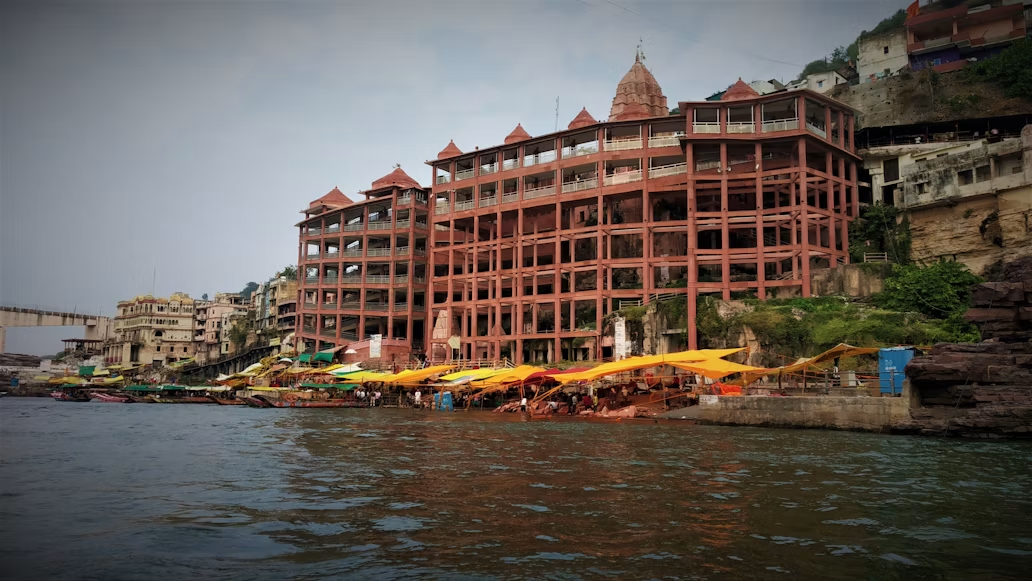
Omkareshwar sits on Mandhata, an island in the Narmada river shaped like the sacred “Om” symbol, in Madhya Pradesh’s Khandwa district. Reaching it by boat across the Narmada is part of the experience, and it pairs naturally with Mahakaleshwar on a Madhya Pradesh twin-Jyotirlinga trip.
- Timings: ~5:00 AM–9:30 PM, commonly morning and evening darshan windows.
- Entry fee: Free general darshan.
- How to reach: Nearest airport Indore (~80 km); Omkareshwar Road railway station ~12 km, then auto/taxi to the ghat. Reach the island by footbridge or boat.
- Time required: 2–3 hours; add 2–3 hours for the ~7 km island parikrama on foot.
- Best time: October–March. In Sawan the Narmada runs high and scenic, but rain can affect boats and the parikrama.
- Ideal for: Couples and families who enjoy a riverside island setting.
- Pro tip: Take the boat at least one way for the iconic island-and-ghats view, go early to beat heat and crowds, and don’t skip the Mamleshwar (Amareshwar) temple on the south bank — it is considered part of the same Jyotirlinga tradition.
Route note: Ujjain to Omkareshwar is ~130–140 km (2.5–3.5 hrs) via Indore, doable as a same-day trip. Indore airport is the natural hub for both Madhya Pradesh Jyotirlingas.
Maharashtra’s three Jyotirlingas: Trimbakeshwar, Bhimashankar & Grishneshwar
Maharashtra is the only state with three Jyotirlingas, which makes it the most efficient region to plan a multi-temple trip. All three sit within a few hours of major cities — Nashik, Pune and Aurangabad — so you can combine darshan with the Western Ghats, wine country and the Ellora caves.
5. Trimbakeshwar Jyotirlinga, near Nashik
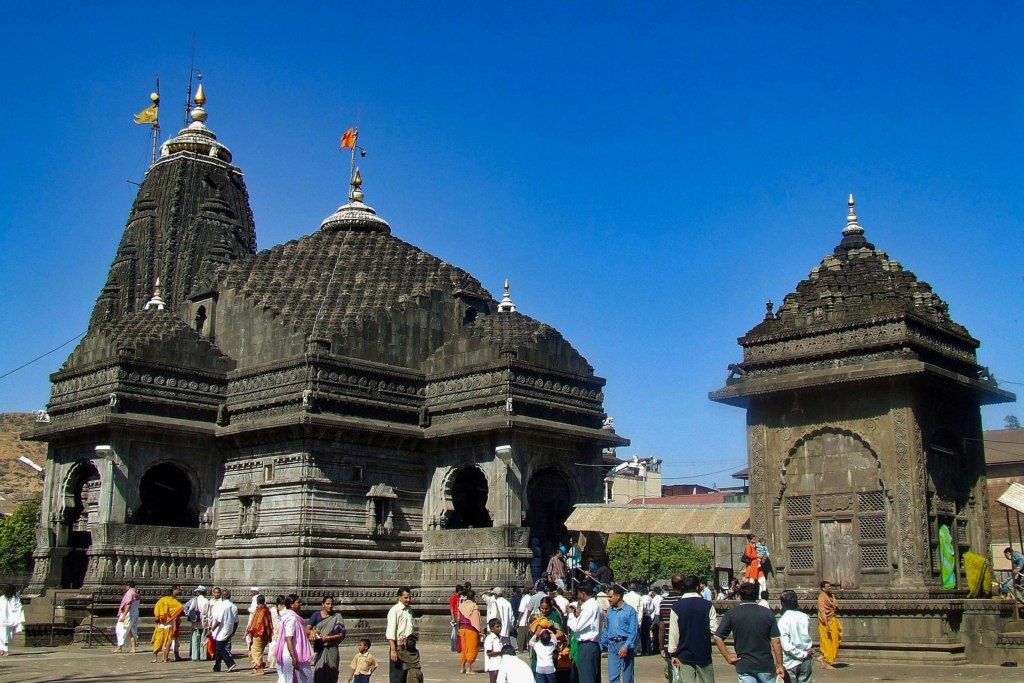
Trimbakeshwar, at the foot of the Brahmagiri Hills near Nashik, marks the source of the Godavari river and is the principal site for rituals like Narayan-Nagbali and Kaal Sarp Shanti. Its three-faced linga representing Brahma, Vishnu and Shiva is unique among the Jyotirlingas.
- Timings: 5:30 AM–9:00 PM; Rudrabhishek ~7:00–8:30 AM.
- Entry fee: Free darshan; VIP/Donation Darshan ~₹200/person via the Trimbakeshwar Temple Trust (carry the QR pass + photo ID).
- How to reach: Nashik (Ozar) Airport ~50–60 km; Mumbai (~180 km) for wider connectivity. Nashik Road railway station ~35–40 km; buses/taxis from Nashik CBS take ~40–50 minutes.
- Time required: 15–20 minutes early morning; 4+ hours in Sawan queues.
- Best time: October–March. Sawan Mondays are extremely crowded — this is one of the most Sawan-significant Jyotirlingas.
- Ideal for: Ritual-focused pilgrims and Brahmagiri trek seekers.
- Pro tip: Pair darshan with the early-morning Brahmagiri Hill trek (2–3 hrs) to the Godavari source before heat and crowds build. The sanctum linga is small and water-covered, so don’t expect a large idol view.
6. Bhimashankar Jyotirlinga, near Pune
Bhimashankar lies deep in the Sahyadri hills about 110–125 km from Pune, inside a wildlife sanctuary that is the protected home of the Indian Giant Squirrel. During the monsoon — which overlaps Sawan — the surrounding Western Ghats are at their greenest, making this the most scenic Jyotirlinga to visit in the rains.
- Timings: 5:00 AM–9:30 PM; darshan 5:30 AM–12:00 PM and 12:20–2:45 PM; evening aarti ~7:30 PM.
- Entry fee: Free general darshan; VIP/special darshan ~₹50–₹100/person.
- How to reach: Pune International Airport ~110–125 km; Pune Junction railway station, then bus/taxi ~3 hrs. MSRTC buses from Pune Shivajinagar (first ~4:30 AM).
- Time required: A full day from Pune (early start essential).
- Best time: November–February for clear roads; monsoon/Sawan is dramatic but slippery and foggy.
- Ideal for: Pilgrims who want darshan plus a Western Ghats nature getaway; Pune and Mumbai weekenders.
- Pro tip: Start very early, reach by mid-morning, and pair darshan with the Bhimashankar Wildlife Sanctuary and the Nagphani viewpoint while the monsoon greenery is at its best.
7. Grishneshwar Jyotirlinga, near Ellora
Grishneshwar, in Verul village beside the Ellora Caves near Chhatrapati Sambhajinagar (Aurangabad), is traditionally counted as the last of the 12 Jyotirlingas. The present temple was rebuilt by Ahilyabai Holkar in the 18th century, and its location next to a UNESCO World Heritage site makes it a rare pilgrimage-plus-history combination.
- Timings: ~5:30 AM–9:30 PM; extended to ~3:00 AM–11:00 PM during Sawan.
- Entry fee: Free. Mobile phones are typically not allowed inside; cloakroom available.
- Dress code: Men enter the sanctum bare-chested in a dhoti; women wear a saree or chudidar.
- How to reach: Chhatrapati Sambhajinagar (Aurangabad) Airport ~30–35 km; Aurangabad railway station ~30 km. Buses toward Ellora/Kannad or a taxi.
- Time required: 45 minutes–1.5 hours; a full day if combined with Ellora.
- Best time: October–March. Sawan Mondays peak, but extended Shravan hours ease the queues.
- Ideal for: History lovers and day-trippers from Aurangabad.
- Pro tip: Do Grishneshwar at opening (~5:30 AM) and walk over to the Ellora Caves when they open (~6:00 AM) before tour buses arrive — but plan it for any day except Tuesday, when Ellora is closed.
The Himalayan & northern Jyotirlingas: Kedarnath & Kashi Vishwanath
8. Kedarnath Jyotirlinga, Uttarakhand
Kedarnath, at about 3,583 m in the Garhwal Himalayas, is the highest and hardest to reach of the 12 Jyotirlingas, accessible only by a 16 km trek from Gaurikund or by helicopter. The temple is open seasonally, and for 2026 the doors opened on 22 April and close around 11 November — so it is open through Shravan/August 2026.
- Timings: Roughly 4:00/6:00 AM–3:00 PM, reopening ~5:00–7:00/9:00 PM.
- Entry / costs: Free darshan. Char Dham Yatra registration is free and mandatory (no access past Sonprayag without it). Pony ~₹3,000–₹4,500; palki ~₹6,000+. Helicopter (only via the IRCTC HeliYatra portal): round-trip ~₹6,390 (Sirsi), ~₹10,164 (Phata), ~₹12,762 (Guptkashi), plus fees and GST.
- How to reach: Jolly Grant Airport, Dehradun ~249 km; Rishikesh railway station ~210 km. Drive to Sonprayag, shuttle to Gaurikund, then trek or fly.
- Time required: 2 days minimum on foot; one long day by helicopter.
- Best time: May–June and September–October. Shravan/August falls in monsoon — green and atmospheric, but landslide and road-closure risk is real, so carry buffer days.
- Ideal for: Pilgrims and trekkers seeking a high-Himalayan journey.
- Pro tip: Book a Guptkashi-origin helicopter and overnight at Guptkashi (~1,319 m) for gradual acclimatisation before reaching 3,583 m — it markedly cuts the risk of altitude sickness versus a same-day ascent.
9. Kashi Vishwanath Jyotirlinga, Varanasi
Kashi Vishwanath, in the heart of Varanasi on the west bank of the Ganga, is among the most visited Jyotirlingas and now sits within the expansive Kashi Vishwanath Dham corridor. Sawan here is overwhelming: on the first Monday in 2025, devotees queued for 7–8 hours, and 2026 will be similar.
- Timings: ~2:30 AM–11:00 PM; Sugam (paid) darshan 6:00 AM–6:00 PM. Mangla Aarti 3:00–4:00 AM (~₹500), Bhog/Saptirishi/night aartis ~₹300, Shayan aarti free.
- Entry fee: Free general darshan; Sugam (skip-line) darshan ~₹250/person. Rudrabhishek ₹450 upward. Book only at the official Kashi Vishwanath portal.
- How to reach: Lal Bahadur Shastri Airport ~24 km; Varanasi Junction ~5–6 km. The temple sits in the old-city lanes — vehicles stop at the Dham gates.
- Time required: 1.5–3 hours normally; far longer in Sawan queues.
- Best time: October–March. Sawan (30 July–28 August 2026) is peak, with Mondays the most crowded.
- Ideal for: Spiritual pilgrims and first-time Varanasi visitors.
- Pro tip: In Sawan, enter between 4:00–6:00 AM right after Mangla Aarti for the lightest crowds and fastest darshan — and avoid Mondays entirely if you can flex your dates. Pair it with the evening Ganga Aarti at Dashashwamedh Ghat.
The eastern & southern Jyotirlingas: Baidyanath, Mallikarjuna & Rameshwaram
10. Baidyanath Jyotirlinga, Deoghar
Baba Baidyanath Dham in Deoghar, Jharkhand, hosts the largest Shravan gathering of any Jyotirlinga: the month-long Shravani Mela draws an estimated 50–55 lakh pilgrims, many walking the 109 km barefoot kanwar route from Sultanganj carrying Ganga water. If you want to witness one of the world’s biggest religious gatherings, this is the temple — but plan for serious crowds.
- Timings: ~4:00 AM open; morning darshan to ~2:00/3:00 PM, midday break, reopening 6:00 PM with Shringar Puja; closes ~9:00 PM. Near-continuous during the Shravani Mela.
- Entry fee: Free darshan; VIP/Shighra darshan ~₹500/person.
- How to reach: Deoghar Airport ~12 km (limited flights); Ranchi (~250 km) as fallback. Jasidih Junction (~9–10 km) is the best-connected railhead.
- Time required: 2–4 hours normally; half-to-full day during Sawan.
- Best time: October–March for comfort; Sawan for the Mela experience.
- Ideal for: Devout pilgrims and those wanting the full kanwar-yatra atmosphere.
- Pro tip: During the Mela, avoid Mondays — the peak-of-peak days — and visit on a weekday instead; book Deoghar hotels weeks in advance as rooms sell out. Pair with Basukinath Dham (~45 km).
Name note: Parli Vaijnath in Maharashtra also claims this Jyotirlinga, but Deoghar is the most widely accepted site.
11. Mallikarjuna Jyotirlinga, Srisailam
Mallikarjuna at Srisailam, on the Nallamala hills above the Krishna river in Andhra Pradesh, is one of the rare sites that is both a Jyotirlinga and a Shakti Peetha. Because Andhra follows the Amanta calendar, its Shravan peak falls later — mid-August into September 2026.
- Timings: ~4:30 AM–10:00 PM, with morning and evening darshan windows; hours extend during Shravan.
- Entry fee: Free Sarva Darshan; Seegra darshan ~₹150; VIP ~₹500; Sparsha Darshan (touch the linga) ~₹500, offered only Sat–Sun–Mon. Book at the Srisailam Devasthanam portal.
- How to reach: Rajiv Gandhi International Airport, Hyderabad ~200–215 km (4.5–5 hrs); nearest rail Markapur Road ~85 km. Road from Hyderabad is the practical route.
- Time required: 2–3 hours; half-day with Sparsha Darshan and the Bhramaramba shrine.
- Best time: November–February. Maha Shivaratri and Shravan are very busy; weekday mornings are quietest.
- Ideal for: Couples and groups comfortable with a hill-temple setting.
- Pro tip: If you want to physically touch the linga, plan a Saturday, Sunday or Monday visit and pre-book Sparsha Darshan — it sells out and isn’t offered on other days. Combine with the Akkamahadevi Caves, reached by boat on the Krishna backwaters.
12. Rameshwaram Jyotirlinga, Tamil Nadu
Ramanathaswamy Temple at Rameswaram, on Pamban Island in Tamil Nadu, is the southernmost Jyotirlinga and home to India’s longest temple corridor. Its signature ritual is a bath at the 22 sacred theerthams (wells) followed by a dip in the sea at Agni Theertham before sanctum darshan.
- Timings: ~5:00 AM–1:00 PM and ~3:00–9:00 PM; Spatika (crystal) Linga darshan ~5:00–6:00 AM.
- Entry fee: Free temple entry; Spatika darshan ~₹50; 22-theerthams bath ~₹25/person; Agni Theertham sea bath free.
- Dress code: Traditional attire enforced — dhoti/veshti for men, saree or salwar-kameez with dupatta for women; no jeans, shorts or sleeveless tops in the sanctum.
- How to reach: Madurai International Airport ~170–179 km; Rameswaram railway station ~1.3 km via the Pamban bridge.
- Time required: 3–4 hours including the theertham bath and sanctum darshan.
- Best time: October–April (coastal heat is intense April–June).
- Ideal for: Ritual-focused pilgrims and architecture lovers.
- Pro tip: Carry two sets of clothes — one to get soaked at the 22 wells and a dry set for darshan. Do the theerthams and Agni Theertham at sunrise, then change into your dry set, to enjoy a near-empty dawn temple. Add Pamban Bridge and Dhanushkodi nearby.
Distances and how to plan your Jyotirlinga route
Covering all 12 Jyotirlingas in one trip means roughly 12,000–15,000 km of travel across nine states, which is why most pilgrims complete them region by region over several visits. The smartest approach is to group temples that share a gateway city or highway.
| Regional circuit | Temples | Gateway city | Suggested days |
| Madhya Pradesh pair | Mahakaleshwar + Omkareshwar | Indore | 2–3 days |
| Maharashtra trio | Trimbakeshwar + Bhimashankar + Grishneshwar | Nashik / Pune / Aurangabad | 4–6 days |
| Gujarat pair | Somnath + Nageshwar (with Dwarka) | Rajkot / Jamnagar | 3–4 days |
| Himalayan | Kedarnath (with Char Dham) | Rishikesh / Dehradun | 3–5 days |
| Varanasi | Kashi Vishwanath | Varanasi | 2 days |
| Eastern | Baidyanath (with Basukinath) | Deoghar | 2 days |
| Southern | Mallikarjuna; Rameshwaram | Hyderabad; Madurai | 2–3 days each |
The Maharashtra trio and the Madhya Pradesh pair are the easiest to chain together because of short road distances and a shared airport hub at Indore for the latter. The Gujarat, Himalayan, eastern and southern temples are best treated as standalone trips built around their own gateway cities.
Suggested Shravan 2026 Jyotirlinga itineraries
Weekend plan: Maharashtra (2 days)
- Day 1: Arrive Nashik, early-morning Trimbakeshwar darshan, optional Brahmagiri trek, evening at leisure in Nashik’s wine country.
- Day 2: Drive to Bhimashankar for darshan and the wildlife sanctuary, or head to Aurangabad for Grishneshwar + Ellora Caves.
Madhya Pradesh circuit (3 days)
- Day 1: Arrive Indore, transfer to Ujjain, evening Ram Ghat aarti.
- Day 2: Pre-dawn Bhasma Aarti at Mahakaleshwar (pre-booked), explore Mahakal Lok and Kaal Bhairav.
- Day 3: Day trip to Omkareshwar (~130 km), boat across the Narmada, return via Indore.
Extended Maharashtra + MP yatra (6–7 days)
- Combine the two circuits above: Nashik (Trimbakeshwar) → Pune (Bhimashankar) → Aurangabad (Grishneshwar) → Indore (Mahakaleshwar + Omkareshwar). Five Jyotirlingas in a week, all by road and short flights, covering the most accessible cluster of the twelve.
Full 12-Jyotirlinga yatra
- Allow 16–30 days if attempting all twelve, ideally split into regional legs across the year. Many pilgrims save Kedarnath for the clear May–June or September–October windows and reserve Sawan for the temples closest to home.
Where to stay near the Jyotirlingas
For most Jyotirlingas, the practical base is the temple town itself, where you’ll find trust guesthouses and hotels close to the sanctum. But for the Maharashtra trio and the Himalayan leg, a private villa or homestay gives families and groups far more comfort between long darshan days — space to rest, home-cooked meals, and a calm retreat after the crowds.
StayVista bases for your Jyotirlinga trip:


- Trimbakeshwar: Stay in a villa in Nashik — 40–50 minutes from the temple, with the bonus of Maharashtra’s wine country.
- Bhimashankar: Base yourself at a Lonavala villa, Karjat villa or near Pune for an easy Sahyadri drive.
- Kedarnath staging: Break the Himalayan journey with a Rishikesh homestay before heading to the hills.
- Hill add-on: Extend a Maharashtra trip with an Igatpuri or Mahabaleshwar monsoon getaway.
Booking a villa works best when you’re travelling as a family or group and want a single comfortable base for the Maharashtra and Madhya Pradesh circuits. For temple towns like Ujjain, Varanasi, Deoghar and Rameshwaram, a stay close to the sanctum keeps your early-morning darshans easy.
Sawan darshan tips: beating the crowds in 2026
- Avoid the two shared Mondays: 17 and 24 August are holy Mondays in both calendars and the busiest temple days of the year.
- Book special darshan early: Mahakaleshwar Bhasma Aarti and Kashi Vishwanath Sugam darshan must be booked only on their official portals, 30–60 days ahead for Sawan.
- Go at dawn: The 4:00–6:00 AM window after the first aarti is the lightest-crowd slot at almost every major shrine.
- Respect dress codes: Mahakaleshwar, Grishneshwar, Rameshwaram and sanctum jalabhishek at Nageshwar all require traditional attire.
- Plan Kedarnath around the weather: Sawan is monsoon in the Himalayas; carry buffer days for landslides and book helicopters only via the official IRCTC HeliYatra portal.
- Carry minimal items: Many temples bar phones and bags — use the free cloakrooms and travel light.
Frequently asked questions
There are 12 Jyotirlingas in India, spread across nine states. Maharashtra has three (Trimbakeshwar, Bhimashankar and Grishneshwar), Gujarat and Madhya Pradesh have two each, and Uttarakhand, Uttar Pradesh, Jharkhand, Andhra Pradesh and Tamil Nadu have one each.
Somnath in Veraval, Gujarat, is traditionally revered as the first of the 12 Jyotirlingas. It sits on the Saurashtra coast and is one of the most rebuilt temples in India.
In North India (Purnimanta calendar), the Sawan Somwar Mondays in 2026 fall on 3, 10, 17 and 24 August. In Maharashtra, Gujarat and South India (Amanta calendar), they fall on 17 and 24 August, 31 August and 7 September.
Sawan is the holiest month to worship Lord Shiva, so it is spiritually ideal, but it is also the most crowded and overlaps the monsoon. Expect long queues at major shrines like Kashi Vishwanath, Trimbakeshwar and Baidyanath, and plan early-morning darshan and advance bookings.
Visiting all 12 Jyotirlingas takes roughly 16–30 days because they span nine states and about 12,000–15,000 km. Most pilgrims complete them region by region over several trips rather than in one continuous journey.
Kedarnath in Uttarakhand is the hardest to reach, sitting at about 3,583 m in the Himalayas. It requires a 16 km trek from Gaurikund or a helicopter ride, and the temple is open only seasonally (22 April to around 11 November in 2026).
Yes. The Kedarnath temple is open through Shravan 2026, as the yatra season runs from 22 April to around 11 November. However, August is monsoon in the Himalayas, so carry buffer days for possible landslides and road closures.
Book Mahakaleshwar Bhasma Aarti only at mahakaleshwar.nic.in or shrimahakaleshwar.com, and Kashi Vishwanath Sugam darshan only at shrikashivishwanath.org. Both fill quickly during Sawan, so book 30–60 days in advance and avoid unofficial agents.
Plan your Shravan 2026 Jyotirlinga journey
The 12 Jyotirlingas are best experienced thoughtfully rather than rushed — pick a region, time your darshan around the crowds, and give yourself room to absorb each shrine. Shravan 2026 (30 July to 28 August in North India) is the most auspicious window of the year, and with the right route and bookings, even the busiest temples become manageable. When you’re planning the Maharashtra or Madhya Pradesh circuits, a comfortable StayVista villa makes an easy, restful base between temple days. For the bigger picture, see our companion guide to the 12 Jyotirlingas in India.