
Pulikali Festival: Thrissur’s Tiger Dance Takes Over Swaraj Round on the Fourth Day of Onam
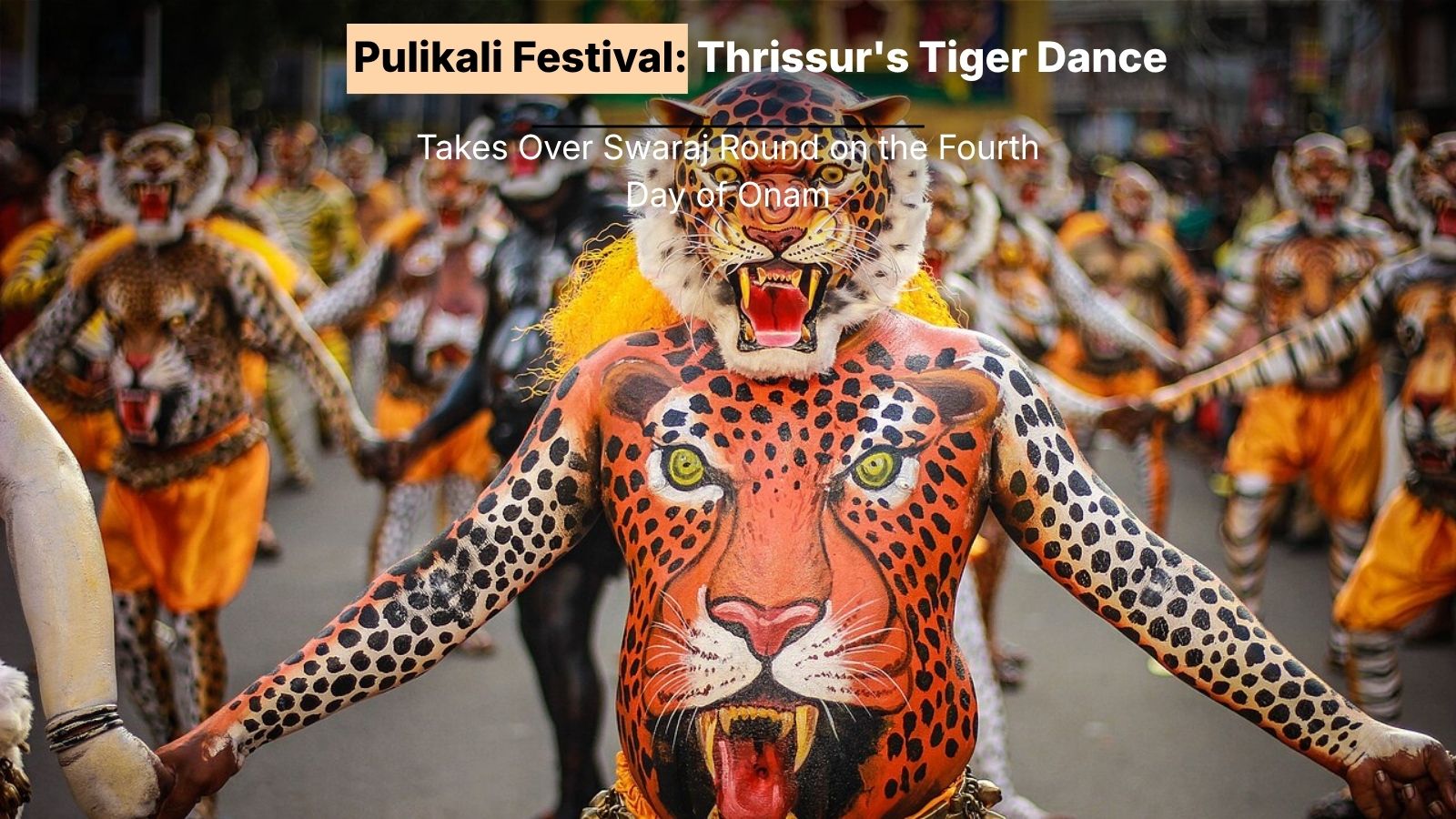
The Pulikali festival is Kerala’s most theatrical Onam tradition, a street parade in Thrissur where hundreds of performers paint their bodies as tigers and hunters and dance through Swaraj Round to deafening drumbeats. It happens every year on the fourth day of Onam, and in 2026, that’s Friday, August 28. If you’re planning your Onam trip around one unmissable spectacle, this is it.
| Pulikali Thrissur 2026 date | Fourth Onam falls on August 28, 2026; Thrissur’s Pulikali procession is currently scheduled for August 29, 2026; confirm with the Thrissur Corporation closer to the date |
In this Blog
What Is Pulikali? Meaning and Quick Facts
What is the meaning of Pulikali? In Malayalam, puli means tiger and kali means play, so Pulikali literally translates to “the play of tigers.” It’s also known as Kaduvakali, and the performers who take on the tiger roles are called Pulikalikkar.
Here’s the Pulikali festival at a glance:
| Quick Fact | Detail |
| What it is | A folk dance where performers are painted as tigers and hunters |
| Celebrated on | The fourth day of Onam (Nalaam Onam) |
| Pulikali Thrissur 2026 date | Friday, August 28-29, 2026 |
| Main venue | Swaraj Round, Thrissur |
| Origin | Introduced by Maharaja Rama Varma (Sakthan Thampuran) of Cochin over 200 years ago |
| Best known in | Thrissur district, also practised in Palakkad |
| Performers | 300–800+ dancers from village troupes across the district |
| Instruments | Chenda, thakil, udukku |
If you remember nothing else: Pulikali is a 200-year-old tiger-themed street dance performed in Thrissur on the fourth day of Onam, drawing over a lakh spectators to Swaraj Round every year.
The Story Behind Pulikali: Which District Is Famous for It?
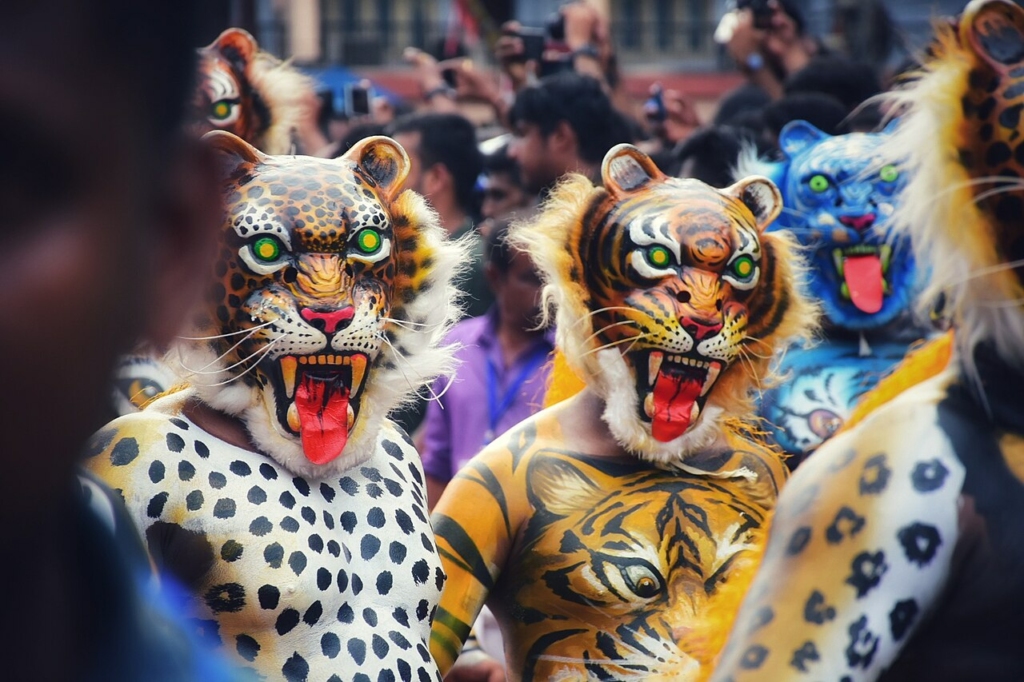
Which district is famous for Pulikali? Thrissur, hands down. While the dance form is performed in pockets of Palakkad too, Thrissur is where it became a full-blown cultural institution — and the answer most locals, tour guides, and Kerala Tourism itself will give you.
What is the story behind Pulikali? The tradition traces back to the Cochin royal court. Maharaja Rama Varma, popularly called Sakthan Thampuran, is credited with introducing Pulikali as royal Onam entertainment more than two centuries ago. What started as a diversion for the Cochin aristocracy has since become one of the most democratic, crowd-powered festivals in Kerala — funded largely by local clubs, sponsors, and community contributions rather than any single royal patron.
Why is Pulikali celebrated? Onam itself marks the mythical homecoming of King Mahabali, a beloved ruler believed to visit his people once a year. Every element of Onam the Pookalam flower carpets, the Onam Sadhya feast, the boat races—is really a way of saying “welcome home.” Pulikali adds spectacle and street-level joy to that welcome, turning the fourth day into a citywide carnival rather than a quiet ritual.
The Cultural Impact of Pulikali: More Than a Performance
It’s easy to see Pulikali as a one-day spectacle, but for Thrissur, it functions closer to a civic institution than a stage show. The scale of preparation and public investment behind it tells you how deeply the festival is woven into the district’s identity.
A discipline, not just a costume. Established Pulikali troupes, names like Pulimada, Melakot, and Viyyur, carry generational weight in Thrissur observe roughly 41 days of fasting and physical preparation, starting from the first day of the Malayalam month of Karkidakam and running through to the fourth day of Onam. Performers train their bodies to withstand hours of dancing under a heavy coat of paint and, for many, a padded belly. That kind of sustained commitment turns Pulikali from a fun Onam add-on into something closer to a seasonal vocation for hundreds of Thrissur residents.
A local economy of its own. The Thrissur Corporation and district administration treat the event as a civic priority, not an afterthought. Recent editions have included insurance coverage worth up to ₹50 lakh for performers and public safety, along with direct financial support around ₹3.12 lakh per participating team, to cover costumes, floats, and paint. Add in the tableaux competitions, prize money for the best-dressed troupes, and even post-event kerosene supplies to help performers remove the oil paint, and you start to see Pulikali as a small, self-contained festival economy that supports artists, painters, tailors, and float-makers across the district for weeks beforehand.
A soundtrack with its own legacy. The percussion arrangement most troupes dance to known as Pulimelam, was composed by Thottungal Ramankutty Asan and has anchored the festival for more than 70 years. That’s a detail worth sitting with: the rhythm dictating hundreds of dancers’ movements today is the same one performers moved to decades ago, passed down the way a folk song is passed down rather than written into any official record.
A pull that goes beyond Kerala. What started as royal entertainment now draws visitors from across the state and increasingly from abroad; recent editions have hosted international delegations of tourism professionals specifically to witness the festival. For Thrissur, often nicknamed the Cultural Capital of Kerala, Pulikali functions as a kind of annual proof of concept: a living folk art that still fills a city centre with crowds every single year, without needing to be staged for tourists to survive.
For the people of Thrissur, that combination of discipline, civic backing, inherited music, and genuine local pride is what separates Pulikali from a simple parade. It’s less a performance for an audience and more a performance by the city, about itself.
Which Day of Onam Is Pulikali?
Which day of Onam is Pulikali? It falls on the fourth day, known as Nalaam Onam, right after the more solemn, feast-heavy Thiruvonam. Onam runs across ten days, but four are public holidays in Kerala — First Onam, Thiruvonam, Third Onam, and Fourth Onam. For Onam 2026, the sequence looks like this:
- First Onam — Tuesday, August 25, 2026
- Thiruvonam (main day) — Wednesday, August 26, 2026
- Third Onam — Thursday, August 27, 2026
- Fourth Onam (Nalaam Onam) — Friday, August 28, 2026 — Pulikali festival 2026 procession in Thrissur — currently listed as Saturday, August 29, 2026 by Thrissur event organisers
A quick clarification for planners: Fourth Onam and the Thrissur Pulikali procession don’t always land on the same calendar date. The Thrissur Corporation sets the final procession date each year, and for 2026, it’s currently set for August 29 — a day after the official Fourth Onam holiday. If you’re booking travel around this, it’s worth checking the Corporation’s official announcement in the weeks leading up to Onam, since local schedules can shift.
By the time the fourth day rolls around, most families have finished the Sadhya, the flower carpets have started to wilt, and Thrissur switches gears from devotion to full-blown revelry. That contrast — quiet ritual followed by riotous street theatre is part of what makes the Pulikali festival such a photogenic close to the Onam calendar.
How Crowded Does Onam Get? Comparing the Four Onam Holidays
Not all four Onam holidays draw the same kind of crowd, and they don’t draw them for the same reason. Thiruvonam is a home-and-hearth day; Pulikali is a go-out-and-watch day. Here’s a general, illustrative comparison of how footfall and public activity typically compare across the four Onam holidays in Thrissur and Kerala at large — based on how each day is traditionally observed, not an official headcount:
| Onam Day | Primary Activity | Typical Crowd Behaviour | Relative Public Footfall |
| First Onam | Shopping, home preparations, Pookalam-laying begins | Mostly local, spread across markets and homes | Moderate |
| Thiruvonam (2nd Onam) | Onam Sadhya, family gatherings, temple visits | High activity, but concentrated indoors and in homes | High (dispersed) |
| Third Onam | Cultural programs, visiting relatives, smaller local events | Localised crowds at community events | Moderate |
| Fourth Onam — Pulikali festival | Pulikali procession at Swaraj Round | Massed in a single public location for hours | Highest (concentrated) |
The key distinction is concentration. Thiruvonam sees enormous participation, but it’s spread across tens of thousands of individual homes and family kitchens. Pulikali, by contrast, funnels a huge share of that same festive energy into one specific public space — Swaraj Round — for a single afternoon. That’s why, even though Thiruvonam is technically Onam’s “main day,” Fourth Onam is often the day outsiders associate most strongly with visible, photographable crowds in Thrissur. If you’re a visitor hoping to witness Onam rather than just experience its domestic side, the Pulikali festival is the day that delivers the biggest, most concentrated public gathering.
Inside the Pulikali Painting Process
If you think the dance is the main event, wait until you see the prep work. Pulikali painting is an art form in its own right, and it’s arguably as much of a draw as the performance itself.
Here’s what happens in the hours before the parade:
- Base coat — Performers’ bare torsos are shaved and coated in yellow paint to mimic a tiger’s base fur.
- Stripes and detailing — Skilled local artists — often the same families who’ve done this for generations — hand-paint black stripes, white whiskers, and red highlights using oil-based, weather-resistant colours.
- Padding and props — Some performers wear padded bellies to exaggerate the tiger’s girth, a signature comic touch of Thrissur’s Pulikali.
- Final touches — Tiger masks, tails, and hunter costumes (for those playing the “hunter” roles) complete the look.
The entire process can take several hours and typically happens overnight or in the early morning, so by the time the pulikali dance begins in the afternoon, Swaraj Round is already ringed with spectators watching the finishing touches go on.
“Every year, painting starts before dawn — by the time the tigers hit Swaraj Round, they’ve already been ‘tigers’ for six hours.”
How the Pulikali Dance Unfolds at Swaraj Round
The performance itself is loud, physical, and deeply communal. Troupes from different neighbourhoods and clubs across the Thrissur district assemble near the Vadakkunnathan Temple and the Naduvilal area before parading around Swaraj Round.
What you’ll typically see:
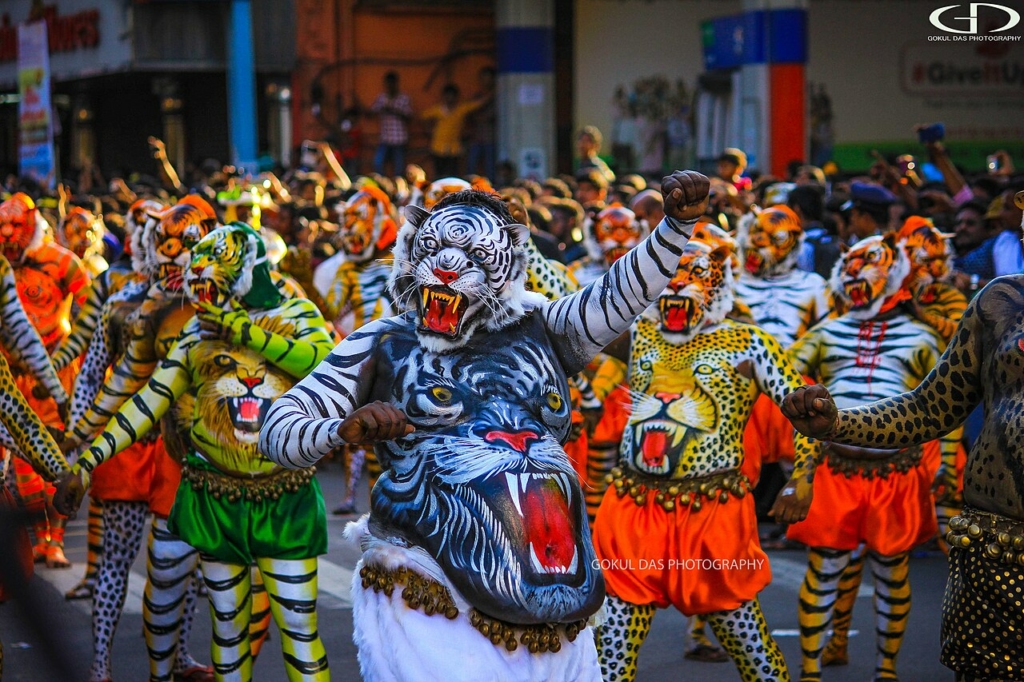
- Group choreography built around a “tiger hunt” theme; dancers alternate between prowling tigers and pursuing hunters
- Percussion-led rhythm, with chenda, thakil, and udukku drummers keeping every troupe in sync
- Elaborate floats and props, with rival clubs competing for the best costumes and choreography
- Massive crowds, often exceeding a hundred thousand spectators lining the round and nearby rooftops
Unlike temple rituals that ask for quiet reverence, this is a festival built for noise, colour, and participation, kids on shoulders, vendors selling snacks, and a genuine street-party energy that’s hard to replicate anywhere else in Kerala.
Best Spots to Watch the Pulikali Festival in Thrissur
- Swaraj Round itself — for the full loop of performers and the loudest atmosphere
- Thrissur Town Hall area — slightly elevated views, good for photography
- Near Vadakkunnathan Temple — catch the troupes as they assemble and begin the procession
Arrive early. Roads around the round close to traffic once the parade begins, and prime viewing spots fill up fast.
Pulikali Festival in India: Why It Resonates Beyond Kerala
While the Pulikali festival in India is unmistakably a Kerala and specifically Thrissur tradition, its reach has grown well beyond the state. Malayali communities across India and abroad now stage smaller Pulikali-style performances during their own Onam celebrations, and the Thrissur event itself pulls tourists from across the country every August or September. It’s become shorthand, almost, for Kerala’s ability to turn devotion into theatre, the same instinct that gives the state its temple elephant processions and snake boat races.
For visitors, this cultural weight is exactly why Pulikali photographs and videos travel so well on social media every Onam season and why travel writers keep circling back to Thrissur as the state’s unofficial “festival capital.”
Things to Do in Onam Festival Season (Beyond Pulikali)
If you’re building a longer Kerala itinerary around Onam, Pulikali is just one stop. Consider pairing it with:
- Onam Sadhya — the traditional 20-plus-dish feast served on a banana leaf, best experienced on Thiruvonam day itself
- Aranmula Boat Race — snake boat races usually held a day or two after Fourth Onam
- Athachamayam — the ceremonial opening procession of Onam in Thripunithura
- Pookalam competitions — flower carpet displays in neighbourhoods and public squares across the state
- Kathakali and Kaikottikali performances — classical and folk dance shows staged in cultural venues during the festival week
Between these events, Thrissur, Kochi, and the surrounding backwaters make for a full Onam circuit, one that’s genuinely among the best things to do in Kerala if you’re visiting in August or September.
Where to Stay: Spending a Day at a StayVista Villa in Thrissur
Watching the Pulikali festival is a full-day commitment: early starts to catch the painting, a long afternoon on your feet at Swaraj Round, and a late evening once the crowds thin out. A private villa in Thrissur gives you somewhere to decompress in between, without the noise and check-in queues of a city hotel.
A typical villa day during Pulikali season might look like this:
- Morning: Slow breakfast on the villa’s veranda, then a short drive into Thrissur to catch performers being painted near Swaraj Round
- Midday: Head back to the villa’s pool to cool off before the afternoon heat and the parade crowds build
- Afternoon: Return to Swaraj Round for the main procession and dance
- Evening: Back at the villa for a home-style Kerala meal, with the private pool and garden as a quiet contrast to the day’s noise
Location: StayVista’s Thrissur and greater Kochi villas typically sit a comfortable 30–60 minute drive from Swaraj Round, tucked into quieter residential or backwater-adjacent pockets, close enough for an easy day trip, far enough to skip the festival traffic at night.
Average price: Kerala villas on StayVista generally range from around ₹12,000 to ₹27,000+ per night depending on size, amenities, and season; expect rates to trend toward the higher end during Onam week given demand. Larger multi-bedroom villas suit families or groups travelling together for the festival.
How to get there: The nearest airport is Cochin International Airport (COK), roughly 1–1.5 hours from most Thrissur-area villas by road. Thrissur also has its own railway station on the main Kochi–Kozhikode line, making it accessible by train from across Kerala and neighbouring states.
How to book: Villas can be browsed and booked directly on StayVista’s Kerala and Thrissur collections, with filters for pool access, group size, and proximity to Thrissur city. Given how quickly Onam-week accommodation fills up, booking a few weeks ahead is strongly recommended.
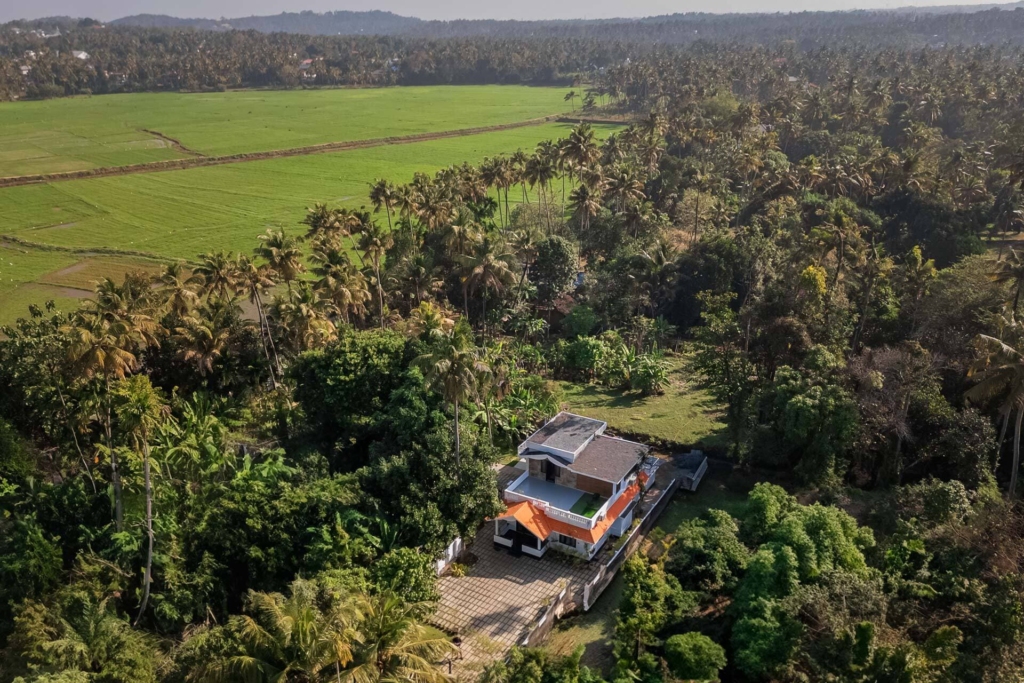
Places to Stay in Thrissur

FAQs About the Pulikali Festival
Pulikali means “play of tigers” in Malayalam, a folk dance where performers paint themselves as tigers and hunters and perform to percussion music during Onam.
It’s credited to Maharaja Rama Varma (Sakthan Thampuran) of the Cochin royal family, who introduced it as Onam entertainment over 200 years ago. It has since grown into a community-driven festival organised by local clubs and troupes.
Thrissur district, particularly the Swaraj Round area, is the epicentre of the Pulikali festival, though the dance is also practised in parts of Palakkad.
Pulikali is tied to the fourth day of Onam, Nalaam Onam — August 28, 2026 on the calendar. However, Thrissur’s actual Pulikali procession is currently scheduled for August 29, 2026, so it’s worth confirming the exact date with local sources closer to the event.
It’s part of Kerala’s Onam festivities, which mark the mythical homecoming of King Mahabali. Pulikali adds a joyful, high-energy street celebration to the festival’s final days.
Yes, it’s a public street event at Swaraj Round, open to all spectators without tickets, though prime viewing areas can get crowded.
Ready to Watch the Tigers Dance?
There’s something genuinely thrilling about watching grown men transform into tigers for a day, dancing through the streets of a city that takes its folklore seriously. If you’re planning to catch the Pulikali festival in 2026, build in a day on either side to explore Thrissur’s temples, markets, and backwater edges, and pick a villa base that lets you step away from the crowd whenever you need to.
Onam only comes once a year. Make sure you’re watching it from the front row.