

All 8 Ashtavinayak Temples: 2, 3 and 4-Day Routes for Ganeshotsav 2026
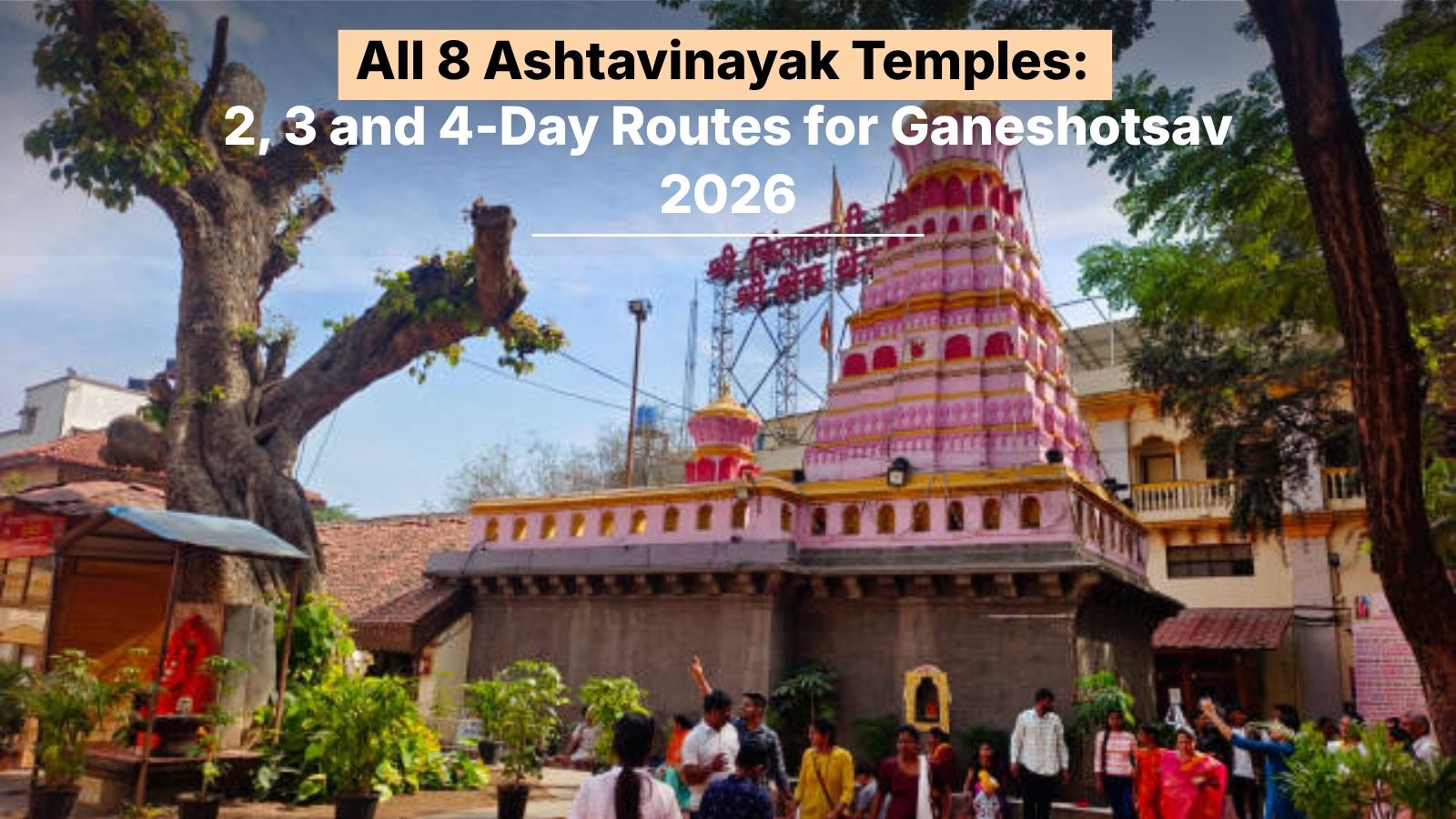
The Ashtavinayak Temples are eight revered Ganesha shrines across Maharashtra traditionally visited in a prescribed sequence: Morgaon, Siddhatek, Pali, Mahad, Theur, Lenyadri, Ozar and Ranjangaon. For Ganeshotsav 2026, the circuit can be covered in 2, 3 or 4 days, with Pune serving as the most practical base for shorter itineraries.
In this Blog
What is the Ashtavinayak Yatra in Maharashtra?
The Ashtavinayak Yatra is a pilgrimage circuit covering eight temples dedicated to different forms of Lord Ganesha across Pune and Raigad districts and adjoining areas of Maharashtra. The traditional route begins and ends at Mayureshwar Temple in Morgaon. Maharashtra Tourism lists the sequence as Morgaon, Siddhatek, Pali, Mahad, Theur, Lenyadri, Ozar and Ranjangaon.
The eight temples are:
| No. | Temple | Location | Form of Ganesha |
| 1 | Mayureshwar | Morgaon | Mayureshwar |
| 2 | Siddhivinayak | Siddhatek | Siddhivinayak |
| 3 | Ballaleshwar | Pali | Ballaleshwar |
| 4 | Varadvinayak | Mahad | Varadvinayak |
| 5 | Chintamani | Theur | Chintamani |
| 6 | Girijatmaj | Lenyadri | Girijatmaj |
| 7 | Vighneshwar | Ozar | Vighneshwar |
| 8 | Mahaganapati | Ranjangaon | Mahaganapati |
Morgaon is traditionally both the first and final stop, making it an important point in the completion of the pilgrimage.
When is Ganeshotsav 2026?
Ganesh Chaturthi falls on Monday, September 14, 2026, marking the beginning of the major Ganeshotsav period. In Mumbai, the Madhyahna Ganesha Puja muhurat is listed as 11:20 AM to 1:48 PM, while the Chaturthi tithi begins on September 14 and ends on September 15.
For an Ashtavinayak pilgrimage, however, travellers do not need to visit specifically on Ganesh Chaturthi. The temples are pilgrimage destinations throughout the year, while Ganeshotsav brings significantly greater religious activity and visitor movement.
During the festival period, travellers should account for:
- Longer queues for darshan
- Slower road journeys around temple towns
- Increased demand for accommodation
- Festival processions and local traffic diversions
- Limited flexibility for completing multiple temples in one day
A 4-day itinerary is therefore more suitable for travellers who want to combine darshan with a manageable road journey.
Where are all 8 Ashtavinayak Temples located?
The eight shrines are spread across different parts of Maharashtra rather than concentrated in one town. Most are accessible by road, making a self-drive vehicle, hired cab or organised pilgrimage vehicle practical for completing the circuit.
1. Mayureshwar Temple, Morgaon
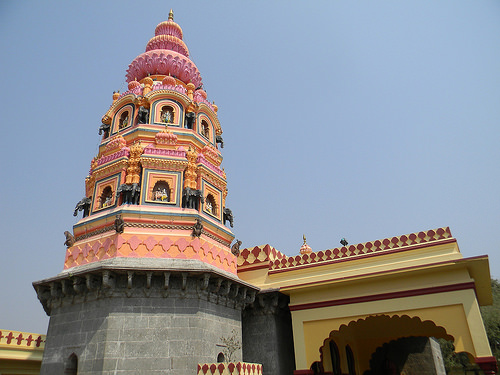
District: Pune
Ganesha form: Mayureshwar
Morgaon is the traditional starting and ending point of the Ashtavinayak Yatra. The temple is dedicated to Mayureshwar, the form of Ganesha associated with the legend of defeating the demon Sindhu. Maharashtra Tourism identifies it as the first and most significant temple in the circuit.
Morgaon is approximately 80 km from Pune by road, making Pune a convenient starting point for travellers arriving from Mumbai, Bengaluru or other cities by air or rail.
2. Siddhivinayak Temple, Siddhatek
District: Ahmednagar
Ganesha form: Siddhivinayak
Siddhatek is situated on the banks of the Bhima River and is traditionally the second temple of the circuit. The temple is associated with Lord Ganesha as Siddhivinayak, a form connected with the attainment of spiritual accomplishment or siddhi.
The temple’s riverside setting and rural surroundings make this section of the journey noticeably different from the more urban-accessible shrines around Pune.
3. Ballaleshwar Temple, Pali
District: Raigad
Ganesha form: Ballaleshwar
Pali is home to Ballaleshwar, the third temple in the traditional sequence. The shrine is associated with the devotee Ballal and is one of the two Ashtavinayak temples named after a devotee rather than a manifestation of Ganesha.
Pali is around 110 km from Mumbai, according to Maharashtra Tourism, and can be combined with Mahad on the same leg of a longer pilgrimage.
4. Varadvinayak Temple, Mahad
District: Raigad
Ganesha form: Varadvinayak
The fourth stop is Varadvinayak Temple at Mahad in Khalapur taluka. The shrine is associated with Ganesha as the bestower of boons. The temple houses a Swayambhu idol and is also known for its Nandadeep, an oil lamp traditionally said to have been continuously burning since 1892.
Mahad is particularly convenient to combine with Pali because the two Ashtavinayak temples are relatively close to each other.
5. Chintamani Temple, Theur
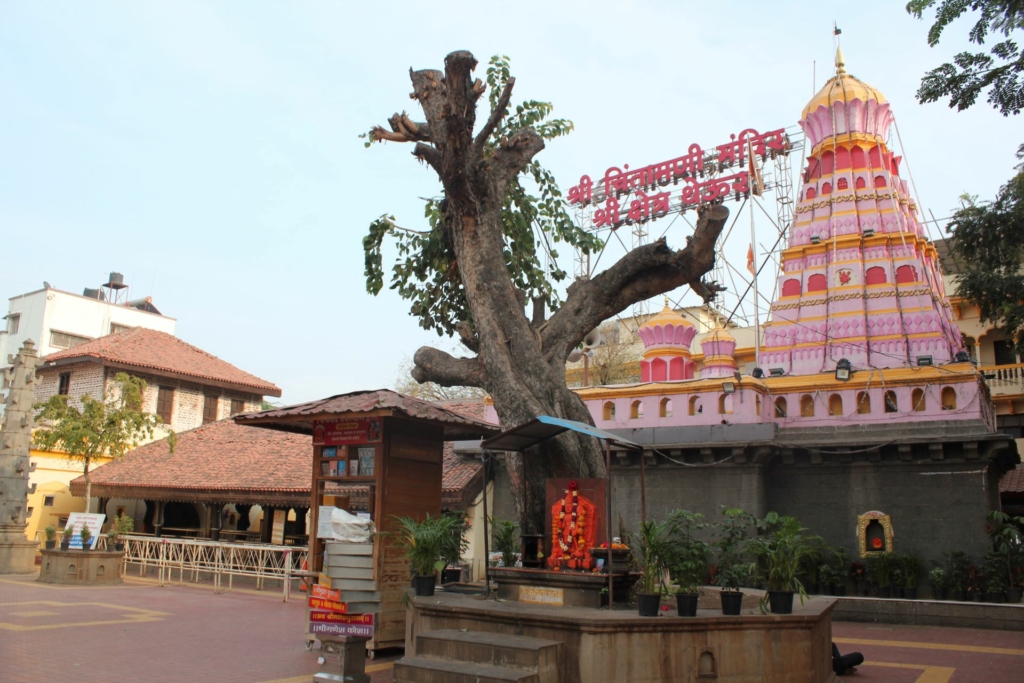
District: Pune
Ganesha form: Chintamani
Theur is the fifth temple and is dedicated to Chintamani Ganesha. The temple has a strong connection with the Peshwa period and remains an important pilgrimage destination near Pune.
Ganesh Chaturthi is one of the major festivals observed at Theur, with special decorations, rituals and increased pilgrim activity.
6. Girijatmaj Temple, Lenyadri
District: Pune
Ganesha form: Girijatmaj
Lenyadri is one of the most distinctive stops on the circuit because the temple is carved into a rock-cut cave complex. Reaching the shrine requires climbing 307 stone steps, making it the most physically demanding temple visit on a tightly scheduled itinerary.
The temple is associated with Ganesha in his child form, Girijatmaj, and the shrine is located within the Lenyadri cave complex.
Travellers with elderly family members or young children should allow additional time for this stop.
7. Vighneshwar Temple, Ozar
District: Pune
Ganesha form: Vighneshwar
Ozar is home to Vighneshwar Temple, traditionally the seventh shrine. The temple is known for its golden dome, traditional architecture and association with Ganesha as Vighneshwar, the remover of obstacles.
Ozar is particularly convenient to pair with Lenyadri because the two temples are only around 15 km apart, according to Maharashtra Tourism.
8. Mahaganapati Temple, Ranjangaon
District: Pune
Ganesha form: Mahaganapati
Ranjangaon is the eighth temple in the traditional sequence and is dedicated to Mahaganapati. The shrine is approximately 50 km from Pune and is associated with the legend of Lord Shiva seeking Ganesha’s blessings before fighting Tripurasura.
After visiting Ranjangaon, pilgrims traditionally return to Morgaon to complete the circuit.
What is the traditional order of the Ashtavinayak Yatra?
The traditional order should be followed when the objective is to complete the pilgrimage according to the established circuit rather than simply visit all eight temples.
Morgaon → Siddhatek → Pali → Mahad → Theur → Lenyadri → Ozar → Ranjangaon → Morgaon
Maharashtra Tourism’s official pocket guide specifically identifies Morgaon as the traditional starting and ending point and lists this sequence.
For a road trip, however, the itinerary can be adapted to reduce backtracking, particularly when the available time is only two or three days.
What is the best 4-day Ashtavinayak route from Pune?
A 4-day Ashtavinayak itinerary is the most balanced option for Ganeshotsav 2026. It allows two or three temples per day while keeping the traditional sequence intact.
Day 1: Pune → Morgaon → Siddhatek
Route: Pune → Morgaon → Siddhatek
Begin with Mayureshwar at Morgaon, the traditional starting point of the pilgrimage. Continue towards Siddhatek for the second darshan.
Overnight: Siddhatek or Pune
Keeping the first day to two temples leaves room for traffic delays and longer festival queues.
Day 2: Siddhatek → Pali → Mahad
Route: Siddhatek → Pali → Mahad
Continue with Ballaleshwar at Pali and Varadvinayak at Mahad. These two temples form a natural pair on the Raigad section of the circuit.
Overnight: Mahad, Pali or nearby
This is one of the more efficient days geographically because Pali and Mahad are relatively close.
Day 3: Mahad → Theur → Lenyadri → Ozar
Route: Mahad → Theur → Lenyadri → Ozar
Visit Chintamani at Theur before continuing towards the Lenyadri caves. Since Lenyadri involves 307 steps, it is advisable to avoid scheduling the climb late in the day during a crowded festival period.
End the day at Ozar, which is approximately 15 km from Lenyadri.
Overnight: Ozar/Junnar
Day 4: Ozar → Ranjangaon → Morgaon → Pune
Route: Ozar → Ranjangaon → Morgaon → Pune
Complete the eighth temple at Ranjangaon and return to Morgaon, traditionally completing the Ashtavinayak circuit.
Overnight: Pune or onward destination
This route is best for travellers who want the traditional sequence without attempting four or five temples in a single day.
How can the 8 Ashtavinayak Temples be covered in 3 days?
A 3-day route works for travellers comfortable with longer road journeys and early starts. It is more demanding than the 4-day option, particularly during Ganeshotsav.
Day 1: Pune → Morgaon → Siddhatek → Pali → Mahad
Visit:
- Morgaon
- Siddhatek
- Pali
- Mahad
Stay overnight around Mahad or move towards the Pune side depending on the next day’s route.
Day 2: Mahad → Theur → Lenyadri → Ozar
Visit:
- Theur
- Lenyadri
- Ozar
Allow extra time at Lenyadri because of the 307-step climb. (Maharashtra Tourism)
Stay around Ozar/Junnar.
Day 3: Ozar → Ranjangaon → Morgaon → Pune
Visit:
- Ranjangaon
- Morgaon
Ranjangaon is the eighth temple, after which returning to Morgaon completes the traditional circuit.
Best suited for: Couples, friend groups and experienced road-trippers who prefer covering the circuit quickly.
Can all 8 Ashtavinayak Temples be covered in 2 days?
Yes, but a 2-day Ashtavinayak Yatra is a fast-paced road trip rather than a relaxed pilgrimage. It involves early starts, multiple long drives and limited flexibility for festival queues.
For travellers determined to complete all eight in two days, a practical split is:
Day 1: Pune → Morgaon → Siddhatek → Pali → Mahad → Pune
Cover:
- Morgaon
- Siddhatek
- Pali
- Mahad
Return towards Pune or stay strategically for the next day’s route.
Day 2: Pune → Theur → Lenyadri → Ozar → Ranjangaon → Morgaon → Pune
Cover:
- Theur
- Lenyadri
- Ozar
- Ranjangaon
- Morgaon
The second day is particularly demanding because Lenyadri involves a climb of 307 steps.
During Ganeshotsav, this itinerary should be treated as an ambitious minimum rather than the recommended option. Even a short queue at each temple can significantly alter the day’s schedule.
Which Ashtavinayak itinerary is best for Ganeshotsav 2026?
The choice depends mainly on available time and tolerance for road travel.
| Duration | Temples per day | Pace | Best for |
| 2 days | 4–5 | Very fast | Experienced road-trippers |
| 3 days | 2–4 | Fast | Short pilgrimage breaks |
| 4 days | 2–3 | Moderate | Families and first-time visitors |
For Ganeshotsav 2026, the 4-day route is the strongest option because it provides more buffer for festival crowds, road congestion and darshan queues.
What is the best starting point for the Ashtavinayak Yatra?
Morgaon is the traditional starting point. The Mayureshwar Temple is also the final temple in the traditional completion of the pilgrimage.
For travellers arriving from outside Maharashtra, Pune is usually the most practical transport hub for planning the circuit. Morgaon is approximately 80 km from Pune by road, while Ranjangaon is around 50 km away.
Travellers from Mumbai can also begin from the Raigad side, particularly if they want to combine Pali and Mahad first, but this does not follow the traditional sequence.
How should travellers plan an Ashtavinayak Yatra during Ganeshotsav 2026?
Ganeshotsav is one of the busiest periods to undertake the pilgrimage, so planning around crowds is more important than simply calculating driving distances.
1. Start early
Morning departures provide more flexibility for darshan and reduce the risk of reaching later temples after peak crowds.
2. Keep buffer time
Do not plan the itinerary purely around estimated driving time. Festival traffic, parking, queues and local processions can add considerable delays.
3. Book accommodation in advance
Accommodation around Morgaon, Siddhatek, Pali, Mahad, Theur, Junnar and Ozar can become limited during major festival dates.
4. Check temple arrangements before departure
Opening hours, darshan arrangements, parking and crowd-management measures can change during major festivals. Travellers should confirm the latest information with the respective temple authorities before setting out.
5. Account for Lenyadri’s climb
The 307 steps at Lenyadri make this stop different from the other seven temples.
6. Carry essentials
A practical pilgrimage kit should include:
- Comfortable footwear
- Drinking water
- Light clothing suitable for September weather
- Umbrella or rain protection
- Basic medicines
- Phone power bank
- Cash for small purchases and offerings
What is the weather like during Ashtavinayak Yatra in September?
Ganeshotsav 2026 begins on September 14, placing the pilgrimage in the late-monsoon period in Maharashtra.
Travellers should therefore expect potentially wet roads, humid conditions and occasional rain, particularly around the Sahyadri sections near Lenyadri, Ozar and Raigad.
This has practical implications for the road trip:
- Keep additional driving time after heavy rain.
- Use footwear with good grip for Lenyadri.
- Avoid scheduling the cave climb too late in the day.
- Check local weather and road conditions before leaving.
- Keep flexible hotel check-in times where possible.
What are the key differences between the 8 Ashtavinayak temples?
Each shrine has its own form, mythology and physical setting, making the circuit more than a sequence of similar temple visits.
| Temple | What makes it distinctive |
| Morgaon | Traditional beginning and end of the circuit |
| Siddhatek | Bhima River setting |
| Pali | Ballaleshwar form and Ballal legend |
| Mahad | Varadvinayak and historic Nandadeep |
| Theur | Chintamani and strong Peshwa-era associations |
| Lenyadri | Rock-cut cave temple and 307 steps |
| Ozar | Vighneshwar temple and distinctive golden dome |
| Ranjangaon | Mahaganapati and traditional final shrine |
Maharashtra Tourism identifies Pali and Mahad as the third and fourth Ashtavinayak temples respectively, while Lenyadri and Ozar form the sixth and seventh stops.
What should travellers know before driving the Ashtavinayak circuit?
The circuit is best approached as a road pilgrimage rather than a conventional sightseeing tour. Distances between individual temples vary considerably, and the traditional sequence does not always represent the shortest possible driving route.
A few practical points make the journey easier:
- Self-drive: Gives maximum flexibility but requires careful parking and route planning.
- Private cab: Convenient for families and groups, especially during Ganeshotsav.
- Public transport: Possible, but connecting multiple temples in sequence can be time-consuming.
- Pune base: Useful for shorter itineraries, although overnight stays along the circuit reduce daily driving.
- Festival travel: Build at least a few hours of contingency into the schedule.
The Maharashtra Tourism website confirms road connectivity for individual temples including Morgaon, Pali, Mahad, Ozar and Ranjangaon.
Frequently Asked Questions
How many Ashtavinayak temples are there?
There are eight Ashtavinayak temples dedicated to different forms of Lord Ganesha across Maharashtra. The traditional circuit begins and ends at Mayureshwar Temple in Morgaon and includes Siddhatek, Pali, Mahad, Theur, Lenyadri, Ozar and Ranjangaon.
What is the order of the Ashtavinayak temples?
The traditional order is Morgaon, Siddhatek, Pali, Mahad, Theur, Lenyadri, Ozar and Ranjangaon, followed by a return to Morgaon. This sequence is recognised by Maharashtra Tourism as the traditional Ashtavinayak Yatra route.
When is Ganesh Chaturthi in 2026?
Ganesh Chaturthi falls on Monday, September 14, 2026. In Mumbai, the Ganesh Chaturthi tithi begins at 7:06 AM on September 14 and ends at 7:44 AM on September 15.
Can Ashtavinayak be completed in 2 days?
Yes, all eight temples can be attempted in two days, but the itinerary is demanding and involves substantial driving. During Ganeshotsav, increased crowds and traffic can make a two-day schedule difficult, so three or four days provide greater flexibility.
How many days are enough for Ashtavinayak Yatra?
Four days is a comfortable duration for completing the traditional circuit without rushing through every temple. Three days works for travellers comfortable with longer driving days, while two days is best reserved for a tightly scheduled road trip.
Which Ashtavinayak temple has the most steps?
Lenyadri requires visitors to climb 307 stone steps to reach the temple carved into the rock-cut cave complex. It is therefore important to allow additional time for this temple when planning a multi-stop itinerary.
Which Ashtavinayak temple is near Pune?
Several Ashtavinayak temples are accessible from Pune, including Morgaon, Theur and Ranjangaon. Morgaon is approximately 80 km from Pune, while Ranjangaon is around 50 km away, making Pune a convenient base for shorter circuits.
Which Ashtavinayak temples are near Mumbai?
Pali and Mahad are among the more convenient Ashtavinayak temples for travellers starting from Mumbai. Maharashtra Tourism places Pali at approximately 110 km from Mumbai, while Mahad is also accessible from Mumbai by road.
Is Ashtavinayak Yatra possible during Ganeshotsav?
Yes. The temples remain important pilgrimage destinations during Ganeshotsav, but visitor numbers and local festival activity increase significantly. Travellers should book accommodation early, allow extra road time and verify current temple arrangements before travelling.
Which Ashtavinayak route is best for families?
A 4-day route is generally the most practical for families because it limits the number of temples covered each day and provides more time for meals, rest and unexpected delays. Families should give particular attention to the 307-step climb at Lenyadri.
Planning Your Ashtavinayak Yatra for Ganeshotsav 2026
The Ashtavinayak Yatra combines eight distinct Ganesha shrines across Maharashtra rather than functioning as a single concentrated temple complex. For Ganeshotsav 2026, beginning on September 14, a four-day circuit offers the best balance between following the traditional sequence and allowing for festival crowds, road conditions and darshan time.
For travellers with only a weekend, the two-day route is possible but demanding. A three-day itinerary offers a workable middle ground, while four days allows the pilgrimage to unfold at a more manageable pace.