
Mathura–Vrindavan Travel Guide 2026: Temples, Janmashtami & How to Visit
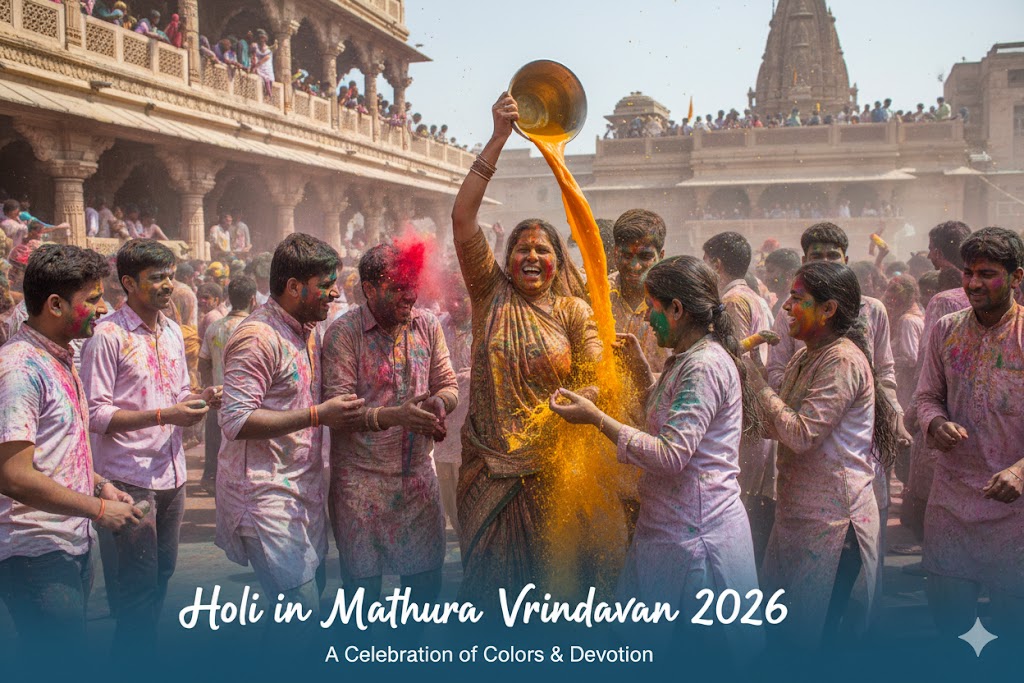
Note (April 2026): Holi 2026 has passed (it was celebrated in Mathura–Vrindavan from February 25 to March 4, with the main colour celebration on March 14). This updated guide covers Mathura–Vrindavan as a year-round destination — temples, ghats, practical visitor information, and the upcoming Janmashtami 2026 (August 15–16), which is the next major festival event in the region.
In this Blog
Mathura–Vrindavan: Why This Region Is Worth Visiting Any Time of Year
Most people discover Mathura–Vrindavan through Holi — the world’s most famous colour festival plays out here across ten extraordinary days each spring. But the region’s temples, ghats, and living traditions make it one of North India’s most rewarding pilgrimage and cultural destinations throughout the year.
Mathura is the birthplace of Lord Krishna. Vrindavan, 11 km away, is where he spent his childhood. Together they form one of Hinduism’s most sacred regions — the Braj Bhoomi — with more than 5,000 temples, an ancient ghat-lined riverfront on the Yamuna, and a devotional culture that has changed very little over centuries.
This guide covers everything you need for a visit in 2026: the major temples and their timings, how to reach from Delhi, where to stay, summer visiting tips, and the upcoming Janmashtami celebration in August.
[stayvista_cta text=”Find private stays near Mathura–Vrindavan on StayVista”]
Quick Info: Mathura–Vrindavan at a Glance
| Detail | Info |
|---|---|
| Distance from Delhi | ~145 km via Yamuna Expressway (2–2.5 hours by car) |
| Nearest railway station | Mathura Junction (on Delhi–Mumbai and Delhi–Chennai lines) |
| Nearest airport | Agra (Pandit Deen Dayal Upadhyaya Airport) — 60 km; Delhi IGI — 160 km |
| Best time to visit | October–March (cool, clear); avoid peak summer (May–June, 40–45°C) |
| Ideal duration | 2–3 days for a thorough visit |
| Language | Hindi; some English spoken at ISKCON and major temples |
| Next major festival | Janmashtami — August 15–16, 2026 |
Holi at Mathura–Vrindavan: Why It’s India’s Most Famous
If you’re reading this after Holi 2026, save this section for planning 2027. The Holi celebrations in the Braj region are not one event but a series of rituals and celebrations spread over 10–14 days, each with its own character:
- Lathmar Holi (Barsana and Nandgaon, ~10 days before main Holi): Women chase men with lathis (wooden sticks); men shield themselves with leather shields. A boisterous, theatrical re-enactment of Krishna’s playfulness.
- Phoolon Ki Holi (Vrindavan’s Banke Bihari Temple, ~1 week before): Priests shower devotees with flowers instead of colours — a gentler, visually stunning ceremony.
- Widow’s Holi (Gopinath Temple, Vrindavan): Widows who were previously excluded from Holi celebrations now participate in a dedicated ceremony — one of the most moving sights in the Braj region.
- Rangwali Holi (Main Holi day): Streets of Mathura, Vrindavan, and the ghats fill with colour. The Dwarkadheesh Temple in Mathura hosts one of the most energetic public celebrations.
Next Holi (2027): March 3, 2027. Lathmar Holi in Barsana will fall around February 21–22, 2027. Book accommodation by November 2026 — Vrindavan ashrams and guesthouses fill within hours of opening bookings.
Upcoming: Janmashtami 2026 — August 15–16
Janmashtami marks the birth of Lord Krishna — the single most important festival in the Mathura–Vrindavan calendar after Holi. In 2026, Janmashtami falls on August 15–16 (the exact timing depends on when midnight — Krishna’s birth hour — falls in different Hindu calendar calculations, leading some temples to celebrate on the 15th and others on the 16th).
The Mathura–Vrindavan experience on Janmashtami is extraordinary:
- Krishna Janmabhoomi Temple (Mathura): The temple complex built over the site traditionally identified as Krishna’s birthplace hosts the main celebrations. The idol is bathed in panchamrit (a ritual mixture of milk, curd, honey, ghee, and sugar) at midnight. Hundreds of thousands of devotees fill the temple and surrounding streets.
- Dwarkadhish Temple (Mathura): One of the grandest temples in Mathura, with extended puja schedules and elaborate decorations through Janmashtami week.
- ISKCON Vrindavan: The most international-friendly celebration — English commentary, professional sound and lighting, and a well-managed crowd flow. The midnight birth ceremony is dramatic and moving. ISKCON also runs a free midnight feast (mahaprasad) for visitors.
- Banke Bihari Temple (Vrindavan): Unique in that the deity’s face is ceremonially revealed only briefly at midnight — a flash of a glimpse that devotees wait hours for.
- Prem Mandir (Vrindavan): The most visually spectacular temple for Janmashtami, with fountain and light shows running through the festival nights.
How to book for Janmashtami 2026: Accommodation within 10 km of Mathura–Vrindavan fills by June. The stretch between Mathura and Vrindavan (NH44 and surrounding areas) has several hotel clusters. For a more private experience, look at StayVista properties near Agra (60 km away) — close enough for the drive in, with more space and comfort than Mathura’s crowded guesthouses during the festival.
Practical tips for Janmashtami: Security arrangements are significant — vehicle access near the main temples is restricted from the evening of August 14. Arrive by 6 PM if you want a good position near the temples. The crowd at Krishna Janmabhoomi peaks between 10 PM and 2 AM. If you can’t handle dense crowds, ISKCON’s managed experience is the better choice — entry is orderly and air-conditioned waiting areas are available.
Major Temples: Timings and What to Expect
ISKCON Temple Vrindavan (Sri Krishna Balaram Mandir)
The International Society for Krishna Consciousness temple in Vrindavan is one of the most welcoming for international visitors. Built in white marble with elaborate carvings, it houses the deities of Radha-Shyamsundar, Gaura-Nitai, and Krishna-Balarama.
- Timings: 4:30 AM – 1:00 PM and 4:30 PM – 8:30 PM (varies slightly by season)
- Darshan windows: 7 major darshan timings daily, each with specific rituals (mangala aarti, shringar, rajbhog, etc.)
- Entry: Free; photography of deities restricted during aarti
- What to see: Mangala aarti at 4:30 AM (most peaceful time); evening shringar aarti at 7:30 PM (most elaborate)
- How to reach: 2 km from Vrindavan bus stand; auto-rickshaws available
- Ideal for: All visitors, including those unfamiliar with Hindu temple culture — ISKCON’s guides explain rituals in English
Krishna Janmabhoomi Temple, Mathura
Built adjacent to the Shahi Eidgah mosque (a contested but coexisting arrangement), this complex houses the small octagonal chamber (Garbh Griha) traditionally identified as Krishna’s birth cell, alongside the grand Keshav Dev Temple.
- Timings: 5:00 AM – 12:00 PM and 4:00 PM – 9:30 PM
- Entry: Free; security check required; no mobile phones inside the Garbh Griha chamber
- Best time to visit: Early morning (5–7 AM) when crowds are smaller
- How to reach: 500 metres from Mathura Junction railway station
- Time required: 1–2 hours for the full complex
- Ideal for: Pilgrims and those interested in the historical/cultural significance of Krishna’s birthplace
Banke Bihari Temple, Vrindavan
One of the most beloved temples in Vrindavan, dedicated to Lord Krishna in his form as Banke Bihari (the triple-bending form). The deity is uniquely kept behind a curtain that is drawn and opened repeatedly during darshan — a tradition said to prevent devotees from going into a trance from the overwhelming gaze of the idol.
- Timings: 7:45 AM – 12:00 PM and 5:30 PM – 9:00 PM (summer); 8:45 AM – 1:00 PM and 5:30 PM – 9:00 PM (winter)
- Entry: Free; the lane leading to the temple is extremely narrow and crowded — leave bags at your accommodation
- Best time: Early morning or evening; weekday mornings are significantly less crowded than weekends
- Pro tip: The swing festival (Jhulan Yatra, mid-August) is exceptional here — the deity is placed on a flower-decorated swing for five days
Prem Mandir, Vrindavan
The most visually spectacular temple in Vrindavan — a massive white marble structure completed in 2012, with intricate carvings of scenes from Krishna’s life covering every surface. The complex includes illuminated musical fountain shows in the evening.
- Timings: 5:30 AM – 12:00 PM and 4:30 PM – 8:30 PM
- Light and sound show: 7:30–8:30 PM daily (free)
- Entry: Free; photography permitted outside the temple hall
- How to reach: 2.5 km from Vrindavan bus stand; well-signposted
- Ideal for: Families and first-time visitors — the scale and cleanliness make it accessible and impressive
Dwarkadhish Temple, Mathura
One of the most important temples in Mathura, dedicated to Lord Krishna in his form as Dwarkadhish (King of Dwarka). Built in 1814 by Seth Gokuldas Parikh, the temple is notable for its ornate architecture and the dramatic aarti celebrations during festivals.
- Timings: 6:30 AM – 1:00 PM and 5:00 PM – 9:00 PM
- Entry: Free
- Best time: Evening aarti (6:30–7:30 PM) — priests perform elaborate rituals with lamps, and the temple interior fills with devotional singing
- Location: In the old city lanes near the Yamuna ghats — combine with a ghat walk
Mathura–Vrindavan in Summer: Practical Tips for April–June Visits
Summer (April–June) is the off-peak season for Mathura–Vrindavan, but visiting is absolutely possible with the right approach. Temperatures peak at 42–46°C in May–June, dropping to more manageable 35–38°C in April.
- Temple visit timing: Plan ALL outdoor and temple visits between 5:00–9:00 AM and 5:00–8:00 PM. The midday heat (10 AM–4 PM) is genuinely dangerous in May–June. Many temples close for afternoon break anyway (typically 12–4 PM).
- Evening ghats: The Yamuna ghats in Vrindavan (Keshi Ghat, Radha Ghat) are at their most atmospheric at sunset. The evening aarti on the riverbank is a quieter, more intimate experience in summer than during Holi or Janmashtami season.
- Accommodation: Choose air-conditioned accommodation. Summer rates are significantly lower than Holi/Janmashtami peak.
- Clothing: Light cotton only; cover shoulders and knees for temple entry. Carry a water bottle and ORS sachets.
- Crowds: Summer is the least crowded time — a real advantage for those who want to experience the temples peacefully rather than in festival throngs.
- Food: The Vrindavan and Mathura area is entirely vegetarian (no meat or eggs served anywhere in the town). Dairy-based sweets — peda (Mathura’s famous milk sweet), rabdi, lassi — are exceptional here.
The Yamuna Ghats: Mathura and Vrindavan
Both Mathura and Vrindavan have ghat-lined stretches along the Yamuna, and they offer very different atmospheres.
Vishram Ghat, Mathura is the most sacred ghat in the city — where Krishna is believed to have rested after defeating the demon Kansa. It’s a working ghat with boat rides, flower offerings, and the evening aarti ceremony. The aarti at Vishram Ghat (daily at sunset, roughly 6:30–7:30 PM in summer) is a smaller, more intimate version of Varanasi’s famous Ganga Aarti — worth attending for the devotional atmosphere.
Keshi Ghat, Vrindavan is where Krishna is said to have bathed after defeating the demon Keshi. The ghat has ancient steps, terracotta-coloured buildings, and is significantly quieter than Mathura’s main ghats. Sunrise at Keshi Ghat — with boats on the water and the sound of temple bells from the surrounding streets — is one of the most peaceful experiences in the Braj region.
Boat rides: Boats are available at Vishram Ghat (Mathura) and Keshi Ghat (Vrindavan). Prices range from ₹100–300 for a 30-minute ride. Negotiate before boarding. The views of the ghats and temples from the water are exceptional at both sunrise and sunset.
How to Reach Mathura–Vrindavan from Delhi
By car: The fastest route is via the Yamuna Expressway (NH19) — Delhi to Mathura is approximately 145 km and takes 2–2.5 hours in light traffic. From Mathura to Vrindavan is another 11 km (20–30 minutes by auto or taxi). Avoid Friday evening and Sunday return — traffic is heavy.
By train: Mathura Junction is well-connected to Delhi (trains from Hazrat Nizamuddin, Delhi, and Anand Vihar stations). Journey time: 1.5–2.5 hours depending on train. Recommended trains: Gatimaan Express (2 hours, fastest) from Hazrat Nizamuddin; many Agra-bound trains also stop at Mathura. Check schedules on the IRCTC website.
By bus: Frequent buses run from Delhi’s Anand Vihar ISBT and Sarai Kale Khan to Mathura. Journey: 3–4 hours. Budget option but less comfortable and slower than train.
Local transport: From Mathura to Vrindavan: auto-rickshaws (₹50–80), e-rickshaws (₹20–40), or taxi (₹200–300). Within Vrindavan, e-rickshaws are the most practical for temple-hopping.
Where to Stay Near Mathura–Vrindavan
Most accommodation in Mathura and Vrindavan itself is in the budget-to-mid-range category — dharamshalas (pilgrimage lodges), guesthouses, and a handful of business hotels. For a more comfortable or private experience, travellers typically stay in Agra (60 km away) or look for properties between Mathura and Agra along the Yamuna Expressway.
StayVista has curated private villas and homestays in the Agra–Mathura corridor, offering the comfort of a private stay with easy access to both destinations. For Janmashtami 2026, these properties are ideal — close enough to drive into Mathura for the celebrations, far enough to retreat to quiet at the end of the night.
What to look for in Mathura–Vrindavan accommodation:
- Air conditioning is essential in summer (April–September)
- Proximity to Vrindavan’s temple cluster vs. Mathura city — decide which you want as your base
- All accommodation in Mathura and Vrindavan is vegetarian and non-alcoholic — this is a religious requirement, not a recommendation
- For Janmashtami and Holi, book 6–8 weeks minimum in advance; last-minute options are extremely limited
Mathura–Vrindavan Travel Tips
- Dress code: Cover shoulders and knees at all temples. Shoes must be removed before entering. Many temples have shoe-keeping stalls outside (₹5–10).
- Photography: Photography is restricted or prohibited inside most temple sanctuaries. Always check before raising your camera. Outdoor temple photography is generally fine.
- Food: The Mathura peda (milk sweet) is a must-buy — get it from established shops like Brijwasi Mithaiwala. Vrindavan’s temple prasad (sacred food offerings) is distributed free at most major temples.
- Safety: The Braj region is considered very safe for visitors. Women travelling solo are common at pilgrimage sites, though basic awareness is always wise. Monkeys are present around many temples — keep bags closed and don’t hold food visibly.
- Guided tours: Delhi to Mathura–Vrindavan day trips are offered by several operators. For a deeper experience, a 2-night stay is strongly recommended.
Frequently Asked Questions
Janmashtami 2026 is on August 15–16. Different temples celebrate on different days based on their calendar calculations — ISKCON Vrindavan typically celebrates on the Vaishnava tithi, while Krishna Janmabhoomi follows the Smarta tradition. We recommend being in the region for both days to catch the full range of celebrations.
Yes. ISKCON Vrindavan and Prem Mandir are particularly welcoming to all visitors regardless of religious background. Most other temples are open to everyone. The main exception is the inner sanctum of Krishna Janmabhoomi, which has specific access restrictions — check at the entrance before entering.
Two nights and three days is ideal for a thorough visit — covering the major temples in both Mathura and Vrindavan, a ghat walk, a boat ride, and the evening aarti at least once. A one-day trip from Delhi is possible but rushed. For festival visits (Holi, Janmashtami), plan at least 3 nights to handle crowds and have flexibility.
Absolutely. The temples are active with rituals and devotees year-round. Outside Holi and Janmashtami, you get quieter temples, easier darshan, and a more contemplative experience. October–February is the most pleasant season weather-wise and is our recommended time for a non-festival visit.
That depends on what you’re looking for. ISKCON is the best for visitors unfamiliar with Hindu temple culture — it’s organised, English-explained, and visually grand. Banke Bihari is the most emotionally intense and culturally authentic experience. Prem Mandir is the most visually spectacular. Most visitors to Vrindavan do all three in a single day.
Holi 2027 main celebration (Rangwali Holi) is on March 3, 2027. Lathmar Holi in Barsana will be approximately February 21–22, 2027. The full Braj Holi sequence runs from roughly February 20 to March 3, 2027. Book accommodation by November 2026 for the best options.