

Kanwar Yatra 2026: Start Date, Haridwar Route & What Travellers Should Know

Kanwar Yatra 2026 runs through the Hindu month of Sawan, starting Thursday, 30 July 2026 and peaking on Sawan Shivratri, Tuesday, 11 August 2026, when jalabhishek takes place. Roads on the Delhi–Meerut–Muzaffarnagar–Haridwar corridor (NH-34) see heavy diversions and closures for roughly two weeks before 11 August. If you are a leisure traveller heading to Rishikesh, Dehradun or Mussoorie, either travel before 30 July or after 13 August, or use the Panipat–Saharanpur road, the train, or Dehradun’s Jolly Grant Airport to skip the crowds entirely.
In this Blog
Kanwar Yatra 2026 at a Glance
| Kanwar Yatra 2026 start date | Thursday, 30 July 2026 (first day of Sawan) |
| Peak day (Sawan Shivratri, jalabhishek) | Tuesday, 11 August 2026 |
| Sawan month ends | Friday, 28 August 2026 (Raksha Bandhan) |
| Worst days to drive the Haridwar corridor | Approx. 1–11 August (worst: 7–11 August) |
| Best time for tourists to travel | Before 30 July or after ~13 August |
| Main affected route | NH-34 (ex NH-58): Delhi – Meerut – Muzaffarnagar – Roorkee – Haridwar |
| Nearest airport (region) | Jolly Grant Airport, Dehradun (DED) — ~40 km to Haridwar, ~20 km to Rishikesh |
| Nearest railway stations | Haridwar, Yog Nagari Rishikesh, Dehradun (~240 km from Delhi) |
When Does Kanwar Yatra 2026 Start and End?
Kanwar Yatra 2026 begins on Thursday, 30 July 2026, the first day of the sacred month of Sawan (Shravan), and builds to its climax on Sawan Shivratri, Tuesday, 11 August 2026 — the day most kanwariyas perform jalabhishek by pouring Ganga water on a Shivling. The wider Sawan month, and with it the flow of pilgrims, continues until Friday, 28 August 2026.
For anyone planning a trip, the single date that matters most is 11 August. The 10–12 days leading up to it are when the roads around Haridwar are busiest, and the crowds thin out noticeably once jalabhishek is done.
Key Sawan 2026 Dates for Uttarakhand Travellers
| Event | Date (2026) | What it means for you |
| Sawan begins / yatra starts | Thu, 30 July | Crowds start building on the Haridwar route |
| First Sawan Somwar (Monday) | Mon, 3 August | Extra footfall on Mondays through the month |
| Second Sawan Somwar | Mon, 10 August | Day before the peak — avoid driving |
| Sawan Shivratri (peak) | Tue, 11 August | Jalabhishek day; heaviest traffic and diversions |
| Return crowd disperses | ~13 August onward | Roads reopen and normalise |
| Sawan ends (Raksha Bandhan) | Fri, 28 August | Region back to regular travel conditions |
Kanwar Yatra 2026 starts on 30 July 2026 and culminates on Sawan Shivratri, 11 August 2026. North India follows the Purnimanta calendar, so for a Delhi-NCR to Uttarakhand trip these are the only dates you need to plan around.
What Is the Kanwar Yatra, and Why Does It Affect Travel?
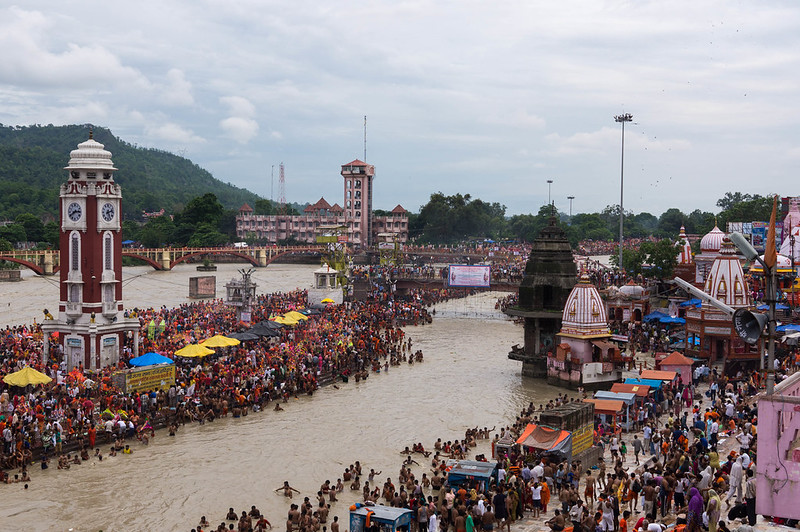
The Kanwar Yatra (also spelled Kanwad Yatra) is an annual pilgrimage in which devotees of Lord Shiva, known as kanwariyas, walk to sacred river points to collect holy Ganga water. They carry it home in decorated pots slung across the shoulders on a pole called a kanwar, then offer it to a Shivling — most auspiciously on Sawan Shivratri. Most walk barefoot in saffron; others travel by cycle, motorcycle or DJ-fitted mini-trucks.
Haridwar (Har Ki Pauri) is the single largest collection point, which is why the roads feeding it get so congested. Other major sources include Gaumukh and Gangotri deep in Uttarakhand, Neelkanth Mahadev near Rishikesh, and Sultanganj in Bihar.
The Kanwar Yatra is India’s largest annual religious gathering. In 2025, Haridwar drew an estimated 4+ crore pilgrims in roughly 15 days, with about 56 lakh departing in the final 24 hours alone.
Numbers on that scale explain why the state administrations reroute traffic for a fortnight. For a family driving up for a Rishikesh weekend, that means the direct road you would normally take is often the one road you cannot use.
At StayVista, our Uttarakhand hosts field the same question every Sawan: “Can I still come up during the Kanwar Yatra?” The short answer is yes — you just have to time it and route it right. Here is exactly how.
The Haridwar Route: Which Roads the Kanwar Yatra Uses
Understanding which corridor the yatra occupies is the whole game, because it is also the corridor most tourists instinctively take toward Uttarakhand. The spine of the pilgrimage on the Delhi-NCR side is NH-34 (formerly NH-58), running Delhi/Ghaziabad → Meerut → Muzaffarnagar → Roorkee → Haridwar. This is the road that carries the bulk of kanwariyas on foot, and it is the first to be restricted.
The Roads That Get Crowded
- NH-34 (ex NH-58): Delhi → Meerut → Muzaffarnagar → Roorkee → Haridwar. The main kanwar marg — expect walking pilgrims across full carriageways.
- Delhi–Meerut Expressway (DME): Feeds the corridor at Meerut; heavily managed during peak days.
- Ganganahar Patri & Pipeline Marg: Dedicated kanwar routes near Haridwar that close to vehicles.
- Local Haridwar & Rishikesh approaches: Har Ki Pauri and the Rishikesh ghats see foot-traffic control and vehicle bans in the final days.
If your usual route to Rishikesh or Dehradun runs through Meerut and Muzaffarnagar on NH-34, assume it will be diverted or closed to regular vehicles for roughly two weeks before 11 August 2026.
Kanwar Yatra 2026 Traffic Diversions and Road Closures
As of 1 July 2026, the UP and Uttarakhand police had not yet published their official 2026 diversion orders — these usually come out a week or two before the yatra. But the pattern is consistent year on year, so you can plan on the following framework and confirm exact dates closer to the time.
| Restriction | Typical timing (before 11 Aug) | Who it affects |
| Heavy-vehicle ban on NH-34, Kanwar Marg, Pipeline Marg & DME | ~10–14 days before Shivratri | Trucks, buses; light vehicles pushed to alternates |
| Meerut diversions | Heavy from ~2 weeks out; cars from ~1 week out | Delhi → Haridwar/Dehradun drivers |
| Ghaziabad diversions (Delhi–Meerut Expressway) | From the start of the peak window | NCR commuters and tourists |
| Delhi–Dehradun Expressway restrictions | Peak days | Tourists using the new expressway |
| DJ / music-truck rules | Whole yatra (size capped 12 ft × 10 ft, volume limits) | Everyone sharing the road |
In practice, general traffic between Delhi and Haridwar gets rerouted via NH-9 (Delhi → Dasna → Hapur) and the Eastern Peripheral Expressway (EPE), which serves as the main heavy-vehicle bypass around NCR. The 2025 orders, for reference, closed light vehicles on the Meerut stretch from around 19 July and imposed a full NH-34 closure in the final days
A Note on the New Delhi–Dehradun Expressway
The Delhi–Dehradun Expressway (roughly 210 km, about 2.5 hours via Baghpat–Shamli–Saharanpur) opened in April 2026 and normally lets you skip Haridwar entirely. The catch: in 2025 the authorities shut the Delhi–Dehradun corridor to regular traffic during peak yatra days. Expect a similar restriction around 7–12 August 2026 and confirm before you rely on it.
When Should Tourists Travel? The Sawan 2026 Crowd Calendar
The smartest move is to treat 11 August as the eye of the storm and plan on either side of it. Here is how the month breaks down for a leisure traveller.
| Window | Crowd level | Recommendation |
| Up to 29 July | Low | Green light — travel freely before Sawan begins |
| 30 July – 6 August | Building | Manageable with alternate routes; avoid weekends |
| 7 – 11 August | Peak | Avoid road travel on the Haridwar corridor entirely |
| 12 – 13 August | Dispersing | Wait a day or two after Shivratri |
| 14 – 28 August | Low | Green light — roads normalised, monsoon-fresh hills |
The best time for tourists to visit Haridwar and Rishikesh in 2026 is before 30 July or after 13 August. If you must travel during the peak fortnight, take the train or fly into Dehradun rather than driving the NH-34 corridor.
A practical tip our team leans on: even in the “manageable” windows, leave before dawn. Kanwariya foot traffic and diversions build through the day, so a 5 a.m. start out of Delhi buys you clearer roads than a mid-morning one.
Alternate Routes to Rishikesh, Dehradun and Mussoorie
If you are set on driving during Sawan, skip the Kanwar corridor and go west of it. These are the routes that keep you clear of the heaviest pilgrim flow.
Route 1: Delhi–Dehradun Expressway (Baghpat–Shamli–Saharanpur)
The fastest option in normal conditions and the one that bypasses Haridwar altogether. Watch for peak-day closures, though.
- Distance / time: ~210 km, ~2.5 hours to Dehradun
- Best for: Dehradun and Mussoorie trips
- Status during yatra: Likely restricted 7–12 August
- Pro tip: Perfect before 30 July or after 13 August; keep a backup route saved for the peak days.
Route 2: Via Panipat and Saharanpur
The dependable workhorse route. It runs well west of Meerut–Muzaffarnagar, so it stays largely clear even at peak.
- Distance / time: ~300 km, ~6–7 hours to Dehradun/Rishikesh (Delhi → Panipat → Shamli → Saharanpur → Dehradun)
- Best for: Reliable access when the expressway is shut
- Status during yatra: Generally open
- Pro tip: Fuel up at Panipat; fewer clean stops once you turn toward Shamli.
Route 3: Via Karnal and Yamunanagar
A slightly longer western arc, useful if Saharanpur checkposts are congested.
- Distance / time: ~330 km via Delhi → Karnal → Yamunanagar → Ambala–Dehradun bypass
- Best for: Drivers already heading up NH-44 toward Chandigarh side
- Status during yatra: Generally open
- Pro tip: Good highway dhabas around Karnal for a proper meal break.
Route 4: Via Bijnor and Kotdwar (for Rishikesh)
An eastern hill route that sidesteps Haridwar completely — longer and winding, but scenic and crowd-free.
- Distance / time: ~400 km via Delhi → Gajraula → Bijnor → Kotdwar → Dugadda → Rishikesh
- Best for: Rishikesh-bound travellers who enjoy the drive
- Status during yatra: Open but hilly — avoid after dark in monsoon
- Pro tip: Check for landslide advisories on the Kotdwar–Dugadda stretch during heavy rain.
For Dehradun and Mussoorie during Kanwar Yatra, the Panipat–Saharanpur road (~300 km) is the most reliable alternative to the blocked NH-34 corridor. For Rishikesh, the Bijnor–Kotdwar route (~400 km) avoids Haridwar entirely.
What About Nainital?
Good news if your heart is set on the hills but not on Ganga country: Nainital sits east of the Kanwar corridor, reached via NH-9 through Moradabad and Rampur. It is largely unaffected by the yatra, which makes it a genuinely stress-free alternative for a Sawan-window getaway from Delhi.
Reaching Uttarakhand by Train and Air (The Crowd-Free Options)
If the idea of route-planning around road closures sounds exhausting, the simplest answer is to not drive at all. Trains and flights bypass the diversions completely.
By Air – Jolly Grant Airport, Dehradun (DED)
Flying into Jolly Grant Airport, Dehradun is the single best crowd-avoidance move from Delhi and other metros during the yatra. From the airport it is about 20 km (40 minutes) to Rishikesh, roughly 40 km (70 minutes) to Haridwar’s Har Ki Pauri, and a short hop into Dehradun city. You land north of the entire pilgrim corridor.
By Train
Delhi to Dehradun/Haridwar is about 240 km by rail, and trains run unaffected by road diversions. Your station options are Haridwar Junction, the newer Yog Nagari Rishikesh station, and Dehradun. One caveat: rail demand spikes sharply during Sawan, so book as early as you can — ideally the moment the reservation window opens.
Flying into Jolly Grant Airport (DED) puts you ~20 km from Rishikesh and ~40 km from Haridwar, north of the pilgrim corridor — the fastest way to reach Uttarakhand during Kanwar Yatra without touching a diverted road.
What Travellers Should Know on the Route
Beyond traffic, a few practical realities catch first-time Sawan travellers off guard. A little preparation goes a long way.
- Many dhabas turn pure-veg (satvik). Roadside eateries along the pilgrim path often go vegetarian for the month. Plan meal stops accordingly, and carry snacks for kids.
- DJ trucks mean slow, loud convoys. Music-fitted mini-trucks (capped at 12 ft × 10 ft with volume limits in 2026, move slowly. Keep your distance and don’t try to squeeze past.
- Drive with extra patience around kanwariyas. Pilgrims frequently walk on the carriageway. Slow right down, avoid honking, and never risk contact — any incident involving a kanwariya can escalate quickly. This is the one rule locals stress most.
- Be respectful with cameras. The yatra is a devotional act, not a photo-op. Keep a respectful distance if you photograph the walkers.
Is It Safe to Visit Haridwar and Rishikesh During the Yatra?
Yes – the region is heavily policed during Sawan, with hundreds of officials, drone and CCTV surveillance, and organised crowd management. Safety is rarely the issue; congestion is. Haridwar itself becomes extremely crowded around Har Ki Pauri in the peak fortnight, so if your goal is a peaceful riverside break, base yourself in Rishikesh, Dehradun or Mussoorie and visit Haridwar, if at all, on a non-peak day.
Rishikesh stays lively but manageable, especially on the Tapovan and Laxman Jhula side. Mussoorie and Dehradun, sitting above the plains, are barely touched by the yatra crowds and make an easy, comfortable base for families.
Where to Stay: A Calm Base Away From the Crowds
The trick to enjoying Uttarakhand during Sawan is to sleep well away from the pilgrim thoroughfares and venture out selectively. A private homestay or villa – with its own kitchen, space for the family, and hosts who know the local road situation day to day – beats a roadside hotel on the corridor every time.
StayVista has handpicked homestays and private villas across the quieter pockets of the region:
- Rishikesh & around: Riverside and Tapovan-side homestays for yoga-and-Ganga trips, positioned off the main ghat crush.
- Dehradun: Valley homes with gardens and hill views, an easy 40 minutes from Jolly Grant Airport.
- Mussoorie: Hill cottages and view villas well above the plains and the yatra traffic.
- Nainital: Lake-district stays that skip the kanwar corridor entirely – ideal if you want the hills without the Sawan crowds.
Book a place with parking and flexible check-in, and message your host before you set out – they will tell you which approach road is open that day.
How to Plan Your Trip Around the Yatra
Option A: Beat the Crowd (Before 30 July)
Squeeze in your Rishikesh or Haridwar trip in the last full week of July, before Sawan begins. Roads are clear, hotels and homestays are cheaper, and you get the monsoon-green hills without the congestion.
Option B: The Peak-Fortnight Play (30 July – 11 August)
If these are the only dates you have, do this: fly into Dehradun or take the train, base yourself in Mussoorie or Dehradun (above the crowds), and treat Rishikesh/Haridwar as an optional day trip on a non-peak day only. Skip 7–11 August for any Haridwar plans.
Option C: The Easy Alternative (Nainital)
Want the hills with zero yatra friction? Point the car toward Nainital via Moradabad instead. It sidesteps the corridor completely and works as a relaxed 2–3 day weekend from Delhi.
Option D: Wait It Out (After 13 August)
The sweet spot for many travellers: the second half of August. The pilgrim crowds are gone, the weather is fresh, rates soften, and you get Rishikesh and Haridwar closer to their calm best.
Frequently Asked Questions
Kanwar Yatra 2026 starts on 30 July 2026, the first day of Sawan, and peaks on Sawan Shivratri, 11 August 2026, when jalabhishek is performed. The Sawan month, and the pilgrim flow, continues until 28 August 2026.
Sawan Shivratri in 2026 falls on Tuesday, 11 August. This is the culmination of the Kanwar Yatra and the day traffic and crowds around Haridwar are heaviest. It should not be confused with Maha Shivratri, which falls in February–March.
NH-34 (formerly NH-58) through Meerut and Muzaffarnagar is the main affected corridor, along with the Delhi–Meerut Expressway and dedicated kanwar margs near Haridwar. Heavy vehicles are banned about two weeks before Shivratri and general traffic is diverted via NH-9 (Dasna–Hapur) and the Eastern Peripheral Expressway in the peak days.
In 2025 the Delhi–Dehradun corridor was shut to regular traffic during peak yatra days. A similar restriction around 7–12 August 2026 is likely, so confirm the official 2026 order before relying on the expressway during that window.
Avoid the NH-34 corridor. Drive via Panipat–Saharanpur (~300 km) for Dehradun, or Bijnor–Kotdwar (~400 km) for Rishikesh. Better still, take a train to Dehradun/Yog Nagari Rishikesh, or fly into Jolly Grant Airport, which sits north of the pilgrim corridor.
Yes. The region is heavily policed with drone and CCTV surveillance and organised crowd control. The main challenge is congestion, not safety. For a peaceful trip, base yourself in Rishikesh, Dehradun or Mussoorie and avoid Haridwar on peak days (7–11 August 2026).
It is India’s largest annual religious gathering. In 2025, an estimated 4+ crore pilgrims reached Haridwar over roughly 15 days, with about 56 lakh leaving in the final 24 hours – which is why the roads are managed so tightly.
The Bottom Line
Kanwar Yatra 2026 doesn’t have to derail your Uttarakhand plans – it just rewards travellers who plan ahead. Remember the three numbers: the yatra starts 30 July, peaks on 11 August, and eases after 13 August. Travel on either side of that peak, or use the train or Jolly Grant Airport if you must go during it, and stick to the western alternate routes rather than the NH-34 corridor.
When you are ready to book a calm base above the crowds – in Rishikesh, Dehradun, Mussoorie or Nainital – browse StayVista’s handpicked homestays and villas across Uttarakhand, and travel the smart way this Sawan.