
Asia’s Cleanest Village Just Made a Rule That Will Change How You Visit
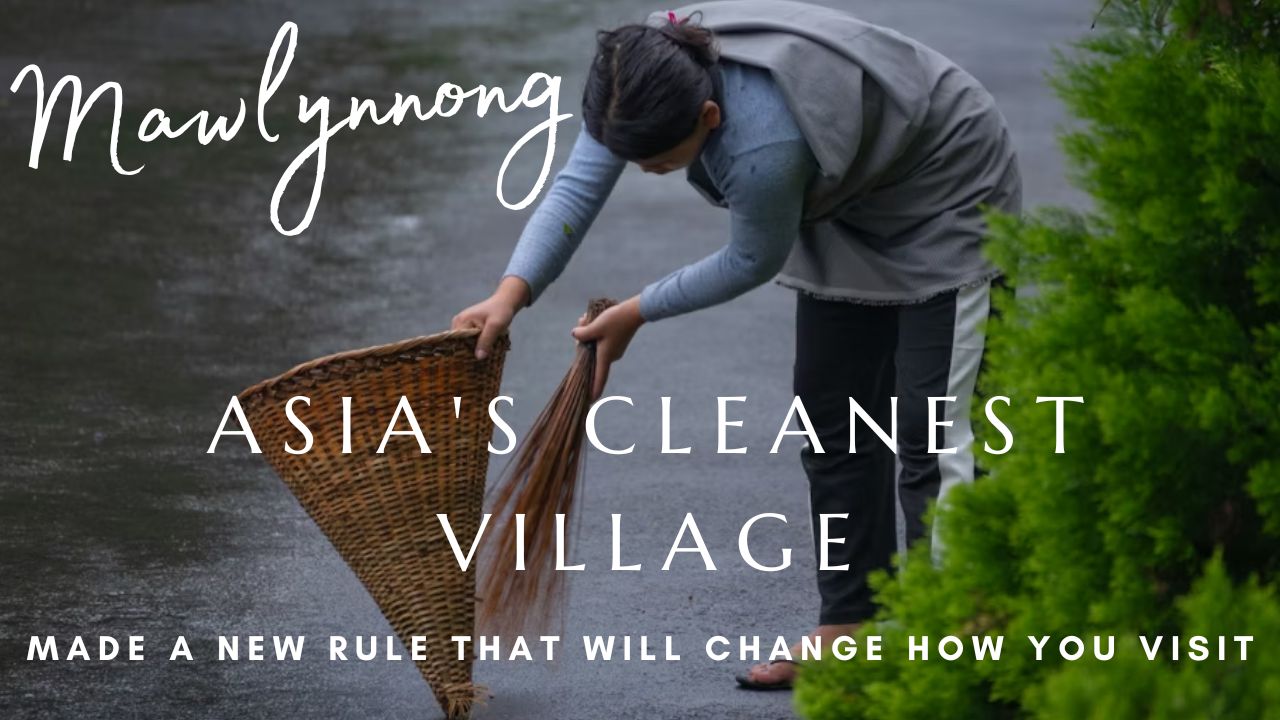
Mawlynnong is a Khasi village in Meghalaya’s East Khasi Hills — 90 km from Shillong — that Discover India magazine named Asia’s cleanest village in 2003. It has no municipal cleaning staff. Every resident, including children, is bound by community bylaws to sweep public paths and compost waste. In March 2026, the village added a new rule: it’s now closed to day-trippers on Sundays (Outlook Traveller, March 2026). Here’s what to know before you go.
In this Blog
Quick Info
| Location | East Khasi Hills district, Meghalaya |
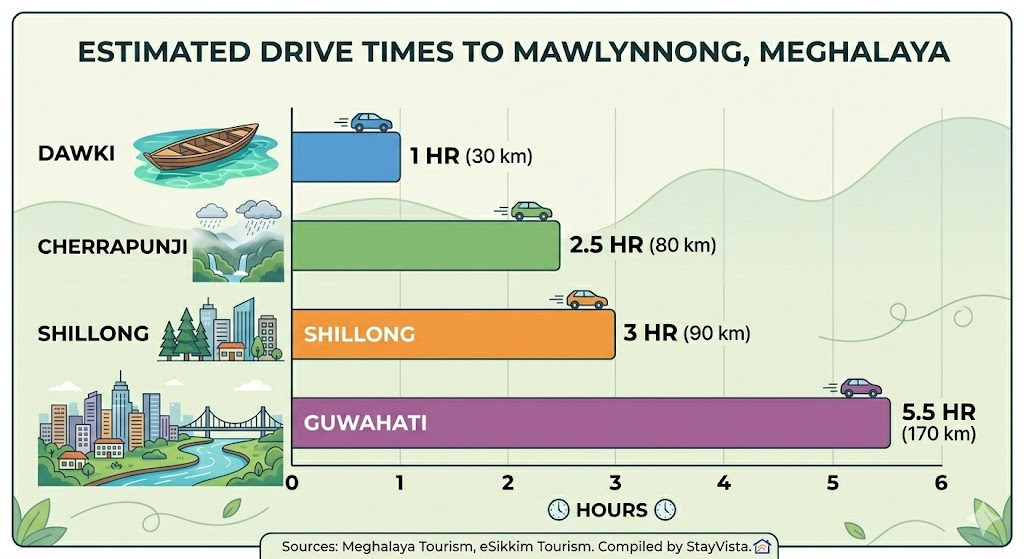
| Distance from Shillong | 90 km · ~3 hours by road |
| Distance from Guwahati airport | 170 km · ~5.5 hours by road |
| Nearest town | Pynursla (30 km) |
| Village entry fee (2026) | ₹100 per person + parking (verify on arrival) |
| Best time to visit | October to April |
| Ideal duration | 1 day trip from Shillong, or 1 night overnight stay |
| Closed to day-trippers | Sundays (2026 rule) |
| Language | Khasi (primary); Hindi and English widely spoken |
An Evening Walk Through Mawlynnong

The first thing you notice isn’t the cleanliness. It’s the quiet.
We visited Mawlynnong on a Wednesday in late October — peak season, post-monsoon. By 5 pm most day-trippers were already headed back to Shillong, and the village returned to itself. A girl in school uniform swept a bamboo-edged path outside a blue-painted home. Two women stood near the Church of the Epiphany, arguing gently in Khasi. A small boy carried compost scraps to the nearest bamboo bin without being told.
There are about 900 people in Mawlynnong, spread across roughly 95 households (Wikipedia). The village is predominantly Christian — three churches, no temple — and literacy sits at 90%, well above the state average. Homes are modest but freshly painted. Gardens are everywhere.
What you don’t see is also the point. No plastic on the paths. No cigarette stubs. No open drains. The absence is the architecture.
Why Is Mawlynnong Called Asia’s Cleanest Village?
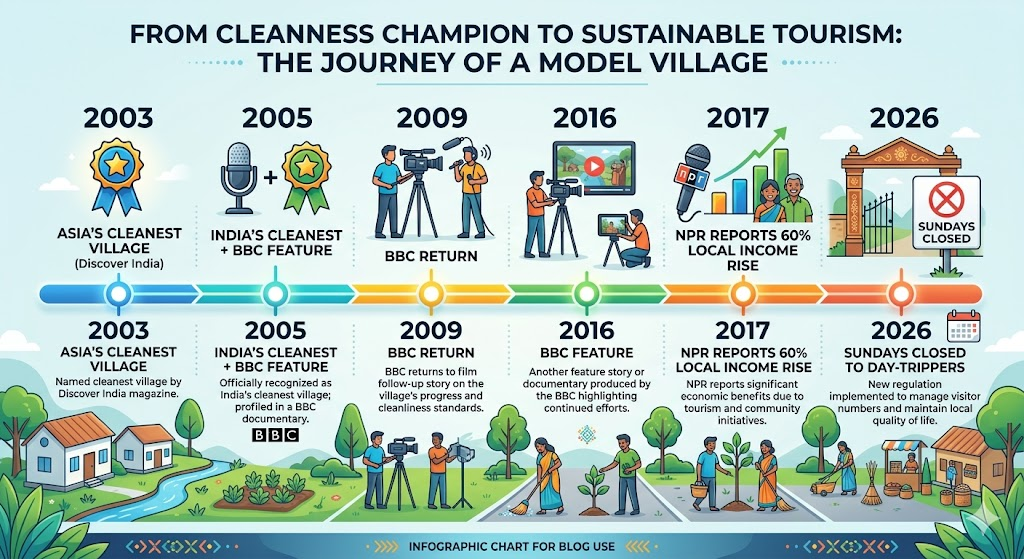
In 2003, the India-based travel magazine Discover India declared Mawlynnong “Asia’s Cleanest Village” — a title that stuck. Two years later, in 2005, the same publication named it the cleanest village in India. The BBC featured the village in 2005, 2009, and again in 2016, and NPR reported in 2017 that tourism driven by the title had lifted household income in the village by roughly 60% (Wikipedia citing NPR).
The recognition wasn’t handed down by a state survey. It was earned through a system the village had already run for decades — community-enforced cleanliness, bamboo dustbins at 50-metre intervals, a long-standing ban on plastic, and a household-level composting rhythm.
The title matters, but it’s the mechanism underneath that’s interesting. We’ll get to that.
What Changed in Mawlynnong in 2026? (And Why It Matters for Visitors)

In March 2026, Mawlynnong added a new rule to its visitor code: the village is now closed to day-trippers on Sundays (Outlook Traveller, March 2026). Shops along the main stretch shut. Homestays continue to host guests already staying overnight, but buses and taxi convoys from Shillong are turned back.
The reason, per the village council’s statement, is resident burnout. Mawlynnong receives somewhere between 800 and 1,500 visitors on a busy weekend — a lot for a settlement of 900 people. Sundays, traditionally church and family time, had become the worst-affected day.
What this means if you’re planning a trip:
- Go Mon–Sat for a day trip. Tuesday to Thursday are the quietest.
- If you want a Sunday experience, book an overnight homestay for Saturday night. You’ll get Sunday morning in an almost-empty village before breakfast.
- Plan Sunday for Dawki (30 km), Cherrapunji (80 km), or Shillong city — all nearby and open.
Our take: The Sunday rule is the best thing the village has done for visitor experience in years. Weekday Mawlynnong feels like a living village; a packed Saturday Mawlynnong feels like a stage set. If you can shift your dates, do.
Why It Actually Works — The Community Mechanism

Mawlynnong isn’t clean because the government swept it. It’s clean because a set of community rules, enforced socially rather than legally, has run continuously since well before the 2003 title. Understanding the rules is the real reason to visit.
Community by laws.
Every household is expected to contribute to cleaning the public paths. Adults sweep assigned stretches; children are often assigned cleaning duty through school as part of a rotating community roster.
Plastic ban.
Polythene bags and single-use plastics have been banned in the village since the early 2000s — years before India’s national plastic rules. Shops sell only in paper or bamboo packaging. Visitors carrying plastic are asked to take it back out with them.
Bamboo dustbins.
Roughly 150 hand-woven bamboo bins line the village paths, spaced so no corner of the village is more than a short walk from one. Waste is collected, dry waste separated, and organic waste routed to a composting pit that feeds back into household gardens.
Rainwater harvesting.
Most homes harvest monsoon runoff — East Khasi Hills averages among the world’s highest rainfall — reducing dependence on the municipal supply.Shame-based enforcement. There are no fines for littering. The sanction is social — a resident or shopkeeper caught breaking the rules loses standing in the village council. In a community of 900 people where most are related through the Khasi matrilineal clan system, social pressure is enforcement.
A 2014 academic study on the Mawlynnong model found the combination of social enforcement and economic reward — tourism income tied directly to the village’s reputation — made the system self-sustaining. Once cleanliness became the brand, the brand became the reason to keep cleaning.
Myth-bust: Isn’t Mawlynnong the village where nobody locks their doors?
No — that’s a different village, and it’s worth correcting. A viral story circulates online about an “Indian village where nobody locks their doors.” It’s repeatedly and wrongly attributed to Mawlynnong. The actual village is Shani Shingnapur, in Ahmednagar district, Maharashtra, where local belief in Lord Shani is said to protect the village from theft. Houses there famously have no doors at all, let alone locks.
Mawlynnong has doors. People lock them. The story you heard is about a different place, ~2,400 km away, with a completely different cultural logic. The two villages are often conflated in “amazing India villages” listicles. If you’re visiting Mawlynnong for the no-lock story, you’re going to the wrong state. If you’re visiting for something genuinely unique — the community cleanliness model, the Khasi matrilineal system, and the living root bridges 2 km down the road — you’re in the right place.
What Is the Khasi Matrilineal System? (And Why It Shapes Mawlynnong)

Travel articles about Mawlynnong usually spend one line on this: “The Khasi people are matrilineal.” That line does the culture a disservice.
Matrilineal ≠ matriarchal:
In a matrilineal system, lineage and property pass through the mother’s line, but political and public life is still largely male-led. Khasi society is matrilineal, not matriarchal — a distinction locals will correct you on if you get it wrong (indianculture.gov.in).
Ka Khadduh — the youngest daughter:
Among the Khasi, the youngest daughter (called Ka Khadduh) inherits the ancestral house, the land, and the responsibility of caring for parents and unmarried siblings. She also becomes the custodian of the family shrine and ritual traditions. Older daughters receive their share at marriage, but the ancestral property stays with the youngest.
Ka Kñi — the maternal uncle:
The decision-maker in significant family matters — marriage, property disputes, rituals — is typically the mother’s brother, not the father. A Khasi child’s closest male authority figure is their uncle, not their dad.
Children take the mother’s surname:
Across Khasi, Jaintia, and Garo communities of Meghalaya, children inherit the mother’s clan name. A Diengdoh marries a Khongwir; their children are Khongwirs.
How this intersects with cleanliness:
In Mawlynnong, as in most matrilineal Khasi villages, women are the traditional custodians of both household space and the public paths adjacent to the home. The cleaning culture isn’t enforced top-down by a village chief — it’s carried by the women who inherit and maintain the homes, with the council (still male-dominated) formalising what the household already practises.
The system isn’t without tension. Younger Khasi men have, over the last decade, campaigned for a fairer inheritance model. But for now, Mawlynnong runs on a logic that’s been in place for centuries.
Is the Living Root Bridge Actually in Mawlynnong?

Here’s a clarification every Mawlynnong visitor should have before they go: the living root bridge people associate with Mawlynnong is not actually in Mawlynnong. It’s in Riwai, a smaller Khasi settlement 2 km away, also called Nohwet. The bridge’s formal name is the Jingmaham Living Root Bridge.
It’s a single-decker bridge, roughly 300 years old, crafted from the aerial roots of Ficus elastica — the Indian rubber fig. The bridge spans a small stream and takes about 45 minutes to visit round-trip, including the 200-metre walk down from the road and back up.
Entry fee: ₹30 per person, collected by Riwai villagers and used for maintenance.
Time required: 30-45 minutes.
Ideal for: all ages, though the walk back is steep.
This is not the more famous double-decker bridge, which is at Nongriat, near Cherrapunji — a separate trek entirely that takes 3-4 hours each way. Travel articles routinely confuse the two. Our advice: visit Riwai as a Mawlynnong day trip (it’s genuinely lovely), and plan Nongriat as a separate Cherrapunji hike if you want the double-decker (Wikipedia on living root bridges).
How Do You Reach Mawlynnong? (Fees, Timings & Routes)

How to Reach Mawlynnong
Mawlynnong has no railway station and no airport. You’ll reach it by road from either Shillong or Guwahati.
From Shillong (90 km, ~3 hours)
Shared Tata Sumo jeeps run from Bara Bazar in Shillong to Pynursla and onward to Mawlynnong. A private taxi costs roughly ₹2,500-3,500 for a day trip (Shillong round trip). The route runs Shillong → Pynursla → Dawki junction → Mawlynnong, and the last stretch is narrow but paved.
From Guwahati (170 km, ~5.5 hours)
Take a taxi or bus from Guwahati to Shillong (3 hours), then continue as above. If you’re flying into the Northeast, Guwahati’s Lokpriya Gopinath Bordoloi International Airport is the gateway.
From Dawki (30 km, 1 hour)
Often paired with a Dawki day trip for the Umngot river boat ride. Mawlynnong sits roughly between Shillong and Dawki, so a Shillong → Mawlynnong → Dawki → Shillong loop in a day is common.
For the official regional overview and permitted entry points, see Meghalaya Tourism’s Mawlynnong page.
Entry Fees (2026)
| Attraction | Fee (₹) | Notes |
| Mawlynnong village entry | 100 per person | Plus parking charge |
| Sky View / Skywalk (85 ft bamboo tower) | 10-30 | Recent reports trending to ₹30 |
| Balancing Rock | 10 | Some visitors report ₹20 |
| Riwai Living Root Bridge | 30 | Paid to Riwai villagers |
Timings & Best Time to Visit
- Opening hours: Attractions are typically open 7 am to 6 pm.
- Closed day: Sundays — no day-trip access (2026 rule).
- Best months: October to April. Post-monsoon (October-November) is lush and clear; February to April is dry and comfortable.
- Monsoon (June-September): Spectacular green and waterfalls everywhere, but roads can wash out and walking paths get slippery.
Network, ATMs & Essentials
Mobile network is patchy — Jio and Airtel work inconsistently. There is no ATM in Mawlynnong; carry enough cash from Shillong. Most homestays accept UPI when network permits. Stock basics (water, snacks, any medication) before you arrive.
The Itinerary: One Day or Overnight
Option 1: Day Trip from Shillong
| Time | Activity |
| 7:00 am | Leave Shillong (taxi / shared sumo) |
| 10:00 am | Arrive Mawlynnong; tea at a homestay |
| 10:30 am | Sky View bamboo tower (best morning light) |
| 11:15 am | Village walk — Church of the Epiphany, bamboo-bin paths, handicraft stalls |
| 12:30 pm | Lunch at a local Khasi homestay |
| 2:00 pm | Drive to Riwai (2 km); visit the Living Root Bridge |
| 3:30 pm | Optional: continue to Dawki for the Umngot river boat ride |
| 6:00 pm | Begin return to Shillong |
| ~9:00 pm | Arrive Shillong |
Option 2: Overnight in Mawlynnong (Strongly Recommended)

The day-trip version skims the surface. An overnight stay gets you the village at its best — after day-trippers leave and before they return.
Day 1:
- Late afternoon arrival from Shillong
- Sunset at Sky View (far better light than morning)
- Dinner with your homestay host — typical Khasi thali with rice, pork or fish, and jadoh (rice-and-meat)
- Evening village walk when paths are empty
Day 2:
- Sunrise walk before day-trippers arrive at 10 am
- Riwai Living Root Bridge (beat the crowds)
- Head to Dawki for the afternoon (30 km / 1 hr)
- Continue to Cherrapunji or back to Shillong
Our team’s recommendation: Overnight, every time. A day-trip to Mawlynnong is a photo op; an overnight in Mawlynnong is a village.
Mawlynnong vs Cherrapunji: Which Should You Choose?
If you have only one day in Meghalaya beyond Shillong, pick based on what you want.
| Mawlynnong | Cherrapunji (Sohra) | |
| Main draw | Community cleanliness model, Khasi culture | Waterfalls, caves, double-decker root bridge |
| Vibe | Quiet village, slow pace | Dramatic landscape, outdoor activity |
| Physical effort | Easy walking | Moderate-to-strenuous (Nongriat trek) |
| Best for | Culture + slow travel | Nature + adventure |
| Time needed | Half-day to 1 night | Full day minimum |
| If you have 2 days | Do both — they’re 80 km apart | Do both |
Ideally, visit both. Base yourself in Shillong or Cherrapunji, spend Day 1 on Mawlynnong + Riwai + Dawki, Day 2 on Cherrapunji’s waterfalls and Nongriat trek.
Is Mawlynnong Worth Visiting? An Honest Answer
Go if:
- You’re interested in community-led sustainability models, not just pretty villages
- You care about Khasi culture and matrilineal society as something more than a trivia line
- You value slow travel — a half-day wandering a small village with tea stops
- You’re already doing a Meghalaya circuit (Shillong / Cherrapunji / Dawki) — Mawlynnong fits in naturally
- You can visit on a weekday or stay overnight
Skip (or save for another trip) if:
- You expect a dramatic landscape or adventure — Cherrapunji will deliver that better
- You have only 48 hours in Meghalaya and haven’t seen Cherrapunji yet — prioritise Cherrapunji
- You travel primarily for Instagram shots — the Sky View is pleasant but not epic, and photographing residents without permission isn’t welcome
- You can only visit on a Sunday (2026 closure) without an overnight booking
- You’re allergic to guided-tour-style itineraries — the main village loop is short, and without context the experience can feel thin
The honest answer is that Mawlynnong rewards travellers who come curious about how a community does something, not just travellers looking at what a community has. Come for the mechanism, stay for the matriliny, and leave with a better understanding of how villages can self-govern around a shared standard.
Where Should You Stay Near Mawlynnong?
In Mawlynnong village: There are 8-10 village-run homestays, mostly family-owned and modest. Expect ₹1,500-3,000 per night for a clean room with attached bath; meals are typically ₹200-400 per person and worth having. Homestays fill up on weekends — book ahead. Staying with a Khasi family is the closest you’ll get to understanding how the cleanliness system works day-to-day.
Shillong as a base (90 km / 3 hrs): Wider range of accommodation, more food and nightlife options. Best if you’re combining Mawlynnong with Cherrapunji and Dawki.
Cherrapunji as a base (80 km / 2.5 hrs): Closer to Mawlynnong than Shillong is, and you get Cherrapunji’s waterfalls and the Nongriat trek built into your trip.
StayVista doesn’t currently operate properties in Meghalaya — we’re honest about that. If you’d like to extend your Northeast trip with villas or homestays elsewhere in India, browse our destinations. For Meghalaya specifically, your best bets are the village homestays themselves or Shillong hotels.
FAQs
Mawlynnong was declared Asia’s cleanest village in 2003 by the India-based travel magazine Discover India. Two years later, in 2005, the same publication named it the cleanest village in India. The BBC subsequently featured the village in 2005, 2009, and 2016, cementing its reputation internationally (Wikipedia).
Half a day covers Mawlynnong village plus the Riwai Living Root Bridge. One overnight stay is strongly recommended — it lets you see the village before and after day-trippers. Two days lets you combine Mawlynnong with Dawki or Cherrapunji. Don’t allocate more than two days to Mawlynnong alone; it’s a small village.
Yes — as of March 2026, Mawlynnong is closed to day-trippers on Sundays. The village council introduced the rule to reduce weekend tourist pressure (Outlook Traveller, March 2026). Guests with confirmed overnight homestay bookings can stay through Sunday, but buses and taxi day-trips from Shillong are turned back.
Yes. Dawki is 30 km from Mawlynnong (about 1 hour by road), and most day-trippers combine both in a Shillong → Mawlynnong → Riwai → Dawki → Shillong loop. Start by 7 am from Shillong, spend the morning in Mawlynnong, reach Dawki by 3 pm for the Umngot river boat ride, and return to Shillong by 9 pm.
Mawlynnong is considered one of the safest destinations in Northeast India. The village is small, literate, and matrilineal — women are active and visible in public life. Homestays routinely host solo travellers. Standard precautions apply for the drive from Shillong (travel by daylight, use registered taxis), and mobile network is patchy, so share your itinerary before you leave.
The primary language is Khasi, an Austroasiatic language native to Meghalaya. Most Mawlynnong residents also speak fluent English and Hindi — the village has been receiving international visitors for over two decades, and literacy in the village is around 90%. A few words of Khasi (like khublei, “thank you”) are always appreciated.
No ATM is available in Mawlynnong itself. The nearest ATMs are in Pynursla (~30 km) and Shillong. Carry enough cash. Mobile network is patchy — Jio and Airtel work inconsistently, BSNL slightly better. Most homestays accept UPI when network permits, but don’t count on it.
Not exactly. The famous single-decker living root bridge associated with Mawlynnong is actually in Riwai village (also called Nohwet), about 2 km from Mawlynnong. It’s formally the Jingmaham Living Root Bridge, roughly 300 years old, and built from Ficus elastica roots. The more famous double-decker bridge is at Nongriat, near Cherrapunji — a separate location (Wikipedia).
A Note Before You Go
Mawlynnong is a village, not an attraction. The people you’ll meet aren’t performers. The cleanliness you’ll see isn’t staged. Leave the path cleaner than you found it, ask before photographing anyone, carry your plastic back out, and when you stay overnight in a homestay — as we’d encourage you to — ask your host about the Khasi inheritance system. You’ll learn more in one evening than any article can give you.