
Where To See Frozen Lakes in Kashmir in January 2026
In this Blog
The moment the lake froze beneath my feet
I’ll never forget the moment my boots first crunched onto the frozen edge of Pangong Tso.
It was January 14th, just before sunrise. The thermometer clipped to my jacket trembled at –28°C, and even my eyelashes felt brittle with frost. The lake I’d known in summer—liquid, shimmering, restless—was now a flawless sheet of ice stretching into the horizon. Completely still. Completely silent. Completely unreal.
Most people see frozen lakes in photographs and think: magical. ethereal. dreamy. But standing on one? Hearing the faint, hollow cracks beneath your boots? Watching trapped air bubbles shimmer under transparent ice? Feeling the world go quiet in a way that doesn’t happen anywhere else? That’s not dreamlike. That’s humbling.
When I first visited Kashmir in winter, I thought frozen lakes were simply beautiful. Five January visits later, I know they’re far more than that. They’re transformative.
If you’re planning to chase frozen lakes in Kashmir in January 2026, here’s everything you need to know—from someone who has stood on the ice, breathed in the cold, and lived these winters up close.
Why January 2026 is the ultimate frozen lake season
January in Kashmir isn’t just the peak of winter.
It’s Chillai-Kalan—the harshest, coldest 40 days of the Kashmiri calendar, beginning on December 21 and ending on January 31. These aren’t “winter vibes.” This is winter in its rawest form.
People often assume Kashmir in December is freezing. And it is. But December is a hint. January is the revelation.
January Is When Lakes Fully Commit to Ice
December brings thin edges of frost.
January brings solid sheets.
In my January 2024 and 2025 trips:
- Srinagar dipped to –5°C to –7°C at night
- Gulmarg reached –10°C and below
- Pangong Tso dropped to –28°C at sunrise
This is the temperature switch that turns water into glass.
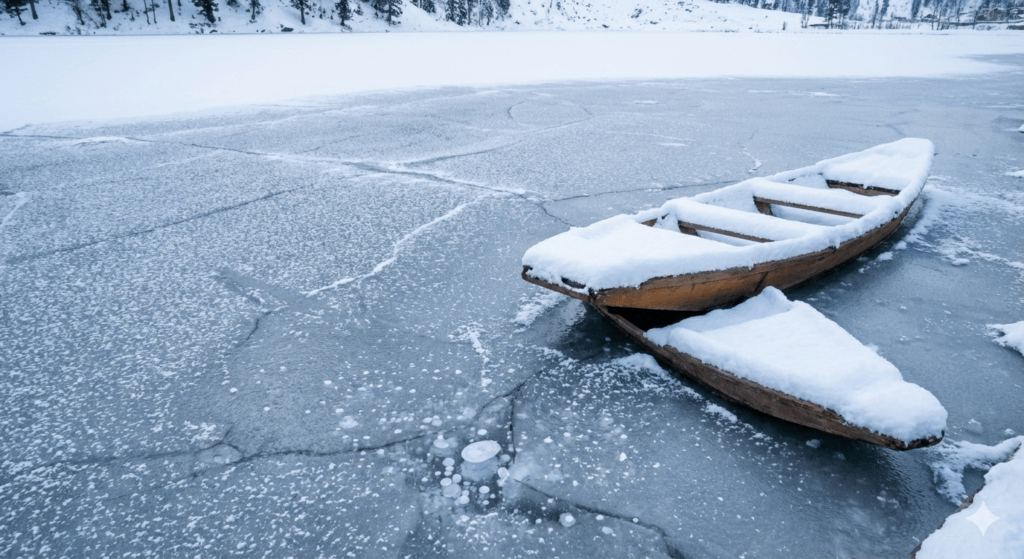
Dal Lake freezes along the edges.
Nigeen begins to seal over almost completely.
Pangong transforms into a 134-km frozen world you can walk on confidently.
And in January 2026, the freeze timing will follow the same pattern.
Altitude: The Force Behind the Freeze
Dal Lake sits low in the valley. A shallow freeze. Fleeting. Poetic.
Nigeen sits slightly higher. A firmer freeze. Still quiet.
But Pangong Tso sits at 14,250 feet, where oxygen thins, wind bites, and the cold doesn’t gently settle—it dominates. Even salty water freezes solid at this elevation.
Altitude explains everything.
- Dal = delicate winter film
- Nigeen = near-complete, serene ice sheet
- Pangong = absolute freeze from shore to horizon
This is why travelers who arrive just after New Year—between January 4 and January 8—often witness the first stable freeze of the season.
January Travel: The Romance & The Reality
Travel blogs often glamorize winter, but here’s the truth:
January lakes are majestic because they’re difficult.
Roads close without warning.
Engines stall at dawn.
Your breath turns into crystals.
Your eyelashes freeze.
Your fingers feel the cold before anything else does.
But that’s exactly why January feels magical.
In January 2025, I spent three days at Pangong and saw only three other travelers. Imagine 134 kilometers of frozen silence—and you’re the only one walking across it.
If solitude speaks to you more than comfort, January is your season.
Is January too cold for Kashmir?
Short answer: Yes — and that’s exactly why the lakes freeze beautifully.
In January, Kashmir enters peak Chillai-Kalan, when temperatures drop to –5°C in Srinagar and –25°C to –30°C in Ladakh. It’s cold enough for lakes to freeze reliably, but still manageable if you pack proper winter layers. If you want to witness frozen lakes, this is the only time they appear in their full form.
What’s the difference between Kashmir in December vs January?
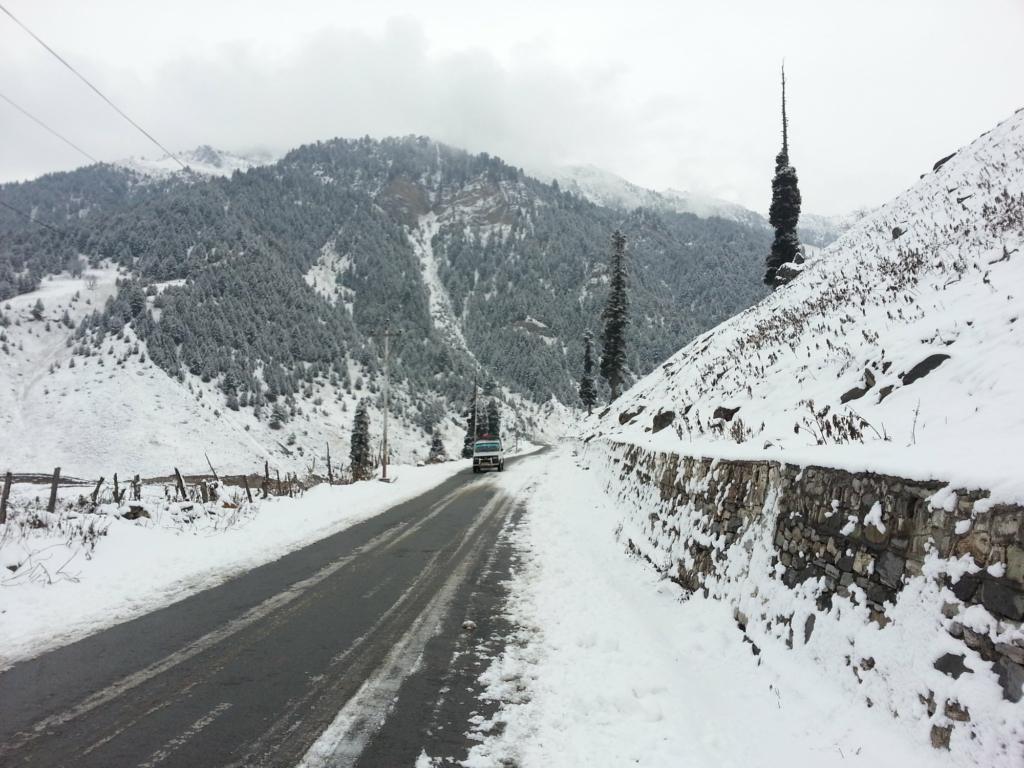
- December: Lakes begin thin freeze, snowfall starts, mornings are crisp, but ice is unreliable.
- January: Lakes freeze consistently, temperatures drop sharply, and snowfall builds. It’s the best month to see solid ice at Dal Lake, Nigeen, and Pangong.
If your goal is to see frozen lakes in Kashmir, choose January, not December.
The 6 Frozen Lakes in Kashmir That You Can Actually Visit In January
Below are the lakes I’ve personally visited in January—walked on, photographed, and frozen beside. No borrowed descriptions. No second-hand advice. Only lived in winter.
Which lakes in Kashmir freeze in January?
Based on my winter visits across five seasons, these lakes typically freeze in January:
- Pangong Tso: Fully frozen
- Tsomoriri: Fully frozen
- Nigeen Lake: Nearly complete freeze
- Dal Lake: Partial freeze (edges only)
- Nundkol Lake: Fully frozen (requires a trek)
- Saif-ul-Malook: Partial freeze depending on snowfall
If you want the classic “walk on solid ice” moment, Pangong, Tsomoriri, and Nundkol are your best bets.
1. PANGONG TSO, LADAKH — Complete Freeze | The Most Dramatic Frozen Lake in India
What You’ll Experience
Pangong in winter feels like stepping into an alternate reality.
The ice is so transparent that when I stood on it, I could see deep blue fractures running across the lake floor. The horizon blurs as sky reflects onto ice, and mountains appear doubled—one real, one made of frozen glass. Silence here is so deep it feels alive.
If you ask me where to experience the most cinematic winter landscapes in India, the answer is always Pangong.
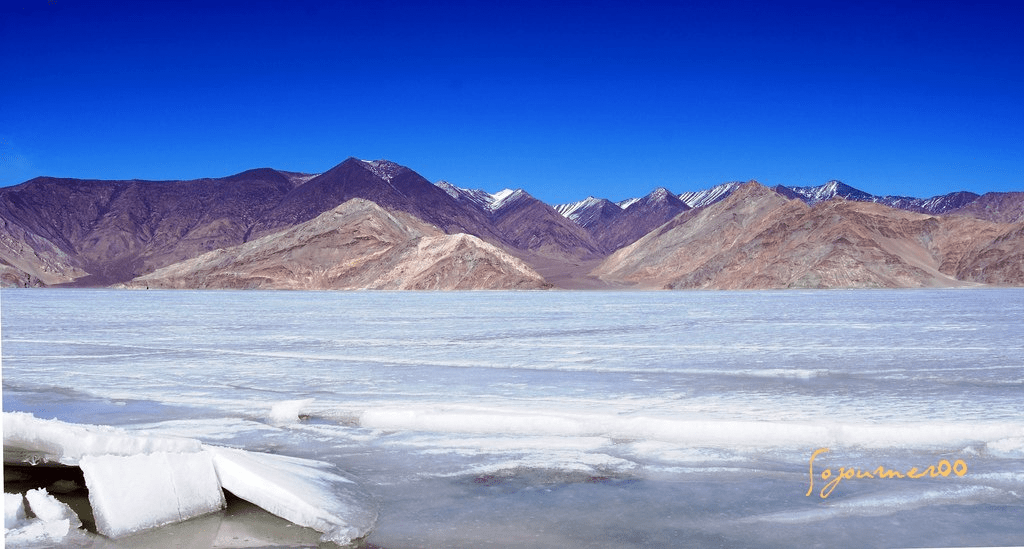
Picture Credits: Wikimedia Commons
January 2026 Conditions
- Day: –10°C to –15°C
- Night: –25°C to –30°C
- Ice Thickness: ~40–50 cm
- Best Window: Jan 10–31
Best For
Adventure travelers, winter photographers, and couples who want an out-of-this-world moment.
Challenges
The beauty comes at a cost:
- Chang La Pass closures
- Frostbite risk
- Basic accommodation
- High altitude sickness potential
- Mandatory Inner Line Permit
Photography Tip
Shoot at sunrise when the light skims the lake at a low angle, creating mirror-like reflections.
2. DAL LAKE, SRINAGAR — Partial Freeze | Kashmir’s Most Romantic Winter Lake
What You’ll Experience
Dal Lake in January is a poem in motion.
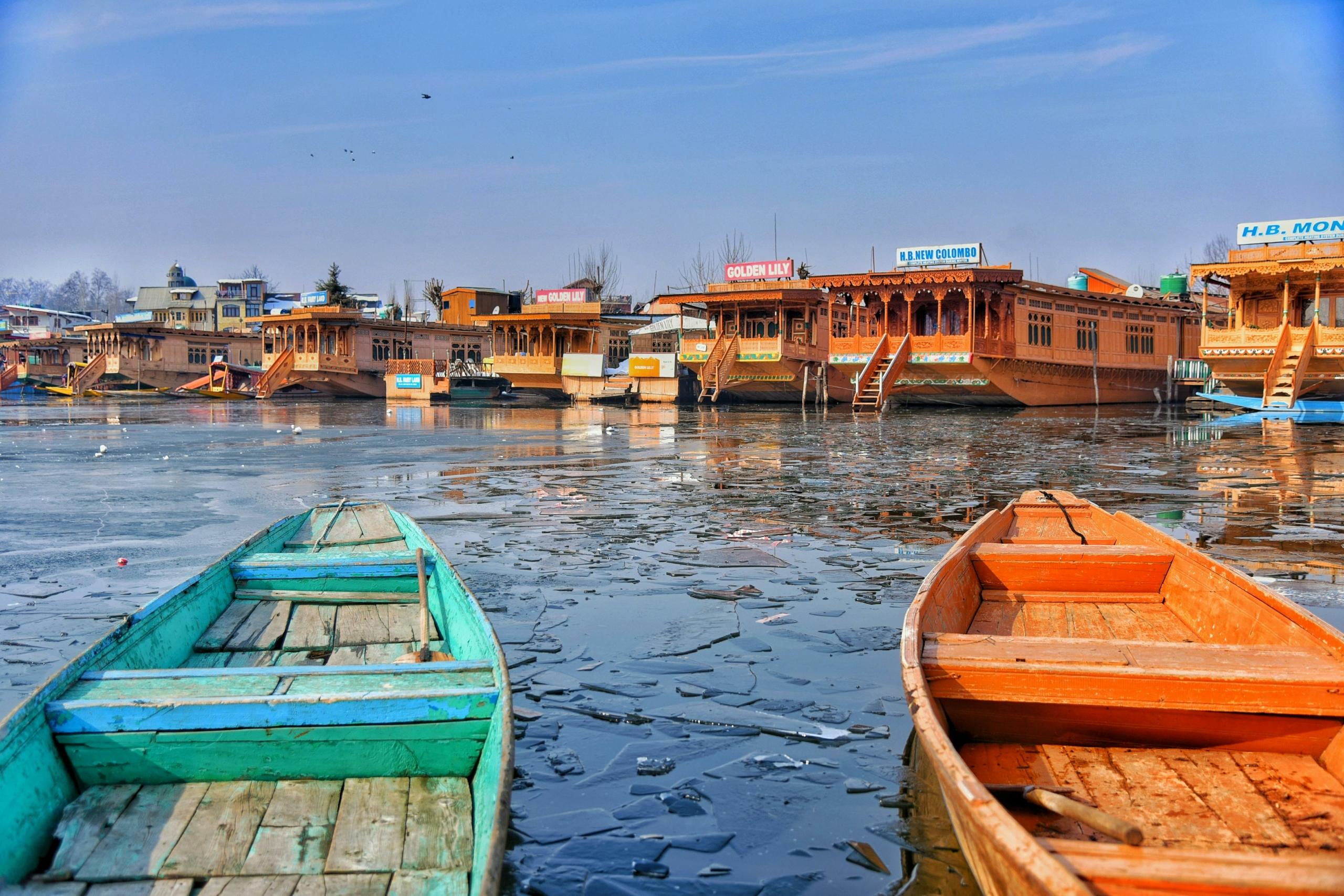
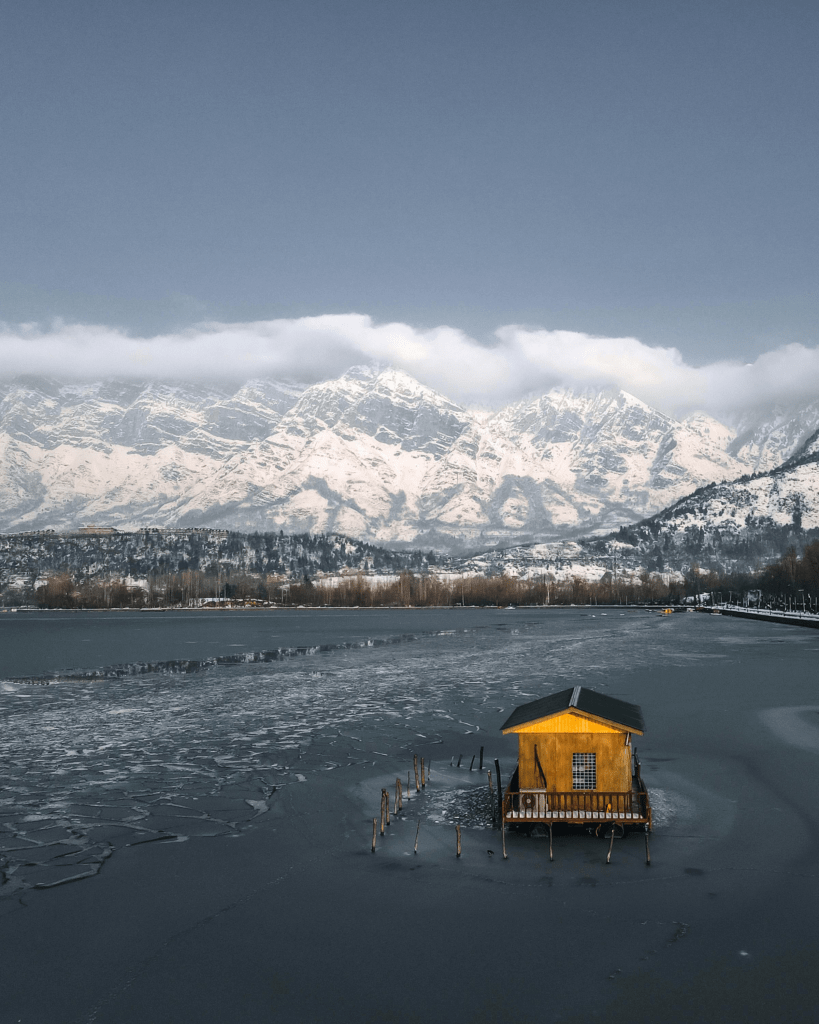
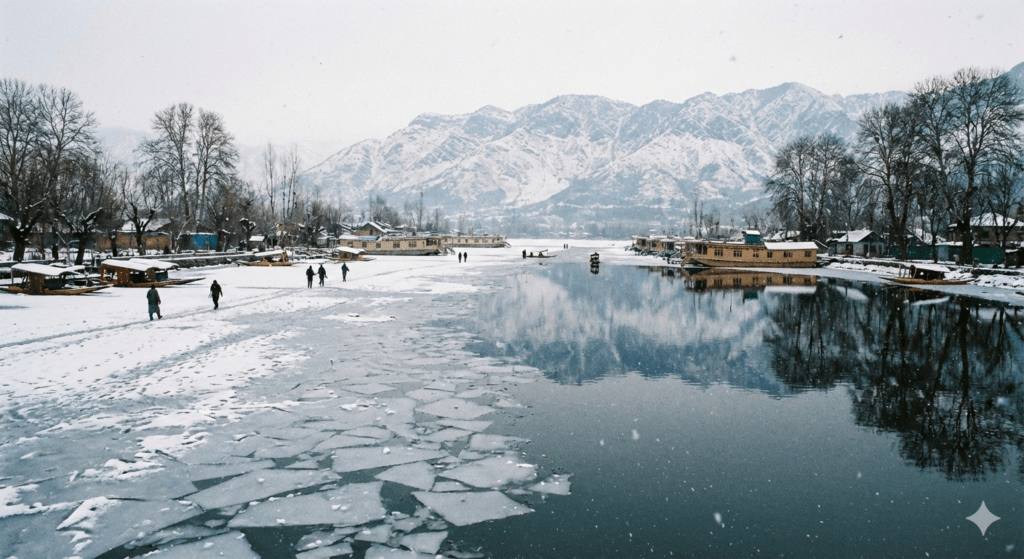
From your houseboat window, you’ll watch thin sheets of ice form overnight. Dawn paints them gold. Shikaras break through slowly, the sound of cracking ice echoing across the lake. Mist wraps the surface in a soft veil.
Dal doesn’t freeze completely—but the partial freeze is what makes it atmospheric. Intimate. Cinematic.
January 2026 Conditions
- Night: –5°C to –2°C
- Freeze Window: 4 AM–10 AM
- Day: 2°C to 4°C
Best For
Honeymooners, families, photographers, and couples who want the winter charm without extreme temperatures.
Honest Insight
Dal Lake freezing affects the livelihoods of boatmen and vendors. Travel kindly, respectfully, and without demanding early-morning shikara rides when it’s unsafe.
Where To Stay Near Dal Lake?
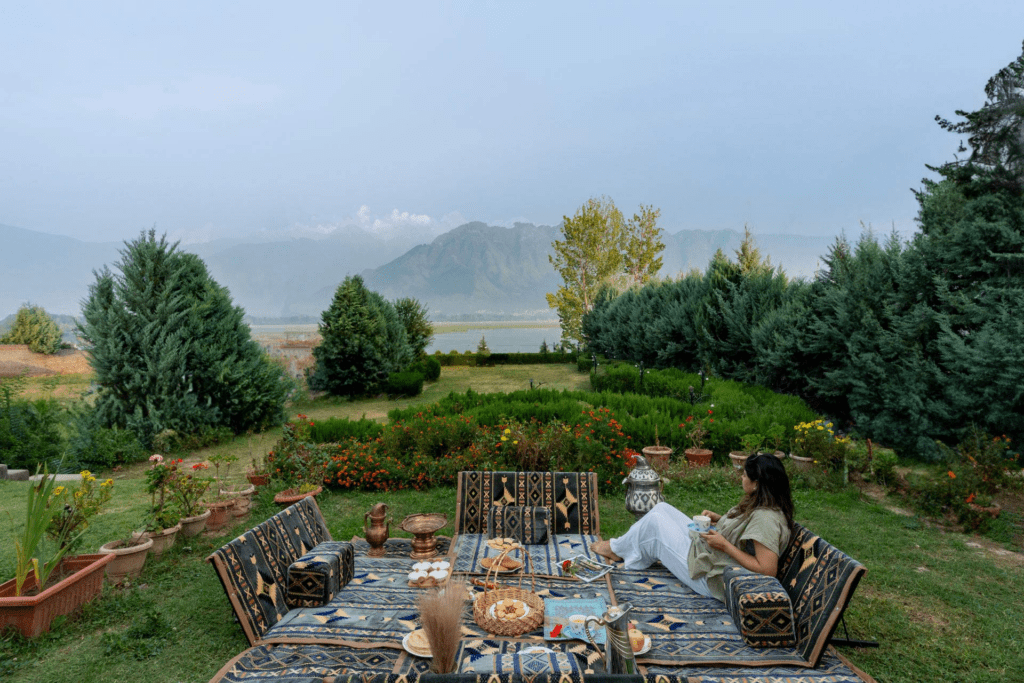
3. NIGEEN LAKE, SRINAGAR — Near-Complete Freeze | The Quietest Winter Mirror in Kashmir
What You’ll Experience
If Dal Lake is the grand stage, Nigeen is the whispered conversation.
Shallower, quieter, and less commercial, Nigeen freezes more firmly than Dal. During my January 2024 trip, I watched the lake slowly seal itself overnight until it became a flawless sheet of ice reflecting the sky in shades of blue, silver, and pale gold.
At dawn, the silence is profound. The ice looks like polished glass, broken only by delicate frost patterns. Once, at 7 AM, I watched a low winter mist hover above the lake before dissolving into sunlight—it felt like witnessing a secret.
Local Insights
- Fewer boats mean undisturbed freezing.
- Locals sometimes cross frozen patches (only with experience—never attempt alone).
- Ideal conditions for long-exposure photography.
Best For
Writers, couples seeking solitude, photographers who prefer clean lines & minimalist winter landscapes.
Honest Take
Fewer cafes, shops, and tourist amenities than Dal—but infinitely quieter.
4. SAIF-UL-MALOOK, KAGHAN VALLEY — Partial Freeze | Alpine Drama at Its Best
What You’ll Experience
Saif-ul-Malook is the kind of place that makes you stop mid-step.
Surrounded by towering snow-clad cliffs and dense pine forests, the lake sits at 3,500 meters—high enough for dramatic winter colors, thin ice sheets, and crisp mountain winds. In January, the lake becomes a patchwork of ice and water: blue glass in one corner, frosted white in another, liquid reflections near the shore.
On my January visit, the ride up felt like climbing into a monochrome painting. At the lake, the air thinned, the silence sharpened, and the world felt distilled to snow, wind, and water.
Local Insights
- The road often opens late morning.
- Winds can make it feel like –20°C.
- By afternoon, long shadows drop temperatures dramatically.
Best For
Alpine lake hunters, day-trippers, travellers who want winter scenery without Ladakh’s extremeness.
Honest Challenge
This lake is unpredictable in January. Conditions change daily. Always coordinate with local guides.
5. TSOMORIRI, LADAKH — Complete Freeze | The Quietest Frozen Lake in India
What You’ll Experience
Tsomoriri is the lake you visit when you want winter to feel ancient.
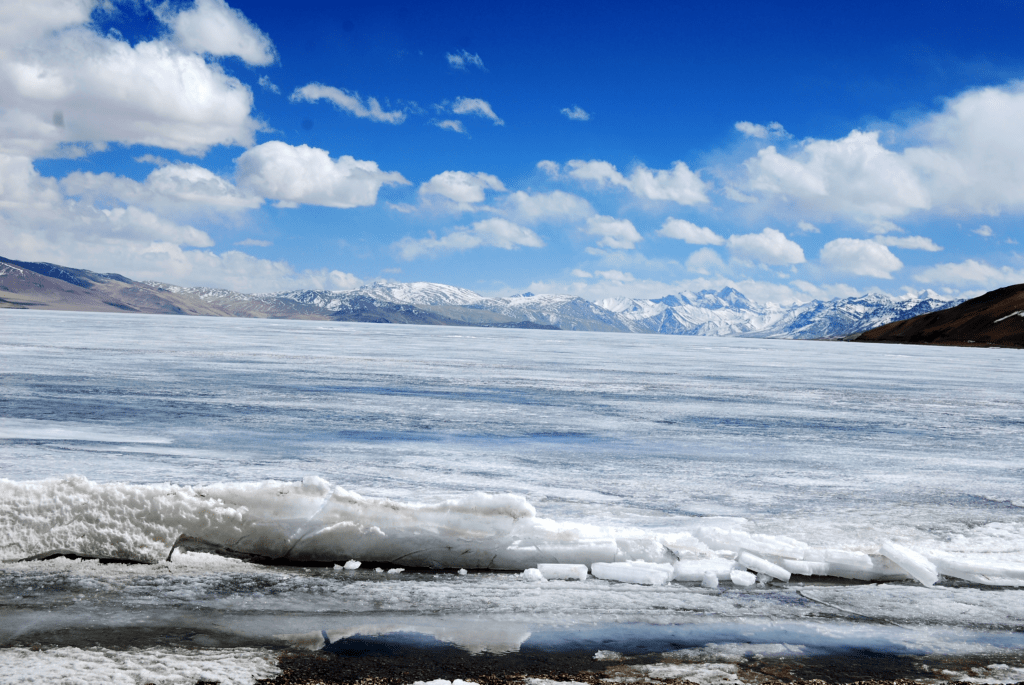
Deep inside Ladakh’s high-altitude plateau, Tsomoriri freezes completely into a textured expanse of white and blue. On my January visit, the lake was utterly still—an empty, stunning world where wind carved patterns into frozen surfaces.
I walked for nearly two hours without encountering a single soul. The solitude is astonishing. At one point, I stood in the middle of the frozen expanse and felt the kind of silence that makes your heart beat louder.
Local Insights
- Only a handful of homestays remain open.
- Winds can be fierce—carry proper face protection.
- The landscape feels like Antarctica in some stretches.
Best For
Seasoned travellers seeking depth, stillness, and winter wilderness.
Honest Take
This is the most demanding frozen lake experience in India—but also the most unforgettable.
6. NUNDKOL LAKE, NEAR PAHALGAM — Complete Freeze | For Those Who Want to Earn the View
What You’ll Experience
Nundkol is not a lake you stumble upon—you earn it.
Accessible only through a snow trek near Mount Harmukh, the journey itself is half the reward. When I trekked towards Nundkol in late January, every step was a soft crunch through untouched snow. The forest muffled sound. The air tasted metallic. And the climb revealed the lake slowly, like a curtain lifting.
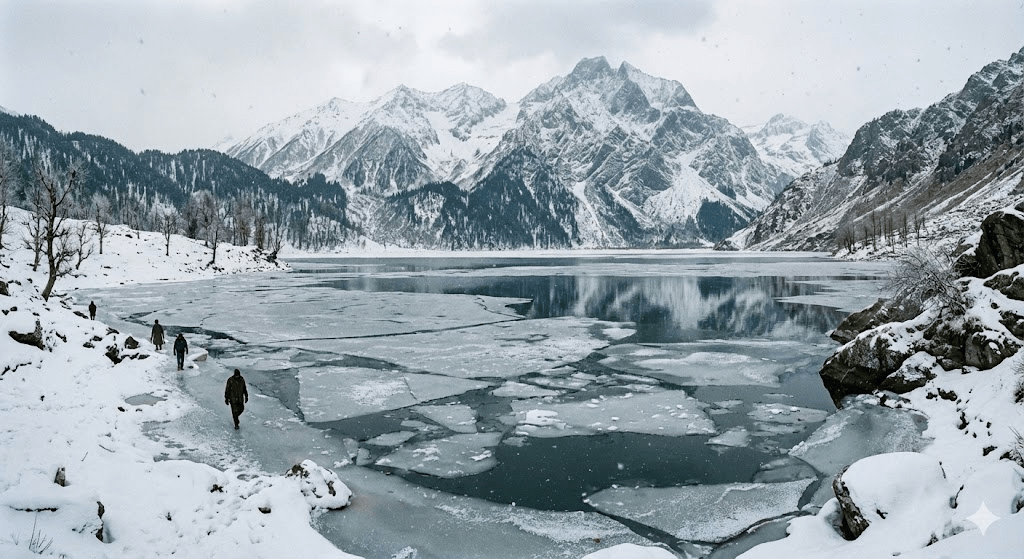
Nundkol in winter is absolutely pristine: a frozen oval framed by snow-covered rocks, with Harmukh towering majestically behind it. The ice is smooth in some places, wind-textured in others, and always breathtaking.
Local Insights
- Must be attempted with a guide—snow bridges shift daily.
- Best window is short: often just 8–10 good days in January.
- Reflections of Harmukh beneath the ice are surreal on clear days.
Best For
Trekkers, photographers craving rare winter shots, travellers who want experiences untouched by mainstream tourism.
Honest Challenge
If you want comfort, skip this.
If you love adventure, this will stay with you forever.
Which frozen lake in India is best for photography?
If your goal is winter photography, here’s the ranking based on visibility, ice clarity, light, and landscape:
- Pangong Tso — clearest ice, golden sunrise light
- Tsomoriri — quiet, textured frozen patterns
- Nundkol Lake — pristine, untouched, mountain reflections
- Nigeen Lake — minimalist winter compositions
- Dal Lake — atmospheric mist + partial freeze
- Saif-ul-Malook — alpine drama, varied freeze
For dramatic “walking on ice” shots → Pangong
For mood + atmosphere → Dal & Nigeen
For rare, untouched winter landscapes → Nundkol
Practical Guide on How To Visit The Frozen Lakes in January
A. The Best Time to Travel
- Jan 1–10: Freeze forming, unstable
- Jan 10–25: Peak window (solid ice + stable skies)
- Jan 25–31: Snowstorms possible
Sweet spot: Jan 12–20.
B. Packing Essentials
You cannot negotiate with the Himalayan winter.
- Merino wool thermals
- Down jacket (–15°C to –20°C rating)
- Waterproof gloves + liners
- Winter boots (–25°C rated)
- Balaclava, wool cap, neck warmer
- Sunglasses (snow glare)
- Hand warmers
- Portable oxygen (for Ladakh)
C. Road Safety
- Pangong routes can close anytime
- Srinagar lakes accessible
- Saif-ul-Malook depends on the weather
- Nundkol trek requires a guide
D. Permits & Budget
- Pangong & Tsomoriri: Inner Line Permit
- Budget: ₹30,000–₹50,000 for 5–6 days
E. Health
- Acclimatize in Leh
- Drink water constantly
- Protect extremities
- Don’t stay on ice too long without breaks
So, what is the best week to see frozen lakes in Kashmir?
From five winters of observation, the most reliable window is:
January 12–20
Why?
- The ice is thick
- Skies clearer
- Roads usually stable
- Cold is consistent enough for a solid freeze
Early January = unpredictable
Late January = possible storms
And, what to wear to survive Kashmir in January?
A simple packing formula:
Base → Middle → Insulation → Outer Shell
- Merino thermals (base)
- Fleece or wool sweater (middle)
- Down jacket (insulation)
- Waterproof outer shell (wind + snow protection)
- Gloves, liners, wool socks, snow boots
- Balaclava + sunglasses for glare
If your shoes aren’t winter-rated, your trip will be miserable.
The Magic Behind The Ice
Frozen lakes show you things that photos never will.
If you sit quietly at sunrise—really sit—something extraordinary happens. The lake begins to speak. Tiny cracks flicker beneath the surface. Distant echoes bounce across mountains. Your breath forms clouds. Your fingers go numb. Your heart rate slows.
When I returned from Pangong in January 2025, I tried explaining the experience. But how do you explain standing on a frozen world that feels ancient? Or how silence can feel louder than sound? Or how ice can teach you something about yourself?
Frozen lakes in Kashmir aren’t attractions.
They’re experiences that strip away noise and leave only clarity.
January 2026 will bring the same Chillai-Kalan stillness, the same majestic freezes that December only hints at, and the same quiet landscapes that make Kashmir feel untouched. Whether you’re planning a New Year trip, a photography journey, or simply want to experience the serenity of frozen lakes, winter is Kashmir’s most honest season.
StayVista’s winter-ready cottages in Srinagar and villas near Pahalgam offer warmth, comfort, and the kind of local expertise you need for January travel. Winter isn’t just cold here—it’s a personality. And with the right guidance, it becomes unforgettable.
If you’re planning a Kashmir trip in December or January, book early. Winter stays fill fast among travelers seeking solitude, snowfall, and ice.
I’ll see you on the ice. Bring thermals.
Also Read: Kashmir in November & December – Travel Tips, Snow Experiences & Must-See Sights
Kashmir Itinerary: Best Places to Visit in Kashmir in January 2026