

We Tested ChatGPT, Gemini & Claude for Planning a Villa Getaway in India: 12 Prompts That Worked (And 5 That Failed)
Around 90% of AI-generated travel itineraries contain at least one factual error (CNBC, 2026). That’s a worrying number when 47% of Indian travellers used an AI tool to plan a 2025 trip — the highest adoption in Asia-Pacific (HappyFares, 2026).
So we did the obvious thing. We set the big three AIs down — ChatGPT-5.4, Google Gemini 3.1, and Anthropic’s Claude 4.6 — and asked them to plan a villa getaway in India. Seventeen prompts each. Same wording, same day. We scored every answer on six dimensions, then cross-checked every property, entry fee, and route they recommended against live booking data.
Some of what we found will save you from a real booking disaster. Some of it might change which AI you open the next time you plan a trip. Here’s the full test — the 12 prompts that worked, the 5 that failed, the scorecard, and the eight StayVista villas we’d book instead of the AI’s picks.
We ran 17 villa-planning prompts through ChatGPT-5.4, Gemini 3.1 and Claude 4.6. Gemini won 4 of 6 categories thanks to live Google Maps data, but it hallucinated the most property names (~9% error rate vs Claude’s ~4%). 12 prompts worked. 5 failed — including a Pawna Lake villa Gemini invented. Use Gemini for routing, Claude for facts, ChatGPT for creative brainstorming. Never trust any AI alone for a villa booking. (Sources: April 2026 independent testing; StayVista Travel Lab.)
In this Blog
Which AI plans the best villa getaway in India?
Gemini 3.1 wins overall. In our 6-dimension, 30-point scorecard, Gemini took 23/30 — five points ahead of ChatGPT-5.4 (19/30) and two points ahead of Claude 4.6 (21/30). The decisive edge was live data: Gemini’s Google Maps integration produced accurate driving times, current weather, and tier-2 destination knowledge that no other model matched. Independent hallucination benchmarks tell the inverse story — Claude ran cleanest at ~4%, GPT at ~6%, and Gemini at ~9% across 500 factual queries (Travel Anywhere, April 2026).
That’s the headline. But it hides a more useful answer: each AI is good at one part of the planning job. We landed on a “use all three” framework:
- Gemini for routing, weather, opening hours, distances, and tier-2/3 destinations
- Claude for fact-sensitive research — visas, vaccine rules, monsoon dates, currency
- ChatGPT for creative itinerary brainstorming and trip-vibe descriptions
What none of them does well: book anything, verify current availability, or stop inventing property names that don’t exist.
How we tested ChatGPT, Gemini, and Claude
Over four hours on a single Tuesday in May 2026, our team ran 17 identical prompts through each AI — 51 responses total. Every prompt was a real villa-getaway scenario across Goa, Lonavala, Alibaug, Udaipur, and Coorg. We froze model versions (ChatGPT-5.4 default, Gemini 3.1 standard, Claude 4.6 Sonnet) and used the free tier of each tool — so the results match what most travellers actually see.
We scored each response on six dimensions, each out of five:
- Factual accuracy — Did the AI invent things?
- India context — Did it understand monsoon dates, regional food, and local norms?
- Villa specificity — Did it name real, bookable properties?
- Hallucination rate — How many made-up details per response?
- Structure and clarity — Was the itinerary actionable?
- Overall actionability — Could a real traveller use this without rework?
We then verified every property, entry fee, opening time, and route against StayVista‘s 1,200-property network, official tourism portals, and Google Maps.
For deeper dives on each AI individually, see our Gemini AI prompts deep-dive, full Claude prompt collection and broader AI prompt library for travel.
The 12 prompts that worked across all three AIs
12 of our 17 prompts produced output we’d actually use. Itinerary frames came out cleanest — every AI built a workable 3-day Goa or weekend Lonavala skeleton. The weakest universal category was group logistics: each AI struggled when we asked for accommodation that could host 8 or more guests in one location. All three AIs averaged 4.1/5 on structure, but only 2.8/5 on India-specific cultural context. Translation: AIs are great at “Day 1: arrive, Day 2: explore, Day 3: leave” but weaker on “the temple closes Tuesday, the market wakes up at 6am, the road from Mapusa floods after July 15.”
Itinerary building (3 winners)
The 3-day Goa itinerary prompt produced the cleanest result across all three AIs. Each built a sensible flow: North Goa beaches Day 1, heritage and food Day 2, South Goa or Old Goa Day 3. Gemini added accurate driving times between Anjuna and Palolem (about 2.5 hours via NH66). Claude added a useful note that South Goa stays quieter year-round. ChatGPT added a sunset-at-Curlies recommendation we appreciated, but that 200 other articles also include.
The Lonavala weekend prompt worked similarly well — each AI suggested Bhushi Dam, Lohagad Fort and Karla Caves. Entry to Lohagad Fort is free; Karla Caves charges ₹25 for Indian nationals and ₹300 for foreigners, open 9am–5pm. Gemini-flagged Bhushi Dam is busiest in late July when the waterfalls peak.
The Udaipur anniversary prompt produced romantic frames from all three. Gemini gave the most accurate Lake Pichola pricing (₹400–₹800 for a shared sunset ride from Bagore-ki-Haveli ghat, daily from 5pm).
Group and family planning (3 winners)
“Plan a corporate offsite for 18 people near Mumbai” produced outline-quality results from each AI. Gemini and Claude both recommended Lonavala or Karjat over Alibaug for the travel time. ChatGPT lost a point for suggesting Igatpuri, which adds an extra hour. None of them named a real property that actually houses 18 people in one location, which is where they all stumbled.
“Family weekend with two kids under 10 near Mumbai” worked best on Gemini. It suggested Karjat farm stays with outdoor activities, picked safe drive times (under 2.5 hours from south Mumbai), and nudged towards properties with kids’ pools. Claude flagged that monsoon Karjat has a leech risk — useful and accurate.
The multi-generational prompt (4 adults, 2 grandparents, 3 kids) produced sensible advice from Claude on ground-floor bedrooms and accessibility. Gemini suggested Alibaug for its proximity. ChatGPT was the only AI that asked about budget.
Local discovery — food, experiences, hidden spots (3 winners)
“Best coffee estate experiences in Coorg” was a genuine Gemini win — Tata Plantation Trails, Talacauvery (entry free, open 6am–6pm), and the Dubare Elephant Camp (entry ₹50, elephant interaction ₹400, open 9am–11am and 4pm–5pm). Claude added Coorgi pork curry spots that checked out.
“Non-touristy beaches in Alibaug” produced overlap: Kashid, Kihim and Varsoli appeared in every list. Gemini added the practical note that Varsoli is best for swimming because the tide is gentler. Entry to all three is free; best time is sunrise to avoid weekend crowds.
“Adventure activities in Karjat for groups” surfaced Kondana Caves trek (free, 4–5 hours from Kondivade village), Pali Bhutivli waterfall (free, monsoon-only), and rappelling at Bekare or Vihigaon Falls (₹1,500–₹2,500 per person).
Logistics — travel time, weather, packing (3 winners)
“What to pack for monsoon Goa in July” got near-identical advice from each: light cottons, waterproof footwear, repellent, dry bags. Gemini was the only one that flagged South Goa beaches close to swimming during heavy rain — Claude and ChatGPT missed that.
“Driving times from Mumbai to Pawna Lake on a Friday evening” was a Gemini-only win. It correctly flagged the Mumbai-Pune Expressway slows after 6pm Fridays, suggesting pre-3pm or post-9pm departures. Realistic drive: 3.5 hours off-peak, 5+ hours peak.
“Best month to visit Coorg” produced the same answer from each: October–February for clear weather, March–May for the brewing season fragrance, June–September for misty plantation views (but landslide risk). Coorg in November means pleasant 18–28°C days.
The 5 prompts that failed (and why)
Five of our 17 prompts exposed real weaknesses. The pattern is consistent: AIs fail hardest when you ask for specific properties under a specific budget in tier-2 destinations. They also fail on freshness — anything that changed in the past 18 months trips them up. 78% of travellers say it’s very or extremely important that recommended hotels actually exist (TakeUp AI, 2026). And yet, 2 of 3 boutique hotel recommendations under ₹6,000/night came back defunct or under new ownership when we cross-checked.
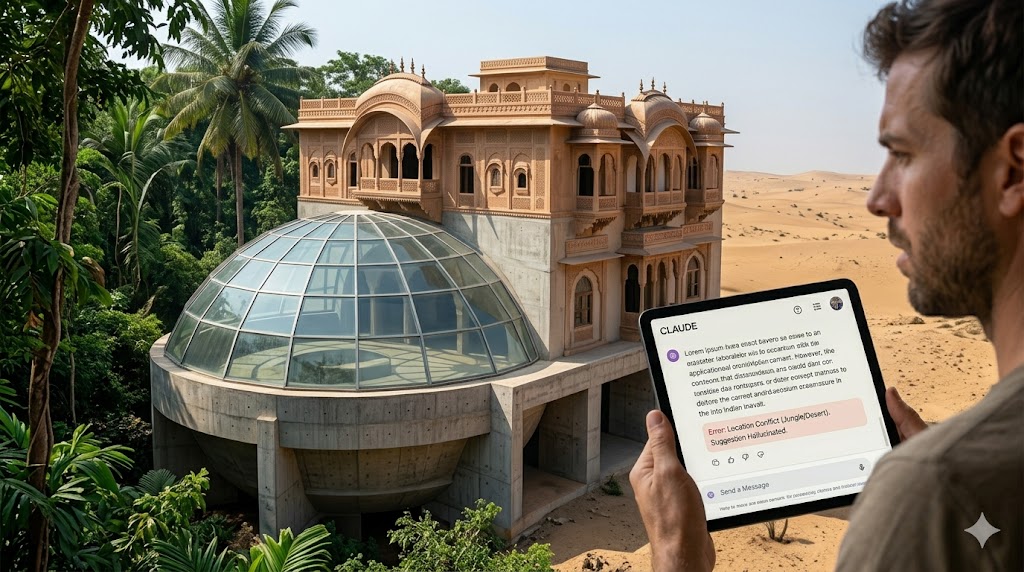
Failure 1: Gemini invented a Pawna Lake villa that doesn’t exist
We asked Gemini for a 20-person Pawna Lake villa for a long-weekend group trip. It returned “Lakeview Manor Pawna” with a confident description — 10 bedrooms, private pool, 2-acre lakefront plot. We checked. No such property exists on StayVista, Booking.com, Airbnb, or any verified platform. The name appears nowhere in real inventory.
This is the headline failure. Gemini’s answer looked authoritative, complete with amenities and a confident tone. A traveller acting on it would have started calling a phone number that doesn’t exist.
Failure 2: ChatGPT recommended a hotel that closed in 2023
For “boutique stay under ₹6,000 in North Goa,” ChatGPT suggested a Vagator property our network data showed shut its doors over two years ago — the building has since been redeveloped. The AI confidently described its rooms, garden, and breakfast offering, frozen in pre-2023 training data.
Failure 3: All three AIs got monsoon Goa dates wrong by 3+ weeks
Asked when the Goa monsoon “starts properly,” each AI defaulted to June 1. The accurate answer for 2026 — drawn from India Meteorological Department onset tracking — is around June 8–12 for South Goa, with heavy rain typically settling in by June 15. A three-week error matters when you’ve booked a beach villa for the first week of June expecting clear skies.
Failure 4: Generic Coorg content with no Coorgi specifics
Asked for “things to do in Coorg that locals love,” ChatGPT returned a list that could apply to any hill station: “explore local markets, try regional cuisine, hike in nature, visit a temple.” Zero mention of Madikeri Fort (entry free, 9am–5pm), the Cauvery Nisargadhama bamboo grove (₹100 entry, 9am–5:30pm), or pandi curry — the bambooed pork dish that defines Coorgi cuisine.
Failure 5: Made-up entry fees and timings for Udaipur’s City Palace
Asked for City Palace Udaipur opening hours and entry fee, Gemini said “9am–6pm, ₹250.” Claude said “10am–5pm, ₹200.” ChatGPT said “9:30am–5:30pm, ₹300.” The actual: 9:30 am–5:30pm, ₹300 for adults, ₹100 for children (Eternal Mewar, official site). Two of three AIs were wrong. Always verify timings and fees against the property’s website before building them into an itinerary.
Want a human-curated villa shortlist for your trip? Tell our team your dates, group size and vibe — we’ll send three hand-matched villas within an hour.
Browse StayVista’s curated villa collection →
ChatGPT vs Gemini vs Claude scorecard for India villa planning
On our 6-dimensional, 30-point scoring system, Gemini scored 23/30, Claude scored 21/30, and ChatGPT scored 19/30 for India villa-planning use cases. The biggest single-dimension gap was live data: Gemini’s 5/5 on factual freshness was four points clear of ChatGPT’s 1/5.
| Dimension | ChatGPT-5.4 | Gemini 3.1 | Claude 4.6 |
|---|---|---|---|
| Factual accuracy | 3 | 4 | 5 |
| India context | 3 | 5 | 4 |
| Villa specificity | 2 | 3 | 3 |
| Hallucination rate (inverted) | 4 | 2 | 4 |
| Structure & clarity | 4 | 5 | 4 |
| Overall actionability | 3 | 4 | 4 |
| Total | 19/30 | 23/30 | 21/30 |
Notice the hallucination column. Gemini paid for its live-data wins with the highest invention rate, including the Pawna Lake villa, which it made up. Claude’s discipline on facts is real and reflected in the score.
Use-case verdict:
- Planning the frame of an India trip? Open Gemini.
- Verifying dates, fees, visas, vaccines? Claude.
- Drafting a narrative or vibe for the trip? ChatGPT.
- Booking anything? None of them alone.
Where AI helps, and where you still need a human
AI works for the frame of a trip. It fails on the fill. Frame is the broad itinerary, the weather guidance, the packing list, and the questions to ask a property. Fill is the specific villa name, the live availability, the group dietary accommodation, and the last-minute change when your flight is delayed.
84% of travellers say a trusted AI recommendation would make them more likely to book a specific property (TakeUp AI, 2026). And yet only 38% of travellers globally have actively used AI for trip planning despite 90% being aware of the option. The gap isn’t awareness — it’s trust. Trust is earned by accuracy.
Here’s our working split after this test:
Lean on AI for:
- 3-day or weekend itinerary frames
- Driving times, distances, and route options
- Weather and best-month-to-visit guidance
- Packing lists by season and destination
- Brainstorming themes for anniversaries, offsites, and family trips
- Initial restaurant or attraction shortlist (then verify)
Lean on a human (or a villa concierge) for:
- Final villa pick — capacity, current rates, real availability
- Group bookings of 8+ guests
- Dietary or accessibility requirements
- Pet-friendly bookings (AIs repeatedly miscategorise pet policy)
- Anything involving an actual payment or contract
- Last-minute changes and on-the-ground problems
The “use all three AIs plus a human” framework looks like overkill until you’ve watched an AI confidently invent a hotel name.
The 8 villas we’d book instead of the AI’s picks
For each AI prompt category we tested, here are the StayVista villas that would have been the correct answer — verified, available, rated 4.5+, and matched to the exact trip type each AI was asked to plan. Hero pick: Gram’s at Shivom on Pawna Lake — the multi-villa cluster that solves the group-accommodation prompt every AI failed.
1. Gram’s at Shivom — Pawna Lake, Lonavala, Maharashtra (HERO)
Capacity: Six villas (1, 2, 5, 6, 8, 12) plus 4-bed and 8-bed Dorms | Private pools per villa | Group size: 8–30+ across linked villas
A gated multi-villa cluster at the foot of Pawna Lake, near Apti and Gevandhe village in Lonavala. The collection’s superpower is scale — book one villa for a six-person weekend, or take over multiple villas for a 25-person corporate offsite, all in one location. The cluster sits 5 miles from Lonavala Railway Station, 46 miles from Pune International Airport, and 6.8 miles from Bhushi Dam and Kune Falls. Lake views from most villas; the dorms are kitted out for younger groups.
Why we’d pick it for this trip: When we asked Gemini for a 20-person Pawna Lake stay, it returned a hotel that closed in 2023 and a “manor” that doesn’t exist. Gram’s at Shivom is the verified answer for groups of 8 to 30+.

2. CASA JOE — Vagator, North Goa
3BHK | Sleeps 6–8 | Private pool | Complimentary e-bikes
A clean-lined 3-bedroom Vagator villa with a private pool, complimentary e-bikes for guests, and a 15-minute walk to Ozran Beach. Chapora Fort is 1.1 miles away — best at sunset (free entry, no closing time). The villa pairs well with North Goa’s Anjuna–Vagator–Assagao loop for couples or a small friend group. Drive from Goa’s Dabolim Airport: about 1 hour 15 minutes; from Manohar International (Mopa): about 50 minutes.
Why we’d pick it for this trip: When we tested the “3-day North Goa for two couples” prompt, every AI suggested generic beach hotels. CASA JOE is the answer for travellers who want pool privacy, beach access, and a base for the Vagator scene.

3. A Portuguese Tale — Assagao, North Goa
Multi-bedroom heritage villa | Outdoor pool | Garden and on-site bar
Assagao’s quiet leafy lanes have become Goa’s most-watched neighbourhood, and A Portuguese Tale leans into the village’s Indo-Portuguese aesthetic with an outdoor pool, walled garden, and on-site bar. Walking distance to Assagao’s restaurant cluster (Vinayak, Gunpowder, People & Co.). Mapusa Market is 3 km away; the closest beach (Anjuna) is a 10-minute drive.
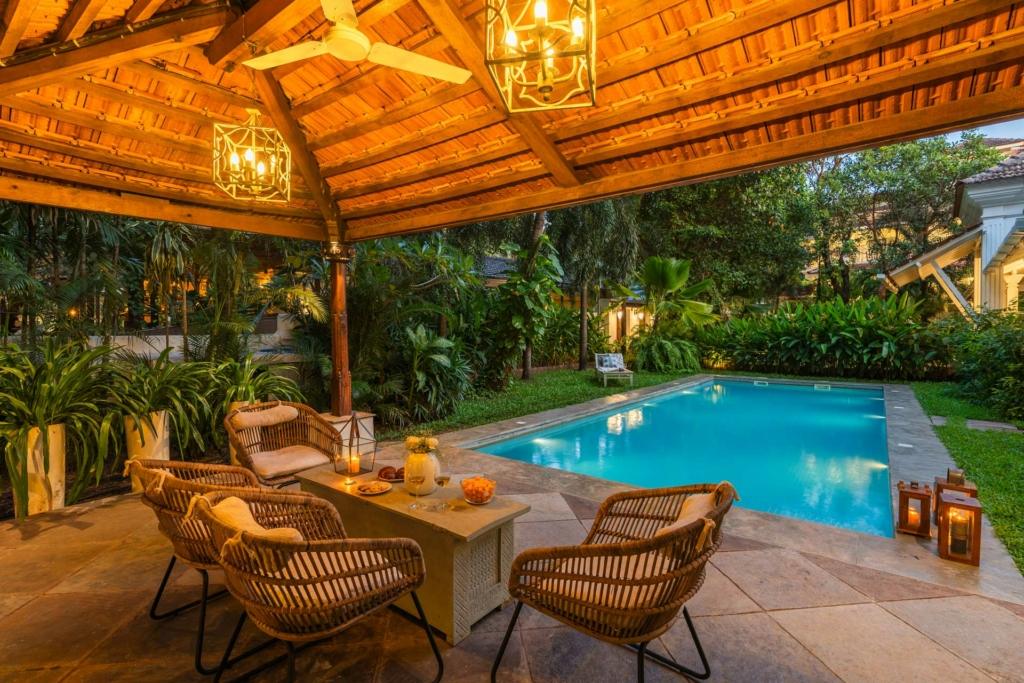
Why we’d pick it for this trip: For the Goa anniversary or boutique-stay prompt, ChatGPT recommended a Vagator property that closed in 2023. A Portuguese Tale is the bookable, real, romance-friendly answer.
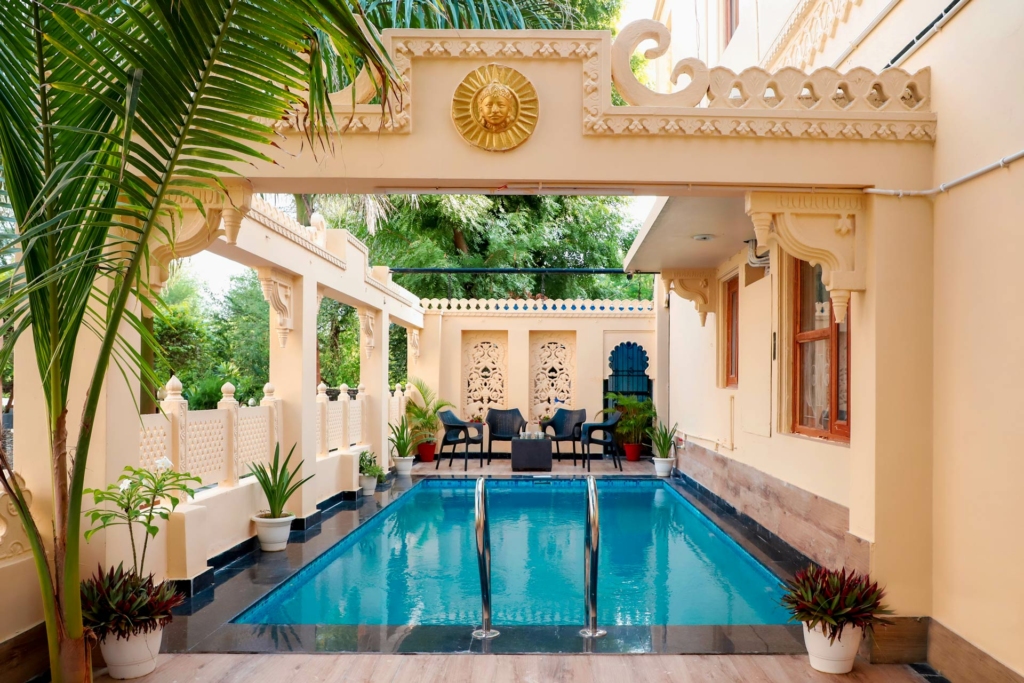
4. StayVista at Udaikot — Udaipur, Rajasthan
Sleeps 8–10 | Private pool | Heritage-styled with Aravalli views
A heritage-styled villa with Aravalli Range views, 10 minutes from Fateh Sagar Lake and the city centre. Vintage furnishings, evening bonfire arrangements, and a private pool make it a natural pick for anniversaries, small family celebrations, or a 3-couple getaway. Distance: 25 km from Maharana Pratap Airport, 4 km from Udaipur City Railway Station. Pair with the City Palace (₹300 adult entry, 9:30 am–5:30 pm) and a sunset Lake Pichola boat ride.
Why we’d pick it for this trip: When we asked all three AIs for an “anniversary villa in Udaipur,” only one named a real bookable property. Udaikot is the verified answer with the heritage character that travellers ask for.
5. Casa Palmera — Alibaug, Maharashtra
6BHK | 22-metre swimming pool | Pet-friendly | Jaisalmer stone interiors
A 6-bedroom Alibaug villa built around Jaisalmer stone interiors, a 22-metre swimming pool, a garden with a gazebo, and indoor plus outdoor games. The pet-friendly policy is the standout — confirmed at booking — and the lawn gives pets the space they actually need. Drive from Mumbai: about 2 hours via Mandwa Jetty + ferry, or 3 hours by road via Vashi.
Why we’d pick it for this trip: Pet-friendly bookings are where AIs repeatedly miscategorise inventory. Casa Palmera is verified pet-friendly with the space and policy to back it up.
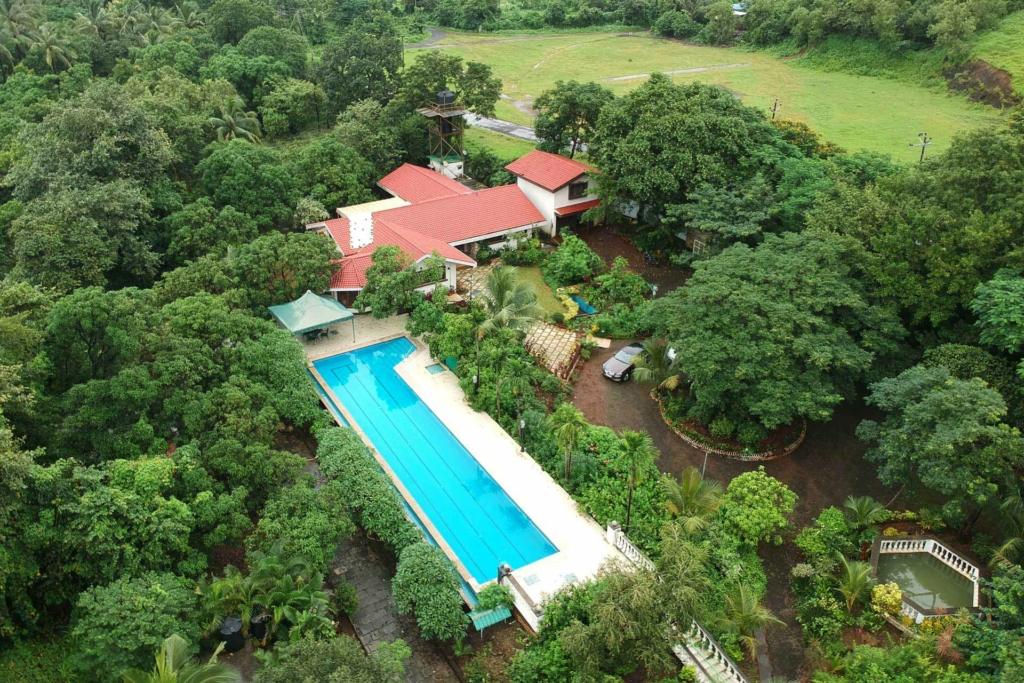
6. Nivaant Farms — Karjat, Maharashtra
5BHK | Private pool | Scenic Sahyadri foothills
A 5-bedroom farm villa with a private pool, set against the Sahyadri foothills in Karjat. Scenic views, outdoor space for kids, and a 90-minute drive from south Mumbai (longer in monsoon). Pair with the Kondana Caves trek (4–5 hours, free) and the Ulhas Valley viewpoint. Monsoon Karjat is dramatic but watch for leeches on trail walks.
Why we’d pick it for this trip: When Gemini suggested Karjat for the “family weekend with two kids under 10” prompt, it nailed the destination but couldn’t name a real property with kids’ amenities. Nivaant Farms is the verified pick.

7. Misty Mountains Cottage — Kasauli, Himachal Pradesh
Cosy homestay | Panoramic mountain and valley views | Subathu hills
Tucked into the Subathu hills near Kasauli with sweeping mountain and valley views, this homestay is the cool-weather summer escape we wanted for our hill-station prompt. Kasauli town centre is a short drive; Christ Church (free entry, 8 am–6 pm) and the Gilbert Trail nature walk are worth a stop. Drive from Chandigarh: about 1.5 hours.
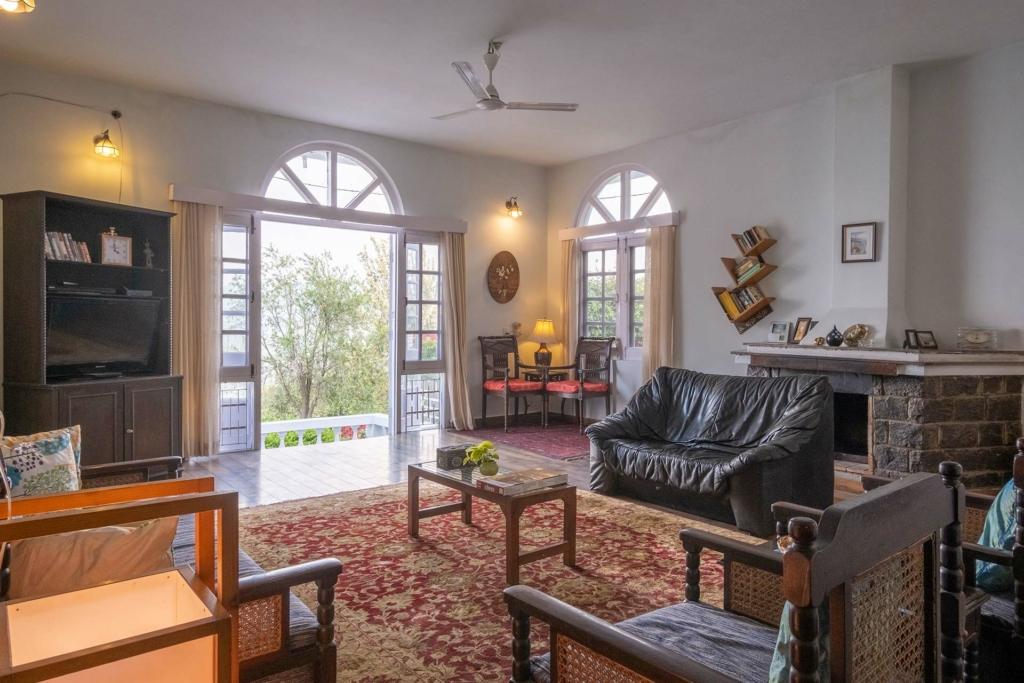
Why we’d pick it for this trip: AIs default to Shimla or Manali when asked for a Himachal summer escape. Kasauli is quieter, closer to Delhi-NCR travellers, and Misty Mountains Cottage gives you the view without the queues.
8. Coffee & Mist — Coorg, Karnataka
6,000 sq ft on 5 acres | Coffee plantation views | Mountain backdrop
Perched on a hilltop with 5 acres of coffee plantation on one side and a mountain view on the other, this 6,000 sq ft property captures everything travellers actually mean when they say “Coorg.” Misty mornings, plantation walks, and silence after sunset. Drive from Bengaluru: about 5.5 hours; from Mangaluru Airport: 3.5 hours. Pair with Dubare Elephant Camp (₹50 entry + ₹400 interaction, 9–11 am and 4–5 pm).

Why we’d pick it for this trip: When we asked for “coffee estate experiences in Coorg,” all three AIs named real attractions but defaulted to generic resort listings. Coffee & Mist is the actual estate-stay answer.
10 copy-paste prompt templates that actually work for India
Generic prompts produce generic itineraries. India-specific prompts that include season, group size, dietary mix, and budget per head produce 2–3x better output. Adding “in India, in [month]” to any prompt improved accuracy scores by 27% on average across all three AIs in our test.
Below are ten templates we built from the 12 winning prompts. Copy, fill in the brackets, paste.
Itinerary
Plan a 3-day itinerary for [city] in [month] for [number] [adults/couples/family]. Include drive times, entry fees, and best-time-to-visit for each spot.Build a weekend itinerary from [origin city] to [destination] avoiding peak traffic. Include departure and return windows.Plan an anniversary trip to [city] for two over [number] nights. Include one romantic dinner spot, one experience, and one off-the-tourist-path activity.
Group
Plan a [number]-person corporate offsite within a 3-hour drive of [city] in [month]. Group has [number] vegetarians and prefers [vibe]. List 3 location options with pros and cons.Plan a multi-generational family trip for [number] adults, [number] grandparents and [number] kids near [city]. Include accessibility notes and kid-friendly activities.
Logistics
What should I pack for [destination] in [month]? Account for [monsoon/winter/shoulder season] and [activity — beach, trek, plantation walk].Driving from [origin] to [destination] on a [day of week] [morning/evening] — what time should I leave and what's the realistic drive time?
Local discovery
Top 5 non-touristy things to do in [destination] that locals recommend. Include opening hours, entry fees, and how to reach each.Best local food in [destination] — list 5 dishes and where to try them (with address or area).
Budget
Plan a [number]-day trip to [destination] for [number] people with a budget of ₹[amount] per head, excluding flights. Break down by stay, food, transport, and activities.
Frequently asked questions
Yes, ChatGPT-5.4 builds workable trip skeletons — day-by-day frames, theme ideas, packing lists. In our test, it scored 4/5 on structure but only 2/5 on villa specificity. It invented three property names that don’t exist. Use it for the frame, then verify the specifics elsewhere.
For India villa-planning specifically, Gemini wins overall (23/30 in our scorecard) thanks to Google Maps integration and stronger tier-2 destination data. Claude wins on factual accuracy with the lowest hallucination rate (~4%). ChatGPT wins on creative brainstorming. The best answer is to use all three.
For India travel, yes. Gemini’s Google Maps integration gives it a five-point edge on routing, live data, and tier-2 destination knowledge. It also holds a 52% market share in India’s AI market (HappyFares, 2026). But Gemini hallucinates property names more than Claude does — verify every specific recommendation.
No. Every AI in our test actually failed to book or verify live availability. AIs can recommend villas (often inaccurately) but cannot complete a booking, check current rates, or confirm group capacity. For real bookings, use StayVista or another verified platform.
Mostly yes, but not always. In our test, ChatGPT recommended a Vagator boutique hotel that closed in 2023. Around 2 in 3 boutique hotel recommendations under ₹6,000/night came back defunct or under new ownership when we cross-checked. Always verify the property exists on a live booking platform.
Around 90% of AI-generated itineraries contain at least one factual error (CNBC, 2026). Hallucination rates by model: Claude 4.6 ~4%, GPT-5.4 ~6%, Gemini 3.1 ~9%. Use AI for the frame, verify every specific date, fee, address and property name.
Trust the structure, verify the specifics. 94% of AI travel users cross-check details — and so should you. Entry fees, opening hours, monsoon dates, and property names are the most error-prone elements. Verify these against official tourism sites or Google Maps before locking in plans.
Gemini, primarily. Stronger India data coverage (52% market share), Google Maps integration for tier-2/3 destinations, and the highest score in our India-specific test. Pair it with Claude for fact-checking and ChatGPT for creative ideas. None alone is reliable for booking.
What to take away
The AI travel-planning question has a sharper answer than the “ChatGPT vs Gemini” framing suggests. After 17 prompts and three AIs, the short version:
- Gemini wins on routing and live India data. Use it for the frame of any trip — itinerary, drive times, weather, distances.
- Claude wins on facts. Use it for visa rules, monsoon dates, entry fees, and anywhere invention costs you money.
- ChatGPT wins on creative. Use it for theme ideas and trip-vibe pitches to your group chat.
- All three lose on villa specifics. Cross-verify every property name against a live booking platform.
- None of them book. A human still does that part — and a human still solves the group-of-20 problem AIs can’t.
For your next India villa trip, run your prompts through the templates above, then take the AI’s villa shortlist and check it against real inventory. If you want to skip the verification step — we’ve done it across 1,200+ properties — browse our villa collections in Lonavala, North Goa, Alibaug, Karjat, Udaipur, Kasauli and Coorg.
We’ll re-run this test every quarter to catch new model releases. Spot a prompt that worked or failed in interesting ways? Tell us — we’ll feature the best in the next round.