

Hampi Travel Guide 2026: Ruins, River Crossing, Treks & When to Visit
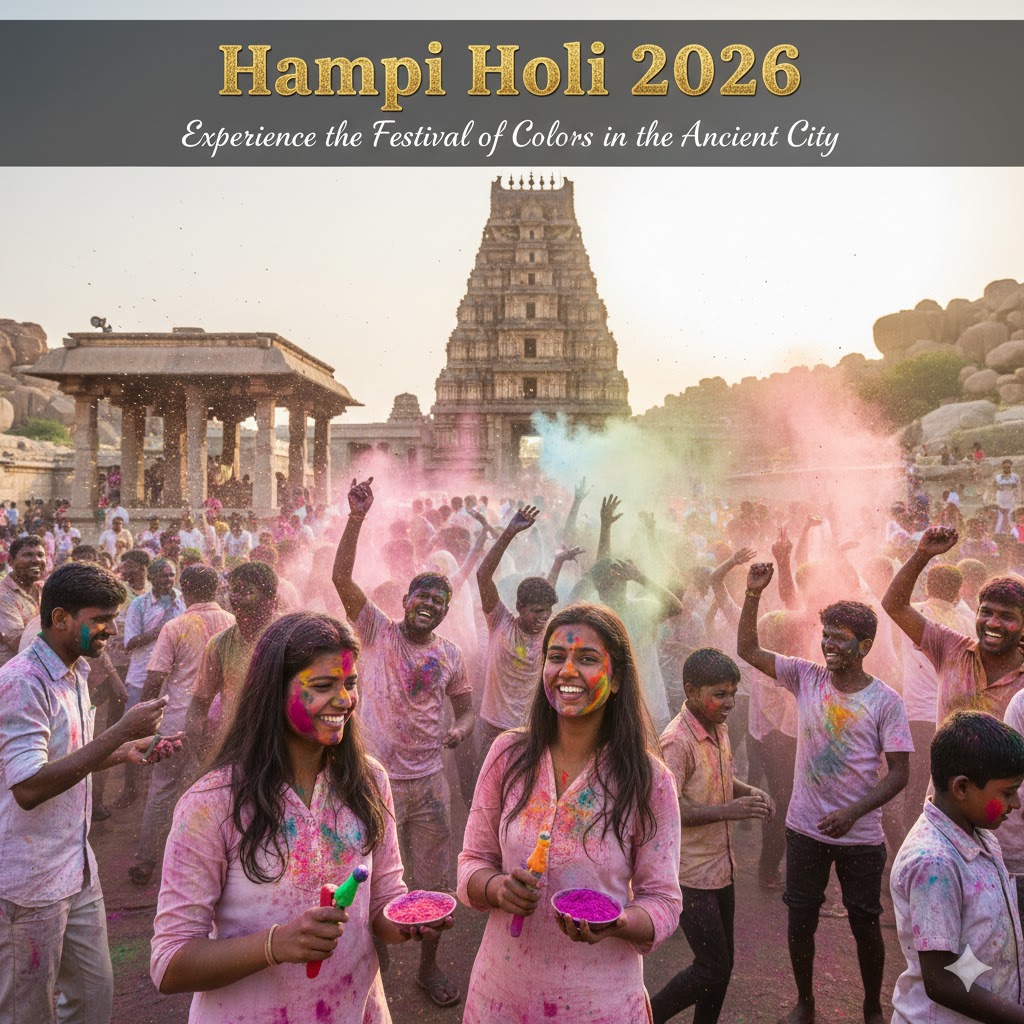
Note: Holi 2026 at Hampi has passed. Looking to plan your Hampi trip? Read on for the complete guide to visiting year-round — from summer sunrises on the ruins to monsoon river crossings and the cool post-monsoon months when Hampi is at its most spectacular.
[su_box title=”Quick Info” box_color=”#f5a623″ radius=”4″]Best Time to Visit: October–February (cool, dry) | Nearest Airport: Hubli (143 km) / Bengaluru (350 km) | Nearest Station: Hospet (13 km) | Ideal Duration: 2–3 days | From Bengaluru: ~6–7 hours by car, overnight bus or train to Hospet[/su_box]
Hampi is one of India’s most visually extraordinary destinations — a UNESCO World Heritage Site where 15th-century Vijayanagara Empire ruins sit among a landscape of massive granite boulders, banana plantations, and the jade-green Tungabhadra river. No photograph fully captures it. You need to be standing on a boulder at sunrise, watching the mist lift over temple towers, to understand why people return to Hampi again and again.
In this Blog
TL;DR: What Makes Hampi Worth the Trip
Hampi was the capital of the Vijayanagara Empire — once one of the largest cities in the world. Today, 500-year-old temples, market ruins, royal enclosures, and stone chariots sit largely intact across a 26 sq km site. The boulder-studded landscape is unlike anywhere else in India, and the backpacker village on the north side of the Tungabhadra adds a laid-back contrast to the sacred ruins on the south bank.
Holi 2026 in Hampi — What Happened This Year
Holi 2026 fell on March 3–4, with Holika Dahan on the evening of March 3 and the main colour celebrations on the morning of March 4. Hampi’s Holi is an organic, backpacker-driven affair rather than a ticketed event — the foreign traveler community and Indian visitors mix freely in the open grounds around the Virupaksha Temple and the boulder areas north of the river. It’s informal, photogenic, and memorable.
For those planning ahead: Holi 2027 falls on March 2–3. Hampi in early March is ideal — pleasant weather (25–32°C), low rain risk, and a festive atmosphere. Book guesthouses in the hippie village (north bank) or Hampi Bazaar at least 6–8 weeks ahead for Holi dates.
Hampi in April–June 2026: Summer Visits Done Right
Summer is Hampi’s least-visited season — which paradoxically makes it one of the most interesting times to visit if you know how to work the heat.
April: Magical Sunrises and Dramatic Shadows
In April, temperatures climb to 38–42°C by midday — but from 5:30 to 9am, Hampi is cool, golden, and almost entirely yours. The low morning sun catches the granite boulders at an angle that makes the ruins glow amber, and shadows fall across the stone carvings in a way that only happens at this time of year and at this hour. April is arguably the best month for photography at Hampi.
The practical strategy: be on Matanga Hill or Hemakuta Hill by 6am for sunrise, complete your site visits by 9:30am, shelter through the midday heat (12–4pm), and head to the boulder cafés on the north bank for lunch. Resume in the late afternoon when temperatures drop.
Must-See Sites Before 9am in Summer
Virupaksha Temple — The oldest continually functioning temple in Hampi, dedicated to Lord Shiva and active since the 7th century. The main gopuram (entrance tower) is 50 metres tall. An elephant named Lakshmi blesses visitors each morning (tip: arrive early for a quieter blessing). Entry: Free for the main temple (camera fee ₹50) | Timings: 6am–1pm, 2:30–8:30pm | Pro tip: The temple tank reflects the gopuram in early morning light — one of Hampi’s best compositions.
Vittala Temple Complex — Hampi’s most celebrated structure, home to the iconic Stone Chariot (Garuda Ratha) and the musical pillars that produce different notes when tapped. The temple complex dates to the early 15th century. Entry: ₹600 for foreigners, ₹40 for Indians (combined ticket covers multiple sites) | Timings: 6am–6pm | Distance from Virupaksha: 2.5 km (10 min by auto or bike) | Pro tip: Go at 6am when the site opens — by 9am, tour groups arrive in numbers.
Hampi Bazaar Ruins — The 800-metre market street that once supplied the empire’s capital, now a series of columned pavilions and courtesans’ quarters. Walking this corridor at dawn, with no vendors and long shadows, gives you the clearest sense of Hampi’s original scale. Entry: Free | Best time: 6–7:30am
Coracle Rides on the Tungabhadra — Still Running in Summer
Coracle boats — circular, basket-like vessels woven from bamboo and sealed with tar — have been crossing the Tungabhadra between Hampi’s south bank and the hippie village for centuries. They still run in summer, though crossing times and frequency depend on river levels. In April–May, the river is lower and calmer, making crossings straightforward.
Crossing point: Near Virupaksha Temple (south bank) to Anegundi road (north bank) | Fare: ₹30–50 per person | Best time: Early morning — operators start at sunrise | Duration: 5–10 minutes per crossing | Pro tip: The round coracle ride without crossing (just a spin on the river) is a popular sunrise activity — ask boatmen directly.
Boulder Camping: Hampi’s Year-Round Unique Experience
Hampi’s defining landscape feature is its boulders — massive granite formations deposited over millions of years, piled in precarious-looking stacks across the terrain. The north bank (hippie village / Virupapur Gaddi) has several guesthouses and cafés built into and around these boulders. Some offer rooftop camping on boulder terraces, with views across the river to the ruins.
This experience is available year-round. In April–May, the combination of low tourist numbers and clear nights makes boulder camping more immersive. Recommended areas: Virupapur Gaddi (north bank), where cafés like Mango Tree (riverside) and several boulder guesthouses operate. Price range: ₹500–2,500 per night depending on room type.
Practical Heat Guide for Summer Visits
- Start time: Be at your first site by 5:30–6am. Non-negotiable in May.
- What to carry: 2+ litres of water per person, electrolytes (ORS sachets), sunscreen SPF 50+, a light long-sleeved shirt (protects from sun and is required in some temples), and a hat or scarf
- Footwear: Rubber or EVA sandals — you’ll remove shoes at most temples and the stone gets extremely hot by 9am
- Midday shelter: The north bank (hippie village) has shaded cafés where you can eat, read, and wait out the heat — Mango Tree (riverside) and several boulder cafés are the classic stops
- Resume at: 4pm for late afternoon visits — Lotus Mahal, Elephant Stables, and Zenana Enclosure (all in the Royal Centre, 3 km from Hampi Bazaar) are good afternoon spots
Hampi in Monsoon (June–September): Photogenic But Plan Carefully
Monsoon transforms Hampi’s landscape. The boulders turn mossy green, the banana plantations flourish, and the Tungabhadra fills and rushes dramatically. Sunset over the river in July, with storm clouds over the ruins, is genuinely one of India’s great travel photographs.
The practical reality: coracle crossings are suspended during high monsoon (usually July–August) when the river swells. Some north bank guesthouses close. A few low-lying ruins and paths may flood. The Hampi government occasionally restricts access to flood-prone areas near the river.
When to visit in monsoon: Late September to early October is the sweet spot — rains have eased, the landscape is green, rivers are receding but not dangerous, and tourist infrastructure is starting to reopen. This window gives you Hampi at its most photogenic with most sites accessible.
Hampi in October–February: The Best Season
October to February is when Hampi earns its reputation. Temperatures drop to a comfortable 20–32°C, the landscape is still green from monsoon, and the site is dry enough for full access. December–January sees peak tourist numbers (and peak prices for guesthouses) — but even then, the ruins are large enough to absorb crowds without feeling congested.
November is arguably the best month — post-monsoon green landscape, pre-December crowds, and the Hampi Utsav festival (usually held in the first week of November) with classical music, dance performances, and light installations across the ruins. Check the exact Hampi Utsav 2026 dates closer to October as the state government announces them annually.
Complete List of Must-See Sites in Hampi
1. Virupaksha Temple
Hampi’s spiritual heart and the only temple in continuous use since the 7th century. The main shrine faces east toward the Tungabhadra. The camera obscura in the main gopuram — a natural projection of the inverted temple tower inside a dark chamber — is one of Hampi’s little-known curiosities. Ask a temple priest to show you. Entry: Free (camera ₹50) | Timings: 6am–1pm, 2:30–8:30pm | Ideal for: All visitors | Time required: 1–1.5 hours
2. Vittala Temple and the Stone Chariot
The architectural peak of Vijayanagara craftsmanship. The Stone Chariot (technically a shrine for Garuda, Vishnu’s vehicle) is Hampi’s most photographed structure. The musical pillars in the main hall produce distinct tones when struck — although tapping is now restricted to prevent damage, guides can demonstrate. Entry: ₹40 Indians / ₹600 foreigners (combined site ticket) | Timings: 6am–6pm | Time required: 1.5–2 hours | Pro tip: Walk the 2.5 km from Hampi Bazaar along the Vittala Road ruins rather than taking an auto — the road itself is lined with ancient market stalls.
3. Matanga Hill
The highest point in Hampi, offering a 360-degree view of the entire ruined city, the Tungabhadra valley, and the surrounding boulder landscape. The sunrise from here is widely considered the best in Hampi. Entry: Free | Climb time: 20–30 minutes from base | Best time: 5:30am for sunrise | Caution: The path is unlit — use a torch and go with others if visiting at dawn | Ideal for: Photographers, trekkers
4. Lotus Mahal and Elephant Stables
Part of the Zenana Enclosure (the royal women’s quarter), the Lotus Mahal is an elegant two-storey pavilion combining Hindu and Islamic architectural elements — arched openings with corbelled ceilings, a style unique to Vijayanagara. The adjacent Elephant Stables (11 chambers, each housing one royal elephant) show a similar Indo-Islamic aesthetic. Entry: Included in combined site ticket | Timings: 6am–6pm | Time required: 45 minutes | Best time: Late afternoon (4–5:30pm) when light enters the stables at a low angle
5. Hazara Rama Temple
The private royal temple of the Vijayanagara kings, covered floor to ceiling with narrative friezes depicting scenes from the Ramayana. Over 1,000 carved panels — hence “Hazara” (thousand) Rama. The level of sculptural detail is unmatched in Hampi. Entry: Free | Timings: 6am–6pm | Time required: 45–60 minutes | Ideal for: History buffs, art lovers
6. Hemakuta Hill
A cluster of pre-Vijayanagara temples (10th–14th century) on a hill south of Virupaksha Temple — older and less visited than the main sites. The hill also offers one of the best sunset views in Hampi. Entry: Free | Best time: Sunset (6–7pm) | Time required: 1 hour | Pro tip: Combine with Virupaksha morning visit — they’re adjacent.
7. Anegundi — The Living Village
Across the Tungabhadra (north bank), Anegundi is a village that predates the Vijayanagara Empire — believed to be the mythological Kishkindha from the Ramayana. Coracle across, explore the older fortified village, and visit Anjaneya Hill (the birthplace of Hanuman, according to local tradition — 570 steps, rewarded with panoramic views). Entry: Free | Best time to visit: Morning | How to reach: Coracle from south bank (₹30–50) or road via Kamalapuram (15 km) during monsoon when coracles are suspended
Planning Your Hampi Itinerary
Two Days in Hampi
Day 1 — Morning: Sunrise on Matanga Hill (5:30am), Virupaksha Temple and Hampi Bazaar ruins (7am), Vittala Temple and Stone Chariot (9am). Midday: Coracle to north bank, lunch at a boulder café. Afternoon: Hampi Bazaar area on foot, Hemakuta Hill sunset.
Day 2 — Morning: Royal Centre — Lotus Mahal, Elephant Stables, Hazara Rama Temple (6–9am). Late morning: Queen’s Bath (unusual royal bathing complex with balconies inside), Underground Shiva Temple. Afternoon: Coracle ride, Anegundi village walk, sunset from Anjaneya Hill.
Three Days: Add a Day Trek and Tungabhadra Dam
Day 3 — Visit Tungabhadra Dam (12 km from Hampi, with a garden and viewpoint), and do the half-day Hampi Sandur trek or boulder scramble. The boulder terrain around Hampi has informal scrambling routes — ask guesthouse owners for current guides who know the routes safely.
How to Reach Hampi
From Bengaluru: 350 km — 6–7 hours by car. Overnight trains (Hampi Express or Mettupalayam Express) depart from KSR Bengaluru City station to Hospet Junction (13 km from Hampi) — travel time ~8 hours. Overnight buses also available from Majestic Bus Stand, Bengaluru.
From Hyderabad: 380 km — 6 hours by car. Train to Guntakal, then change to Hospet.
From Hospet: 13 km to Hampi — auto (₹200–300), shared tempo (₹20–30 per person), or taxi.
Within Hampi: Bicycle rental is the classic Hampi transport (₹100–150/day). Autos available for longer distances to Vittala Temple or the Royal Centre. Bike rentals (scooters) available on the north bank — useful for covering the Royal Centre and surrounding villages.
Where to Stay in Hampi
Accommodation in Hampi divides into two distinct areas: Hampi Bazaar (south bank), closer to Virupaksha Temple and the main ruins, and Virupapur Gaddi / hippie village (north bank), the backpacker enclave with boulder cafés, hammock guesthouses, and a more relaxed vibe.
For those visiting with family or preferring more comfort, Hospet (13 km) has better hotel options. StayVista also has curated stays in Karnataka that work as comfortable bases for those who want to explore the region at their own pace, with the option to day-trip to Hampi.
Frequently Asked Questions
Is Hampi worth visiting in summer (April–June)?
Yes, with the right strategy. The heat is intense (38–44°C by midday) but manageable if you start early (5:30am) and shelter from 11am–4pm. You’ll have major sites largely to yourself, and the morning light on the ruins in April is exceptional for photography. Fewer tourists means more personal interactions with temple priests and local guides.
Can you visit Hampi during monsoon?
Hampi during monsoon (June–September) is photogenic but requires planning. Coracle crossings are suspended during high monsoon (July–August). Some low-lying sites may flood. Late September to early October is the ideal monsoon-adjacent window — greenery, fewer restrictions, and most guesthouses open. Check with accommodation ahead if planning a July–August visit.
What is the entry fee for Vittala Temple Hampi?
The combined Hampi site ticket costs ₹40 for Indian nationals and ₹600 for foreign tourists. This covers Vittala Temple, the Royal Centre (Lotus Mahal, Elephant Stables, Hazara Rama Temple), and several other protected monuments. The ticket is available at the Vittala Temple entrance and at the Hampi Bazaar information centre.
How long does it take to see Hampi properly?
Two full days is the minimum to see the main sites. Three days allows you to include Anegundi village, Govindanahalli (crafts cooperative), and one of the surrounding day trips. Four days is comfortable for those who want to add boulder scrambling, a Tungabhadra Dam visit, and repeat sunrise/sunset experiences.
Is Hampi safe for solo female travelers?
Hampi is generally considered one of the safer destinations in South India for solo travelers, including women. The north bank (hippie village) has a strong backpacker community and guesthouses with good reputations. As with any destination, early morning hikes (Matanga Hill, Hemakuta Hill) are safer in a group or with other travelers — ask your guesthouse to connect you with other guests heading the same way.
What is the best base for visiting Hampi?
For backpackers: stay in the north bank guesthouses (Virupapur Gaddi). For families or those wanting more comfort: Hospet (13 km, 20 minutes by auto) has better hotel options. For couples or small groups wanting a premium experience with privacy: StayVista has properties in Karnataka that can serve as a comfortable weekend base.