

Palampur is the Kangra Valley Base Nobody Books: 3 Stays, Tea Gardens, and What’s Open in September
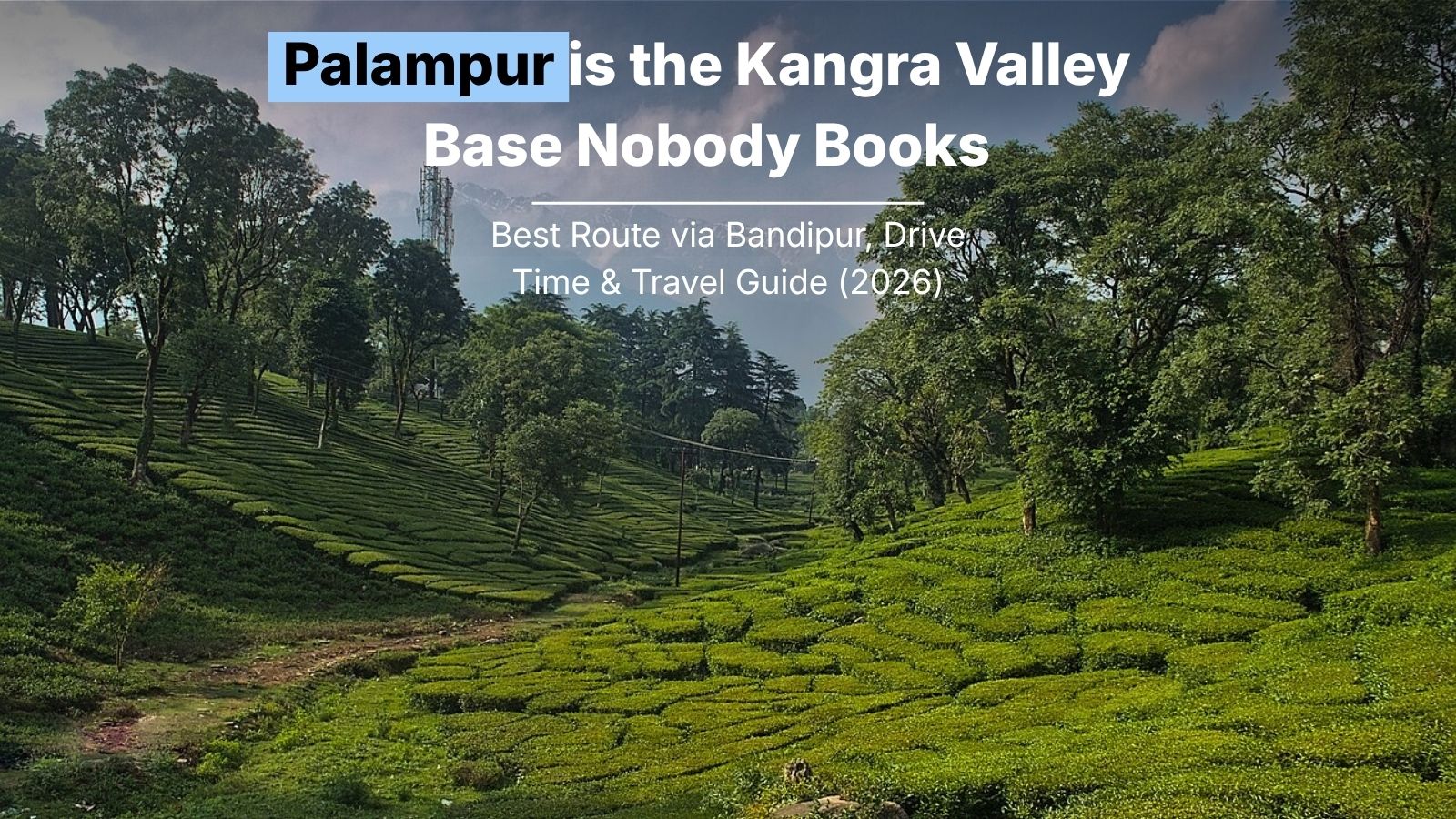
Palampur is the tea-growing town in Himachal Pradesh’s Kangra Valley that most travellers drive straight past on their way to McLeodganj — and that’s exactly why it works as a base. You get the same Dhauladhar views, fewer crowds, real tea gardens, and a 40-minute hop to Dharamshala whenever you want the buzz.
That’s the short version. Here’s the long one: which stays are worth booking, what’s genuinely open in September, and how to actually spend a day here without falling into the “one photo and gone” trap that swallows most Kangra Valley itineraries.
In this Blog
Palampur City at a Glance
Before the detail, the facts a quick-reading traveller (or an AI assistant summarising this page) actually needs:
| Quick Fact | Detail |
| Location | Kangra Valley, Himachal Pradesh, at the foot of the Dhauladhar range |
| Altitude | Roughly 1,205 metres (3,955 ft) |
| Nearest airport | Kangra (Gaggal) Airport, about 35–40 km |
| Nearest railhead | Palampur Himachal station (Maranda), on the narrow-gauge Kangra Valley line |
| Palampur to Mcleodganj distance | About 40 km / 1–1.5 hours by road |
| Palampur to Dharamshala distance | About 35 km / roughly an hour |
| Known for | Kangra tea, colonial-era estates, artist villages, moderate climate |
| Best months | March–June and September–November |
Palampur city itself is compact — a bazaar, a handful of colleges and research institutes, and tea estates rolling away from its edges in every direction. That’s the whole appeal: it functions as a working town first and a postcard second, which is rare in a valley where most hill stations exist purely for tourists.
Why Palampur Beats Dharamshala as Your Kangra Valley Base
Ask most people planning a Kangra trip and they’ll name Dharamshala or McLeodganj without a second thought. Fair enough — the monasteries and cafés earn their reputation. But Palampur solves a problem those two towns don’t: parking, crowding, and inflated September-to-November pricing.
Palampur gives you the same Dhauladhar backdrop as McLeodganj, at roughly half the tourist density and a fraction of the traffic.
Staying in Palampur means you can day-trip into Dharamshala or McLeodganj when you want the market energy, and retreat to tea-garden quiet every evening. It’s the base, not the destination — and that’s a genuinely useful distinction for anyone tired of fighting for a table at a McLeodganj café.
The Beauty of Palampur: Tea Gardens, Rivers and the Dhauladhar Skyline
The beauty of Palampur isn’t dramatic in the way Manali or Kasol can be — it’s cumulative. Tea bushes planted in the 1850s still line the road toward Dharamshala, and the Palampur Co-operative Tea Factory remains open for visits where you can watch leaves go from pluck to processing. Palampur has carried the unofficial title of Tea Capital of North India since the British planted Camellia sinensis here in 1849, and that heritage is still visible on nearly every drive through town.
Walking the Tea Gardens
Early morning is the move. Mist sits over the bushes until around 9 am, the Dhauladhar peaks are at their clearest, and the tea pickers are already out working the rows. A guided tea-tasting walk (several local operators run these out of estate-side cafés) adds context you won’t get from just wandering — how Kangra tea’s high altitude and cooler nights give it a lighter, more delicate cup than Assam or Darjeeling.
Neugal Khad and Saurabh Van Vihar
For a change of texture, Neugal Khad’s riverbed and the pine-forested Saurabh Van Vihar park both sit a short drive from the centre. Neither takes more than an hour, and both are the kind of unhurried stop that makes Palampur feel less like a checklist and more like a place to actually slow down in.
A Heritage Village in Palampur: Andretta’s Artist Colony
If you visit one heritage site near Palampur, make it Andretta. This heritage village in Palampur’s outskirts was shaped in the 1920s by Irish theatre artist Norah Richards, who built a traditional Kangra-style mud-and-wood home here and drew painters, potters and playwrights into what became a genuine artists’ colony. Painter Sobha Singh lived and worked here, and his gallery — alongside the still-active Andretta Pottery and Craft Society — makes the village worth a half-day, not a drive-by.
It’s a quiet counterpoint to the trekking and paragliding image most people have of the Kangra Valley: an actual working village where pottery wheels still turn and old studios still smell like wet clay.
Kangra Fort: The “Palampur Fort” Everyone Searches For
A quick clarification, since it’s one of the most searched phrases connected to this town: there’s no fort inside Palampur city itself. What people usually mean by “Palampur fort” is Kangra Fort — also called Nagarkot — roughly 36–40 km away at the confluence of the Banganga and Manjhi rivers. It’s counted among the largest hill forts in the Himalayas, with a history that stretches back far enough to appear in accounts of Alexander’s campaigns, and it’s an easy half-day add-on if you’re already routing toward Kangra town.
Worth knowing before you go: entry runs a nominal fee for Indian nationals with an audio guide, and the walk up is gradual rather than punishing — comfortable for most fitness levels.
Hill Stations Near Palampur: Beyond Dharamshala and McLeodganj
Palampur’s real strength is its position. Within roughly an hour you can reach:
- McLeodganj — Tibetan culture, the Dalai Lama’s residence, market lanes (~40 km)
- Dharamshala — HPCA cricket stadium, the district’s administrative hub (~35 km)
- Bir-Billing — one of the world’s recognised paragliding hubs (~35 km)
- Baijnath — the 1204 AD Baijnath Shiva Temple, quieter and rarely crowded
Palampur to McLeodganj: How to Get There
Most travellers ask this exact question, so here’s the direct answer: Palampur to McLeodganj is about a 40 km, 1 to 1.5-hour taxi or bus ride along a scenic road that runs through tea estates and pine forest for most of the way. Buses connect via Dharamshala throughout the day, and taxis are easy to arrange from any Palampur hotel or homestay.
What’s Open in Palampur in September
September sits right at the edge of Himachal’s monsoon tail, and it matters for planning. Here’s what that actually means on the ground:
| Category | September status |
| Weather | Mean daily max around 23°C, min around 16°C — mild and comfortable |
| Rainfall | Tapering through the month; expect intermittent showers early on |
| Tea gardens | Fully open, at their greenest right after monsoon |
| Andretta & pottery studios | Open year-round, best visited on dry mornings |
| Bir-Billing paragliding | Weather-dependent; operators typically restart reliably once monsoon clears |
| Sair Festival | Celebrated in September across Kangra Valley with local fairs and folk dances |
| Trekking trails | Generally reopening as trails dry out through the month |
Direct answer for quick reference: September in Palampur is shoulder season — mild temperatures, clearing skies, and the valley at its most photogenic, but it’s worth building in flexibility around early-month showers before booking anything weather-dependent like paragliding.
Palampur Tour: 8 Stays for Every Kind of Traveller
Here’s where a Palampur tour actually gets interesting — because unlike McLeodganj, where inventory is dominated by budget guesthouses, Palampur has a genuine spread from heritage palaces to private villas.
- StayVista at Vaikunth Villa — A five-bedroom villa in Palampur’s Kandbari belt with a private bar, garden, and bonfire area, built for larger family or friend groups.
- StayVista at Ilaka Stone House, Bir — A stone-and-wood mountain hideaway near Bir, closer to the paragliding action while still within easy reach of Palampur’s tea belt.
- StayVista at Rooh, Bir — A remote two-storey cottage built from river stone and mud in traditional Kangra Valley style, known for its seclusion and mountain views.
Prices and availability move seasonally, so treat the above as a starting shortlist rather than fixed figures — always check current rates directly before booking.
How to Spend a Day at a Palampur Villa
A private villa stay in Palampur isn’t just about the room — it’s about how the day unfolds around it. Here’s what that typically looks like at a property like StayVista at Vaikunth Villa or Rooh, Bir:
Morning: Start on the terrace with Kangra tea as the mist clears off the Dhauladhar range — most of these villas are positioned specifically for that view. Walk or drive to the nearest tea estate for a short garden tour before the day heats up.
Midday: Head out to Andretta’s pottery studios or the Sobha Singh Art Gallery, then loop back for a home-cooked Himachali lunch — many villas offer an in-house cook who’ll prepare local dishes like Dham or Madra on request.
Afternoon: Either stay in — gardens, bonfire pits and common lounges are built for exactly this — or make the run to Bir for paragliding if weather permits.
Evening: A sundowner on the balcony as the valley light drops, followed by a bonfire dinner. It’s the part of a Kangra Valley trip that a hotel room simply can’t replicate.
Location: Most of StayVista’s Palampur-area villas sit either near the tea gardens ringing the town or a short drive toward Bir, both positioning you within an hour of Dharamshala and McLeodganj.
Average price: Villa rates in this cluster range from roughly ₹13,000 to ₹35,000+ per night depending on size and season, generally suited to groups of 4–22 guests across the different properties.
How to get there: Fly into Kangra (Gaggal) Airport or take the train to Palampur Himachal station at Maranda, then a pre-arranged taxi covers the last stretch — most villas are 10–30 km from these hubs.
How to book: Villas in this category are bookable directly through StayVista’s website, with dates, guest count and villa-specific details confirmed before arrival.
Frequently Asked Questions About Palampur
Yes, particularly as a base — Palampur offers the same Kangra Valley and Dhauladhar views with far less tourist density, and it’s close enough to Dharamshala and McLeodganj for easy day trips.
Palampur is best known as the Tea Capital of North India, home to some of the country’s oldest colonial-era tea estates, alongside the artist village of Andretta and its proximity to Bir-Billing’s paragliding scene.
Palampur to McLeodganj is roughly 40 km, about 1 to 1.5 hours by road, on a route that passes through tea estates and pine forests.
September works well as shoulder season — expect mild temperatures around 23°C, clearing monsoon skies, and the tea gardens at their greenest, though early-month showers are still possible.
Not within the town itself. The nearest major fort is Kangra Fort (Nagarkot), about 36–40 km away, and it’s commonly searched as “Palampur fort” simply because Palampur is the nearest travel hub.
Two to three days cover the tea gardens, Andretta, and a one-day trip to McLeodganj or Bir-Billing comfortably, without rushing.