
Pokhara vs Bir Paragliding 2026: ₹15K Bir or ₹40K Pokhara?
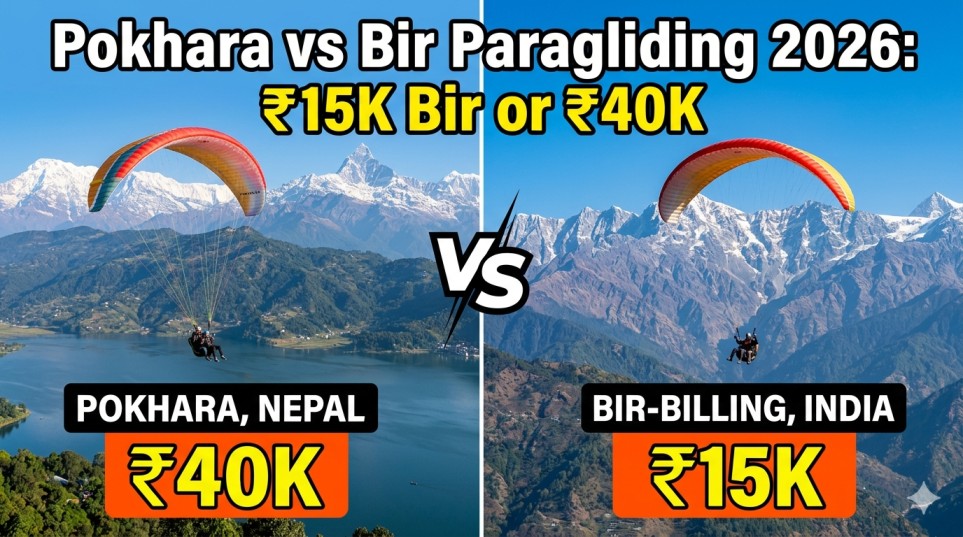
Pokhara has seen a more than threefold increase in tandem paragliding flight operations since 2019, with operators reporting 120,000+ commercial flights in 2024 alone (Accio Business Trend Report on Paragliding, 2025). A growing share of those passport-stamped flyers are Indian. The hashtag is spreading. Reels of Sarangkot launches loop endlessly on weekend timelines. And suddenly, the question we hear at StayVista has shifted from “should I try paragliding in Bir?” to “should I just fly to Pokhara instead?”
Here’s our honest answer — written by a team that has paraglided in Bir, hosted hundreds of guests who flew there, and watched Pokhara become the bucket-list flex that Indian travellers can’t stop searching. A note before we begin: StayVista runs villas in Bir, not in Pokhara. We’ll flag where that might bias us. The goal here isn’t to sell you a stay — it’s to help you pick the right paragliding trip for your travel style, budget, and weekend.
For most Indian travellers, Bir Billing wins on cost and convenience — tandem flights start at ₹2,500, takeoff is at 2,400m (world’s second-highest paragliding site), and you can reach Billing from Delhi in 12 hours without a passport. Pokhara wins on views and accessibility for beginners — Annapurna panoramas, October–May season, and a ~₹5,000–7,000 tandem flight for Indians using local pricing. Choose Pokhara if it’s your first time and views are the priority. Choose Bir if you want longer flights, repeat visits, and a weekend-shaped trip. Last verified May 2026.
In this Blog
Quick Comparison: Pokhara vs Bir Billing at a Glance
| Category | Pokhara (Nepal) | Bir Billing (India) |
|---|---|---|
| Takeoff site | Sarangkot (1,592m) | Billing (2,400m) — world’s 2nd highest |
| Landing zone | Phewa Lakeside | Bir village (1,400m) |
| Standard tandem flight | 30–45 minutes | 15–30 minutes |
| Extended package | Cross-country up to 1 hour | 45–60 minutes |
| Paragliding price (Indians) | ₹5,000–7,000 (NPR 8,000–11,000) | ₹2,500–3,500 |
| Local-rate price | NPR 6,000 (~₹3,800) at some operators | Same as above |
| Best season | October–May; peak Nov–Dec | October–June; peak Oct–Nov |
| Visa for Indians | None required; carry passport or voter ID | N/A — domestic travel |
| Total trip cost from Delhi | ₹25,000–40,000 per person | ₹15,000–25,000 per person |
| Trip length needed | 5–7 days | 2–4 days (weekend possible) |
| Best for | First-timers, views, international flex | Repeat flyers, weekenders, budget |
| Our verdict | Wins on view + ease for beginners | Wins on cost + flight length |
Why are Indians suddenly searching for Pokhara vs Bir in 2026?
Two things have happened at once. The Pokhara Paragliding Competition 2026 just opened the season with international press coverage (NepInsights, May 2026). And Indian travellers — who have always known Bir as the country’s premier paragliding spot — are now seeing Pokhara loop on their feeds with Annapurna behind every shot. The result: search demand for both terms is climbing, with a noticeably steeper curve for Pokhara among Indian users.
This isn’t a replacement story. Bir is still cheaper, closer, and a better repeat destination. Pokhara is becoming what international travel does best for Indians — a Reel-worthy upgrade for the bucket list. A trip you take once, then come back to Bir for the regular adrenaline fix.
The honest reframe: Most “which is better” questions answer themselves once you ask the right secondary question. So instead of “Pokhara or Bir?”, ask: What kind of paragliding trip do I want — a weekend, or a passport stamp?
For a deeper dive once you’ve picked your destination, see our complete guide to Bir Billing paragliding — it covers operator booking, packages, and our recommended pilots.
What does paragliding in Pokhara actually look like?
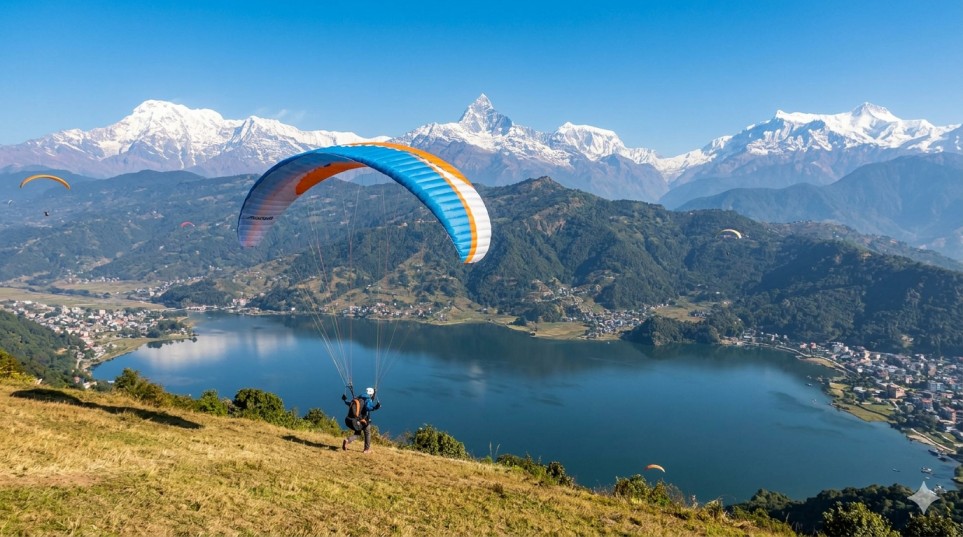
A typical Pokhara tandem flight runs 30–45 minutes from Sarangkot Hill (1,592m) down to a landing strip near Phewa Lake. According to Nepal Tourism data, Sarangkot operators run 20,000+ flights per year in the peak season alone, making it one of the highest-volume paragliding sites in Asia. For most Indian travellers, this is the view shot — Annapurna, Machhapuchhre, and Dhaulagiri stacked across the horizon, with Phewa Lake mirroring blue underneath your feet.
Where you launch and land
Sarangkot is a small hill town about 30 minutes by jeep from Pokhara’s Lakeside area. The takeoff strip is a grass clearing with a wind sock; the launch queue can run 20–30 pilots deep in peak November. Landing happens at one of two zones near Phewa Lake’s shore, where a pickup van returns you to Lakeside within 10 minutes.
Pokhara paragliding price in Indian rupees
- Standard tandem (30 min): NPR 8,500–11,000 (₹5,300–6,900) — the most common booking
- Tandem with photos and video: NPR 11,000–13,000 (₹6,900–8,200)
- Local/Indian rate (negotiable with some operators): NPR 6,000–8,500 (₹3,800–5,300)
- Cross-country flight (1 hour): NPR 13,000–18,000 (₹8,200–11,300)
Indian citizens travelling to Nepal can often access pricing close to the Nepali rate of NPR 6,000 — operators are not obligated to charge “foreigner rates” for SAARC nationals, and Indian rupees are widely accepted in Pokhara (₹100 = NPR 160 approximately, May 2026).
Practical details (Pokhara)
| Detail | What to know |
|---|---|
| Best time to visit | November–December (clear thermals + Annapurna visibility) |
| Flight timings | 9 AM–2 PM daily (Oct–May) |
| How to reach from India | Delhi → Kathmandu (1.5 hr, ₹6,000–10,000 RT) → Pokhara (25-min flight or 6–8 hr bus) |
| Visa for Indians | None. Valid passport or voter ID + 2 photos |
| Time needed for the trip | 5–7 days (combine with Kathmandu, Chitwan, or bungee jumping) |
| Ideal for | First-timers, couples, view-priority travellers |
| Pro tip | Book the 9 AM slot — afternoon thermals at Sarangkot get bumpy November onwards. Pre-pay in INR through Lakeside agencies to lock in rates. |
The bungee + Chitwan add-on: Most Pokhara trips that go beyond a 3-day weekend stack two more things — bungee jumping over the Bhote Koshi gorge (a 160m drop, one of the highest in Asia) and a Chitwan National Park jungle safari (rhinos, elephant grass, jeep + canoe). If you’re already paying for flights and a visa, these turn Pokhara from a paragliding trip into a proper Nepal adventure week.
What does paragliding in Bir Billing actually look like?
Bir Billing wins on altitude. The takeoff at Billing sits at 2,400 metres above sea level, making it the second-highest paragliding site in the world (Incredible India / Ministry of Tourism). Tandem flights cost roughly half what you’d pay in Pokhara — ₹2,500 to ₹3,500 for a standard 15–30 minute flight, with extended packages up to ₹6,000.
Where you launch and land
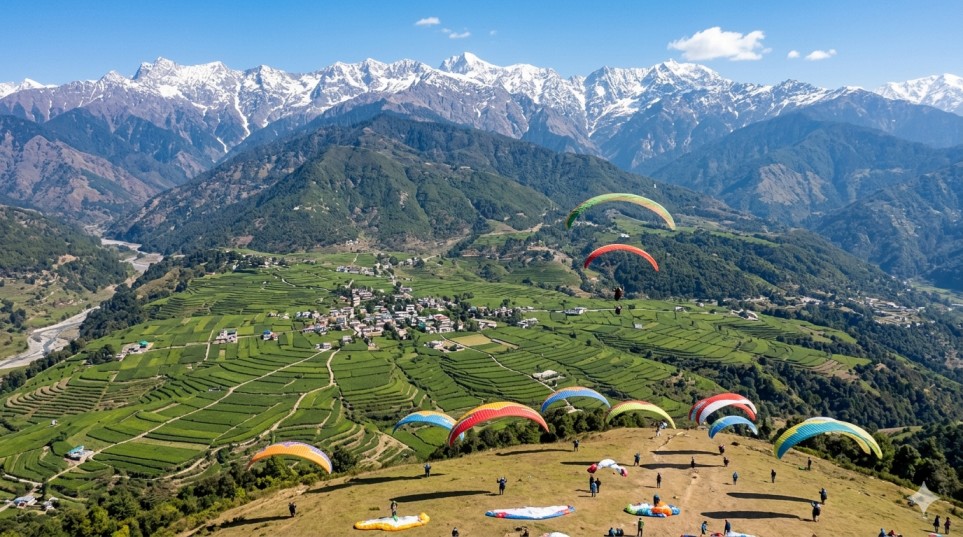
Billing is the takeoff site — a meadow at 2,400m, reached by a 45-minute drive on a winding mountain road from Bir. Bir is the landing zone — a small Tibetan colony at 1,400m, ringed by tea estates and monasteries. The 1,000m vertical drop between launch and landing is what makes Bir flights so long and stable. Operators like HP Adventures and Travel Bir Billing run shuttle services from Bir village to Billing every morning.
When we flew in Bir
[PERSONAL EXPERIENCE] Our team flew tandem from Billing in October 2025, just as the post-monsoon thermals were stabilising. The launch queue moved faster than we’d expected — about 20 minutes from check-in to running off the meadow. The first 90 seconds after takeoff are the loudest part: wind in your ears, the pilot’s harness creaking, the Dhauladhar range opening up to your left like a slow reveal. We circled in a thermal at roughly 2,600m for four or five minutes before our pilot pointed us downvalley toward the Tibetan flags strung across the landing zone. The whole flight ran 22 minutes. The landing was textbook — light jog, soft touch. The post-flight chai at the Bir landing zone café cost ₹40. The flight itself cost ₹2,800.
Bir Billing paragliding cost and weight limit
- Standard tandem (15–30 min): ₹2,500–3,500
- Extended flight (45–60 min, weather permitting): ₹4,500–6,000
- GoPro footage add-on: ₹500–1,000
- Weight limit: 30–90 kg standard; flyers between 90–110 kg pay ₹500 extra for a larger glider (Bir Billing Paragliding Adventure, 2025)
- Age limit: 12–65 years; under-18s require parental consent
Practical details (Bir)
| Detail | What to know |
|---|---|
| Best time to visit | October–November (peak); March–May (secondary) |
| Flight timings | 10 AM–3:30 PM daily, weather-dependent |
| How to reach | Delhi → Bir: 520 km / 12 hr by road, OR Delhi → Kangra (Gaggal Airport) 1 hr flight + 70 km cab, OR Delhi → Pathankot by train + 3 hr cab |
| Time needed for the trip | 2–4 days (long weekend works) |
| Ideal for | Adventure-priority travellers, weekenders, return flyers |
| Pro tip | Verify your pilot’s P3 or P4 certification before paying. Avoid unmarked takeoff-site agents — book through HP Adventures, Travel Bir Billing, or a known aggregator. |
If you’re spending more than a weekend, our guide on things to do in Bir beyond paragliding covers Tibetan monasteries, tea estates, and the café trail that turns Bir into a slow-travel weekend.
Which is cheaper for Indians — Pokhara or Bir Billing?
For a complete trip from Delhi, Bir Billing costs roughly 40% less than Pokhara. The tandem flight alone is cheaper in Bir (₹2,500–3,500 vs ₹5,000–7,000), and you save another ₹10,000–15,000 by not flying internationally. Here’s the line-by-line breakdown for a 3-night stay.
Pokhara trip total (Delhi origin, 4 nights)
| Item | Cost (₹) |
|---|---|
| Delhi–Kathmandu return flight | 12,000–18,000 |
| Kathmandu–Pokhara (flight or bus) | 1,500–6,000 |
| Paragliding tandem | 5,000–7,000 |
| 4 nights mid-range stay (Lakeside) | 8,000–12,000 |
| Local transfers, food, entry fees | 4,000–6,000 |
| Visa | Free (carry passport + 2 photos) |
| Total estimate | ₹30,500–49,000 |
Bir trip total (Delhi origin, 3 nights)
| Item | Cost (₹) |
|---|---|
| Delhi–Dharamshala (Gaggal) flight OR Volvo bus | 4,500–7,000 |
| Cab to Bir | 1,500–2,500 |
| Paragliding tandem | 2,500–3,500 |
| 3 nights mid-range stay (Bir or Palampur) | 6,000–12,000 |
| Local transfers, food | 2,000–3,000 |
| Total estimate | ₹16,500–28,000 |
The verdict on cost: Bir is the cheaper trip end-to-end. But here’s the nuance — if you’d take a Nepal vacation regardless of paragliding (Kathmandu temples, Chitwan jungle safari, bungee jumping, Boudhanath stupa), Pokhara’s added cost is just the tandem flight itself, which is only ~₹2,000 more than Bir. Bir wins on the standalone cost. Pokhara wins on cost-per-experience if you’re already going to Nepal.
Which is safer in 2026 — and what did 2025’s accidents teach us?
Both destinations are regulated and have strong safety records when you fly with certified operators. But 2025 wasn’t a quiet year for either. In January 2025, Himachal Pradesh recorded three paragliding-related deaths in separate incidents (Hill Post, 2025). In June 2025, two Indian tourists from Varanasi crashed into Phewa Lake during a Pokhara tandem flight — both were rescued without serious injury (Tourism Info Nepal, 2025).
[UNIQUE INSIGHT] The pattern across the investigated 2025 incidents — Pokhara and Bir alike — is consistent. In every case where a cause was published, the issue was one of three: an unlicensed operator, faulty or uninspected equipment, or a weather window that should have grounded all flights. Tandem paragliding itself, run by certified pilots in safe conditions, remains one of the lower-risk adventure activities by injury rate compared to skydiving, white-water rafting, or motorbike trekking on the same mountain roads you took to reach the takeoff site.
Pre-flight safety checklist (works for both destinations)
Before you pay, verify:
- Pilot certification — Ask to see the P3 or P4 license. In Nepal, the Civil Aviation Authority of Nepal (CAAN) regulates tandem operators. In India, certifications come through the Aero Club of India and state authorities.
- Annual safety inspection — The glider should have a current inspection certificate. Operators should show this on request.
- Insurance coverage — Operator carries third-party insurance with at least ₹5 lakh medical coverage.
- Weather check — Wind speed under 25 km/h, visibility over 5 km, no thunderstorm warning within 30 km. If the operator flies despite a warning, walk away.
- Informed-consent waiver — You’ll sign one. This is standard practice, not a red flag.
If neither destination fits your travel calendar, our roundup of other paragliding sites in India covers Kamshet, Nainital, Solang Valley, and more — all without the international flight cost.
What’s the best month for paragliding in Pokhara vs Bir Billing?
October–November is the peak for both destinations. This is the only month where conditions overlap — post-monsoon thermals are strong, visibility is clear to the snow-capped peaks, and tour operators are running full daily schedules. After November, the two seasons diverge: Pokhara extends to early May, while Bir runs through June before the monsoon shuts everything down.
The honest verdict: three travel styles, three picks
There’s no single winner here. The right answer depends on what kind of trip you’re actually trying to take — and that’s a different question for different people. We’ve grouped this into three traveller archetypes that we see at StayVista all the time.
Pick Pokhara if you’re a first-time paraglider who wants the view
You’ve never flown before. Annapurna, behind every Reel-able shot is the goal. You can spare 5–7 days for the trip and ₹30,000–40,000 for the experience. You’d treat the paragliding flight as one part of a Nepal vacation that also includes Kathmandu temples, a Chitwan safari, and maybe bungee jumping over the Bhote Koshi. Verdict: Pokhara is the right call. Book the 9 AM Sarangkot tandem in November, stack Chitwan on the back end.
Pick Bir Billing if you want the longer flight, repeat trips, or a weekender
You’ve maybe flown before — or you want to fly again, often. You’d rather spend ₹15,000–20,000 twice a year than ₹40,000 once. You want flights that go higher and last longer. You like the idea of a 3-day Himachal weekend without an airport. Verdict: Bir is the right call. October–November first trip, March–April second trip.
Pick both if you’re getting serious about the sport
You’re past the bucket-list phase. You’d consider getting your P2 certification. The 5–7 day Nepal trip every couple of years gives you the cross-country flight time and Annapurna-altitude experience; Bir twice a year is your home practice ground. Verdict: Both. Different roles in your flying calendar.
Planning the Bir trip? Our team’s favourite stays are 10–30 minutes from the Bir landing zone — Tibetan-style cottages, Dhauladhar-facing villas, and family-sized homes built for the post-flight wind-down.
Where should you stay near Bir Billing?
Most Bir paragliding trips work best from a stay in Bir town itself or nearby Palampur — within 30 minutes of the landing zone, far enough from the takeoff chaos for a quiet morning before the flight. Since StayVista doesn’t operate in Pokhara, our recommendations here are for the Bir trip specifically. If you’re heading to Pokhara, the Lakeside hotel strip is the natural base — book directly via Nepal-side operators.
Ilaka Stone House, Bir
A Tibetan-inspired stone-built, walking distance from Bir village’s paragliding café strip and the landing zone. Best for couples, photographers, and small groups who want to wake up with the Dhauladhar visible from the porch. Plays especially well in October — the post-monsoon light hits the stone facade beautifully around 5 PM.
Villa Vivendi, Dharamshala
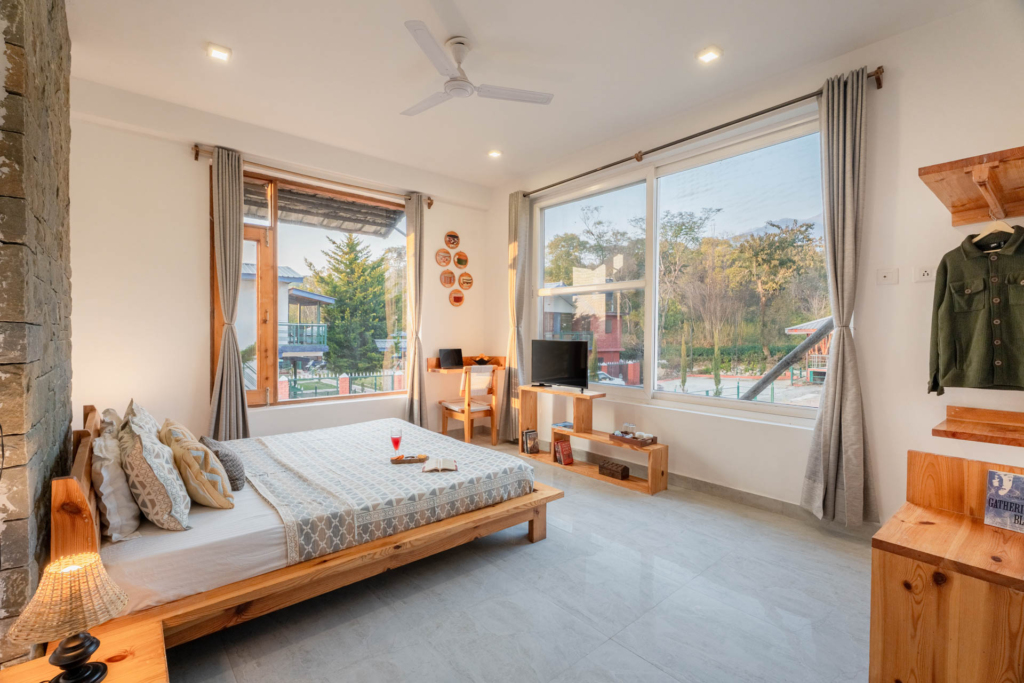
Roughly 2 hours from Bir, in the pine forests above Dharamshala. Use this when Bir inventory is sold out, or if you’re combining the paragliding trip with a McLeod Ganj culture stop. Mountain views, big lawns, ideal for families of 6–8.
Stonehill Manor & Vintage Musings, Dharamshala
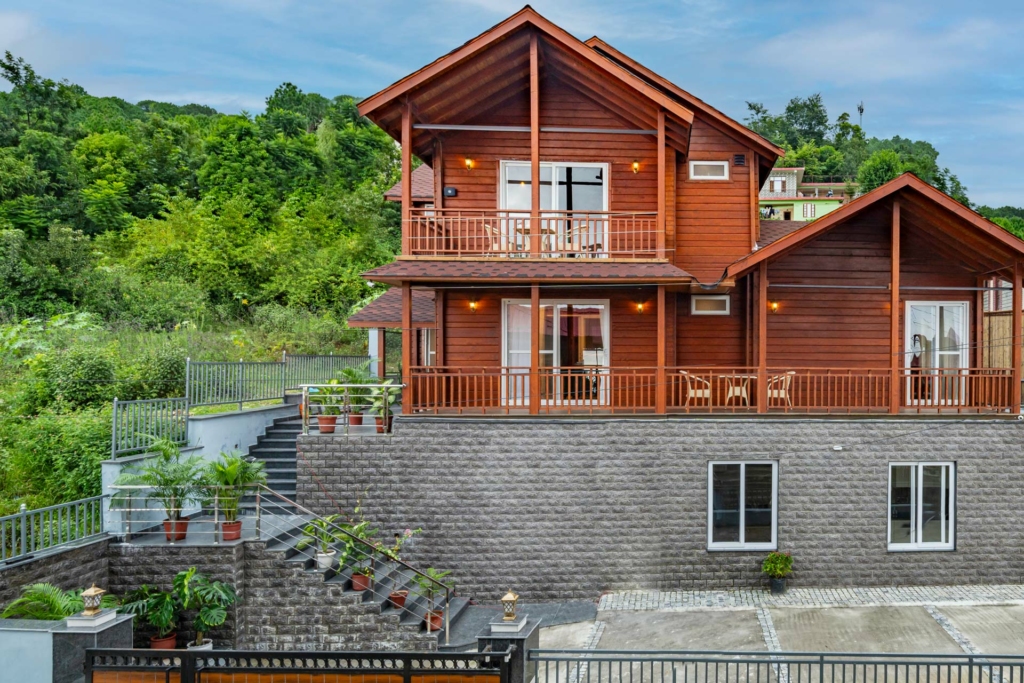
Both are seven minutes’ walk from the Dalai Lama Main Temple — useful if you’re stacking Bir paragliding with a Dharamshala-McLeod Ganj cultural extension. Vintage Musings has a more boutique feel; Stonehill Manor works for bigger groups.
Honest note on bias: We don’t run inventory in Pokhara, so we genuinely can’t recommend a specific Pokhara stay. The Pokhara Lakeside strip has 200+ hotels in the ₹2,500–8,000 range — we’d suggest reading recent Tripadvisor reviews and avoiding anything that doesn’t have a 4.0+ rating with 100+ reviews.
If Bir inventory is sold out for your dates, browse our Palampur villas (45 minutes from Bir, quieter tea-estate setting) or Dharamshala villas (2 hours from Bir, good for combining the trip with McLeod Ganj).
How do you build a 5-day Bir trip (or a 7-day Pokhara trip)?
Bir 5-day itinerary (Delhi origin)
- Day 1: Delhi → Bir (overnight Volvo bus or morning flight to Gaggal + 70 km cab). Check in by evening. Quiet dinner at Avva’s Café.
- Day 2: Paragliding morning (9 AM shuttle to Billing). Afternoon: Tibetan colony walk, monastery visit, café-hop on Chougan Road.
- Day 3: Bir → McLeod Ganj / Dharamshala (2 hours). Dalai Lama Temple, Bhagsu Falls, evening at Naddi viewpoint.
- Day 4: Dharamshala leisure day — Kangra Fort, Norbulingka Institute, tea estate walk in Palampur.
- Day 5: Return to Delhi via Gaggal or Pathankot.
Pokhara 7-day itinerary (Delhi origin)
- Day 1: Delhi → Kathmandu (1.5 hr flight). Evening at Thamel.
- Day 2: Kathmandu sightseeing — Boudhanath, Pashupatinath, Durbar Square.
- Day 3: Kathmandu → Pokhara (25-min domestic flight or 7-hour scenic drive).
- Day 4: Sarangkot paragliding (9 AM tandem). Afternoon: Bungee at Hemja or zip-line at Sarangkot.
- Day 5: Sarangkot sunrise viewpoint, Phewa Lake boating, Peace Pagoda hike.
- Day 6: Pokhara → Chitwan National Park (3.5 hr drive). Jungle safari, canoe ride, Tharu cultural evening.
- Day 7: Chitwan → Kathmandu → Delhi.
For a longer trip, stretch the Bir itinerary into a full Himachal extension covering Shimla, Manali, and Dharamshala — most travellers add 3–4 days to the paragliding weekend without much extra logistics. And if you’ve narrowed your decision to staying in India, our Bir vs Nainital paragliding comparison helps you pick between the two top domestic sites.
Frequently Asked Questions
Pokhara’s tandem flight itself costs more — ₹5,000–7,000 vs ₹2,500–3,500 in Bir. But the full trip cost depends on flights and stay. Once you add international flights and 4–5 nights in Nepal, a Pokhara trip totals ₹30,000–45,000 per person from Delhi, while a Bir trip totals ₹16,000–25,000. Bir is roughly 40% cheaper end-to-end, but Pokhara becomes competitive if you’re already planning a Nepal vacation.
A standard 30-minute Sarangkot tandem flight costs NPR 8,500–13,000, which works out to roughly ₹5,300–8,200 in Indian rupees at the May 2026 exchange rate (₹100 ≈ NPR 160). Indian travellers can often access local-rate pricing of NPR 6,000–8,500 (₹3,800–5,300) by booking directly through Lakeside operators rather than international platforms. Always confirm the included items — most packages bundle pickup, photos, and insurance.
No visa fee, and no formal visa is required. Indians can travel to Nepal visa-free with either a valid passport or a voter ID card. Carry two passport-sized photos and proof of return travel — Nepal immigration occasionally asks at land borders. If you’re flying via Kathmandu Tribhuvan Airport, the entry process takes 10–15 minutes. Bring some INR cash — Indian rupees up to ₹100 denomination are widely accepted in Pokhara.
Pokhara: typically 10–70 years, with parental consent required for minors. Some operators have flown children as young as 5 and seniors over 75 with health clearance.
Bir Billing: 12–65 years for most operators, with under-18s requiring a parent or guardian’s signature. Health restrictions apply at both sites — heart conditions, recent surgery, pregnancy, or back/spine injuries should be cleared with a doctor first.
Bir Billing: 30 kg minimum, 90 kg maximum standard. Flyers between 90–110 kg pay roughly ₹500 extra for a larger glider, but anything over 110 kg is usually grounded.
Pokhara: 25 kg minimum, 100 kg maximum standard, with some operators accommodating up to 120 kg using larger wings. The weight limit isn’t a soft rule — it determines whether the glider can produce safe lift and descent speed.
Both are regulated and have strong overall safety records when you fly with certified pilots. The Civil Aviation Authority of Nepal regulates Pokhara operators; in India, the Aero Club and state authorities oversee Bir. In every investigated 2025 incident at either site — including the January 2025 Himachal fatalities and the June 2025 Pokhara Phewa Lake crash — the root cause was unlicensed operators, faulty equipment, or weather conditions that should have grounded the flight. Verify your pilot’s P3 or P4 license before paying.
Pokhara: 30–45 minutes is the standard tandem duration. Cross-country packages run up to 1 hour. Bir: 15–30 minutes is the standard tandem; extended packages reach 45–60 minutes for an additional ₹2,000–3,000. Flight duration depends on the thermal activity on the day. October and November give the longest, most stable flights at both sites — by January, Bir flights tend to be shorter due to cooler air and weaker thermals.
In Bir, book directly with operators like HP Adventures, Travel Bir Billing, or through aggregator platforms (Thrillophilia, MakeMyTrip, Yatra). Walk-up bookings work but lock you into whatever pilot’s available. In Pokhara, book through Lakeside operator desks (Frontiers Paragliding, Blue Sky Paragliding) or international platforms (Viator, GetYourGuide) — international bookings cost 15–25% more but include insurance. Always confirm the pilot’s certification level before paying any deposit.
The bottom line
Pokhara wins on view and beginner-friendliness. Bir wins on cost, flight length, and weekend convenience. Both deserve a place on an Indian adventure-traveller’s list — just not for the same trip, and not for the same reason.
- Pokhara: 30–45 minute flight, ₹5,000–7,000 tandem, total trip ₹30K–45K, October–May peak. Best for first-timers and view priority.
- Bir: 15–60 minute flight, ₹2,500–6,000 tandem, total trip ₹16K–25K, October–November peak. Best for repeat flyers and weekenders.
- October–November: The one month both are at their peak. Book 60 days out.
Whichever side of the border you choose, the post-flight stay matters as much as the flight itself. If you’re going to Bir, our team can recommend stays based on your dates and group size — start with the Bir villa collection.