
Purushwadi Firefly Festival 2026 (May 22 – Jun 20): The Lesser-Known Bhandardara Alternative Complete Guide
In this Blog
Purushwadi Fireflies Festival 2026:What you need to know:
- Peak viewing window: May 22 – June 20, 2026 (pre-monsoon mating season)
- Location: Purushwadi village, Akole tehsil, Ahilyanagar (Ahmednagar) district, Maharashtra
- Distance: ~185 km from Mumbai (5–6 hrs drive) · ~190 km from Pune (4.5–5 hrs drive)
- 2026 organizer status: Grassroutes Journeys, the founding NGO operator since 2009, has cancelled its 2026 edition (grassroutes.co.in). Independent operators (Mischief Treks, Ttrikon, Treks and Trails India) are still running tours.
- Typical package price: Up to ₹2,999 per person, twin-sharing tent (2026 operator listings).
- Reality check: Firefly density at Purushwadi has dropped to roughly 20% of historic levels per 2023–24 operator reports, while neighbouring Bhandardara (25 km away) now sees stronger swarms (Mongabay India, Oct 2024).
- Who this guide is for: Travellers from Mumbai or Pune who want a 2-day pre-monsoon escape combining fireflies, light trekking, and rural Sahyadri immersion.

The purushwadi fireflies festival — known locally in Marathi as the Kajwa Mahotsav (“kajwa” means firefly) — is the original community-tourism firefly experience in Maharashtra’s Western Ghats, but the 2026 edition looks very different from the one travel blogs were recommending five years ago. This guide stitches together the 2026 dates, camping logistics, drive directions from both Mumbai and Pune, the eight best places to visit nearby, and the honest conservation story that no other competing article currently surfaces.
What is the Purushwadi Fireflies Festival?
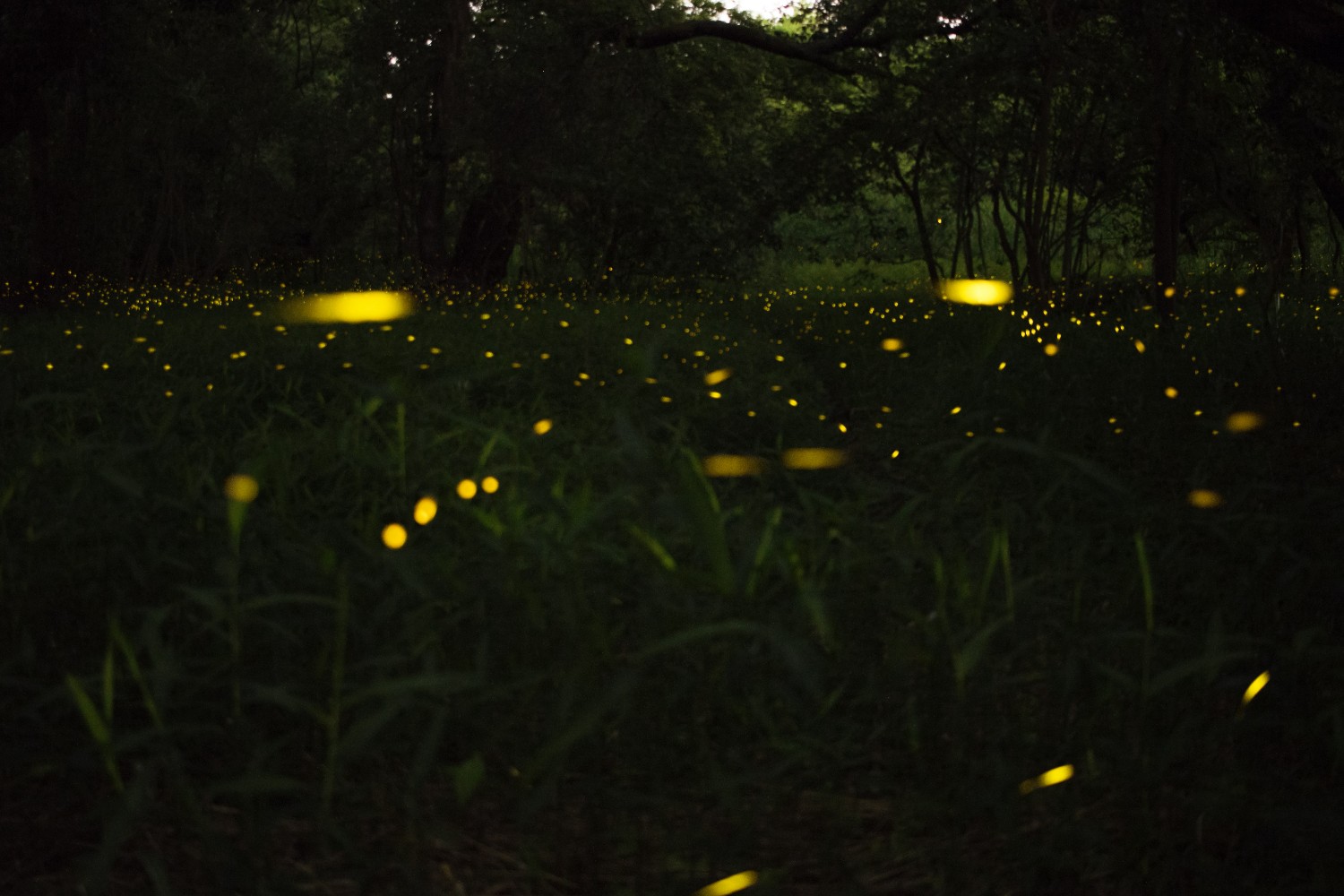
The Purushwadi Fireflies Festivals an annual pre-monsoon nature event in Purushwadi village, where lakhs of synchronized fireflies illuminate Hirda, Behda, mango, and cluster-fig trees for roughly four weeks every May–June. Founded in May 2009 by the rural-tourism NGO Grassroutes Journeys in partnership with the local Mahadeo Koli tribal community (Voices of Rural India), the Kajwa Mahotsav pioneered village-stay-based firefly tourism in the Sahyadris.
Fireflies congregate here because the pre-monsoon window — when daytime temperatures peak and nights stay warm but dry — triggers a synchronized male mating display. Males emit timed flashes from low branches to attract females, and the host-tree mix around Purushwadi produces unusually dense aggregations. India has just been documented to host 92 firefly species in its first national checklist, published in Zootaxa in 2025, with the Western Ghats accounting for 25.33% of that diversity — the highest of any Indian region (Mongabay India, Mar 2026).
Purushwadi Fireflies Festival 2026 dates: when to go

The peak Purushwadi Fireflies Festival 2026 window, locally known as the Kajwa Mahotsav by village natives, runs May 22 to June 20, 2026, with maximum firefly density typically falling in the final week of May and the first week of June — roughly 10–14 days before monsoon onset over Maharashtra. Outlook Traveller and Explurger News both place the golden viewing hour between 8:30 PM and 9:30 PM, when males begin synchronized flashing (Outlook Traveller; Explurger News 2026).
| Week | Date range 2026 | Firefly intensity | Booking pressure |
|---|---|---|---|
| Week 1 | May 22 – May 28 | Building up | Low |
| Week 2 | May 29 – June 4 | Peak | Highest — book 3+ weeks ahead |
| Week 3 | June 5 – June 11 | Peak | High |
| Week 4 | June 12 – June 20 | Tapering with early showers | Medium |
After the first pre-monsoon showers (usually by mid-June), firefly activity drops sharply within 72 hours. If the 2026 monsoon onset is early, plan your trip toward the May 29 – June 4 weekend.
Is the Purushwadi Fireflies Festival actually happening in 2026?
The answer is split. Grassroutes Journeys — the NGO that founded the purushwadi fireflies festival (Kajwa Mahotsav) in 2009 has officially cancelled its 2026 edition.Their journeys page lists the event with a one-line note: “Fireflies Festival — Cancelled for 2026” (grassroutes.co.in/journeys). No reason is published.
However, independent adventure operators are still running Purushwadi camping trips during the May 16 – June 21, 2026 window. As of June 2026, confirmed listings include:
- Mischief Treks — Fireflies Festival Purushwadi 2026, ₹2,999 onwards twin-share
- Ttrikon — Purushwadi Fireflies 2026 from Mumbai
- Adventure Nation — Purushwadi Fireflies group departures
- Treks and Trails India — Weekend departures from Mumbai and Pune
What’s missing in 2026 is the Grassroutes village-homestay model, where you stayed inside the homes of 70-plus Mahadeo Koli families with revenue flowing directly to the village. Third-party tours instead run basic dome tents pitched on village outskirts with separate Styrofoam mattresses, packed meals, and a local guide. The experience is firefly-watching plus camping — not the community immersion Grassroutes originally pioneered.
Camping at the Purushwadi Fireflies Festival: what’s included in 2026

For 2026, the typical purushwadi fireflies festival camping package, sometimes listed by Maharashtra operators as the “Kajwa Mahotsav weekend” is a one-night, two-day format priced between ₹2,499 and ₹2,999 per person on twin-sharing. Mischief Treks and Ttrikon publish near-identical inclusions and price bands as of June 2026 (Mischief Treks).
What’s standardly included:
- Tent stay (2–3 sharing, dome tent with Styrofoam mattress)
- Saturday dinner + Sunday breakfast + Sunday lunch (vegetarian, served village-style)
- Bonfire and ice-breaker activities
- Guided night firefly walk (~2 hours)
- Local naturalist talking about firefly species and Mahadeo Koli forest ecology
- Permits, basic first aid, group leaders
What’s typically extra:
- Mumbai/Pune transport (most operators offer Tempo Traveller add-ons at ₹800–1,200/person)
- Personal expenses, mineral water, snacks
- Add-on day treks to Kalsubai or Sandhan Valley
Booking lead time: Operators recommend confirming at least 20 days ahead; peak-weekend departures (last weekend of May, first weekend of June) routinely sell out three weeks in advance. Late bookings within 7 days carry a premium of ₹400–600.
How to reach Purushwadi from Mumbai

The fastest route from Mumbai to Purushwadi is the 185–187 km drive via NH-3 (the Mumbai–Nashik Highway), taking 5 to 6 hours including a tea stop. Most weekend tour buses leave Mumbai by 6:00–7:00 AM Saturday and reach Purushwadi by lunchtime.
Driving directions (recommended):
- Mumbai → NH-3 (Mumbai–Nashik Highway) toward Kasara
- Cross Kasara Ghat → continue to Igatpuri
- Igatpuri → Ghoti → Sangamner road → Rajur
- Rajur → Purushwadi (final 18 km on a narrow ghat road; SUV recommended in dark hours)
By train + cab:
- Best railhead is Igatpuri (~70 km from Purushwadi); served by Mumbai–Nashik trains from CST, Dadar, and LTT
- Kasara is closer to Mumbai but adds 30 km to the road leg; useful if you book a shared cab to Rajur
- Pre-book a cab from Igatpuri to Purushwadi (₹2,000–2,500 one way)
By state bus:
- MSRTC buses from Mumbai to Akole or Sangamner via Kalyan/Igatpuri
- Local jeeps (sumo/shared) from Akole or Rajur to Purushwadi village (₹100–150/person, daylight hours only)
Note: The final 12 km between Rajur and Purushwadi is unlit, single-track, and used by tribal forest traffic. Avoid arriving after dark if self-driving for the first time.
How to reach Purushwadi from Pune
From Pune, Purushwadi is roughly 160–190 km north via Chakan, Rajgurunagar, Sangamner, and Rajur, taking 4.5 to 5 hours. (Multiple operator sites publish slightly different distances; the 190 km figure assumes you bypass Sangamner town congestion.)
Driving directions (recommended):
- Pune → Chakan → Rajgurunagar (NH-60 / SH-55)
- Continue north toward Sangamner
- Sangamner → Akole → Rajur
- Rajur → Purushwadi (final 18 km ghat road)
By train + cab
No direct railhead near Purushwadi from Pune is closer than Igatpuri (~150 km via Nashik). Most Pune travellers drive, ride-share, or join an operator-run Tempo Traveller departure.
By state bus
MSRTC operates Pune–Akole and Pune–Sangamner services daily. Take the morning bus, then a Rajur-bound local from Akole, then a village jeep.
Typical private cab cost (Pune → Purushwadi round trip): ₹6,500–8,500 depending on vehicle type (Indica/Etios/Innova) and seasonal demand.
Purushwadi vs Bhandardara: which firefly destination should you actually choose?
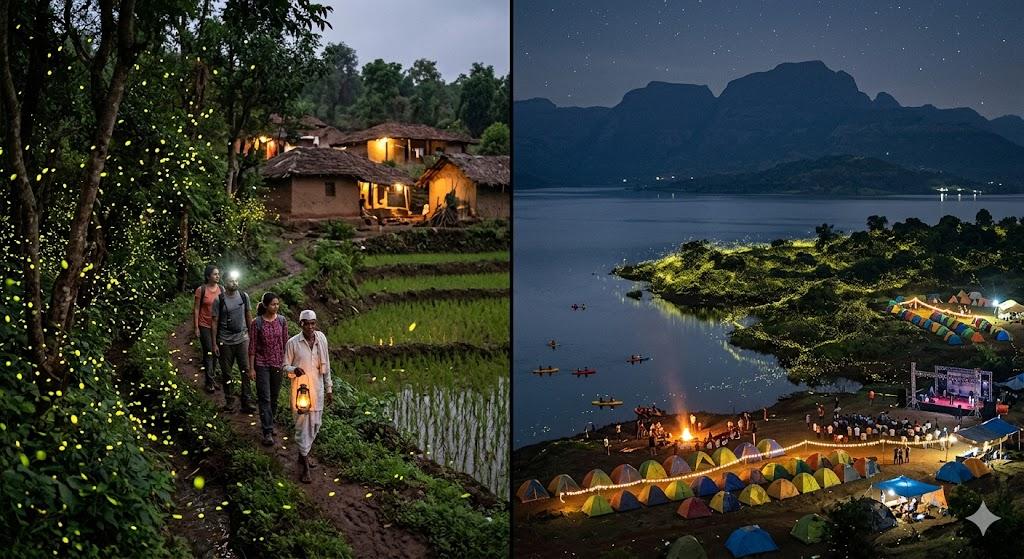
The single most useful comparison for 2026 travellers is purushwadi fireflies festival vs Bhandardara, because the two villages are only 25 km apart but offer very different experiences. Mongabay India’s October 2024 long-form report on Maharashtra’s fireflies notes that Bhandardara now sees roughly 200,000 tourists per year during firefly season — and importantly, stronger firefly density in 2024–25 counts than Purushwadi, where a depleted stream and reduced canopy have thinned the population to about 20% of historic levels.
Comparison snapshot
| Dimension | Purushwadi | Bhandardara |
|---|---|---|
| Distance from Mumbai | 185 km | 165 km |
| Distance from Pune | 190 km | 175 km |
| Accommodation | Basic tents (Grassroutes village stay paused for 2026) | Resorts, MTDC cottages, lakeside camps |
| Crowd density (peak weekend) | Moderate (~150–250 visitors/night) | Very high (1,500+ visitors/night) |
| Firefly density 2024–25 | Declining (~20% of historic counts) | Currently stronger |
| Authenticity | High — tribal village setting | Lower — resort weekend getaway |
| Add-on activities | Sandhan Valley, Kalsubai trek, Amruteshwar Temple | Wilson Dam, Arthur Lake boating, Randha Falls |
| Best for | Quieter night, photography, community feel | First-timers, families, easier logistics |
If your priority is maximum fireflies + easy logistics, pick Bhandardara. If your priority is a quieter night, photographic compositions without crowd headlamps, and rural Maharashtra texture, the purushwadi fireflies festival still wins — just go in mid-week rather than weekend.
Best places to visit in & near Purushwadi
A Purushwadi camping weekend pairs naturally with day-trekking and dam-and-temple drives in the surrounding 50 km. Below are the eight highest-rated additions for a 2-day or 3-day plan.
1. Bhandardara (25 km)

Built around Wilson Dam (1910) and the Arthur Lake reservoir, Bhandardara is the region’s headline weekend destination. Stop for early-morning lake photography, a boat ride on Arthur Lake, and the Umbrella Falls that activate when the dam overflows. (30Stades)
2. Randha Falls (30 km)

A 170-foot cascade on the Pravara river, near Bhandardara. Best photographed in early monsoon (late June onwards) when flow is heavy; pre-monsoon visits show the rock structure cleanly.
3. Sandhan Valley — “Valley of Shadows” (25 km via Samrad village)

A 200-metre-deep gorge carved through basalt, considered one of Maharashtra’s most distinctive canyon treks. Day-trek operators can combine this with your Purushwadi booking; full traverse needs a guide and rappelling gear.
4. Kalsubai Peak (30 km)

At 1,646 m, Kalsubai is the highest peak in Maharashtra. The trek starts from Bari village; a fit hiker can reach summit in 3–4 hours. Pre-dawn climbs reward you with the entire Sahyadri spread, including a view back toward Purushwadi.
5. Ratangad Fort (30 km)

A Shivaji-era hill fort with the famous Nedhe (natural rock window) at the summit. Three- to four-hour trek from Ratanwadi base village; combinable with Amruteshwar Temple visit on the same day.
6. Amruteshwar Temple, Ratanwadi (30 km)

A 9th-century Hemadpanthi-style Shiva temple in black basalt, sitting beside the Pravara river. Among the oldest surviving stone temples in this part of the Sahyadris and the natural cultural complement to a Purushwadi camping weekend.
7. Harishchandragad Fort (40–45 km)

One of Maharashtra’s most celebrated trek-forts, famous for the Konkan Kada cliff and the Kedareshwar cave temple. This is a separate overnight trek — best as a stand-alone weekend rather than a Purushwadi add-on.
8. Ghatghar Dam (25 km)

A pumped-storage hydroelectric dam between Bhandardara and Konkan. Locals report secondary firefly clusters along the surrounding forest roads in early June — useful if Purushwadi’s main viewing sites are crowded.
Why are Purushwadi’s fireflies actually declining?
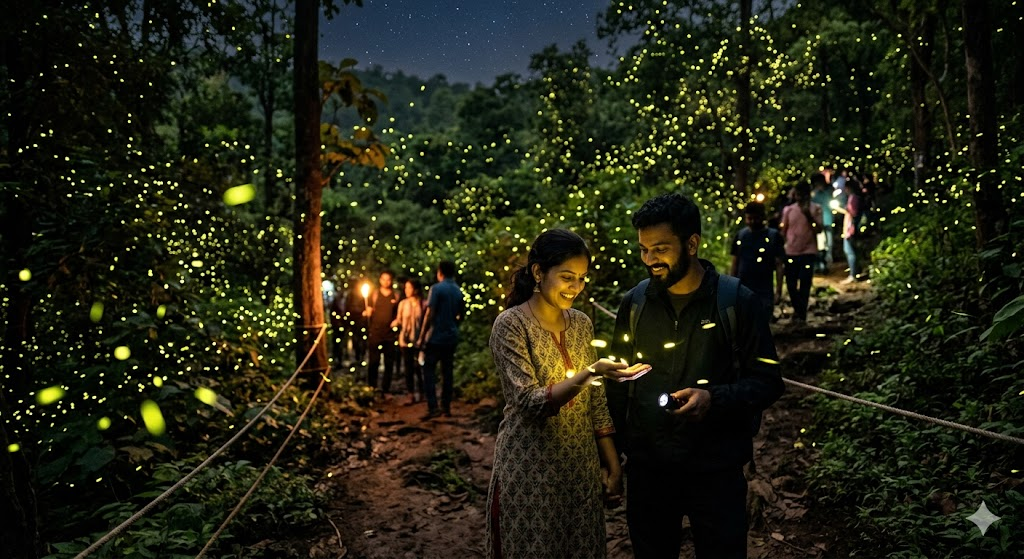
Skipping this section would be dishonest. Mongabay India’s 2024 investigation documents three converging causes for the decline of fireflies around Purushwadi and the wider Akole belt:
- Stream depletion. The seasonal stream that historically watered the host tree clusters has been running thinner each year due to upstream extraction and reduced pre-monsoon precipitation. Female fireflies need moist leaf litter to lay eggs.
- Habitat conversion. Patches of Hirda, Behda, and Jamun trees — the species fireflies congregate on — have been cleared for cashew and mango plantations.
- Light and noise pollution from tourism itself. Bright torches, mobile flashlights, vehicle headlamps on the village approach, and amplified music at large camps disrupt the synchronized mating display, lowering successful pairings each season.
Operator-reported counts suggest 2023–24 firefly numbers were roughly 20% of the 2017 peak. That’s why the village-level conservation model Grassroutes built — capping concurrent visitors at 40 and channelling income back into reforestation — mattered (Mongabay India, Oct 2024). If you go in 2026, use a red-filtered headlamp, no camera flash, and stay on marked paths — these three steps measurably reduce mating-cycle disruption.
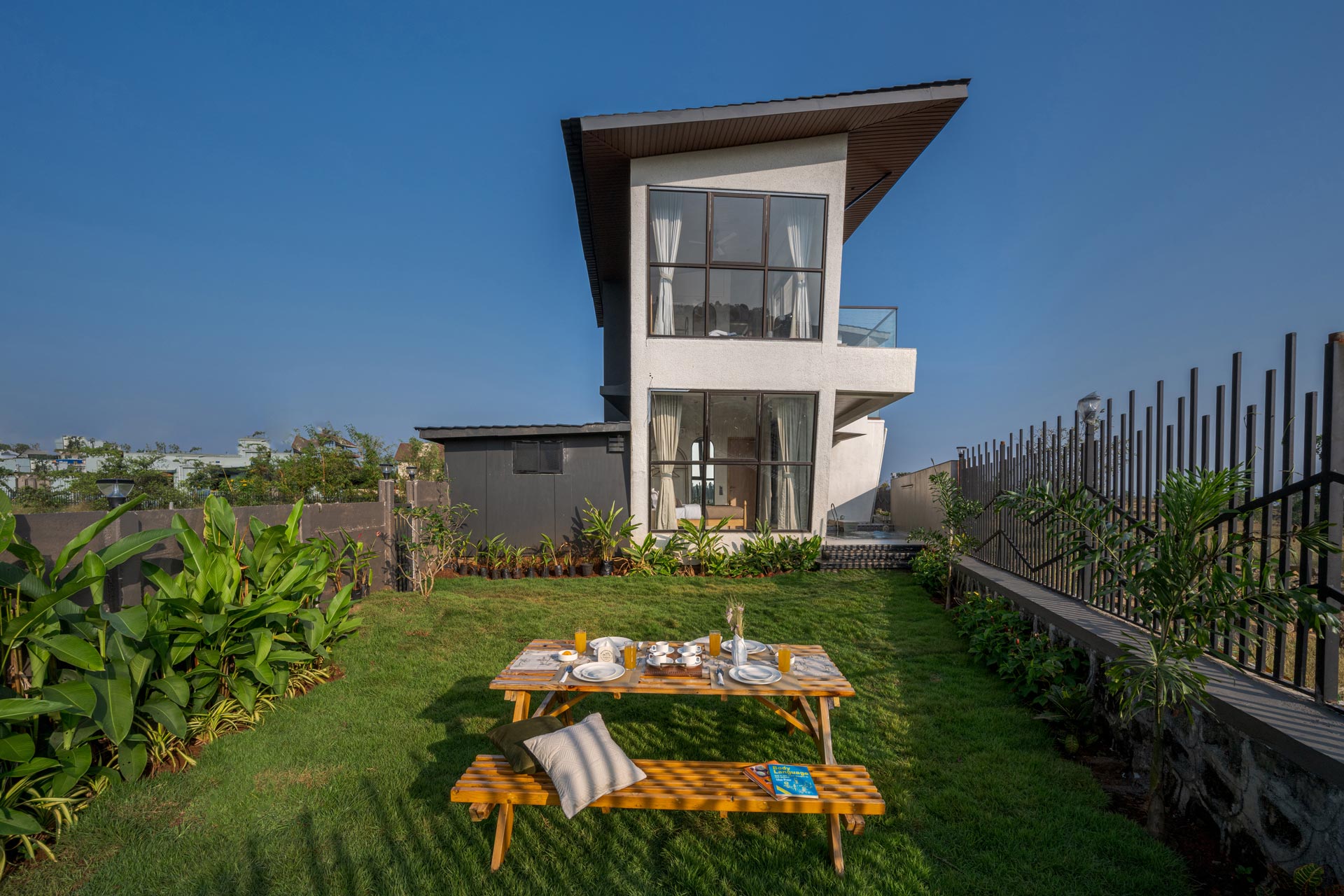
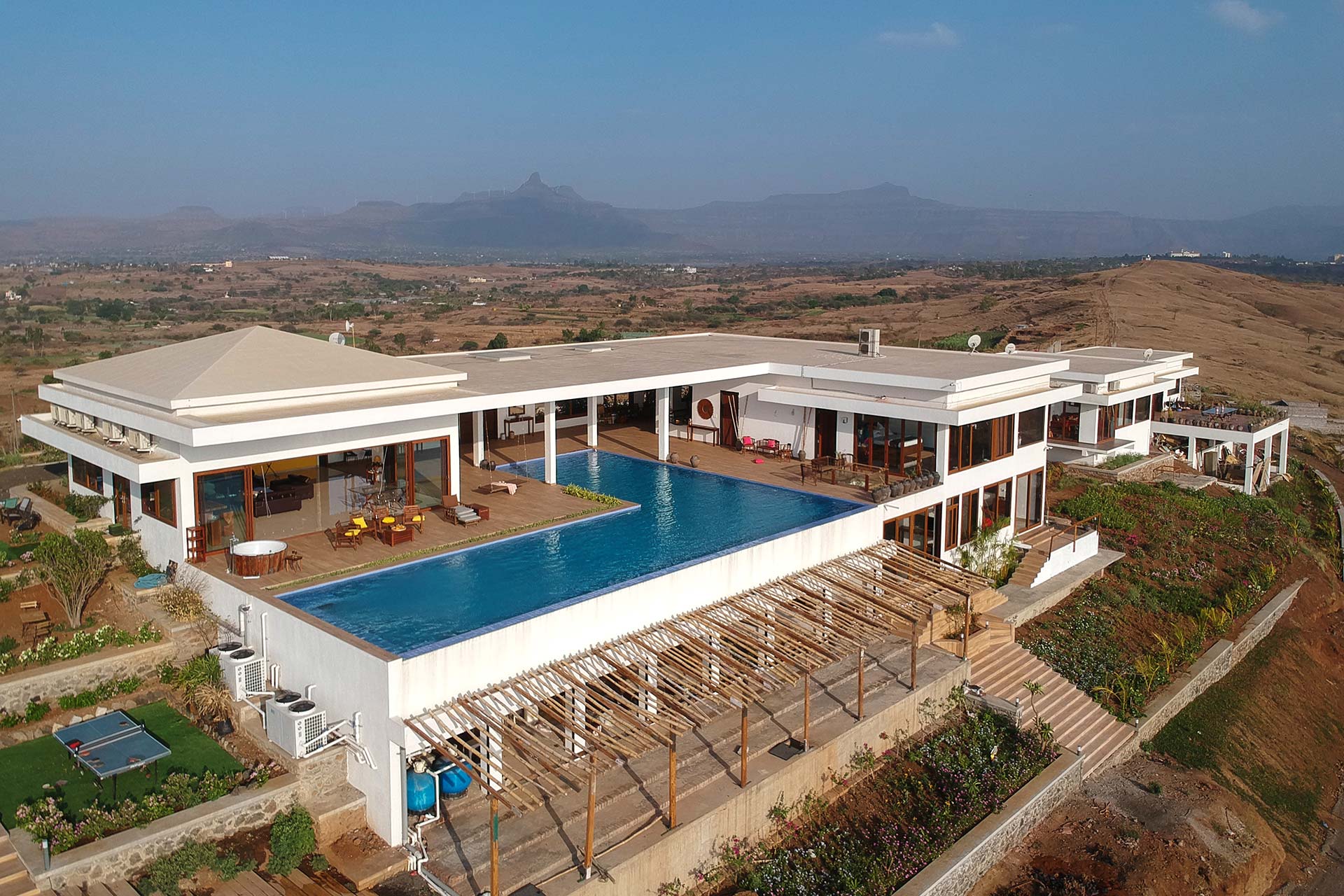
Where to Stay during Purushwadi Firefly Festival (Kajwa Mahotsav) | Best for Group Travellers
A practical 2-day Purushwadi itinerary (May–June 2026)
A standard Purushwadi weekend looks like this if you’re departing from Mumbai or Pune Saturday morning:
Day 1 — Saturday
- 06:30 – Depart Mumbai/Pune
- 13:00 – Arrive Purushwadi, check into tent, lunch with village family
- 14:30 – Optional Ratanwadi + Amruteshwar Temple visit
- 18:30 – Tea and naturalist briefing (firefly etiquette, red-light usage)
- 20:00 – Group dinner around bonfire
- 21:00 – Firefly walk with guide (~2 hours; 8:30–10:30 PM peak)
- 23:30 – Lights out
Day 2 — Sunday
- 05:30 – Optional sunrise to Kalsubai base for short hike, or sunrise from Purushwadi ridge
- 09:00 – Breakfast back at camp
- 10:30 – Visit Bhandardara + Wilson Dam + Arthur Lake boating
- 13:00 – Lunch
- 14:30 – Depart for Mumbai/Pune
- 20:00 – Arrive back
This itinerary fits the standard 2-day operator templates. Add a Sandhan Valley day or Kalsubai summit climb for a 3-day weekend.
What to pack for the Purushwadi Fireflies Festival
- Red-filtered or low-lumen headlamp (white light disrupts firefly displays)
- Full-sleeve clothing — May–June nights still dip to 22–24 °C in the village
- Trekking shoes with grip — the firefly walk crosses uneven terrain
- Mosquito repellent (DEET-based or citronella)
- Power bank — village electricity is intermittent
- Reusable water bottle (no plastic bottles; operators run a no-litter policy)
- Cash — UPI signal is unreliable; carry ₹2,000–3,000 small notes for tea-stall purchases
- Camera with high-ISO capability; avoid flash entirely during firefly viewing
When exactly to book your 2026 trip

The two highest-pressure weekends for the purushwadi fireflies festival in 2026 are May 30–31 and June 6–7. If you can travel mid-week (Tuesday/Wednesday departures), you’ll experience the same firefly density with one-fifth the camp population — a meaningful difference for both photography and conservation impact. Operators usually open 2026 inventory by mid-March; by the second week of April, the peak weekends are 60–70% full.
Frequently asked questions
Yes, but with a major change. Grassroutes Journeys, the founding NGO operator since 2009, has cancelled its official 2026 edition. Independent operators including Mischief Treks, Ttrikon, Adventure Nation, and Treks and Trails India are still running weekend tours between May 16 and June 21, 2026.
The peak viewing window is May 29 to June 11, 2026, with maximum density usually falling 10 to 14 days before monsoon onset. Fireflies are most active between 8:30 PM and 9:30 PM each night. After the first pre-monsoon showers, activity drops sharply within 72 hours.
Purushwadi is roughly 185 to 187 km from Mumbai via the NH-3 Mumbai-Nashik Highway, Kasara Ghat, Igatpuri, Ghoti, Sangamner road, and Rajur. The drive takes 5 to 6 hours including a tea stop. The closest railhead is Igatpuri, about 70 km from the village.
Purushwadi sits about 160 to 190 km north of Pune, depending on whether you route through or around Sangamner town. The drive via Chakan, Rajgurunagar, Sangamner, Akole, and Rajur typically takes 4.5 to 5 hours. There is no direct railhead near Purushwadi from Pune; most travellers drive or join operator-run group transport.
Not necessarily in 2026. Bhandardara, just 25 km from Purushwadi, currently shows stronger firefly density per recent operator counts and Mongabay India reporting, although it draws much larger crowds (around 200,000 visitors per year). Purushwadi offers a quieter, more village-rooted experience but firefly numbers there have declined to about 20% of historic levels.
Standard 2026 camping packages from Mumbai or Pune operators run ₹2,499 to ₹2,999 per person on twin-sharing, covering tent stay, three meals, a guided firefly walk, and bonfire activities. Transport from Mumbai or Pune adds ₹800 to ₹1,200 per person. Late bookings inside 7 days typically carry a ₹400–600 premium.
Yes. Operators generally accept children aged 5 and above; under-12s often pay 60–70% of the adult package. Bring warmer clothing for children since night temperatures drop to 22–24 °C and the firefly walk involves 2 hours of slow forest movement.
Igatpuri railway station is the closest major railhead, roughly 70 km from Purushwadi via the Sangamner road. Kasara station is closer to Mumbai but farther by road from Purushwadi (around 100 km). For Pune-side travellers there is no closer railhead; private transport is recommended.
Network coverage is patchy. Jio and BSNL offer the most reliable signal at low to moderate strength; Airtel and Vi may drop entirely inside the village. Carry a power bank and inform family of your arrival when you reach Rajur, since the final 18 km is largely offline.
Avoid using camera flash, white-light headlamps, mobile flashlights, or loud music. Stay on the guide-marked path. Do not catch or hold fireflies — handling damages the bioluminescent organ. Do not smoke during the walk. These steps directly protect the synchronized mating display that makes the purushwadi fireflies festival possible at all.