
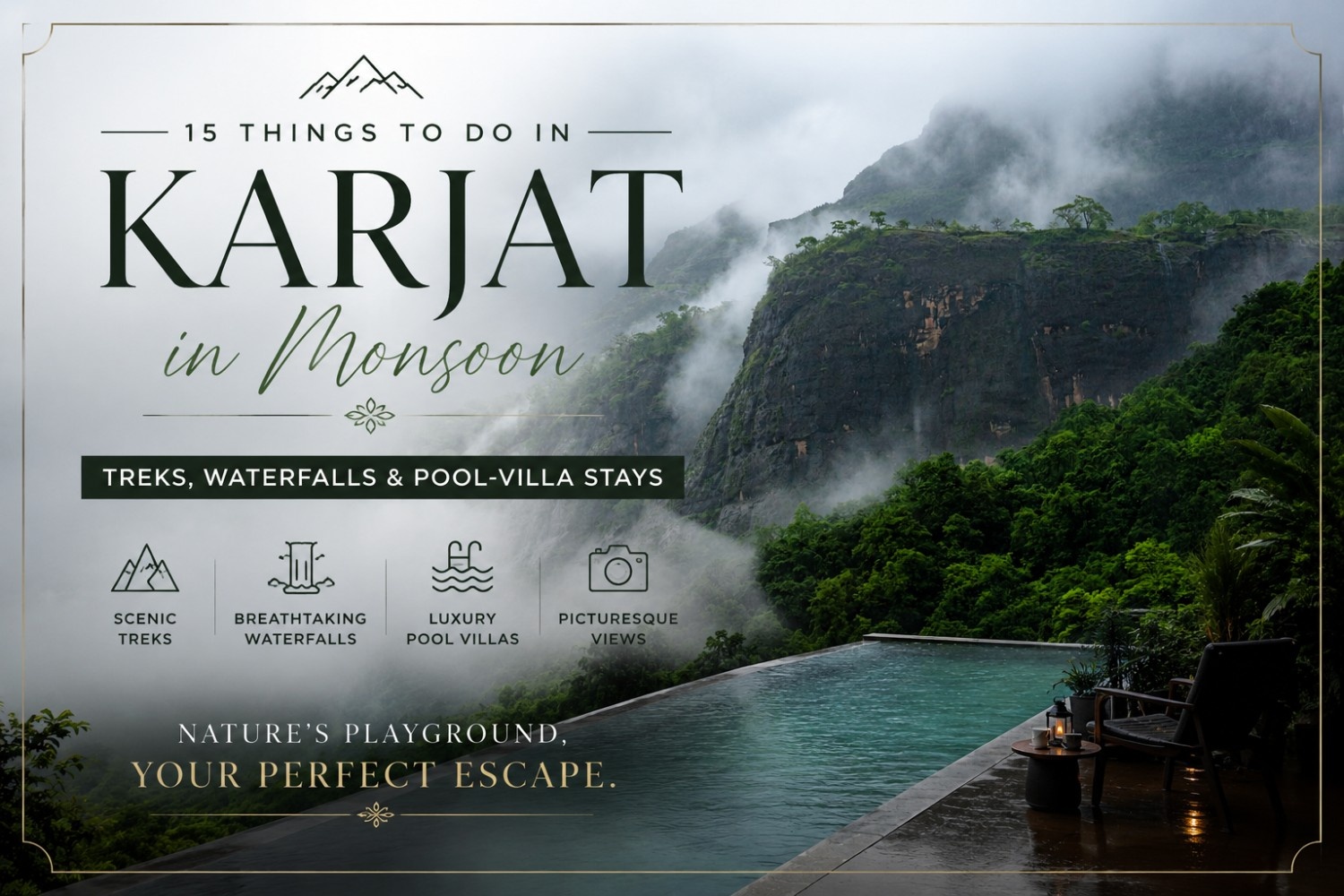
15 Things to Do in Karjat in Monsoon: Treks, Waterfalls & Pool-Villa Stays
In this Blog
What to do in Karjat in monsoon?
Karjat, 62 km east of Mumbai, turns into the Sahyadri’s most accessible monsoon playground between mid-June and late September. The 15 best things to do are five forest treks (Kondana, Peb, Garbett, Sondai, Rajmachi), three reachable waterfalls (Bhivpuri, Zenith, Ulhas Valley), Grade II–III river rafting on the Kundalika at Kolad, a wet-weather day at Imagicaa, birding at Karnala, a spiritual stop at ISKCON Govardhan Eco Village, a picnic at Morbe Dam, paddy-planting at Saguna Baug, and at least one night in a private pool villa to dry off.
Karjat monsoon trip: Quick info
| Best time to visit | Mid-June to late September (peak rainfall: July, August) |
| How to reach from Mumbai | Central Railway local or express (1h 20m–2h 30m); ~70 km by road via NH-48 |
| How to reach from Pune | Pragati / Deccan Express (~1h 25m); ~105 km by road via NH-48 |
| Nearest airport | Chhatrapati Shivaji Maharaj International Airport, Mumbai (CSMIA) — ~70 km |
| Nearest railway station | Karjat Jn (Central Line junction; direct slow and fast locals from CSMT, Dadar, Thane, Kalyan) |
| Ideal duration | 1N/2D weekend; 2N/3D for treks + villa downtime |
| Budget range (per person) | Day-trip ₹1,500–₹3,500 · 1N villa stay ₹3,500–₹12,000 (shared) |

If you live in Mumbai or Pune, Karjat is the easiest way to be standing under a waterfall by lunchtime. Sixty-two kilometres from Mumbai, ninety-one by express train from Pune, and on a Central Line that runs every twenty minutes, it is the lowest-friction monsoon destination in the Sahyadris. Between June and September the town becomes a moss-green, mist-soaked basin ringed by Peb, Bhimashankar, Matheran and Rajmachi — and after a day of trekking, the most useful thing you can do is dry off in a private pool villa, of which Karjat has more than almost any other Indian destination. StayVista alone lists dozens of homes here, several with heated or covered pools you can actually use in the rain.
This guide is built differently from most “things to do in Karjat” listicles. We start with what to skip in monsoon — because three of the most-recommended places online are either closed or genuinely dangerous in heavy rain — then walk through 15 things that are worth doing, with exact distances from Karjat station, entry fees, and the practical detail that determines whether you have a good day or a wet, exhausted one.
Karjat weather in June, July and August: month-by-month

Karjat receives roughly 1,750 mm of annual rainfall, with July alone delivering 550–570 mm across 23 wet days — making it one of the wettest accessible weekend destinations in western India.
Karjat sits on the windward side of the Sahyadri ridge, which pulls Arabian Sea moisture straight onto the town. Annual rainfall averages around 1,750 mm, with the bulk falling in three months. Here is what each looks like on the ground.
| Month | Avg high | Avg low | Rainfall | Wet days | Trip vibe |
|---|---|---|---|---|---|
| June | 33 °C | 29 °C | ~399 mm | 17 | Monsoon ignites — humid, warm, intermittent showers |
| July | 30 °C | 25 °C | ~572 mm | 23 | Peak rain — waterfalls full, treks slippery |
| August | 30 °C | 25 °C | ~419 mm | 20 | Still wet, slightly drier than July, lush valleys |
Source: Weather Spark (Karjat year-round averages, MERRA-2 reanalysis); annual rainfall via climate-data.org. Real-time conditions: IMD Mumbai.
June in Karjat — the warm-up month
June is the most unpredictable monsoon month. The southwest monsoon typically arrives in coastal Maharashtra between June 7 and June 15, but in dry years it can be delayed by two to three weeks. Early-June days are still hot (highs near 34 °C); by month-end, with the monsoon fully set in, highs drop to about 28 °C. Rainfall is the lowest of the three monsoon months (~399 mm over 17 wet days). Best for: early-monsoon treks like Peb Fort and Rajmachi (before peak rain makes them treacherous), Kundalika rafting as flow ramps up, and pool-villa stays when the surrounding hills are turning green but mornings still see sun.
July in Karjat — peak monsoon
July is the wettest month of the year, with ~572 mm across 23 rainy days and a relative humidity that hovers around 91% — the highest of any month. Days are cooler (highs 30 °C, lows 25 °C), but the air feels heavier because it rarely stops being wet. Waterfalls run at full flow, paddy fields are luminously green, and treks like Garbett Plateau, Ulhas Valley and Kondana Caves are at their most photogenic. The trade-off: Peb Fort, Rajmachi (Karjat side) and any unmarked Sahyadri route become genuinely dangerous. Best for: waterfalls, viewpoints, Kundalika rafting, slow villa weekends.
August in Karjat — the lush plateau
August carries the residual saturation of July with slightly fewer rainy days (~20) and ~419 mm of rainfall. Temperatures are nearly identical to July (30 °C / 25 °C). The landscape is at its visual peak — paddy fields are knee-high, hill slopes are completely green, and morning mist sits low in the valleys. Trails are firmer than in July (a week of partial drying makes a difference), but streams remain swollen. Best for: moderate treks (Sondai, Kondana, Garbett), photography, birding at Karnala, and the Saguna Baug paddy-planting season at its midpoint.
Practical takeaway: Plan adventure-heavy itineraries for early June or late August. Reserve mid-July to mid-August for waterfalls, slow days at the villa, and shorter treks — not summit attempts.
What to skip in Karjat this monsoon?
Before the 15 things, three honest exclusions. If you have read other Karjat lists, you have probably seen these recommended for monsoon. They should not be.
- Neral–Matheran Toy Train — Indian Railways suspends the narrow-gauge service from mid-June to mid-October every year for safety; only the Aman Lodge–Matheran shuttle runs intermittently. If a guide tells you to take the toy train in July, it is out of date.
- Dhak Bahiri caves — A 70-degree gradient, fixed-rope sections and a wooden log across a chasm. In dry weather it is an expert-grade trek. In monsoon, on wet basalt, accidents are documented every season.
- Garbett Plateau and Bhimashankar via unmarked trails — The Pune Forest Division’s 2025 monsoon advisory restricts entry to several Sahyadri trails including parts of Bhimashankar, Kalsubai, Ratangad and Andharban during heavy rainfall. Garbett is fine via the standard Bhivpuri route with a guide; freelance route-finding is not.
Now, the 15 worth doing.
Five Karjat treks that come alive in the rain
Karjat’s treks are short by Himalayan standards — most are 4 to 6 hours round trip — but in monsoon they punch far above that weight. Waterfalls grow out of cliff faces, paths turn into streams, and the entire valley fills with cloud. These five are arranged in roughly ascending difficulty.
1. Trek to Kondana Caves and the Kondhane Waterfall

The easiest monsoon trek in Karjat with a real reward at the end. Behind Kondhane village, a one-hour forest path climbs to a row of 1st-century-BC Buddhist rock-cut caves — and in monsoon, a waterfall pours directly across the cave mouth. The hike is short, the gradient is gentle, and the payoff is genuinely cinematic.
- Entry fee: No entrance fee [confirm at gate; only Tier 4 travel blogs corroborate]
- Timings: 6:00 AM – 6:00 PM (daylight only; no lighting on the trail)
- Best time: July to mid-September, when the waterfall is at full flow
- How to reach from Karjat station: ~15 km. Auto-rickshaw or cab to Kondhane village (~₹400–₹500 one way), then a 1-hour trek up
- Time required: 4–5 hours (round trip plus cave exploration)
- Ideal for: First-time monsoon trekkers, families with teens, history buffs
- Pro tip: Wear floaters or grip sandals — the final 200 metres involves wading through a knee-deep stream that you cannot avoid.
2. Peb Fort (Vikatgad) Trek via Neral

The trek with the ladder section everyone photographs. Peb Fort, locally called Vikatgad, sits at 657 metres on the Matheran range. The Karjat–Neral approach passes through dense forest, then opens onto an iron ladder bolted to a rock face — the moment that earns the trek its reputation. Doable in early or late monsoon; mid-monsoon (mid-July to mid-August) the ladder gets slick and is best avoided.
- Entry fee: None
- Timings: Start by 7:00 AM; full daylight crossing required
- Best time: Early June or September; avoid peak rain days
- How to reach from Karjat station: Central Line local to Neral (10 minutes, ~₹10), then auto to the trek-start at Junction 134 (~₹200)
- Time required: 5–6 hours; ~4 km one way; moderate difficulty
- Ideal for: Intermediate trekkers with prior Sahyadri experience
- Pro tip: Carry a dry bag for your phone — the ladder section has no place to set anything down. Indiahikes documents the route in detail.
3. Garbett Plateau Trek (Bhivpuri route)

The visual showstopper of monsoon Karjat. Garbett is a kilometre-long grass plateau on the Matheran range, where dozens of seasonal waterfalls drop simultaneously off the edge. Start at Bhivpuri Road station and ascend through Diksal village. This is the trek that fills your camera roll.
- Entry fee: None
- Timings: Start by 7:00 AM
- Best time: Late July to early September, when the plateau’s waterfalls are at peak flow
- How to reach from Karjat station: One station back on the Central Line to Bhivpuri Road (~10 minutes); trek begins from the station via Diksal village
- Time required: 4–5 hours ascent; full day if descending to Matheran
- Ideal for: Intermediate trekkers, photographers, anyone who has done one Sahyadri trek before
- Pro tip: Hire a local guide from Diksal village (~₹500–₹800) — the plateau has no marked exit trail and clouds reduce visibility to under 50 metres without warning.
4. Sondai Fort — the easy beginner monsoon trek

If you have never trekked before and want a single one to start with, pick Sondai. The fort sits on a low pinnacle near Sondewadi village, takes about an hour to climb, and rewards you with 360-degree views of Morbe Dam, Prabalgad and the Matheran range. The path is short, the gradient is forgiving, and there is a small Sondai Devi temple at the summit that locals visit through monsoon.
- Entry fee: None
- Timings: Start by 7:00 AM
- Best time: Throughout monsoon — one of the few Sahyadri treks that is genuinely safe in heavy rain
- How to reach from Karjat station: ~10 km to Sondewadi village base by auto (~₹300)
- Time required: 3–4 hours round trip
- Ideal for: Beginners, families with kids over 10, first monsoon trek
- Pro tip: The summit pinnacle requires a 10-metre scramble using natural rock holds — skip it if it is raining hard; the views from below the pinnacle are nearly as good.
5. Rajmachi Fort Trek (Karjat side, via Kondivade)

For experienced trekkers only. Rajmachi is two twin forts — Shrivardhan and Manaranjan — connected by a saddle. The Lonavala-side approach is a gentle 15-km jeep track; the Karjat-side ascent from Kondivade is a steep, river-crossed, forest trek that monsoon turns serious. Multiple operators run this only in early or late monsoon; mid-monsoon the route floods.
- Entry fee: None
- Timings: Start before 6:00 AM
- Best time: First two weeks of June or last two weeks of September
- How to reach from Karjat station: Auto or shared jeep to Kondivade village (~13–14 km, ~₹400)
- Time required: Full day; 5–6 hours ascent
- Ideal for: Experienced trekkers only
- Pro tip: Hire a Kondivade guide (₹800–₹1,200). Landslides and tree-falls on this route are documented every monsoon — Indiahikes flags it as a high-risk monsoon route.
Three Karjat waterfalls you can actually reach
The Sahyadris produce hundreds of seasonal waterfalls every monsoon. Most of them require a serious trek. These three do not — each is within a 30-minute hike of a road or railway station, which makes them the right pick for a day-trip or a half-day with kids.
6. Chase the Bhivpuri Waterfall

The most accessible big waterfall near Karjat. A 15-minute walk from Bhivpuri Road railway station drops you at a multi-tier cascade that local groups use for a swim, a picnic and the obligatory photograph. It is short, family-friendly and very, very crowded on weekends.
- Entry fee: Nominal local upkeep fee [typically ₹20–₹50]
- Timings: Sunrise to sunset, daily
- Best time: Weekday mornings in July–September; weekends draw 500+ visitors
- How to reach from Karjat station: One station back on the Central Line to Bhivpuri Road (10-minute local train), then a 10-minute auto or 20-minute walk
- Time required: 2–3 hours
- Ideal for: Day-trippers, photography, families with older kids
- Pro tip: Do not enter the pool directly under the cascade if it has rained upstream in the previous hour — flash surges are documented and have caused fatalities elsewhere in the Sahyadris.
7. Zenith Waterfall, Khopoli

A wide, photogenic multi-stage cascade just a short shuttle train ride from Karjat. Zenith sits on the outskirts of Khopoli town, on the route towards Imagicaa. The walk in from Khopoli station passes through paddy fields and crosses two small streams, which adds to the experience but means waterproof footwear is non-negotiable.
- Entry fee: None
- Timings: Best between 10:00 AM and 5:00 PM (light and safety)
- Best time: June to September
- How to reach from Karjat station: Karjat–Khopoli shuttle train (~25 minutes; check Central Railway timetable as it is infrequent) or cab (~₹600–₹800 one way)
- Time required: 3–4 hours including the 30-minute walk from station
- Ideal for: Couples, photographers, fitter day-trippers
- Pro tip: Reach by noon. The path floods by late afternoon on heavy-rain days and locals turn visitors back.
8. Ulhas Valley Viewpoint — the “infinite waterfalls” view

The most photographed monsoon panorama in the Karjat region. Ulhas Valley is a horseshoe of Sahyadri cliffs where, after three days of continuous rain, every crack in the basalt becomes a waterfall — sometimes thirty visible at once. You can either drive to the viewpoint and stop there (2–3 hours) or do the full Ulhas Valley Canyon trek (6–7 hours, moderate).
- Entry fee: None (open viewpoint)
- Timings: Daylight hours
- Best time: July to early September; visit 7:00–9:00 AM before cloud cover thickens
- How to reach from Karjat station: ~12–15 km. Cab or auto to Kondivade or Ambivli (~₹400–₹600)
- Time required: 2–3 hours for the viewpoint; 6–7 hours for the full canyon trek
- Ideal for: Photographers, anyone wanting one big panoramic memory of monsoon Karjat
- Pro tip: Carry a microfibre cloth for your camera lens — the spray from the cliffs reaches the viewpoint when wind shifts.
Two adrenaline picks: rafting and theme-park rides
If treks and waterfalls feel passive, Karjat has two monsoon-specific adrenaline activities. One — Kundalika river rafting at Kolad — is genuinely the best monsoon white-water in western India. The other, Imagicaa, is a wet-weather backup with rides, a water park and a roof to retreat under.
9. Kundalika River Rafting at Kolad

Kundalika at Kolad is the only river in Maharashtra with daily dam-released Grade II–III rapids through monsoon, making it the most reliable white-water rafting experience accessible from Mumbai or Pune.
- Price: ₹1,199 weekday / ₹1,500–₹1,700 weekend (rafting only); ~₹2,000 weekend with lunch (Source: riverraftingkolad.in)
- Timings: Primary slot 7:45 AM; secondary slot ~1:30 PM available on full-release days
- Best time: June to September (peak release)
- How to reach from Karjat station: ~30 km by road. Cab ₹800–₹1,200 one way; ~45–60 minutes
- Time required: 2.5 hours on water (12 km, 10 rapids); half-day with travel
- Ideal for: Age 14 and up; first-timers and intermediates
- Pro tip: Book 48+ hours ahead for weekend slots — they sell out by Friday evening in July and August. Wear quick-dry clothing and leave valuables in the operator’s locker, not in your car.
10. Imagicaa World Theme & Water Park, Khopoli

The reliable Plan B when it has rained for three days straight and the family revolts. Imagicaa is a full-scale theme park and adjoining water park on the Mumbai–Pune Expressway, ~20 km from Karjat. Some outdoor dry rides shut down in heavy rain, but the water park is largely weather-resilient and the indoor sections stay open.
- Entry fee: Early-bird theme park from ₹799; water park combo meal ₹1,499 weekday / ₹1,799 weekend (Source: imagicaaworld.com)
- Timings: Vary by day and season — check the official site before booking
- Best time: Weekday visits; weekends draw 8,000+ visitors and lines balloon
- How to reach from Karjat station: ~20 km. Cab ₹500–₹700 one way (~40 minutes)
- Time required: Full day
- Ideal for: Families with kids 6+, groups, mixed-energy travel parties
- Pro tip: Cancellations are not allowed, but rescheduling is permitted up to 48 hours ahead with 15-day validity — book a flexible weekday slot, then commit only when the forecast is clear.
Three stops for nature, birds and a slower pace
Not every monsoon visitor wants to climb a fort. These three stops are for travellers with elders in the party, kids under ten, or anyone happy to swap altitude for a quieter day.
11. Karnala Bird Sanctuary

The closest serious birding spot to Karjat. Karnala Bird Sanctuary, on the Mumbai–Goa highway near Panvel, is a 12.11-sq-km protected forest known for monsoon migrants and resident species: the Malabar whistling thrush, Oriental dwarf kingfisher, Indian pitta and Asian paradise flycatcher. The misty pinnacle of Karnala Fort rises above the canopy and is visible from the entry gate.
- Entry fee: Typically ~₹50 Indian adult / ₹25 child via Maharashtra Forest Department; confirm at gate
- Timings: 6:00 AM – 6:00 PM
- Best time: Monsoon for forest species; winter (December–February) for migrants
- How to reach from Karjat station: ~45–50 km via Panvel. Local train Karjat–Panvel on the Central Line, then 12 km auto/cab to the sanctuary gate
- Time required: Half to full day
- Ideal for: Birders, families with kids interested in nature, easy walkers
- Pro tip: Bring binoculars (8×42 is the sweet spot) and a poncho — the canopy keeps drizzle off but heavy showers find their way down. Background on Karnala via Wikipedia.
12. ISKCON Govardhan Eco Village (en-route, not local)

Honest note: GEV is not “in” Karjat. Govardhan Eco Village sits in Galtare, Wada Taluka, Palghar district — roughly 80–100 km by road from Karjat. It is best done as a half-day stop on a longer Mumbai–Karjat–GEV–Mumbai loop, not from a Karjat base. We include it because so many readers ask about it, and the eco-village is genuinely worth a visit in monsoon, when the campus is at its greenest.
- Entry fee: Free day visit (donations welcomed)
- Timings: Temple 4:30 AM – 7:30 PM; day-tour 10:00 AM – 6:00 PM; free khichdi prasad 9:30 AM–12:30 PM and 4:00–7:30 PM (Source: ecovillage.org.in)
- Best time: Year-round; monsoon makes the campus lush
- How to reach: Best as a route stop on a longer drive — not viable as a day-trip from Karjat alone
- Time required: 4–6 hours on-site
- Ideal for: Spiritual travellers, families with elders, vegetarian food enthusiasts
- Pro tip: Photography of deities is prohibited; campus photography is fine. Carry socks — the temple complex requires bare feet.
13. Morbe Dam and Bekare backwaters picnic

The quiet escape when waterfalls feel too loud. Morbe Dam is a MIDC-managed reservoir that supplies water to Navi Mumbai. The dam wall itself is restricted, but the surrounding picnic area, with views of the full reservoir against the Sahyadri backdrop, is open and rarely crowded. Pair it with the Bekare backwaters in Bhivpuri village for a half-day waterfall-plus-water loop.
- Entry fee: None for the picnic area; the dam structure is a restricted zone with no swimming permitted
- Timings: Daylight only
- Best time: Monsoon and immediate post-monsoon (full reservoir)
- How to reach from Karjat station: ~20 km. Cab or shared rickshaw via the Mumbai–Pune highway (~45 minutes)
- Time required: Half day (3–4 hours)
- Ideal for: Quiet picnics, photography, families avoiding crowds
- Pro tip: Pack your own food — the picnic area has no kiosks, and the nearest dhabas are 4 km away on the highway.
Slow Karjat — farm experiences and a pool villa night
The last two of the 15 are the ones most monsoon visitors actually remember. They are not adventurous. They are about being in a green, wet place that you do not have to leave at sundown.
14. Paddy-planting and farm day at Saguna Baug, Neral

The only experience on this list that is genuinely better in monsoon than any other season. Saguna Baug at Neral is a 40-acre agritourism farm running for forty-plus years. Their monsoon programme includes paddy planting demonstrations, traditional fish-catching from a stocked tank, bullock-cart rides through wet fields, and lunch cooked on a wood-fired chulha. It is hands-on, it is muddy, and kids love it.
- Entry fee: Day visit ₹650–₹950 [Check current rates at sagunabaug.com before booking]
- Timings: 9:00 AM – 5:00 PM typical day-visit window
- Best time: July to early September (paddy planting demos require active fields)
- How to reach from Karjat station: ~15 km to Neral; Saguna Baug is at Neral itself. Auto ~₹250 from Neral station
- Time required: Full day
- Ideal for: Families with young children, urban-disconnect seekers, group offsites
- Pro tip: Carry a complete change of clothes — you will be in mud up to your knees by lunch. Most visitors underestimate this.
15. Stay at a private pool villa with a view
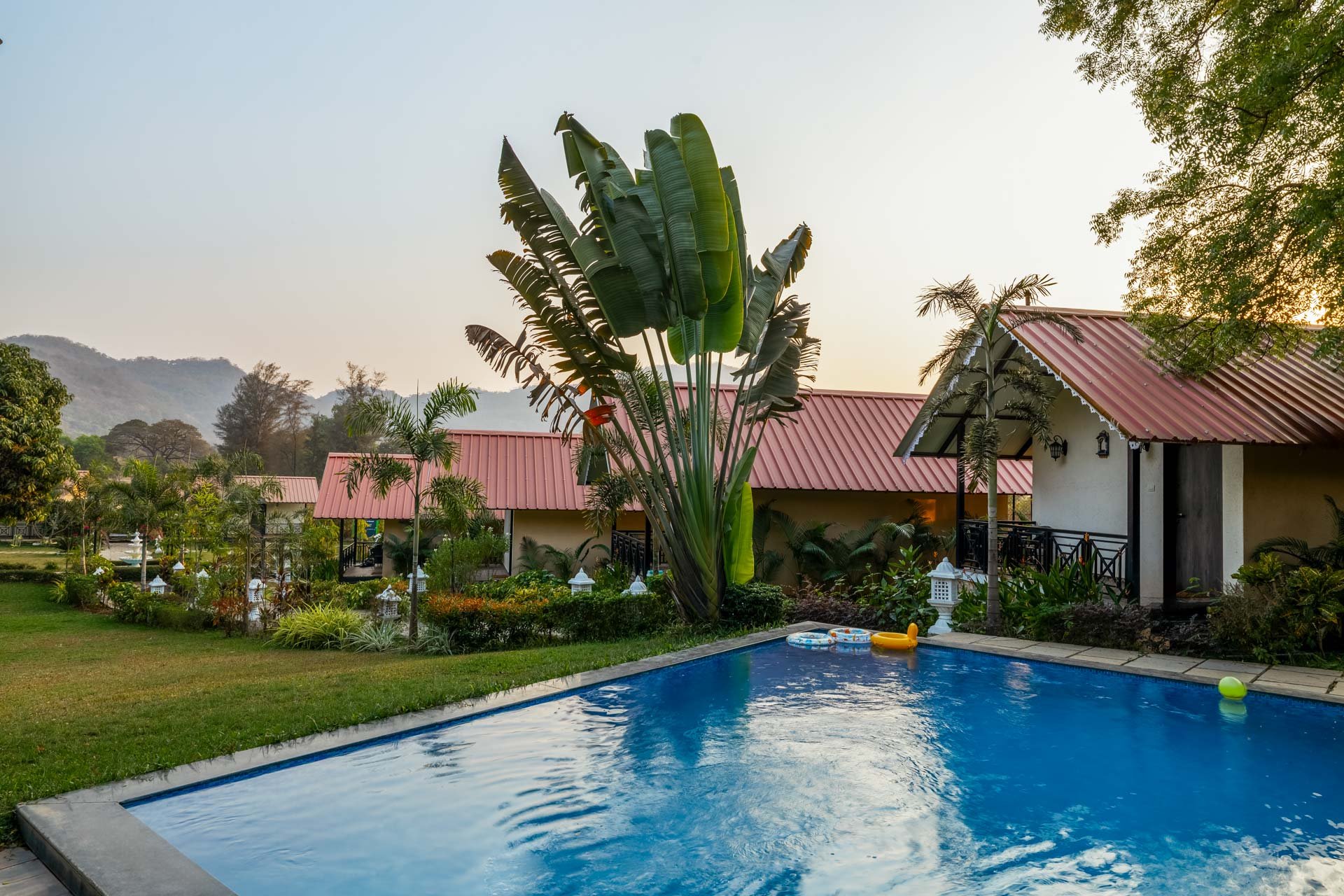
The single most useful thing to do in Karjat in monsoon is to not leave. Karjat has one of the densest concentrations of private pool villas in India — a side-effect of Mumbai’s weekend-home market. In monsoon, when the surrounding paddy fields turn impossibly green and the cliffs run with water, the right villa becomes the entire trip. The differentiator nobody talks about: heated or covered pools, which mean you can actually use the pool when it is drizzling.
- Price: ₹3,500–₹40,000+ per night depending on villa size and amenities
- Timings: Standard check-in 2:00 PM / check-out 11:00 AM
- Best time: Entire monsoon — these months are the least-booked, so rates are softest
- How to reach from Karjat station: Most villas are 5–15 km out; pickups are usually arranged through the host
- Time required: Minimum 1N/2D; 2N/3D is the sweet spot
- Ideal for: Families, groups of friends, couples wanting privacy
- Pro tip: When booking June–September, filter for “heated pool” or “covered deck” specifically — most Karjat villas have open pools that are usable in light drizzle only.
Karjat monsoon safety: Read this before any trek
Most Karjat injuries every monsoon happen to first-time trekkers who underestimated the weather. The Pune Forest Division issued a formal 2025 monsoon advisory urging group travel, mandatory rain gear, and a hard ban on night trekking — and the Akhil Maharashtra Gironarohan Mahasangh (AMGM) has published similar Sahyadri-specific guidelines. Six rules from both, condensed:
- Never trek alone. The forest department’s standing recommendation is a minimum group of three.
- Start early, descend by 4:00 PM. Cloud cover at altitude blocks light by 5:00 PM in monsoon. Headlamps are not enough on wet basalt.
- Pack waterproof. A dry bag for your phone, a poncho over your daypack (not just yourself), and lightweight quick-dry layers. Cotton kills you here.
- Wear trekking shoes with aggressive lugs. Running shoes glaze over on wet basalt within thirty minutes. Floaters work only for waterfall wades, not climbs.
- Manage leeches. Tuck pants into socks, apply Odomos or DEET to ankles, carry table salt or tobacco snuff. Check skin at every break.
- Tell someone your route and ETA. Cellular signal drops in every Karjat valley. Share your plan with your villa host or a friend before you leave.
If a stream that was ankle-deep on your way up is knee-deep on your way down, do not cross it. Wait or detour. Flash-surges from upstream rainfall are the single most-documented cause of Sahyadri monsoon fatalities — referenced consistently by Deccan Herald’s AMGM reporting.
Distances from Karjat station to all 15 activities
| Activity | Distance from Karjat Jn | Travel time |
|---|---|---|
| Bhivpuri Waterfall | ~8 km | 20 min (train + walk) |
| Garbett Plateau trailhead | ~8 km (Bhivpuri Rd) | 20 min |
| Sondai Fort base | ~10 km | 25 min |
| Peb Fort trailhead (Neral) | ~10 km | 25 min |
| Kondana Caves trailhead | ~15 km | 40 min |
| Saguna Baug, Neral | ~15 km | 35 min |
| Rajmachi Karjat-side base | ~14 km (Kondivade) | 35 min |
| Ulhas Valley viewpoint | ~12–15 km | 30 min |
| Morbe Dam | ~20 km | 45 min |
| Imagicaa Khopoli | ~20 km | 40 min |
| Zenith Waterfall, Khopoli | ~25 km | 30 min (shuttle train) / 45 min (cab) |
| Kundalika rafting, Kolad | ~30 km | 50 min |
| Karnala Bird Sanctuary | ~50 km | 1 h 20 min (via Panvel) |
| ISKCON Govardhan Eco Village | ~95 km | 2 h 30 min |
Three Karjat monsoon itineraries
One-day itinerary (day-trip from Mumbai or Pune)
- 5:30 AM: Catch fast local from Dadar/CSMT (or Pragati Express from Pune)
- 7:30 AM: Reach Karjat → auto to Kondhane village
- 8:00 AM – 1:00 PM: Kondana Caves trek + waterfall
- 1:30 PM: Lunch at a Kondivade-area dhaba (₹250–₹400 per head)
- 3:00 PM: Bhivpuri Waterfall (short stop)
- 6:00 PM: Return train
Two-day weekend (1N/2D — the most common Karjat trip)
- Day 1 morning: Travel Mumbai/Pune → check in to pool villa by 2 PM
- Day 1 afternoon: Bhivpuri Waterfall + Ulhas Valley viewpoint (½ day)
- Day 1 evening: Villa dinner, fire pit, pool if weather allows
- Day 2 morning: Sondai or Kondana trek (start 6:30 AM)
- Day 2 afternoon: Check out, lunch at Saguna Baug or villa, return
Three-day extended (2N/3D for trekkers and families)
- Day 1: Arrive, villa, Bhivpuri or Zenith waterfall in evening
- Day 2: Big trek day — Garbett Plateau or Peb Fort
- Day 3: Kundalika rafting at Kolad (morning slot), villa lunch, depart
Where to stay in Karjat in monsoon: Pool villas, picked for the weather
The short answer: a private pool villa, ideally one with a covered or heated pool. Karjat has dozens of options, but in monsoon the deciding factor is whether you can actually use the pool when it is raining.
What to filter for when booking:
- Covered or heated pool — the single most under-rated monsoon amenity
- Indoor entertainment — pool table, projector, board games, indoor games
- Caretaker-included meals — cooking in monsoon is a logistical hassle; villas with on-site cooks remove it
- Power backup — Karjat’s grid drops in heavy monsoon storms; check for inverter or generator
- Distance from Karjat station — under 15 km is ideal for trek mornings; under 5 km if you have elderly guests
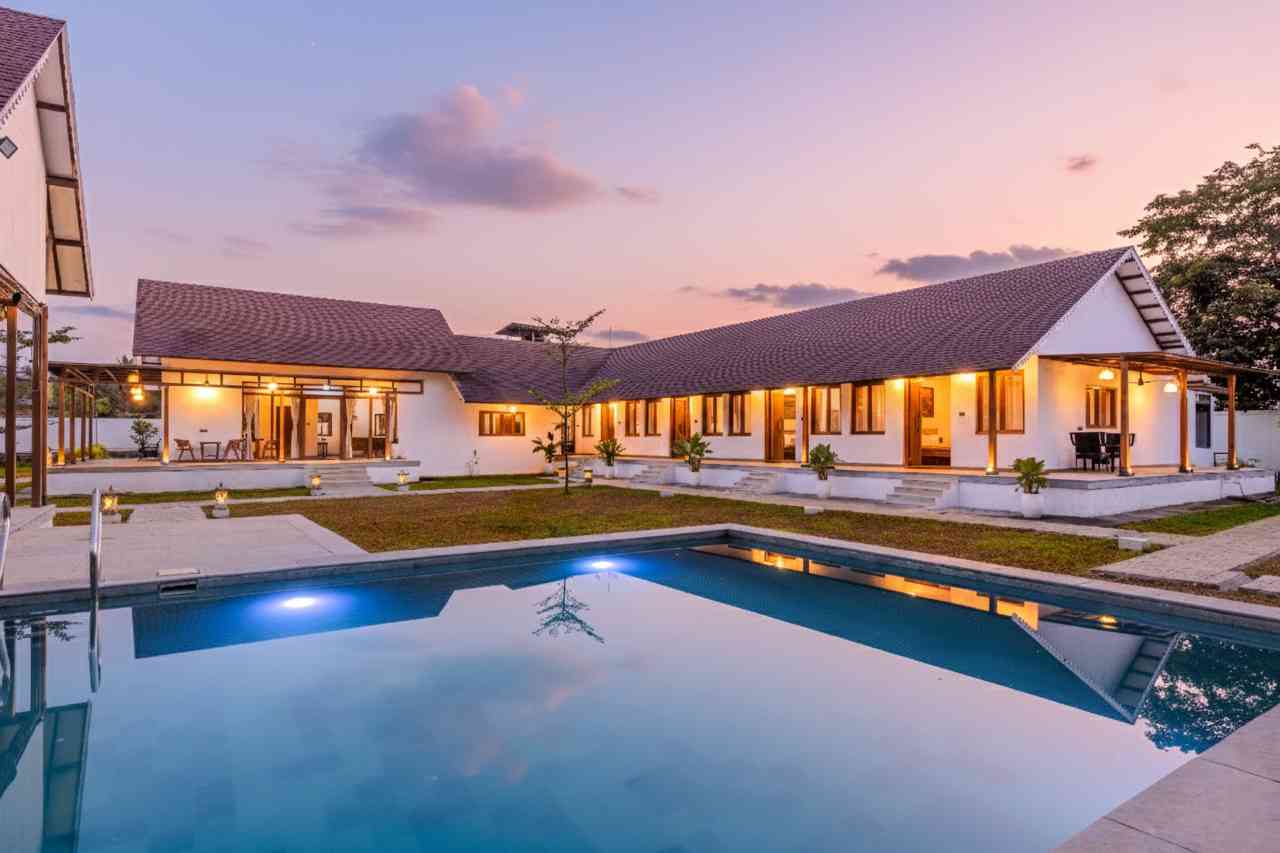
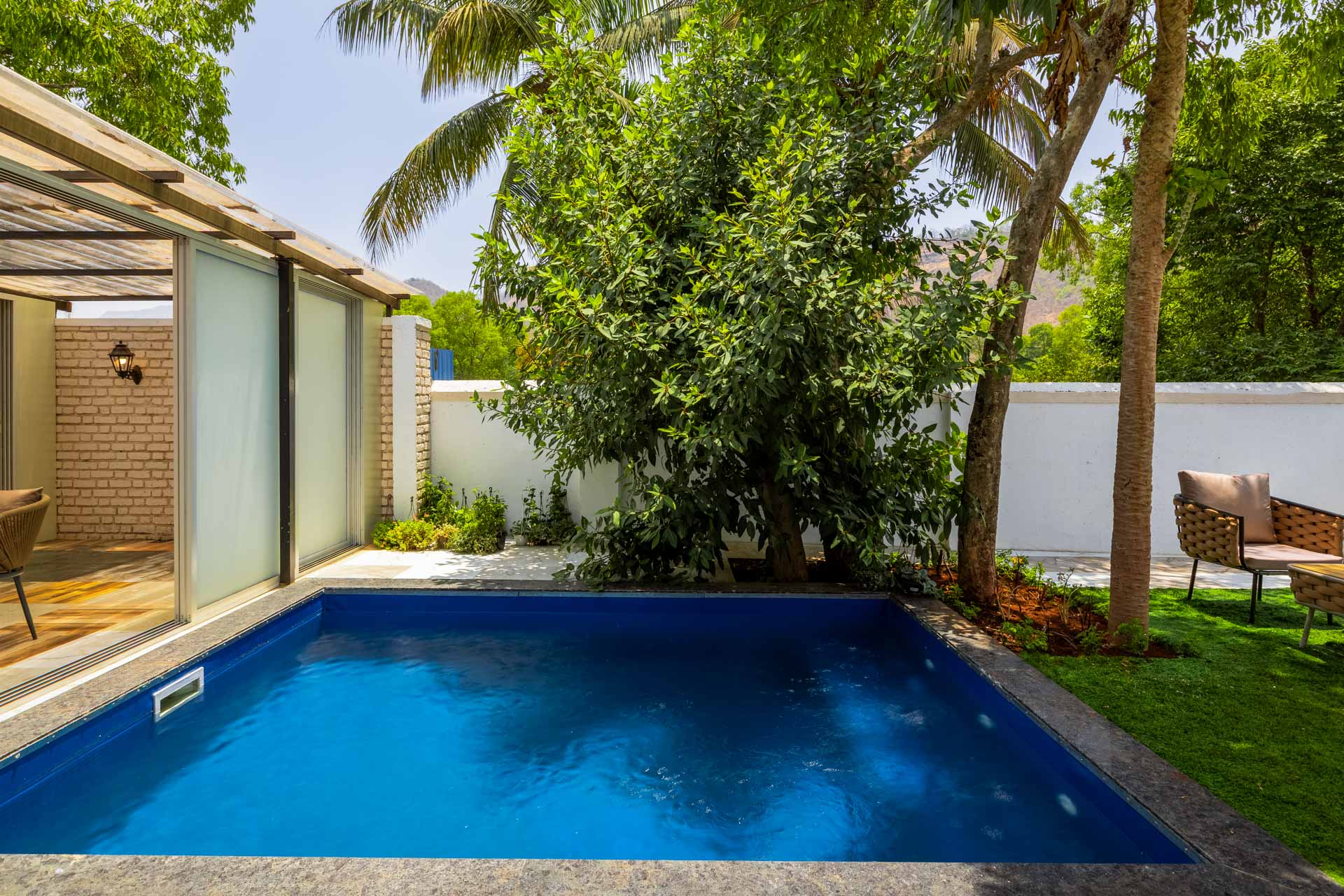
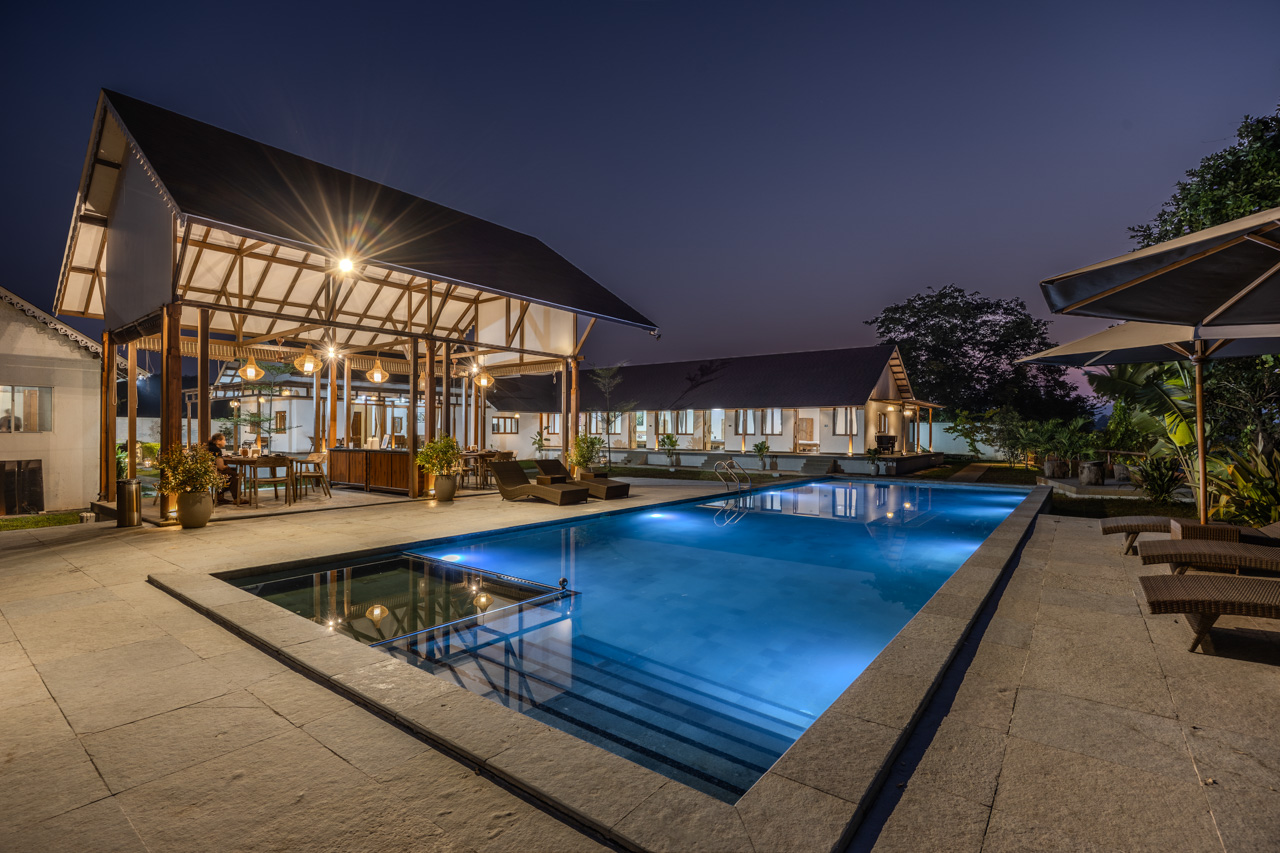
You can browse Karjat pool villas on StayVista filtered by amenity, group size and budget. Several have heated pools and covered decks specifically for monsoon use.
Karjat monsoon FAQ
Yes — Karjat is at its best between mid-June and late September, when the surrounding Sahyadri hills, waterfalls and paddy fields are at peak intensity. It is the most accessible monsoon escape from Mumbai (62 km) and Pune (105 km), and offers everything from beginner treks to Grade III river rafting in a single weekend.
Late July to early September is the sweet spot. June is too unpredictable (rains may not have set in fully) and late September starts drying up. July and August are peak rainfall months — the best for waterfalls and views, the most demanding for treks.
Sondai Fort and Kondana Caves are the two most beginner-friendly monsoon treks in the Karjat region. Both are 3–5 hours round trip, have gentle gradients, and are documented as safe in heavy rain. Peb Fort and Rajmachi are intermediate to advanced; first-timers should avoid both.
Yes — Kundalika is dam-released, which means the water level is controlled. Monsoon is actually the peak season, with Grade II–III rapids running daily. Reputable operators provide certified guides, helmets and life jackets. Minimum age is typically 14.
No. Indian Railways suspends the main Neral–Matheran service from mid-June to mid-October every year for safety. Only the short Aman Lodge–Matheran shuttle runs intermittently. Plan to drive or trek up if you want to visit Matheran in monsoon.
About 70 km. Direct Central Line locals from CSMT, Dadar, Kurla, Thane and Kalyan take 1 hour 20 minutes (fast locals/express) to 2 hours 30 minutes (slow locals). Karjat Jn is a major junction, so trains are frequent in both directions.
Yes, if you book the right one. Open pools are usable only in light drizzle, but villas with heated or covered pools work through any monsoon weather. Monsoon is also the cheapest season for villas in Karjat, so rates are 20–35% lower than peak winter.
Trekking shoes with deep lugs, a poncho or rain jacket (not an umbrella), quick-dry shorts or pants, a dry bag for electronics, a microfibre towel, Odomos or DEET for leeches, a power bank, and one complete change of clothes per day. Skip cotton; pack synthetic or merino.
Plan your Karjat monsoon weekend
Karjat in the rain is one of the few weekend destinations in India where the trip improves the worse the weather gets. Picking the right five or six things from this list — one trek, one waterfall, one adrenaline activity, one slow afternoon and one night in a covered-pool villa — gives you the entire Sahyadri-monsoon experience in 48 hours. The two non-negotiables: respect the forest-department advisories on the treks, and pick a villa where the rain becomes part of the stay rather than something to wait out. Start with Karjat villas filtered for monsoon-ready pools, then build the rest of the weekend around it.