
Ambubachi Mela 2026 at Kamakhya Temple: Dates, Rituals & Travel Guide
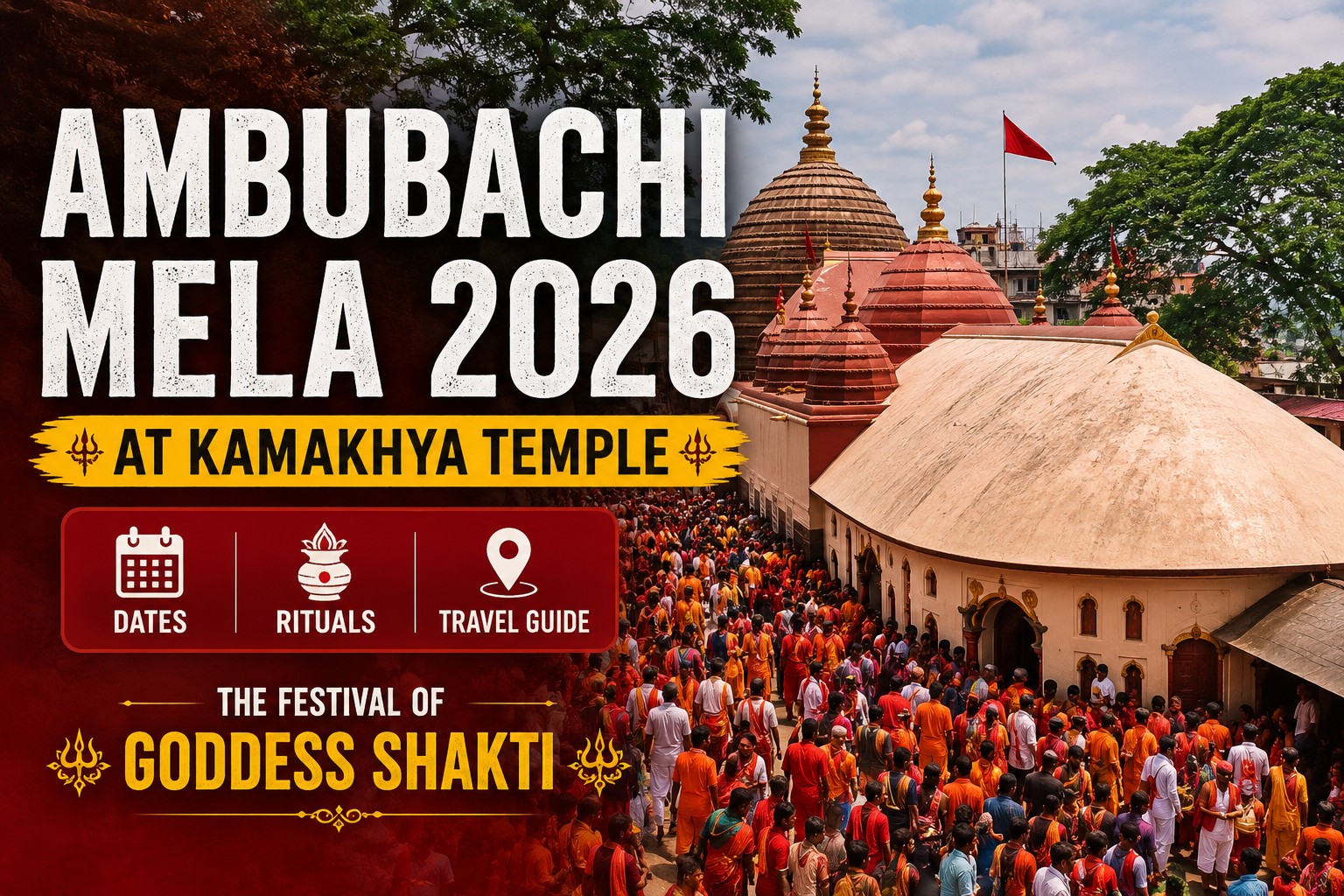
Ambubachi Mela 2026 runs from the night of June 22 to the morning of June 26 at Kamakhya Temple, Guwahati, Assam. The temple’s sanctum stays closed for three days (June 23–25) while the goddess is believed to be in her annual menstrual cycle, and reopens on June 26 for darshan. It is one of India’s largest spiritual gatherings, often called the “Mahakumbh of the East,” drawing several lakh devotees, sadhus, and Tantric practitioners.
Ambubachi Mela is unlike any other Hindu festival. Where most temples celebrate divine power, Kamakhya celebrates divine fertility — openly honouring menstruation as the source of creation rather than treating it as taboo. For four days every June, the Nilachal Hills above Guwahati fill with red-robed sadhus, Tantric ascetics, and pilgrims from across India and beyond.
If you’re planning to witness it in 2026, this guide covers everything: exact dates, the day-by-day ritual schedule, darshan and VIP pass details, how to reach the temple, what to do around Guwahati during the closed days, and where to stay. StayVista’s homestays around Guwahati make a comfortable base for the trip — more on that later.
In this Blog
Quick Info Table
| Field | Details |
| Festival dates 2026 | Night of June 22 – morning of June 26 (4 days) |
| Sanctum closed | June 23, 24, 25 (3 days) |
| Temple reopens | June 26 (after sunrise, post-purification) |
| Location | Kamakhya Temple, Nilachal Hills, Guwahati, Assam |
| Nearest airport | Lokpriya Gopinath Bordoloi International Airport (LGBI), ~20 km / 45–60 min |
| Nearest railway station | Kamakhya Junction, ~6.8 km; Guwahati Railway Station, ~8.3 km |
| Normal darshan timings | 5:30 AM–1:00 PM & 2:30 PM–5:30 PM |
| VIP / Special Darshan pass | ₹501 per person (offcial portal) |
| Ideal trip duration | 3–4 days |
| Entry to temple | Free (general darshan) |
When Is Ambubachi Mela 2026? Exact Dates and Schedule
Ambubachi Mela 2026 begins on the night of June 22 and concludes at sunrise on June 26. The festival falls on the seventh day of the Assamese month of Ahaar, when devotees believe Goddess Kamakhya enters her annual menstrual phase. Temple authorities confirmed the dates in May 2026 and have begun crowd-management preparations with the district administration.
The mela is split into two distinct phases that every visitor should understand before booking travel:
- Pravritti (the closure) — Begins the night of June 22. The sanctum sanctorum is sealed and no darshan is allowed for three full days (June 23, 24, 25). This is when the goddess is believed to be menstruating.
- Nivritti (the reopening) — On June 26, after elaborate purification rituals, the temple doors reopen. This single day draws the largest crowds, with many devotees waiting overnight for the first darshan.
A practical takeaway: If your primary goal is to enter the sanctum and have darshan, plan to be in Guwahati on June 26. If you want to experience the spiritual atmosphere, the sadhus and the fair itself, the three closed days (June 23–25) are the real spectacle.
| Date (2026) | Phase | What happens |
| June 22 (night) | Pravritti begins | Sanctum closes; menstruation cycle believed to begin |
| June 23–25 | Closed period | No darshan; sadhus, Tantrics, fair, spiritual activity peaks |
| June 26 (morning) | Nivritti / reopening | Temple reopens after purification; darshan resumes |
What Is Ambubachi Mela and Why Is It Significant?
Ambubachi Mela is an annual fertility festival that celebrates the menstruation of Goddess Kamakhya, making it one of the few religious events in the world to publicly worship the female reproductive cycle as sacred. The word “Ambubachi” loosely translates to “water sprouting,” symbolising the monsoon’s arrival and the earth’s renewed fertility.
The festival breaks centuries-old taboos around menstruation by reframing it as the very source of life. During these days, devotees believe the creative energy of the goddess — and by extension, mother earth — is at its peak. It is also the most important date on the calendar for Tantric practitioners, who travel from across India to perform sadhana (spiritual practice) during the period when esoteric energies are believed to be strongest.
Ambubachi Mela is often called the “Mahakumbh of the East” because it gathers several lakh pilgrims, sadhus, and ascetics at a single Shakti Peetha over four days, rivalling North India’s largest religious congregations in spiritual intensity.
The legend behind Kamakhya Temple
Kamakhya Temple is one of the 51 Shakti Peethas — sacred sites where parts of Goddess Sati’s body are believed to have fallen. According to mythology, after Sati immolated herself, a grief-stricken Lord Shiva carried her body across the cosmos. Lord Vishnu used his Sudarshan Chakra to cut the body into fragments, and the spot where her womb and genitals (yoni) fell became Kamakhya. This is why the temple has no idol in its sanctum — instead, devotees worship a natural stone cleft, kept moist by an underground spring, as the symbol of the goddess’s creative power.
The present temple was rebuilt in 1565 by King Naranarayana of the Koch dynasty after earlier structures were destroyed by invaders, and its distinctive beehive-shaped shikhara is a landmark of Assamese temple architecture.
The Rituals of Ambubachi Mela Explained
During Ambubachi Mela, the Kamakhya sanctum is covered with a red cloth and sealed for three days, and on the fourth day devotees receive “Angodak” (holy water) and “Angabastra” — small pieces of the red cloth believed to have absorbed the goddess’s power. These prasad items are considered extraordinarily auspicious and are carried home by pilgrims as blessings for fertility, prosperity, and protection.
Here is what unfolds across the festival:
- Covering of the sanctum: Before the closure, the natural rock symbol is draped in red cloth. All farming, cooking of certain foods, and auspicious activities are traditionally paused in nearby households as a mark of respect.
- The three days of closure: No worship happens inside. Outside, the temple complex transforms into a vast spiritual fair — sadhus perform yoga and meditation, Tantrics conduct private rituals, and devotees observe austerities.
- Purification and reopening: On the fourth day, priests perform elaborate cleansing rituals before the doors reopen.
- Distribution of prasad: Devotees queue to receive Angodak (the spring water) and Angabastra (fragments of the sacred red cloth). Supplies are limited, which is part of why reopening day is so crowded.
Note: This is first and foremost a religious observance, not a tourist spectacle. Photography inside the sanctum is prohibited, dress modestly, and follow the instructions of temple volunteers and police, especially in the queues.
Kamakhya Temple Darshan Timings and VIP Pass for 2026
Kamakhya Temple is normally open for darshan from 5:30 AM to 1:00 PM and again from 2:30 PM to 5:30 PM, but during the three closed days of Ambubachi Mela (June 23–25, 2026) the sanctum is shut and darshan resumes only on June 26. Plan your visit around this if darshan is your priority.
To skip the multi-hour general queue, you can buy a Special (VIP) Darshan pass for ₹501 per person, which typically cuts your wait to 30 minutes–1 hour versus 2–5 hours (or much longer on reopening day) in the free line.
| Darshan type | Cost | Typical wait |
| General darshan | Free | 2–5 hours (far longer on June 26) |
| Special / VIP darshan | ₹501/person | 30 min–1 hour |
How to book: Use the official Assam government portal – select “Maa Kamakhya Devalaya,” choose “Special Darshan,” pick your date, pay online, and carry the e-ticket plus a government photo ID. Passes are also sold at the temple counter, but online booking is strongly recommended during the mela.
Note: Confirm 2026 VIP darshan availability and exact slot timings on portal closer to June, as Ambubachi schedules shift year to year.
Crowd reality check: Reopening day (June 26) attracts the heaviest footfall of the year, with overall mela attendance crossing several lakh. Authorities have added a new access route from the Pandu side in 2026 to ease congestion. Expect long queues, heat, and humidity — arrive very early, stay hydrated, and keep valuables minimal.
How to Reach Kamakhya Temple, Guwahati
Kamakhya Temple sits atop the Nilachal Hills, about 8 km west of Guwahati city centre, and is well connected by air, rail, and road, making it one of Northeast India’s most accessible pilgrimage sites. Here are your options.
By air
The nearest airport is Lokpriya Gopinath Bordoloi International Airport (LGBI), roughly 20 km from the temple — about a 45–60 minute drive depending on traffic. Guwahati has direct flights from Delhi, Kolkata, Mumbai, Bengaluru, and most metros. Prepaid taxis and app cabs (Ola/Uber) are available at the airport.
By train
- Kamakhya Junction — the closest station at ~6.8 km, with autos and taxis to the hilltop (15–20 minutes).
- Guwahati Railway Station — ~8.3 km, well connected to Kolkata, Delhi, and the rest of India.
By road
From the base of the Nilachal Hills, shared jeeps, autos, and taxis run up the winding hill road to the temple. During Ambubachi Mela, expect traffic restrictions and diversions on the hill — follow police signage and consider walking up if queues for vehicles are long.
Citation-ready fact: Kamakhya Temple is approximately 20 km from Guwahati’s LGBI International Airport and 6.8 km from Kamakhya Junction railway station, with the temple itself perched on Nilachal Hill about 8 km from the city centre.
Best Time to Visit and Travel Tips
The Ambubachi Mela days (late June) are the most spiritually significant time to visit Kamakhya, but October to April offers the most comfortable weather for general sightseeing in Guwahati. June is peak monsoon — hot, humid, and prone to sudden downpours — so the mela rewards the prepared.
Practical tips for the 2026 mela:
- What to carry: Light cotton clothing, a compact umbrella or raincoat, refillable water bottle, ORS sachets, hand sanitiser, and comfortable walking shoes you can remove easily.
- Footwear: You’ll walk and queue barefoot near the sanctum; carry a cloth bag for your shoes.
- Cash: Keep small denominations for offerings, autos, and local stalls; UPI works in most shops but not all temple-area vendors.
- Health: The combination of heat, humidity, and crowds is demanding — older travellers and young children should pace themselves and avoid the June 26 crush if possible.
- Bookings: Reserve trains, flights, and stays well in advance; Guwahati accommodation fills up fast during the mela.
Places to Visit Near Kamakhya Temple During the Closed Days
The three closed days (June 23–25) are perfect for exploring Guwahati and its surroundings. Here are the best attractions nearby, each with the practical details you need to plan.
1. Umananda Temple (Peacock Island)
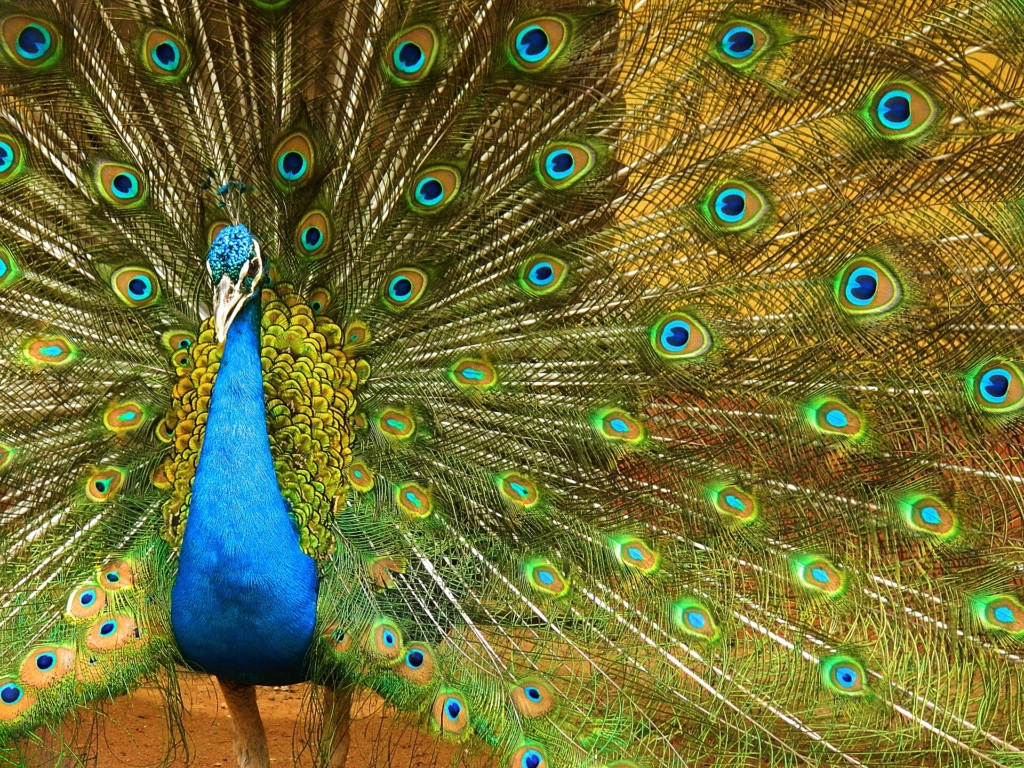
A Shiva temple on the world’s smallest inhabited river island, set in the middle of the Brahmaputra. The short ferry ride is half the experience, offering lovely views of the river and city skyline. The island’s resident golden langurs are a rare sight.
- Entry fee: Temple free; ferry approx ₹20–₹40 per person (govt ferry)
- Timings: ~6:00 AM–5:00 PM (ferry-dependent)
- Best time: Morning, for calmer river and cooler weather
- How to reach: Ferry from Kachari Ghat / Fancy Bazaar, ~7 km from Kamakhya
- Time required: 1.5–2 hours
- Ideal for: Couples, families, photographers
- Pro tip: Check the last return ferry timing before crossing so you’re not stranded.
2. Assam State Zoo cum Botanical Garden
One of the largest zoos in the Northeast, home to the one-horned rhino, tigers, leopards, and a wide variety of birds, right on the slopes near Kamakhya.
- Entry fee: ~₹30 adults; approx extra for camera
- Timings: 8:00 AM–4:00 PM (closed Fridays)
- Best time: Early morning when animals are active
- How to reach: ~7 km from Kamakhya, in Hengrabari
- Time required: 2–3 hours
- Ideal for: Families with kids
- Pro tip: Wear walking shoes; the grounds are spread over a large hilly area.
3. Navagraha Temple
The “Temple of Nine Planets” atop Chitrachal Hill, an ancient centre of astrology and astronomy with nine lingams representing the celestial bodies. The red-domed sanctum has a striking, atmospheric interior.
- Entry fee: Free
- Timings: ~6:00 AM–6:00 PM
- Best time: Late afternoon for city views from the hill
- How to reach: ~10 km from Kamakhya, east Guwahati
- Time required: 45 min–1 hour
- Ideal for: Spiritual travellers, history buffs
- Pro tip: Combine with Navagraha’s hilltop sunset views over Guwahati.
4. Basistha Ashram
A serene hermitage linked to sage Vasistha, set in the forested Sandhyachal hills with three mountain streams meeting nearby. A favourite local picnic and meditation spot.
- Entry fee: Free
- Timings: ~6:00 AM–6:00 PM
- Best time: Morning or post-monsoon for full streams
- How to reach: ~12 km south of Kamakhya
- Time required: 1–1.5 hours
- Ideal for: Couples, nature lovers
- Pro tip: The stream rocks get slippery in the rains — tread carefully.
5. Assam State Museum
A well-curated museum in Ambari showcasing Assam’s sculptures, manuscripts, tribal art, and artefacts — a great rainy-afternoon option during the mela.
- Entry fee: ~₹20 approx; extra for camera
- Timings: 10:00 AM–4:30 PM (closed Mondays & holidays)
- Best time: Midday, especially if it’s raining
- How to reach: ~6 km from Kamakhya, near Dighalipukhuri
- Time required: 1–1.5 hours
- Ideal for: Culture and history enthusiasts
- Pro tip: Photography rules vary by gallery — ask at the entrance.
6. Pobitora Wildlife Sanctuary
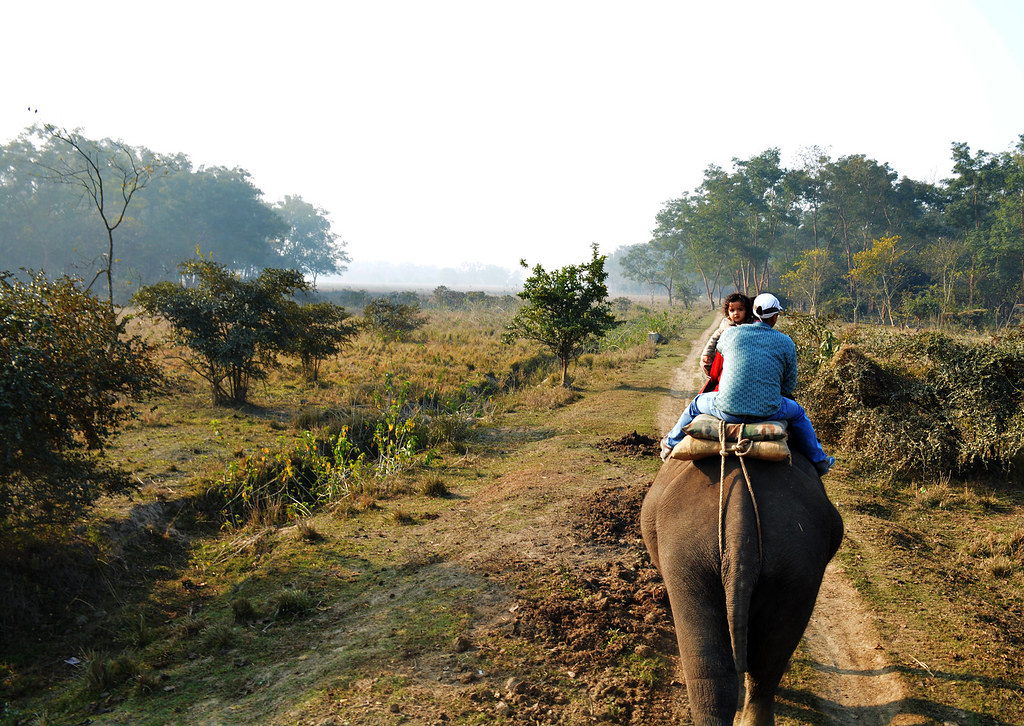
Home to one of the world’s highest densities of the Indian one-horned rhino, plus over 2,000 migratory birds. A rewarding half-day safari trip from Guwahati.
- Entry fee: Indian nationals ~₹50 + jeep/safari charges approx
- Timings: Safaris typically ~7:00 AM–3:00 PM
- Best time: November–March is ideal; June is off-season (check operations)
- How to reach: ~50 km east of Guwahati (~1.5 hours)
- Time required: Half day
- Ideal for: Wildlife lovers, families
- Pro tip: In peak monsoon, safaris may pause — confirm before you drive out.
7. Brahmaputra River Cruise
A sunset cruise on the mighty Brahmaputra is one of Guwahati’s signature experiences, with options ranging from short rides to dinner cruises with cultural performances.
- Entry fee: From ~₹500 per person approx depending on cruise
- Timings: Multiple slots; sunset cruise most popular
- Best time: Evening for sunset over the river
- How to reach: Boards near Fancy Bazaar / Kachari Ghat, ~7 km from Kamakhya
- Time required: 1–2 hours
- Ideal for: Couples, groups
- Pro tip: Book the sunset slot ahead during festival season — it sells out.
8. Bhubaneswari Temple
A small hilltop temple above Kamakhya offers arguably the best panoramic views of Guwahati and the Brahmaputra, especially at sunrise and sunset.
- Entry fee: Free
- Timings: ~6:00 AM–6:00 PM
- Best time: Sunrise or sunset
- How to reach: ~2 km uphill from Kamakhya
- Time required: 30–45 minutes
- Ideal for: Photographers, peace-seekers
- Pro tip: The climb is short but steep — go early to beat the heat.
Suggested Itineraries for Your Ambubachi Mela Trip
A 3–4 day trip is ideal to experience both the spiritual fair and the reopening darshan without rushing. Here’s how to structure it around the 2026 dates.
1-day plan (June 26 – darshan focus)
Arrive in Guwahati the night before. Reach the temple base before dawn on June 26, join the queue (or use your VIP pass), have darshan, collect prasad, and spend the afternoon at Bhubaneswari Temple and a Brahmaputra sunset cruise.
2-day / weekend plan
- Day 1 (June 25): Soak up the fair atmosphere around the closed temple, watch the sadhus, then visit the Assam State Museum and Umananda Temple.
- Day 2 (June 26): Early reopening darshan, prasad collection, and an evening river cruise before departure.
Extended 3–4 day plan
Add a day for Pobitora Wildlife Sanctuary (if monsoon safaris are running), the Assam State Zoo, Navagraha Temple, and Basistha Ashram across June 23–25, keeping June 26 for darshan. This pace suits families and first-time Northeast visitors.
Where to Stay in Guwahati for Ambubachi Mela
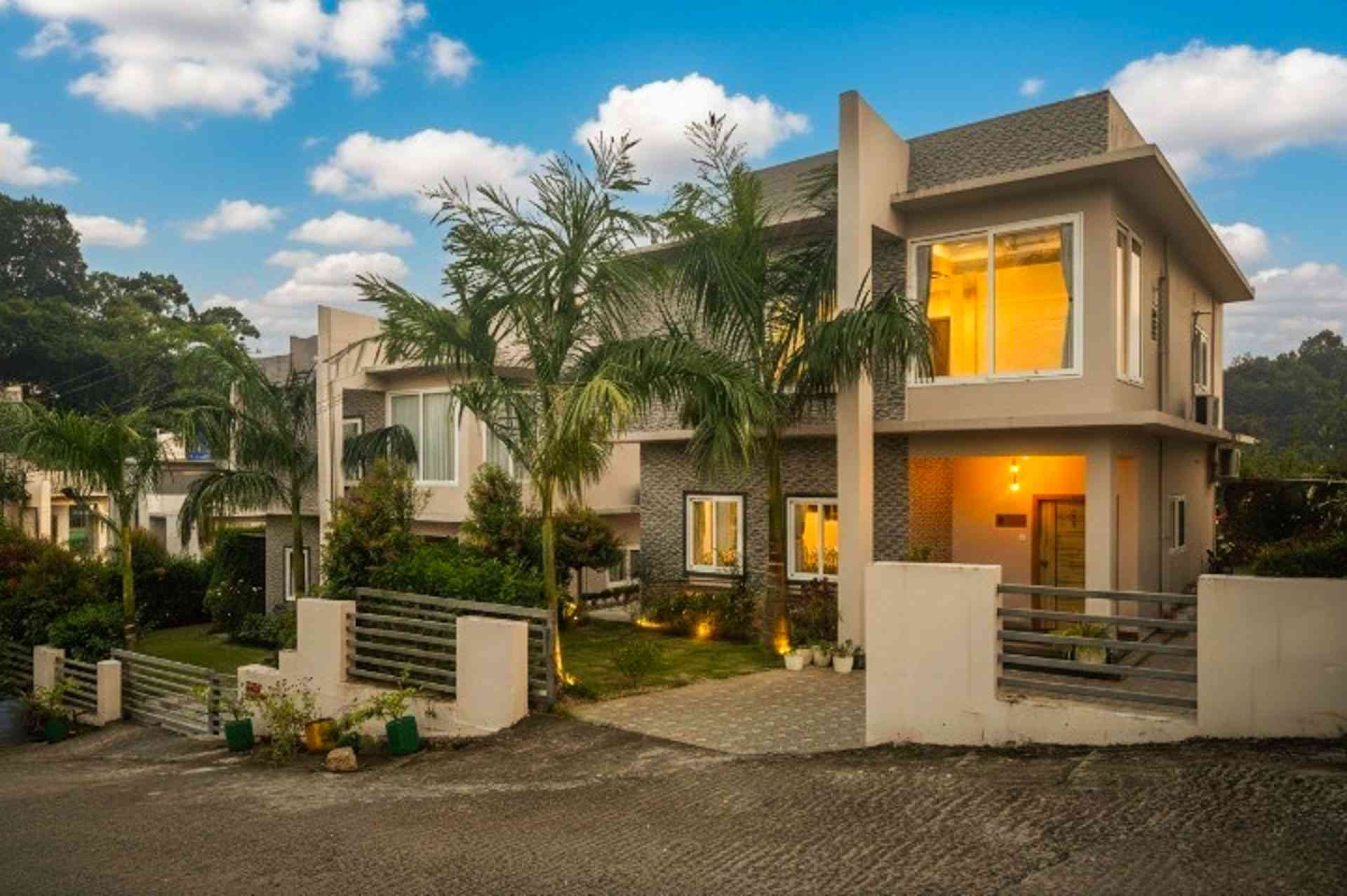
Guwahati’s hotels fill up fast during the mela, and the city’s hill roads get congested — so a comfortable, well-located base makes a real difference. StayVista offers private homestays and villas in and around Guwahati where families and groups travelling for the mela can spread out, cook their own meals, and return to peace and privacy after long, crowded temple days.
Where to stay: For Ambubachi Mela, choose a StayVista homestay on the quieter outskirts of Guwahati rather than the busy temple-side lanes — you get easier parking, more space for groups, and a calm retreat after the crowds. Look for properties with a private kitchen if you’re observing festival dietary customs.
Book early; the late-June window sees a sharp spike in demand across the city.
Ohana 36


Frequently Asked Questions
Ambubachi Mela 2026 runs from the night of June 22 to the morning of June 26 at Kamakhya Temple, Guwahati. The sanctum stays closed June 23–25 and reopens for darshan on June 26.
The temple closes for three days because devotees believe Goddess Kamakhya undergoes her annual menstrual cycle during this period. It is considered a time of intense creative energy, and the sanctum reopens on the fourth day after purification rituals.
No darshan is allowed during the three closed days (June 23–25, 2026). Darshan resumes on June 26, the reopening day, which is also the most crowded. Plan to arrive very early or use a Special (VIP) Darshan pass.
The Special (VIP) Darshan pass costs ₹501 per person and can be booked on the Assam government portal or bought at the temple counter. It reduces wait times to roughly 30 minutes–1 hour.
Kamakhya Temple is about 20 km from LGBI International Airport, 6.8 km from Kamakhya Junction railway station, and 8 km from Guwahati city centre. Taxis, autos, and shared jeeps run up the Nilachal Hills to the temple.
Ambubachi Mela celebrates the fertility and menstruation of Goddess Kamakhya, honouring the female reproductive cycle as the sacred source of life. It is one of the largest Tantric gatherings in India, often called the “Mahakumbh of the East.”
Both can attend, but it is primarily a religious observance. Tourists should dress modestly, follow temple rules, avoid photographing the sanctum, and be prepared for heavy crowds, heat, and monsoon rain in late June.
Plan your Ambubachi Mela 2026 trip
Ambubachi Mela is a once-a-year window into one of India’s most powerful and unusual spiritual traditions. Lock in your travel dates around June 22–26, book a StayVista homestay in Guwahati for a comfortable base, and arrive prepared for the crowds and the monsoon. The reopening of darshan on June 26 is the spiritual high point – but the fair, the sadhus, and the river city around it make the whole trip unforgettable.