
Anjaneri Trek: The 4,264 ft Nashik Plateau Where a Waterfall Falls Upwards
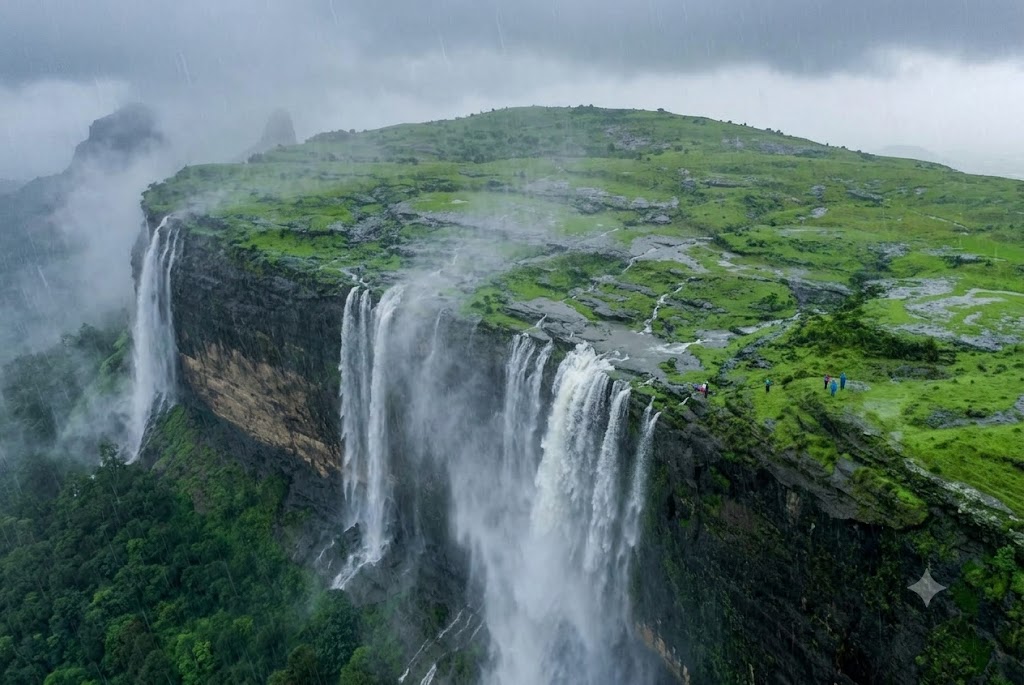
Stand at the right point on the Anjaneri plateau in late July, and the waterfall in front of you runs the wrong way. The wind coming up the cliff face is stronger than the water falling it, so the spray gets picked up and thrown back over the lip. Locals have watched it happen for generations. Most visitors have never heard of it.
The same six weeks that produce it are the six weeks this hill is at its most dangerous. On 21 July 2024, more than 250 trekkers were caught on this plateau in heavy rain. Forest staff formed a human chain and walked them down. The operation began at 11 in the morning and ran into the evening (Free Press Journal, 2024).
Both things are true, and almost nothing written about Anjaneri holds them together. Half the guides online tell you monsoon is the best time to climb. Others give opening hours that don’t match what the forest department actually enforces. A surprising number place this waterfall on a hill 150 km away. Here’s what’s actually the case, where the reverse waterfall is, what the rules are, and how to decide whether this weekend is your weekend.
Anjaneri is a 4–5 km, 3–4 hour climb to 4,264 ft, 20 km from Nashik on the Trimbakeshwar road, believed to be Lord Hanuman’s birthplace. In July–August, wind at the plateau edge blows a waterfall back upwards. It sits inside a notified Conservation Reserve — Maharashtra’s only one created for vultures — so camping is banned and the gate runs 7 AM–6 PM. Skip it in active heavy rain.
In this Blog
Anjaneri trek at a glance
| Altitude | 4,264 ft (~1,300 m) |
| Trek distance | 4–5 km one way |
| Duration | 3–4 hrs up; 5–6 hrs round trip with halts |
| Difficulty | Easy–moderate when dry; moderate in monsoon |
| Gate timings | 7:00 AM – 6:00 PM. Entry restricted in heavy rain at the forest department’s discretion |
| Entry fee | ~₹50 including parking, at the forest checkpost — plus compulsory name and contact registration |
| Camping | Not permitted |
| Guide | Not required; recommended in monsoon |
| Base village | Anjaneri, off Anjaneri Phata |
| From Nashik | ~20 km via Nashik–Trimbakeshwar Road (26 km from Nashik CBS) |
| From Trimbakeshwar | ~11 km |
| From Mumbai / Pune | ~180 km (4 hrs) / ~240 km (6 hrs) |
| Protected status | Anjaneri Conservation Reserve — 5.69 sq km, notified 11 January 2017 |
| Nearest station / airport | Nashik Road (NK) / Nashik (ISK); Mumbai (BOM) |
| Nearest stays | Villas on the Trimbakeshwar side, ~15 km from the trailhead |
What is the Anjaneri reverse waterfall, and when can you see it?
During peak monsoon, high-velocity wind hitting the edge of the Anjaneri plateau pushes falling water back upwards, so the waterfall appears to run in reverse. The window is roughly June to September, peaking in July and August. It’s a wind-driven effect, which means rain alone won’t produce it.
That last point matters more than anything else in this section, and almost no guide says it. A day of torrential rain with still air gives you an ordinary waterfall. A day of moderate rain with hard wind off the valley gives you the thing you came for. Wind is the variable, not rainfall.
Where it actually is: the reverse waterfall point is a distinct stop on the descent — not at the summit, and not at the first plateau. Organised treks reach the top around 9 AM and eat at 11. They start down at 11:30 and hit the waterfall point at about 1 PM. That puts it roughly an hour and a half below the summit, and two hours above the base village. It’s a specific waterfall on the trail, and the updraft off the cliff lifts its spray.
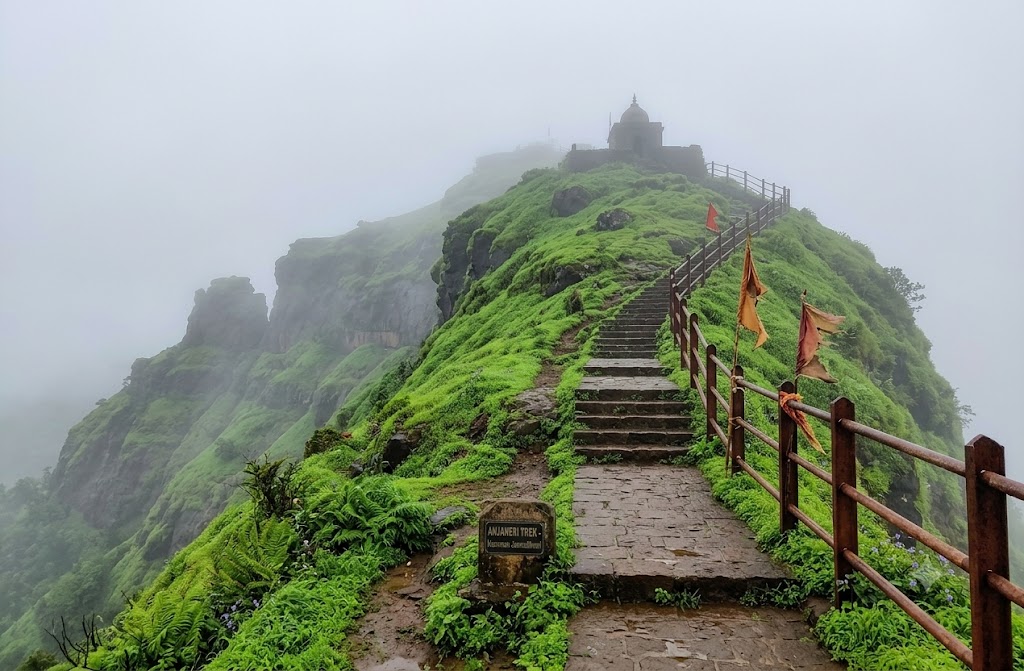
So you see it on the way down, in the early afternoon. That happens to be when the wind is usually strongest, which is convenient, but it also means the waterfall is the last thing on your day, not the first. Plan your turnaround with that in mind.
One clarification, because it trips a lot of people up. You may have read that Anjaneri’s reverse waterfall lies on the way to Tahuli Peak. That’s a different hill altogether. Tahuli sits near Kalyan, about 150 km away, and it has its own separate reverse waterfall. Anjaneri’s is on Anjaneri, in Nashik district.
At Anjaneri near Nashik, high-velocity monsoon wind striking the plateau edge lifts falling water back upwards, creating a reverse waterfall visible roughly June–September and peaking in July–August. The effect is wind-dependent rather than rainfall-dependent, and the viewing point sits on the descent, about 1.5 hours below the 4,264 ft summit.
Is the Anjaneri trek safe in August 2026?
Yes, on a clear, windy morning — and genuinely not on a day of active heavy rainfall. That’s the honest answer, and the July 2024 rescue of 250-plus trekkers is the reason to take the second half of it seriously (Free Press Journal, 2024).
Why the best six weeks to see it are the worst six weeks to climb
This is the tension nobody resolves, so let’s resolve it. The Trimbakeshwar belt gets around 1,564 mm of rain a year, and roughly 488 mm of that lands in July alone. Individual 24-hour readings of 168 mm have been recorded nearby. The plateau that produces the reverse waterfall is the same one that turns to running rock in those conditions.
Separate the two questions. Is the reverse waterfall worth seeing? Yes, and only now. Should you climb today? That depends entirely on today’s forecast, not on the season. Treat them as different decisions and Anjaneri becomes a straightforward trip.
Forest staff and local police are stationed in the area through the monsoon. The department restricts access when conditions turn. Forest Range Officer Vrishali Gade’s guidance after the 2024 operation was direct: if there is heavy rain during your visit, follow the weather predictions and limit your movement.
Skip Anjaneri today if…
- Heavy rain or a thunderstorm is forecast for the Nashik–Trimbakeshwar belt.
- There are fresh landslide reports or a local advisory in place.
- The steps have fast-moving water running down them.
- You’d be starting late, without enough daylight to get down.
- Anyone in your group is unwell, underprepared, or in the wrong footwear.
None of those are judgement calls you should make from a car park at 11 AM. Check the forecast the night before and again at breakfast.
Anjaneri is safe to trek on clear monsoon mornings but hazardous during active heavy rainfall, when the forest department restricts access at its discretion. More than 250 trekkers were stranded on the plateau on 21 July 2024 and evacuated by forest staff in a human chain. The Trimbakeshwar belt receives roughly 488 mm of rain in July alone.
What are the Anjaneri trek timings and forest rules?
The gate runs from 7:00 AM to 6:00 PM; you pay about ₹50 including parking at the forest checkpost, and you register your name and contact details before you start. Camping is not allowed. Neither are DSLRs. Most guides get at least one of these wrong.
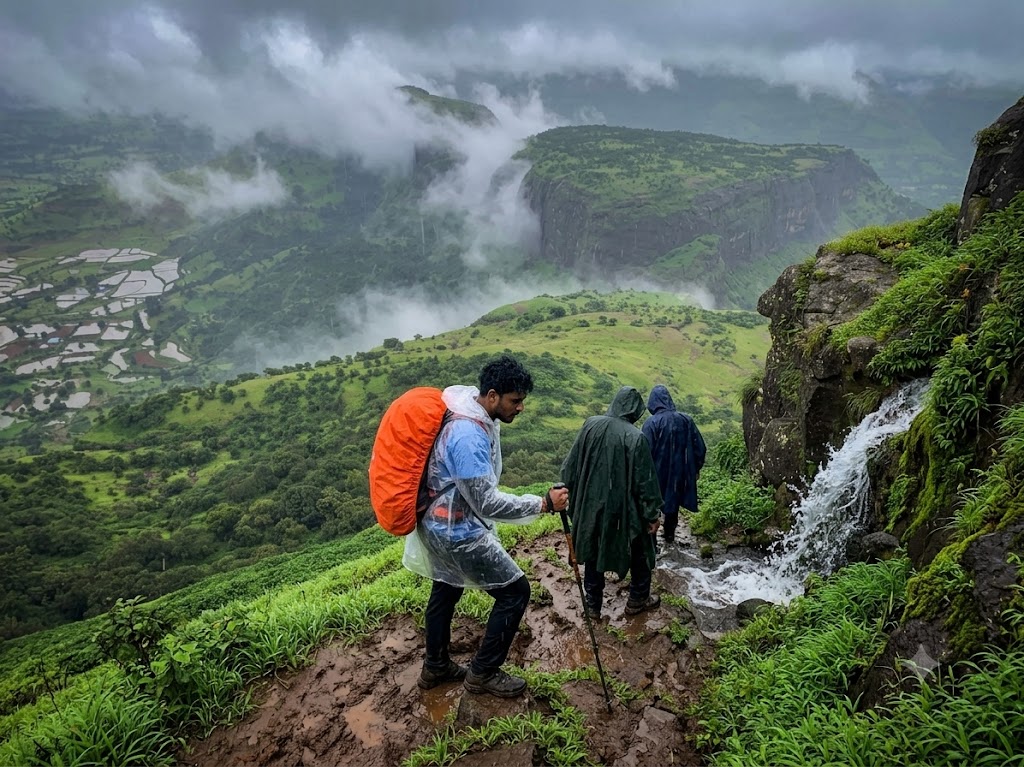
Here’s the part that explains all of it. Anjaneri isn’t a fort with irritating rules attached — it’s a 5.69 sq km wildlife reserve that happens to have a fort on top. It was notified as the Anjaneri Conservation Reserve on 11 January 2017 (Anjaneri Conservation Reserve). Once you know that, every restriction below stops looking arbitrary.
| Rule | Detail |
|---|---|
| Gate timings | 7:00 AM – 6:00 PM |
| Entry fee | ~₹50 including parking, at the forest checkpost |
| Registration | Compulsory — name and contact details, for search-and-rescue purposes |
| Heavy rain | Entry restricted at the forest department’s discretion, regardless of posted hours |
| Camping | Not permitted anywhere on the hill |
| Cameras | DSLRs restricted; phone cameras are fine |
| Drones | Don’t. It’s a raptor nesting site |
| Alcohol & smoking | Prohibited, with prohibitory orders across Nashik West Division tourist spots |
| Water tanks | No swimming, no feet in the water — the village drinks from them |
| Cliff edges | No photography at the edges |
| Waste | Carry everything back down to the village bins |
Sources: Nashik West Forest Division advisories; Maharashtra Forest Department notifications. Verified July 2026 — confirm at the checkpost, as monsoon rules change.
You’ll find plenty of pages saying Anjaneri is open 6 AM to 6 PM. If you turn up at 6, you’ll wait. And the registration step is worth doing properly rather than treating as a formality — it’s the list that gets checked if the weather closes in while you’re up there.
Anjaneri Fort’s gate operates from 7:00 AM to 6:00 PM, with a ~₹50 entry fee including parking and compulsory visitor registration at the forest checkpost. Camping and DSLR cameras are prohibited because the hill lies inside the Anjaneri Conservation Reserve, a 5.69 sq km protected area notified on 11 January 2017.
How hard is it, and can a first-time trekker do it?
A reasonably fit first-timer can do Anjaneri. It’s graded easy-to-moderate in dry conditions and moderate in monsoon, over 4–5 km and 3–4 hours of climbing to 4,264 ft (Incredible India). Grip footwear is the one non-negotiable.
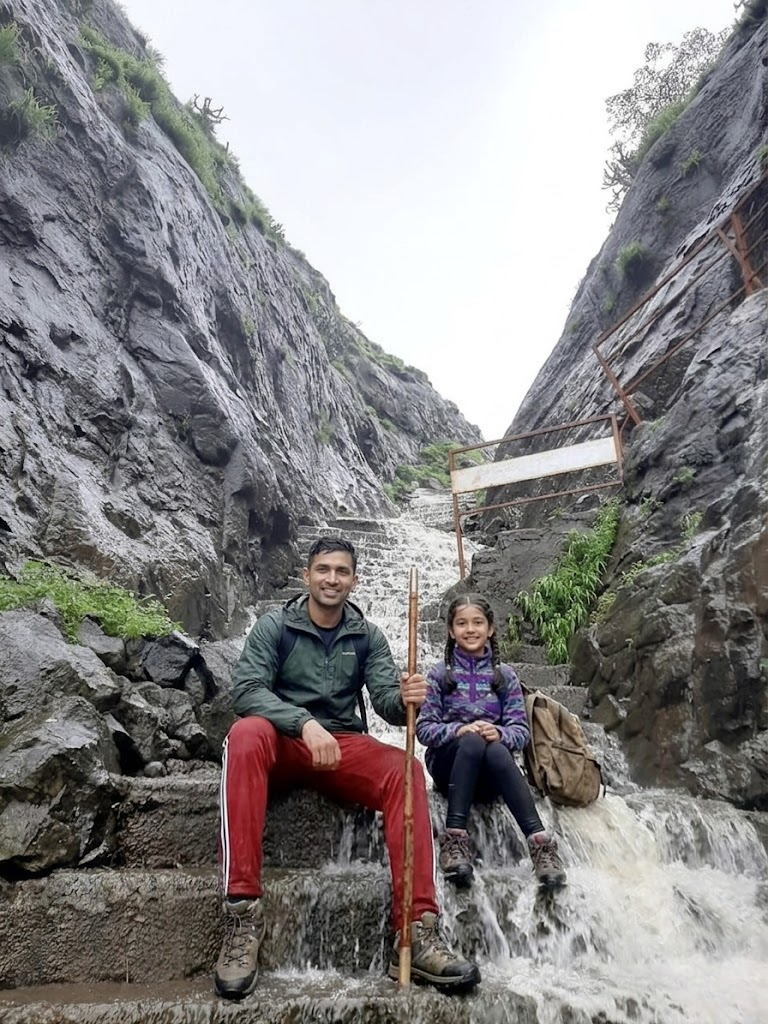
You’ll see the difficulty described as everything from “easy” to “moderately challenging” depending on which page you land on. Both are right — they’re describing different months. The first quarter of the route is concrete and stone steps. Dry, that’s a staircase. Wet, it’s a staircase with water running down it, and the rock further up gets slick.
Families do this trek regularly, and the stone steps make the lower section manageable for children. Older walkers in the group will find the mid-section rockier than the photos suggest. If you’re going in monsoon, go as a group — a slip on wet basalt is a different problem when you’re alone.
Do you need a guide? No. The trail is marked and busy enough on weekends that you won’t lose it. Tell someone your expected return time anyway.
The Anjaneri trek covers 4–5 km and 3–4 hours of ascent to 4,264 ft, graded easy-to-moderate when dry and moderate during monsoon. It suits reasonably fit first-time trekkers in grip footwear, and no guide is required as the trail is marked. Conflicting difficulty ratings online reflect seasonal differences rather than disagreement.
How do you reach Anjaneri from Nashik, Mumbai and Pune?
Anjaneri sits about 20 km from Nashik on the Nashik–Trimbakeshwar road, 26 km from Nashik CBS and roughly 11 km from Trimbakeshwar temple (Incredible India). It’s ~180 km from Mumbai and ~240 km from Pune.
- By car: the simplest option. Head out of Nashik towards Trimbakeshwar and turn off at Anjaneri Phata. Parking is available at the base village, at your own risk.
- By bus: any Nashik–Trimbakeshwar bus will drop you at Anjaneri Phata. From there it’s a 10–15 minute walk to the village and the checkpost.
- By train: Nashik Road (NK) is the nearest station, then a taxi.
- By air: Nashik (ISK) is closest; Mumbai (BOM) for most inbound travellers.
One local thing worth knowing: in August, traffic on the Nashik–Trimbakeshwar road is Shravan pilgrim traffic heading to the Jyotirlinga, not weekend tourist traffic. It builds early, and it doesn’t behave like city congestion. Add 30–40 minutes to whatever your maps app tells you, especially on Mondays.
Which raises the practical problem. You want to be at a checkpost that opens at 7 AM, on a road that clogs with pilgrims, 180 km from Mumbai. That’s not a same-day drive. So where do you sleep?
Where should you stay near Anjaneri?
The closest comfortable option is the cluster of villas on the Trimbakeshwar side of Nashik, roughly 15 km from the Anjaneri trailhead, rather than 20–26 km from Nashik city. That’s 25–35 minutes to the gate instead of 45–60.
The closest comfortable option is the cluster of villas on the Trimbakeshwar side of Nashik, roughly 15 km from the Anjaneri trailhead against 20–26 km from Nashik city. That’s 25–35 minutes to the gate instead of 45–60.personal experience
The arithmetic that decides this for most people: villa check-in is 2 PM. The forest gate opens at 7 AM. A same-day drive from Mumbai or Pune cannot make a 7 AM entry — you need the night before, full stop. And if you book two nights rather than one, you get something more valuable than a lie-in: a second morning in hand. On this hill in August, a weather buffer is the difference between trekking and driving home disappointed.
That’s also the honest case for a villa over a hotel room here. When the forest department closes the gate for rain — and it does — a pool, a covered lawn and a cook on site mean the weekend still works. A city hotel room doesn’t give you that. One thing to know before you plan a self-catered trip. These villas run on cooked-to-order meals rather than guest kitchens. Kitchen access is reheating-only at most of them, and unavailable at Kalrav. Outside food isn’t permitted either, so order meals through the property rather than shopping for them.
Five StayVista villas within reach of the trailhead
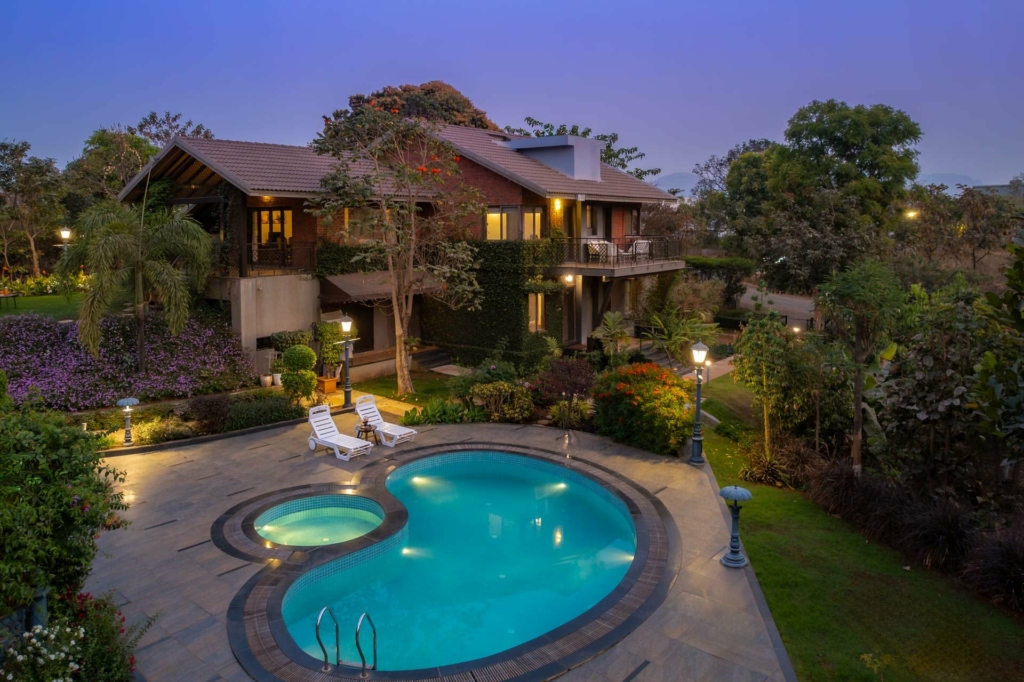
Brickhouse Aranya — 4 bedrooms, 12 guests.
This is the one whose own listing puts Anjaneri at 15 km, alongside Brahmagiri and Trimbakeshwar Jyotirlinga. All four bedrooms have AC, Wi-Fi and ensuite bathrooms, and every bathroom has a geyser. There’s a private pool (30×15 ft, open 8 AM–10 PM) and a 500 sq ft lawn with a gazebo, hammock and loungers. The workstation makes the Thursday-arrival, Friday-work, Saturday-trek pattern possible. Rated 5.0 across 22 reviews, the most-reviewed of this group. Barbecue and bonfire are chargeable extras.
Bohemian — 5 bedrooms, 15 guests
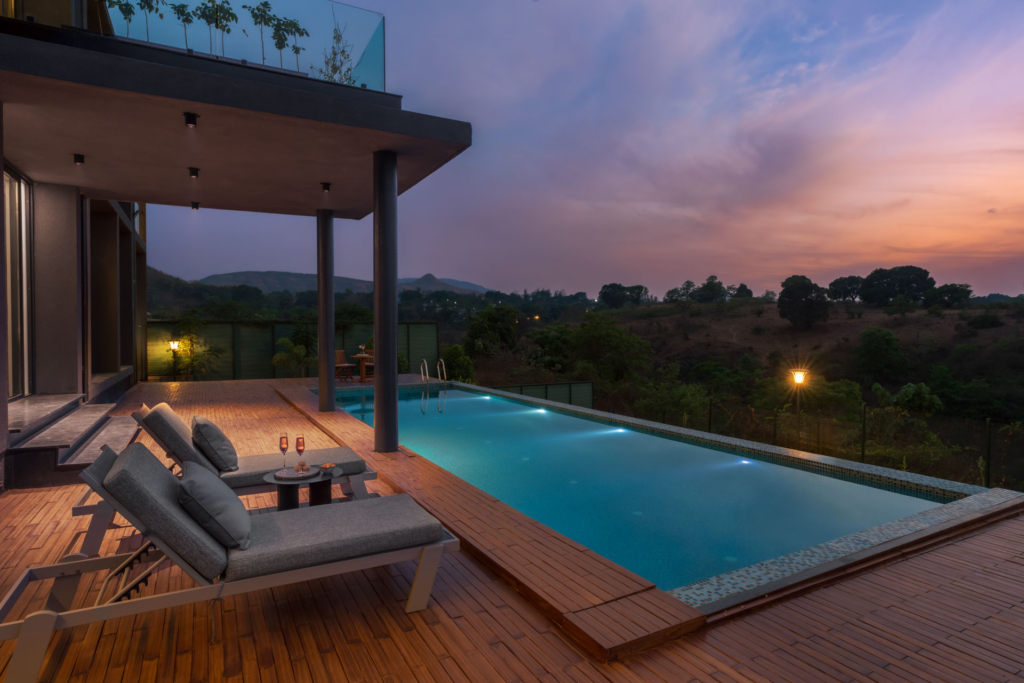
With a private infinity pool looking into the valley and forest views from a 2,000 sq ft lawn. AC, TV and Wi-Fi in every bedroom, geysers in all six bathrooms. About 11.6 km from Trimbakeshwar bus stand, so a similar run to the trailhead. Rated 4.9. Alfresco dining is a chargeable extra.
Horizon Block — 5 bedrooms, 15 guests
With a private infinity pool and listed as senior-citizen-friendly, which makes it the pick for a mixed group pairing Trimbakeshwar darshan with the trek when not everyone intends to climb. Four of the five bedrooms have attached balconies and one bathroom has a bathtub — genuinely useful after a wet descent. One caveat: senior-friendly doesn’t mean step-free here. The property isn’t wheelchair-accessible, so ask about the layout if that matters. Rated 4.8. Alfresco dining is chargeable.
Vayu Farm — 4 bedrooms, 12 guests
Lake views and a 15,000 sq ft lawn, roughly 15 km from Trimbakeshwar bus stand. AC and Wi-Fi throughout, geysers in all six bathrooms, two living rooms. This one has no pool. Worth knowing if a rained-off afternoon is part of your plan. It is the most spacious of the group outdoors, though, and the only one where reheating non-vegetarian food is allowed. Barbecue, bonfire and alfresco dining are chargeable, and there’s a ₹10,000 refundable security deposit.
Kalrav — 6 bedrooms, 8 bathrooms, 18 guests
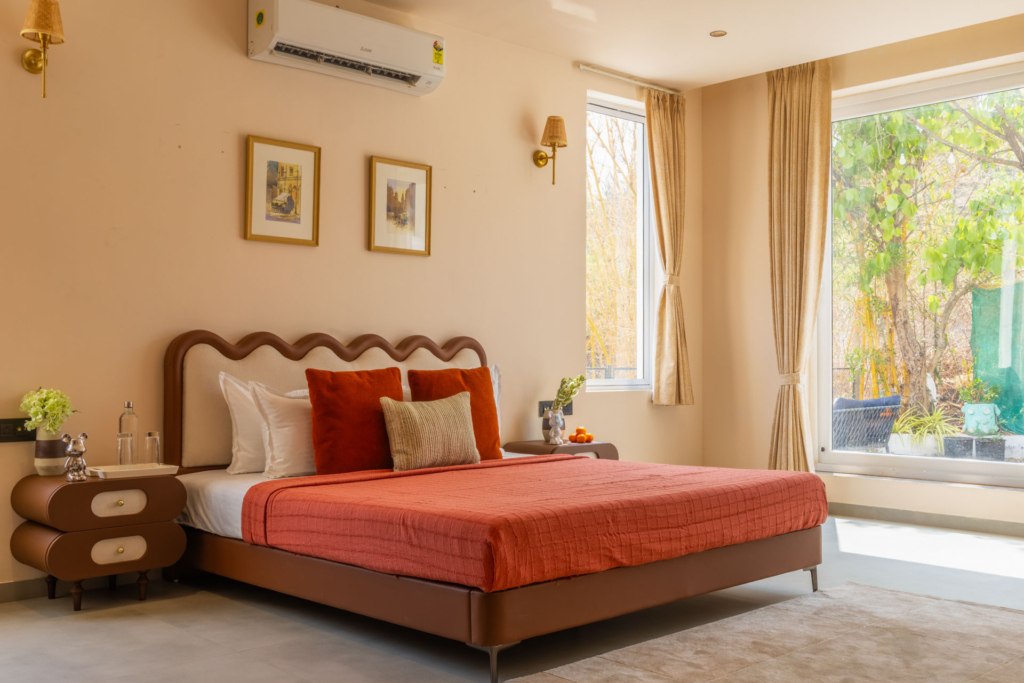
Overlooking Gangapur Dam among mango orchards. This one sits in a different pocket, north-west of Nashik rather than on the Trimbakeshwar road, so it’s a longer run to Anjaneri. It earns its place for two other reasons. It’s fully vegetarian with Jain meals available on request, which makes it the natural choice for Trimbakeshwar pilgrim groups and vegetarian families. And with Sula Vineyards 10 km away, it’s the best base here for a trek-one-morning, vineyards-the-next weekend. Private pool with an attached jacuzzi, plus a separate kids’ pool. There’s an air-conditioned theatre room and two lawns with gazebos. All eight bathrooms have geysers, which you’ll care about after four hours in the rain. Bonfire (₹2,000) and barbecue (₹1,200) are chargeable extras, and there’s no guest kitchen access, so meals need 48 hours’ notice.

Larger groups can look at The Earth Stone or Forest Pearl, both 7 bedrooms sleeping 21, on the same Trimbakeshwar-side stretch. The full list is on villas in Nashik.
How to book, and the one thing to ask for
- Open the villa page or the Nashik listing and enter your dates and guest count.
- Book the night before your trek day, not the trek day itself.
- Check the rate breakdown — rates move with season and weekends.
- Book instantly where the property allows it, or send an enquiry.
- Once confirmed, message the property team and ask for an early or packed breakfast before the 7 AM gate. It’s a normal request and it’s the difference between eating and not eating.
Four house rules to check before you book
These apply across all five villas above, and they catch trekking groups out more than most travellers, so they’re worth knowing at booking rather than at check-in.
- All-male groups aren’t accepted. Trekking parties skew male, so this is the one most likely to affect you — plan a mixed group or speak to the team before you pay.
- None of these are pet-friendly. If you’re travelling with a dog, ask for a pet-friendly Nashik property instead.
- Outside food isn’t allowed, and kitchen access is reheating-only or unavailable. Order meals through the property — and put in your early-breakfast request at the same time.
- Bonfires and barbecues are chargeable, not included. Smoking is confined to exterior areas, hookah isn’t permitted, and noise is kept down after 9 PM.
The Anjaneri trail, stage by stage
The climb breaks into five recognisable stages, and the village-to-plateau section takes about 1.5 hours of the 3–4 hour total. Knowing the stages matters because you need a turnaround time, not just a start time.
| Stage | Time | Cumulative | What you’re on |
|---|---|---|---|
| Anjaneri Phata → base village | 10–15 min | 0:15 | Flat road walk; checkpost and parking here |
| Village → first plateau | ~1 hr 30 min | 1:45 | Concrete and stone steps, then forest and rock. Monkeys on the lower steps |
| Plateau → Anjani Mata temple | 10 min | 1:55 | Open meadow walking |
| Temple → Sita Cave | 10 min | 2:05 | Signed fork; carved cave chambers |
| Temple → citadel & Hanuman temple | 20 min | 2:25 | Final rise to the summit views |
| Reverse waterfall point | ~1 hr 30 min below summit | On descent | Wind-dependent; monsoon only |
Stage times compiled from published trek itineraries and route guides, 2026.
A worked example from an organised monsoon trek: start 5 AM, top by 9, eat at 11, begin descending 11:30, reach the waterfall point at 1 PM, back at base by 3. That’s the shape to copy. If you’re starting at the 7 AM gate instead of 5, shift everything two hours, and you’re still down comfortably.
Landmarks along the way: the twin pinnacles known as Navara and Navari, rock-cut water cisterns, and from the citadel a view across to Trimbakeshwar peak, Brahmagiri and the Vaitarna backwaters. Secure your food and anything loose on the lower steps — the monkeys there are practised.
15 things to see and do at Anjaneri
Anjaneri packs an unusual amount into 4 km: 350 plant species, three vulture species, 11th-century Jain caves and a summit temple. Here’s what to actually stop for.
1. The reverse waterfall
Free · Monsoon only, peaks Jul–Aug · On the descent, ~1.5 hrs below the summit · 20–30 min · All visitors
The reason to come now. Wind off the plateau edge lifts the falling water back up. It’s wind-dependent, so it isn’t guaranteed on any given day even in August. Pro tip: midday and early afternoon usually bring the strongest wind, which is why organised treks schedule it for the way down rather than the way up.
2. Anjani Mata temple
Free · Daylight hours · 10 min past the first plateau · 15–20 min · Families, pilgrims
Dedicated to Hanuman’s mother, and the natural first halt once the climbing eases. Pro tip: this is the best spot on the hill to eat and reassess the weather before committing to the summit push.
3. The summit Hanuman temple
Free · Daylight hours · 20 min from Anjani Mata temple · 20–30 min · All visitors
At the citadel, where Hanuman is represented as a child rather than the adult warrior form (Incredible India). Pro tip: the view here takes in Brahmagiri, Trimbakeshwar peak and the Vaitarna backwaters on a clear morning.
4. Sita Cave
Free · Daylight hours · 10 min from Anjani Mata temple · 15 min · History-minded walkers
Two chambers holding 10–12 people, with carvings inside. Pro tip: carry a torch — the interior is darker than it looks from the entrance.
5. The foot-shaped lake
Free · Best in monsoon when full · Near the plateau top · 10 min · All visitors
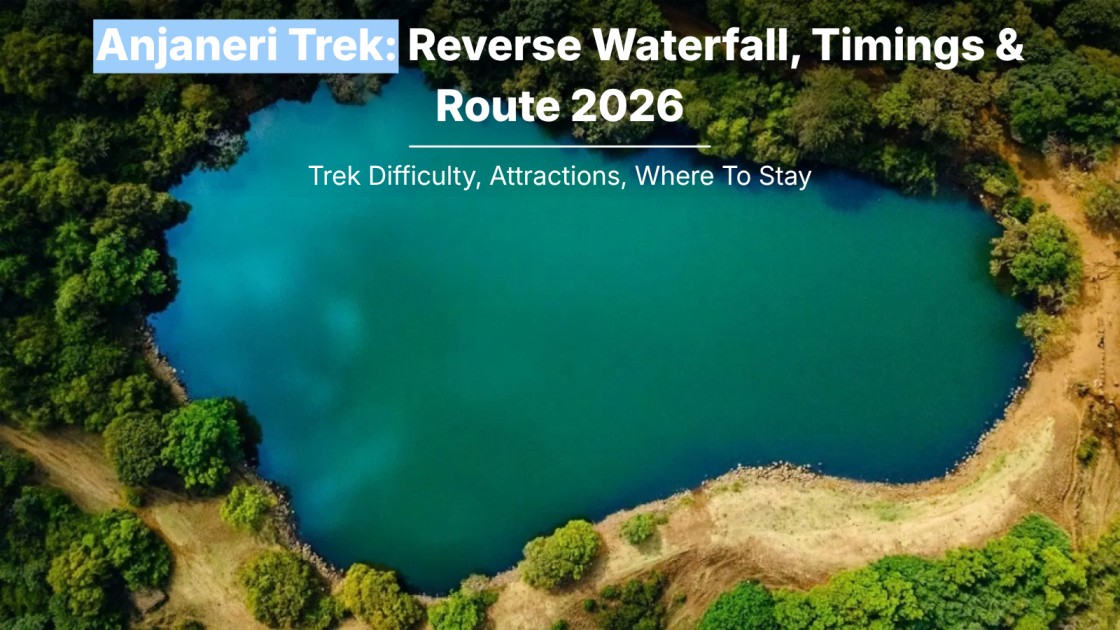
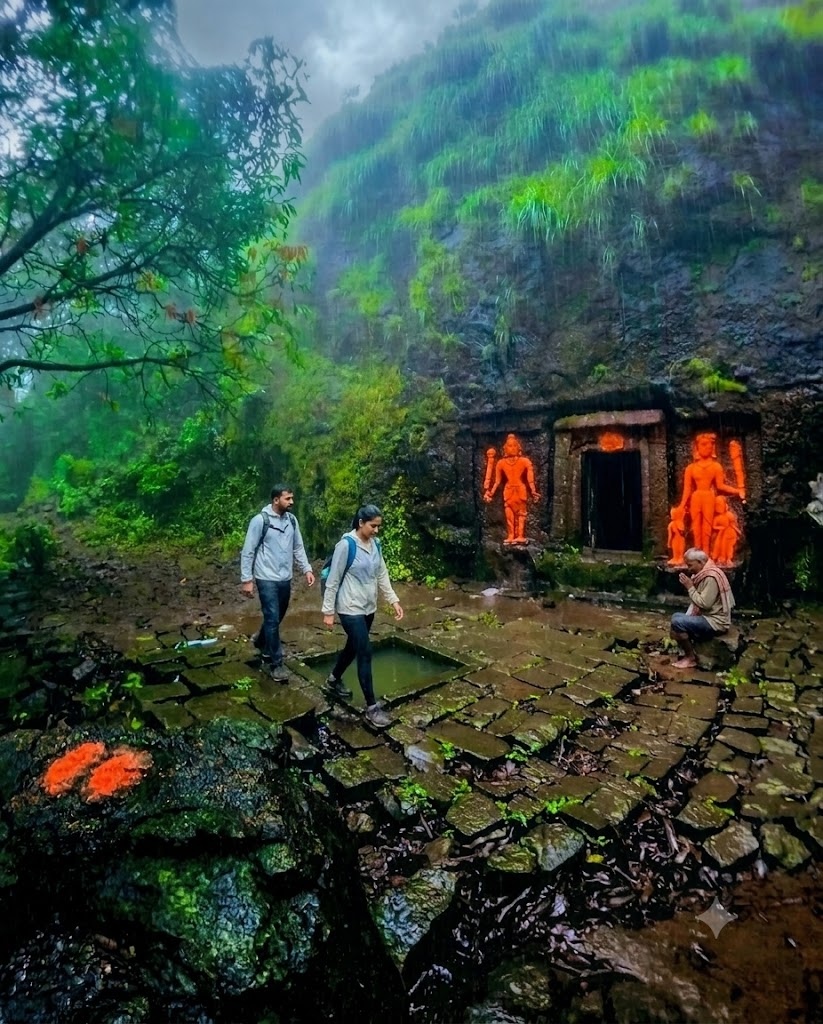
A pond shaped like a footprint, held locally to have been formed by Hanuman’s left foot as he leapt for the sun. Pro tip: the shape reads properly from slightly above, not from the water’s edge.
6. The wildflower plateau
Free · Builds from September, peaks Oct–Nov · Across the ~4 km plateau · 30–45 min · Photographers, families
Roughly 350 plant species grow here. That includes Ceropegia anjanerica, which exists on this hill and nowhere else on Earth (Sanctuary Nature Foundation). Sonki carpets the meadows and the rare Cape York Lily appears among them. Pro tip: trekkers call it a mini-Kaas, and in October the comparison holds up.
7. Vulture watching
Free · Year-round, mornings best · Cliff faces off the plateau · 20–30 min · Birders
Three species: the critically endangered Indian long-billed vulture, the white-rumped vulture, and the Egyptian vulture. Pro tip: watch from well back. These are nesting cliffs, and disturbance is precisely what the reserve exists to prevent.
8. The Jain caves and temple ruins
Free · Daylight hours · Around the village and lower slopes · 30 min · History-minded walkers
The area holds 11th–12th century Jain caves and ruins. The colonial-era surveyor Henry Cousens documented sixteen temples here — two to Vishnu, eight Jain, the rest Shaivite. Pro tip: most walkers climb straight past these. They’re worth the detour on the way down.
9. Rock-cut water cisterns
Free · Daylight hours · On the upper route · 10 min · All visitors
Cut into the rock to hold monsoon water. Pro tip: don’t swim and don’t put your feet in — the village still drinks from these.
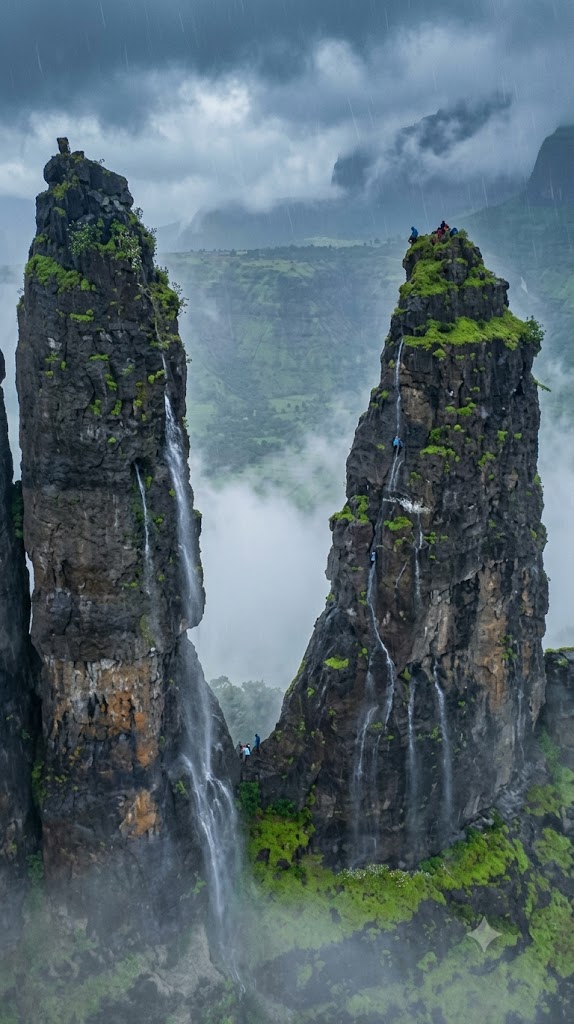
10. Navara and Navari pinnacles
Free · Best in clear weather · Visible from the upper trail · 15 min · Photographers
The twin rock pinnacles that give the ridge its profile. Pro tip: best light is early, before the cloud builds over the plateau.
11. Sunrise from the plateau
Free · Year-round · Requires an early gate entry · 45 min · Photographers, couples
The plateau faces east across the Nashik plain. Pro tip: with a 7 AM gate, you won’t catch true sunrise in summer — this one is easier in winter, when the sun comes up later.
12. The village temple cluster
Free · Daylight hours · Anjaneri village · 20–30 min · Pilgrims, history-minded walkers
Anjaneri village itself is scattered with temple remains and mounds. Pro tip: a good use of the time while your group sorts out parking and registration.
13. Monsoon streams on the lower trail
Free · Jun–Sep · Lower half of the route · Ongoing · All visitors
The lower forest section runs with seasonal water in monsoon. Pro tip: these crossings are where most slips happen. Slow down rather than hopping.
14. Trimbakeshwar Jyotirlinga
Free entry; donation/VIP pass ~₹200 per person · Open 5:30 AM–9:00 PM · ~11 km from Anjaneri · 2–3 hrs · Pilgrims, families
One of the twelve Jyotirlingas, and the obvious pairing with Anjaneri. General darshan runs 5:30 AM–12:00 PM and again 4:00 PM–9:00 PM. Brahma Puja falls between 7:00 and 8:30 AM, and the evening Vishnu Aarti around 7:00 PM. A donation darshan pass can be booked through the Shree Trimbakeshwar Devasthan Trust for faster entry. Pro tip: go the afternoon before your trek, not after — the 4 PM darshan window opens exactly when you’d otherwise be walking down Anjaneri on tired legs. Timings shift on festival days, and in Shravan the queues are a different proposition entirely.
15. Brahmagiri hill
Free · Post-monsoon best · Near Trimbakeshwar · Half day · Fit trekkers
The source of the Godavari, and a second trek for anyone staying two nights. Pro tip: don’t stack Brahmagiri and Anjaneri on the same day in monsoon. Both deserve a fresh start.
When should you actually go? A month-by-month view
Official guidance says October to March (Incredible India). Monsoon guides say July and August. Both are right, because they’re answering different questions — and the reverse waterfall exists only in the window the official guidance steers you away from.
So pick by what you want. July–August: the reverse waterfall, and the highest risk — go on a clear, windy morning or not at all. September: the best compromise, with water still running and wildflowers starting. October–November: the wildflower peak, dry trail, easy visibility. December–February: the most comfortable climbing of the year. April–May: hot and exposed; skip it.
Anjaneri’s most spectacular month and its safest month are not the same. The reverse waterfall appears only from June to September, peaking in July–August, while official tourism guidance recommends October to March for comfortable trekking. September offers the best compromise, with monsoon water still flowing as the wildflower season begins.
Anjaneri is Maharashtra’s only conservation reserve for vultures
Anjaneri holds 350 plant species and three vulture species across 5.69 sq km. It is the only conservation reserve in Maharashtra set aside specifically for threatened vultures (Sanctuary Nature Foundation). It was notified on 11 January 2017.
The vultures are the reason the rules exist. Three species live here. The critically endangered Indian long-billed vulture (Gyps indicus) nests on the cliffs. The white-rumped vulture (Gyps bengalensis) nests in mature trees. The Egyptian vulture makes up the third. The Nature Conservation Society of Nashik counted 120 long-billed vulture nests in 2015. A survey running from January 2019 to May 2020 recorded at least 32 Gyps vultures present at one time (Dethe, Species 26(77), 2025).
India’s vulture populations fell by around 92% in the 1990s after the veterinary drug diclofenac entered the food chain. Places like Anjaneri are what’s left. That’s the context for the drone ban and the camera restriction — a raptor colony and a weekend photography crowd don’t mix.
The plant list is just as unusual. Ceropegia anjanerica is named after this hill because this is the only place it grows. Alongside it are more than 105 bird species and at least 13 mammals, including Indian striped hyena and leopard.
None of it is secure. A proposed 14 km road from Mulegaon to the summit would cut through the reserve. It’s intended to carry pilgrims up by vehicle. The damage would come during construction, then permanently, from traffic, noise and roadkill.
How to trek here without making it worse
- Stay on the marked trail. The meadows are the habitat, not the scenery.
- Carry every scrap of waste back down.
- Keep well back from cliff faces, especially where birds are active.
- No drones, no speakers, no shouting from the edges.
- Don’t enter the water tanks.
Anjaneri Conservation Reserve, notified on 11 January 2017 and covering 5.69 sq km, is the only conservation reserve in Maharashtra created specifically for threatened vultures. It supports three vulture species, over 105 bird species, at least 13 mammals, and 350 plant species — including Ceropegia anjanerica, which grows nowhere else in the world.
What should you carry and wear for Anjaneri in the rain?
Grip footwear matters more than anything else you’ll bring. The first quarter of the route is stone steps that run with water in monsoon, and trainers with worn soles are how people get hurt.
Carry:
- Trekking shoes with genuine grip
- A poncho or rain jacket — not an umbrella. The wind that makes the waterfall reverse will destroy it
- Rain cover for your backpack
- 2 litres of water per person
- Dry bags or zip-lock bags for phone, wallet and ID
- Torch, power bank, basic first aid
- Spare socks and a quick-dry towel
- Photo ID for the checkpost registration
Wear: full-length quick-dry layers rather than shorts, and nothing cotton — it stays wet for hours. A hooded rain layer beats a cap once the wind picks up.
Leave behind: your DSLR. Cameras are restricted on the hill and phone cameras are permitted, so plan your photography around that rather than arguing at the checkpost.
Anjaneri itineraries: one day, or a monsoon weekend
Build any Anjaneri plan backwards from two fixed points: the gate opens at 7 AM, and you want to be off the hill by mid-afternoon.
One-day plan (monsoon)
Check the forecast at 6 AM. Reach the checkpost by 7, register, and start walking. Top by 10, eat at 11, begin the descent by 11:30 so you hit the reverse waterfall point around 1 PM when the wind is up. Back at base by 3. Late lunch in Nashik or at the villa.
Two-night weekend (the version that actually works)
Friday: drive in, check in at 2 PM, Trimbakeshwar darshan in the late afternoon, early dinner, early night.
Saturday: Anjaneri, gate at 7 AM, down by 3, then the pool.
Sunday: your buffer. If Saturday was rained out, this is your second attempt. If it wasn’t, do Brahmagiri, or the Sula vineyards if you’re staying at Kalrav, and drive home after lunch.
Post-monsoon variant (October)
Same shape, different reason. The waterfall is gone but the plateau is in bloom, the trail is dry, and you can add Sita Cave and the Jain ruins without rushing the descent. This is the better trip for families and for anyone nervous about wet rock.
Planning a wider Maharashtra monsoon trip? Our guide to monsoon treks in Maharashtra covers eight beginner-friendly options, and there’s more on the region in our Igatpuri in monsoon guide and this round-up of places to visit near Nashik in the monsoon.
Frequently asked questions about the Anjaneri trek
Yes, on a clear morning; no during active heavy rain. The forest department restricts entry when conditions turn, and more than 250 trekkers were stranded on the plateau on 21 July 2024 before forest staff walked them down in a human chain. Check the forecast the night before and again at breakfast.
The gate runs 7:00 AM to 6:00 PM, and you register your name and contact details at the forest checkpost along with a fee of about ₹50 including parking. Plenty of sites still list 6 AM to 6 PM — if you arrive at 6, you’ll be waiting an hour.
Yes, with basic fitness and shoes that grip. The trek is 4–5 km and 3–4 hours to 4,264 ft, graded easy-to-moderate when dry and moderate in monsoon. The lower quarter is stone steps. Go as a group if you’re attempting it in the rain.
Around 1.5 hours from the base village to the first plateau, 3–4 hours to the summit, and 5–6 hours round trip once you’ve added the Anjani Mata temple, Sita Cave, the foot-shaped lake and the citadel. Organised monsoon treks budget roughly ten hours door to door.
No. Camping is prohibited anywhere on the hill under the Anjaneri Conservation Reserve rules, notified in January 2017. The reserve protects three vulture species, including cliff-nesting Indian long-billed vultures, and overnight activity on the plateau is exactly what those rules exclude.
June to September, peaking in July and August. It’s produced by wind rather than rain, so a still day of heavy rainfall won’t show it. The viewing point sits on the descent, roughly 1.5 hours below the summit, and organised treks reach it around 1 PM when wind is strongest.
The bloom builds from September and peaks in October and November across roughly 4 km of plateau. Around 350 plant species grow here, including Ceropegia anjanerica, which exists on this hill and nowhere else on Earth, alongside Sonki and the rare Cape York Lily.
No. The trail is marked and reasonably busy at weekends, so most walkers manage without one. In monsoon, go in a group rather than alone, tell someone your expected return time, and complete the checkpost registration properly — it’s the list used if anyone has to come looking.
Final word
Anjaneri is a short trek with a long list of rules, and both halves of that sentence are the point. It’s four kilometres to a plateau that holds a plant found nowhere else on the planet. Add a colony of critically endangered vultures, an 11th-century cave complex, and a waterfall that runs backwards six weeks a year. That combination is why the forest department is strict. It’s also why being strict is right.
- Gate 7 AM–6 PM, ~₹50, compulsory registration. Camping and DSLRs are out.
- The reverse waterfall runs June–September, peaks July–August, needs wind, and sits on the descent.
- The best month to see it isn’t the safest month to climb. Judge the day, not the season.
- You cannot make a 7 AM gate on a same-day drive from Mumbai or Pune. Stay the night before.
- Book two nights in monsoon. The second morning is your weather insurance.
Building a weekend around it? The villas on the Trimbakeshwar side put you about 15 km from the trailhead. You get a pool for the afternoon after, and somewhere worth being if the gate closes for rain. Have a look at our villas in Nashik and pick your dates around a clear, windy morning.