8 Best Monsoon Treks in Maharashtra for Beginners (June 2026 Guide with Base Camps & Packing List)
The first monsoon rains turn Maharashtra’s Sahyadri ridges into something out of a Studio Ghibli frame — fog draped across forts, waterfalls roaring back to life, and trails the colour of fresh moss. India Meteorological Department (IMD) forecasts the southwest monsoon will reach Mumbai around June 5, 2026, with Pune following by June 10–12 (Free Press Journal, 2026). That window — late June through the first two weeks of July — is the sweet spot for a first monsoon trek. The rain has arrived, but trails aren’t yet at peak-July downpour levels. We’ve put together a shortlist of eight beginner-friendly forts that you can actually do safely, plus the villa base camps that make a 2-day trek weekend painless.
Late June 2026 is the safest window for a first-time monsoon trek in Maharashtra — monsoon has arrived (IMD: Mumbai onset June 5, 2026) but trails aren’t yet flooded by peak July rain. The 8 safest beginner picks: Lohagad, Visapur, Korigad, Garbett Point, Karnala, Sinhagad, Tikona and Rajmachi (Lonavala route). All reachable by train from Mumbai or Pune.
In this Blog
Quick Info Table — Pre-Trek Snapshot
| Detail | Information |
|---|---|
| Best window | Late June to mid-July 2026 (post-onset, pre-peak rain) |
| Mumbai monsoon onset | ~June 5, 2026 (IMD) |
| Pune monsoon onset | ~June 10–12, 2026 (IMD) |
| Easiest beginner trek | Lohagad Fort (Lonavala) |
| Closest to Mumbai | Karnala Fort (~1.5 hours via Panvel) |
| Closest to Pune | Sinhagad Fort (~25 km from city centre) |
| Typical day-trek duration | Lonavala, Malavli, Bhivpuri Road, Karjat, and Swargate are the key access nodes |
| Public transport | Lonavala, Malavli, Bhivpuri Road, Karjat, Swargate are the key access nodes |
| What to skip in June | Harihar, Andharban, Devkund, Kalsubai, Bhimashankar Shidi Ghat |
| Base camps | Lonavala (Mumbai-side), Karjat (mid-route), Mulshi (Pune-side) |
Many of these treks are within a 30–45 minute drive of StayVista villas in Lonavala, Karjat, and Mulshi — useful base camps if you want a hot shower and a private pool waiting after a wet climb.
Are Monsoon Treks in Maharashtra Safe for Beginners?
Yes — monsoon treks in Maharashtra are safe for beginners if you stick to gradual fort trails like Lohagad, Visapur, Sinhagad, and Korigad, and trek in the first three weeks after monsoon onset. IMD projects 2026 monsoon onset over Mumbai on June 5 and Pune by June 10–12, with overall seasonal rainfall at 92% of long-period average — classified as below normal (Skymet Weather, 2026). This means lighter, more predictable rain windows than typical monsoon years.
What changes between late June and peak July? The Sahyadris receive their heaviest rainfall in July and August — Karjat alone gets 600–700 mm in those two months (StayVista Maharashtra Weather Guide). In contrast, the first two to three weeks of monsoon deliver waterfall flow without peak landslide risk. That’s the window we’re targeting.

Skymet’s 2026 monsoon forecast classifies the season as below normal due to expected El Niño development and a positive Indian Ocean Dipole — the first below-normal call since 2023. For trekkers, this means lighter rain windows in late June and a lower-risk environment than typical monsoon years.
What we’d avoid in June as a first-timer: Harihar Fort (vertical rock-cut steps that become genuinely dangerous when wet), Andharban (jungle river crossings), Devkund (waterfall pool risk), Kalsubai (Maharashtra’s highest peak at 1,646 m — fitness-dependent), and Bhimashankar’s Shidi Ghat (the ladder section). These are not beginner picks during the first monsoon. Save them for your second or third year of trekking.
How Do You Pick a Safe Beginner Monsoon Trek?
Quick answer: A safe beginner monsoon trek in Maharashtra has six attributes — Easy or Easy-Moderate difficulty, train plus last-mile transport access, monsoon-passable base village roads, a sub-three-hour climb, MTDC or Maharashtra Tourism documentation, and no rock-patch or river-crossing sections. With IMD projecting Mumbai monsoon onset on June 5, 2026 and Karjat receiving 600–700 mm of rainfall in July–August (StayVista Maharashtra Weather Guide), the first three weeks of monsoon are the safest band for first-timers.
We built this shortlist using those six filters: difficulty must be Easy or Easy-Moderate, the trail must be reachable by train + last-mile shared transport, the base village must stay accessible during monsoon, the trek time must be three hours or less one-way, the route must have official MTDC or Maharashtra Tourism documentation, and the trail must not include rock-patch or river-crossing sections. We also weighted for crowd tolerance — beginners benefit from busier trails where help is close, so we didn’t push ultra-isolated routes.
The chart below maps all eight picks across difficulty and travel time from their nearest origin city. Bubble size = our Beginner-Safety Score.
We explicitly excluded Harihar, Andharban, Devkund, Kalsubai, and Bhimashankar’s Shidi Ghat from this list — they’re well-known monsoon treks, but they aren’t first-trek territory.
8 Best Monsoon Treks in Maharashtra for Beginners
1. Lohagad Fort — The Easiest Beginner Monsoon Trek
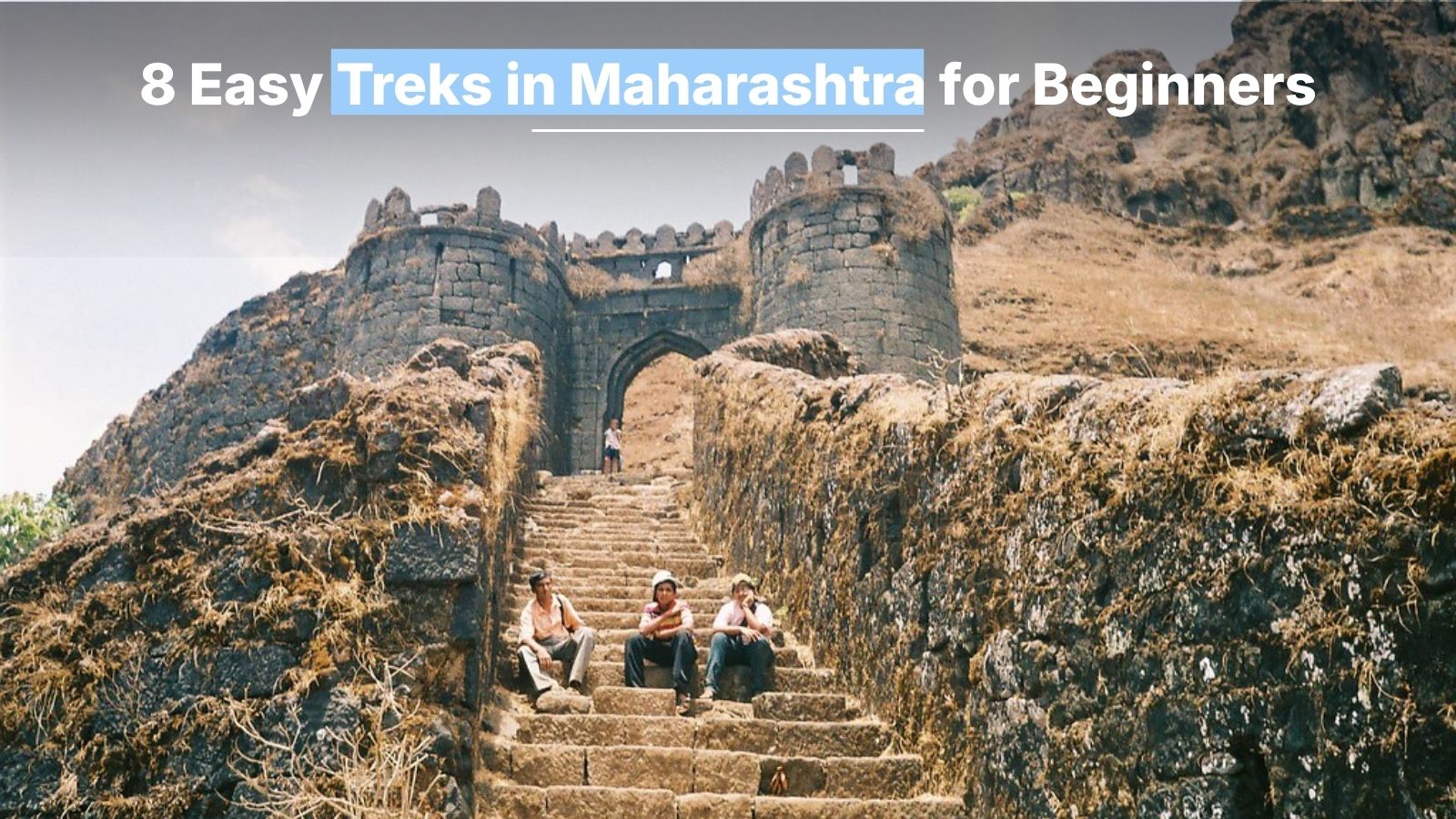
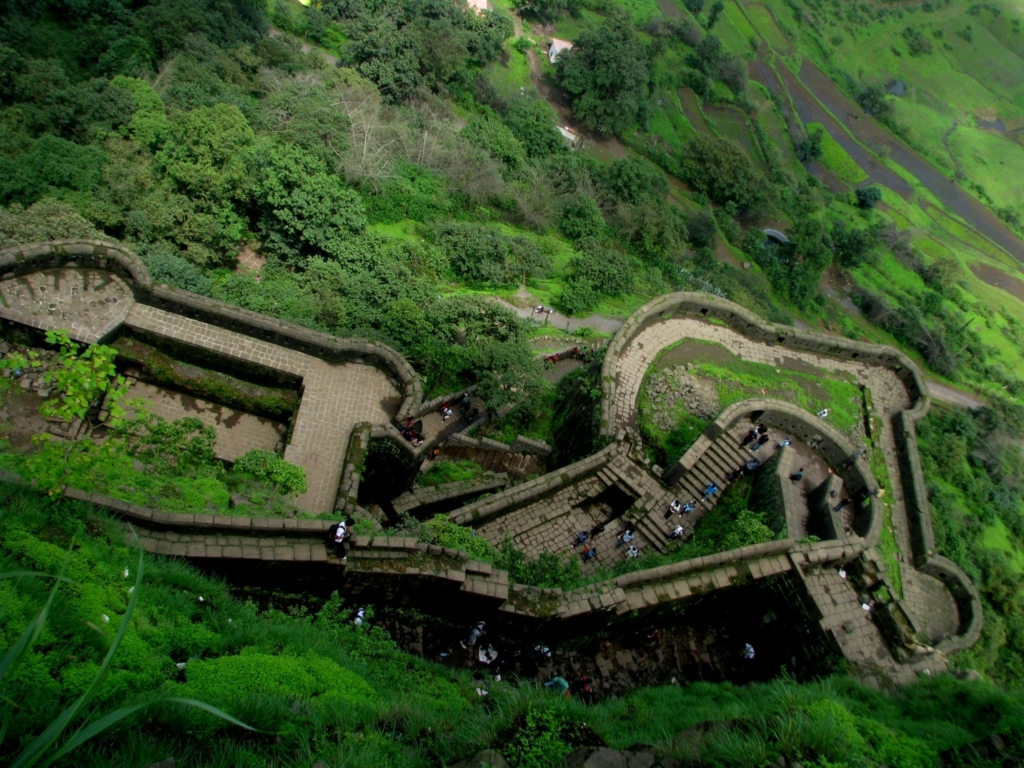
Lohagad Fort is the easiest monsoon trek in Maharashtra for beginners. The trail is reached via Malavli railway station (5 km from base village), takes 2–3 hours one-way on gradual stone steps, has no entry fee, and stays open daily from 9 AM to 6 PM. It is 96 km from Mumbai and 77 km from Pune, both connected by hourly trains to Lonavala — making it the lowest-friction first monsoon trek in Maharashtra.
Lohagad is the trek almost every Sahyadri beginner does first, and for good reason. The 17th-century Maratha fort sits 1,033 m above sea level near Lonavala, with a gradual stone-step path that even first-timers can manage in trail runners. In monsoon, the famous “Scorpion’s Tail” — the fortified spur jutting out from the main wall — disappears into cloud, and the four entry gates (Ganesh, Narayan, Hanuman, Maha Darwaza) frame the rain perfectly for photos. You’ll share the trail with families, school groups, and weekend warriors. That density is a feature, not a bug, for first-timers.

- Difficulty: Easy
- Beginner-Safety Score: 5/5
- Time required: 2–3 hours one-way base to summit
- Entry fee: Free (small parking/photography charges may apply locally)
- Trail timings: 9:00 AM – 6:00 PM (Lonavala Tourism)
- Best time to start: 7:00 AM
- Travel from Mumbai: ~2.5–3 hours (96 km) — train to Lonavala, then local train or auto to Malavli station (5 km from base)
- Travel from Pune: ~1.5–2 hours (77 km) — same Malavli route
- Nearest railway station: Malavli (5 km to base village)
- Ideal for: Absolute first-timers, families, kids over 8
- Pro tip: Skip the weekend if you can. Tuesday–Thursday gives you the same fort, half the crowd, and softer light for photos.
2. Visapur Fort — Lohagad’s Quieter Twin
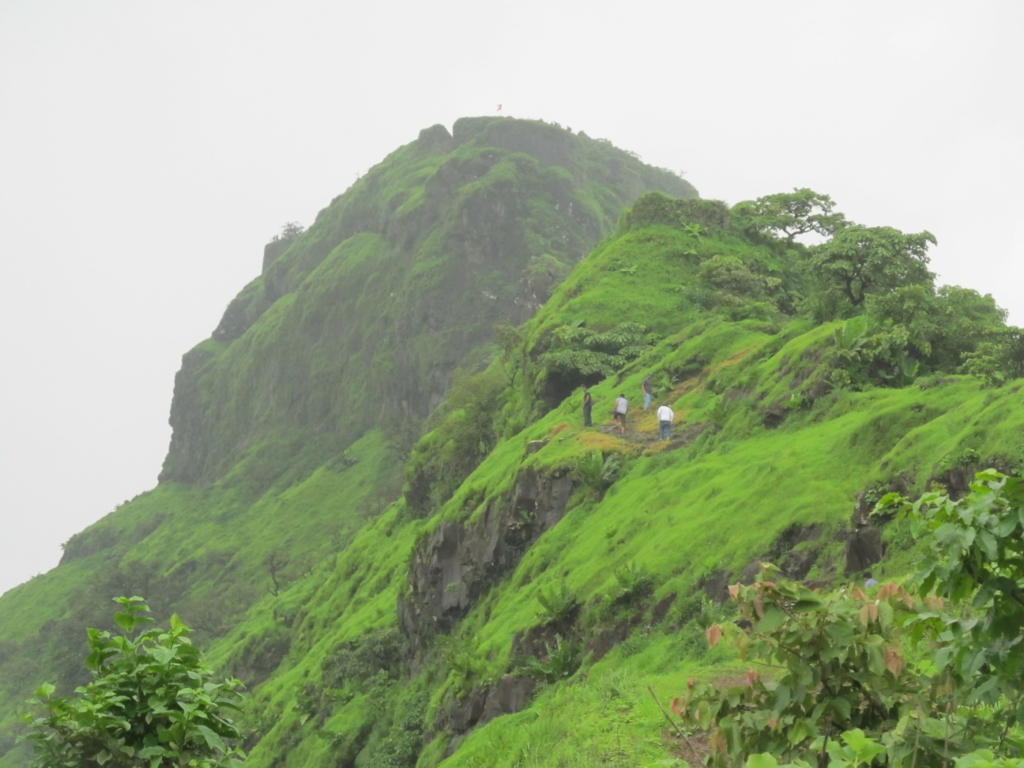
Visapur sits on the same Lonavala-Malavli rail line as Lohagad and is its slightly tougher sibling. The trail has more loose rock and a couple of stream crossings that come alive in monsoon, so it gets the Easy-Moderate label rather than pure Easy. What makes it special is the views back toward Lohagad — on a clear monsoon afternoon you can see both forts and the connecting ridge in one frame. The summit has the remains of a Buddhist-era cave and several ammunition holds. It’s emptier than Lohagad on most days.

- Difficulty: Easy-Moderate
- Beginner-Safety Score: 4/5
- Time required: 2.5–3.5 hours one-way
- Entry fee: Free
- Trail timings: No formal limit; daylight hours recommended
- Best time to start: 6:30 AM
- Travel from Mumbai: ~2.5–3 hours — Malavli station, then 30-min walk to base village
- Travel from Pune: ~1.5–2 hours
- Nearest railway station: Malavli
- Ideal for: Step-up beginners who’ve done Lohagad once
- Pro tip: If you’re feeling fit, do Lohagad in the morning and Visapur after lunch as a same-day double. Start by 6 AM to make both before 4 PM.
3. Korigad Fort — The Offbeat Lonavala Pick
Korigad is the one you do when you want monsoon greenery without the Lohagad crowd. The fort sits at 923 m near Aamby Valley, ~20 km from Lonavala, and the climb is mostly a flight of around 500 stone steps cut into the hillside. The summit is unusually flat — almost like a small grassy plateau — with two intact temples (Koraidevi and Vishnu) and twin freshwater lakes that refill to the brim during monsoon. The whole climb takes under an hour at a relaxed pace.

- Difficulty: Easy
- Beginner-Safety Score: 5/5
- Time required: 1–1.5 hours one-way
- Entry fee: Free (Forest Department may ask for permission at base on rare days)
- Trail timings: Open access — no formal limit
- Best time to start: 7:00 AM
- Travel from Mumbai: ~3.5 hours — Mumbai → Lonavala by train, then a shared cab or auto to Peth Shahpur village (~20 km, allow 45 min on monsoon roads)
- Travel from Pune: ~2.5 hours
- Nearest railway station: Lonavala (then local cab — public bus is patchy)
- Ideal for: Beginners who want quiet, photographers, families with younger kids
- Pro tip: Public transport from Lonavala to Peth Shahpur is unreliable in monsoon. Either pre-book a cab or stay at a Lonavala villa and drive over yourself.
4. Garbett Point — The Plateau Walk Near Matheran
Garbett Point isn’t a fort — it’s a vast green plateau on the way up to Matheran, sitting around 600 m above the Sahyadri foothills. The “trek” is really a long ridge walk through grasslands and forest, ending at a viewpoint that drops sheer into the valley. In late June, the plateau is covered in wildflowers — purple Karvi, yellow Smithia, the works — which makes it one of the prettiest monsoon walks anywhere near Mumbai. The total trail covers ~12 km round-trip.

- Difficulty: Easy
- Beginner-Safety Score: 5/5
- Time required: 4–4.5 hours total round trip
- Entry fee: Free (no formal entry fee for the plateau)
- Trail timings: Daylight hours only
- Best time to start: 7:30 AM (catch the 6:10 AM Karjat fast local from CSMT)
- Travel from Mumbai: ~2.5–3 hours — Mumbai CSMT → Bhivpuri Road station (Karjat fast local, first train 6:10 AM) → 3 km walk or auto to trailhead
- Travel from Pune: ~3.5–4 hours (longer; Pune readers usually skip this one)
- Nearest railway station: Bhivpuri Road
- Ideal for: Mumbai-side weekenders, photographers, slow walkers
- Pro tip: Cross the railway line carefully and follow the marked Matheran trail. Carry 2 litres of water — there are no shops on the plateau.
5. Karnala Fort — The Fort Inside a Bird Sanctuary
Karnala is the closest monsoon trek to Mumbai — barely an hour from the city via the Mumbai-Goa highway through Panvel — and it sits inside the Karnala Bird Sanctuary, which is a small joy in itself. The trail climbs through dense forest to the basalt fort tower at the top, which locals call “Funnel Hill” for its shape. It’s an Easy-Moderate route because the upper section gets genuinely slippery on wet rock, so we knock its safety score down to 4 out of 5 for monsoon.

- Difficulty: Easy-Moderate
- Beginner-Safety Score: 4/5
- Time required: 2–3 hours total
- Entry fee: ₹50 sanctuary entry + ₹60 trek fee per person (camera fee extra)
- Trail timings: Sanctuary 7:00 AM – 5:00 PM; no night entry
- Best time to start: 7:00 AM
- Travel from Mumbai: ~1.5 hours — Mumbai → Panvel by train or road, then state bus/auto to Karnala Bird Sanctuary base (~12 km on the Mumbai-Goa highway)
- Travel from Pune: ~3–3.5 hours
- Nearest railway station: Panvel (then bus/auto)
- Ideal for: Mumbai trekkers short on time, bird-watchers, single-day plans
- Pro tip: Karnala rock can be genuinely slippery in heavy rain. Pick a day with a light-to-moderate forecast, not a downpour day. Wear deep-tread shoes and use the bird sanctuary loop as a slower walk back to the gate.
6. Sinhagad Fort — The Most Accessible Beginner Trek From Pune
Sinhagad is to Pune what Lohagad is to Mumbai — the trek you do first. The fort sits 25 km from Pune city centre on a 1,312-m hill, and the trail is a stone-paved climb from the Pay-and-Park lot to the summit. The fort itself has 17th-century Maratha history (it was the site of Tanaji Malusare’s famous 1670 night assault), and the summit is dotted with pithla-bhakri and kanda-bhaji stalls that serve breakfast to descending trekkers. The PMPML Route 50 bus from Swargate makes it the easiest non-car-owner trek on this list.

- Difficulty: Easy
- Beginner-Safety Score: 5/5
- Time required: 30–45 minutes one-way from Pay-and-Park
- Entry fee: Free trail; ~₹50 vehicle parking at Pay-and-Park
- Trail timings: No formal limit; summit stalls open from ~8 AM
- Best time to start: 6:30 AM
- Travel from Mumbai: ~5 hours (most Mumbai trekkers do this on a Pune weekend)
- Travel from Pune: ~1.5 hours — PMPML Route 50 from Swargate Natraj Stand to Sinhgad Paytha (84-minute ride, ~43 trips daily, first bus 5:00 AM, last 10:10 PM)
- Nearest railway station: Pune Junction (then PMPML bus)
- Ideal for: Pune-based beginners, sunrise trekkers, history buffs
- Pro tip: Weekends get genuinely crowded. Start by 6:30 AM, do the climb in 45 minutes, eat pithla-bhakri at the summit by 8 AM, and you’ll be back at Swargate by 11 AM with the day still ahead of you.
7. Tikona Fort — The Pyramid Near Pawna Lake
Tikona, which literally means “triangular,” is exactly that — a near-perfect pyramidal fort that rises out of the Pawna belt between Lonavala and Pune. The climb is short (under an hour) and gradual, and the summit at 1,061 m gives you a clean 360° view of Pawna Lake, Tung Fort, Lohagad, and Visapur on a good monsoon afternoon. The base village (Tikona Peth) is small and atmospheric. There’s a small Trimbakeshwar Shiva temple on the way up that most trekkers stop at briefly.

- Difficulty: Easy
- Beginner-Safety Score: 4/5
- Time required: 1–1.5 hours one-way
- Entry fee: Free
- Trail timings: No formal limit; daylight only
- Best time to start: 7:00 AM
- Travel from Mumbai: ~3.5–4 hours (125 km) — train to Lonavala, then a 25-km road transfer to Tikona Peth village
- Travel from Pune: ~2.5 hours (60 km) — drive via Paud or Kamshet
- Nearest railway station: Lonavala (then road transfer; no direct public bus to Tikona Peth)
- Ideal for: Pune-based weekenders, photographers, monsoon beginners
- Pro tip: Combine with a Pawna lakeside lunch on the way back. Several local dhabas around Pawna serve fresh fish and bhakri — a Maharashtra monsoon weekend staple.
8. Rajmachi Fort — The Lonavala Route Only
Rajmachi is the only Easy-Moderate trek on this list that we recommend reservedly. The fort sits between Lonavala and Karjat with twin peaks — Shrivardhan and Manaranjan — and there are two ways to reach it: a gradual 15-km Lonavala-side trail, or a steeper jungle climb from the Karjat side. For beginners, take the Lonavala route only. It’s a long walk but a forgiving gradient, and you can break it into a comfortable two-day plan with an overnight in Udhewadi village near the base.

- Difficulty: Easy-Moderate (Lonavala route)
- Beginner-Safety Score: 4/5
- Time required: 5–6 hours one-way (Lonavala route)
- Entry fee: Free
- Trail timings: Open access
- Best time to start: 6:00 AM (for a day plan) or 3 PM (for an overnight at Udhewadi)
- Travel from Mumbai: ~3.5 hours — Mumbai → Lonavala by train, then 15-km local transport to the trail start
- Travel from Pune: ~2.5 hours
- Nearest railway station: Lonavala
- Ideal for: Fit beginners ready for a longer walk, overnight trekkers
- Pro tip: First-timers should not attempt the Karjat-side ascent in monsoon. The trail is steeper and the river crossings can rise fast. Lonavala route or nothing.
What to Pack for a Monsoon Trek in Maharashtra (Beginner Checklist)
For a beginner monsoon trek in Maharashtra’s Western Ghats, the non-negotiables are waterproof hiking shoes with deep tread, a rain poncho (more breathable than a jacket in 30°C humidity), a 10–15L backpack with a rain cover, synthetic quick-dry clothing (skip cotton entirely), electrolyte sachets, a phone in a waterproof pouch, and a headlamp. Hiking poles help on slippery descents.
Footwear (non-negotiable)
- Waterproof trekking shoes with ankle support and deep tread (Quechua, Wildcraft, or Salomon work well at any budget)
- One pair of spare socks sealed in a Ziploc bag — your feet will get wet, and dry socks at the summit feel disproportionately good
Clothing (skip cotton entirely)
- Synthetic quick-dry t-shirt and shorts or track pants
- A light fleece for the summit (temperatures can drop to 18–20°C at altitude even in June)
- Avoid cotton entirely — it stays wet for hours and pulls heat away from your body
Rain protection
- Lightweight rain poncho (ventilates better than a sealed rain jacket in humid Indian monsoon)
- Rain cover for the backpack (most packs include one; if yours doesn’t, ₹250 will buy a separate one)
Pack
- 10–15 litre daypack — more than enough for a half-day trek
Safety kit
- Whistle (cheap, light, occasionally life-saving)
- Mini first-aid: bandages, antiseptic wipes, paracetamol
- ID copy + ₹500 cash for unexpected transport
- Salt pouch or Odomos for forest sections (Karnala and Garbett especially)
Tech
- Phone in a waterproof pouch
- Power bank (5,000 mAh is plenty)
- Offline Google Maps downloaded for the trail region
Snacks and hydration
- 1.5–2 litres of water (refill at the base village if possible)
- 1 electrolyte sachet (ORS or Enerzal)
- Dry fruits, energy bars, or jaggery-peanut chikki
Why ponchos beat rain jackets in Indian monsoon: a sealed Gore-Tex jacket traps heat at 30°C humidity, and you end up sweating as wet as the rain would have made you. A loose poncho lets air move while still keeping you dry. Locals figured this out generations ago.
Where Should You Stay for These Monsoon Treks?
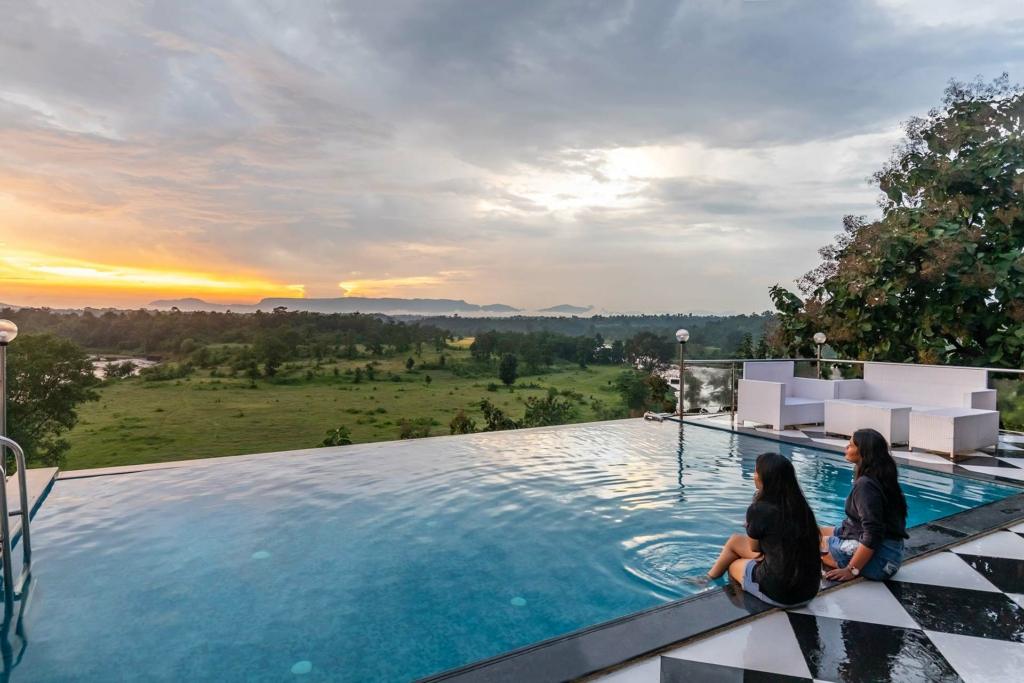
If you’re driving in from Mumbai or Pune for a 2-day trek weekend, the right base camp makes a meaningful difference. Trekking starts at 6 AM, and you’ll want a hot shower and a private pool waiting by 11 AM. We’ve grouped our Maharashtra villa inventory into three regional clusters — Lonavala, Karjat, and Mulshi — each within a 30–45 minute drive of the trek base villages on this list.

Near Lonavala (for Lohagad, Visapur, Korigad, Rajmachi)
- La Palm by StayVista, Lonavala — A 3-acre 8-bedroom estate set across landscaped lawns with a 22×70 ft swimming pool, jacuzzi, full gym, tennis and basketball courts, poolside bar, and steam-sauna room. Sleeps 16. Ideal for large trek groups or families who want resort-style amenities after the climb.
- V Square Villa, Lonavala (4BHK) — A 4-bedroom villa with sweeping valley views, a private swimming pool, and a sprawling lawn. The valley-facing balcony is perfect for watching post-trek rain roll in over the Lonavala ridges.
- Bella Vista Villa, Lonavala (2BHK) — A compact 2-bedroom villa with a private pool — the right pick for couples or two-trekker pairs who want a quiet base near Malavli station and Lohagad’s base village.
Near Karjat (for Rajmachi via Karjat route, Garbett Point drive-over)
- Vine & Splash by StayVista, Karjat — A 9-bedroom riverside villa just 7 km from Kothaligad Fort, with an infinity pool, indoor games room, and BBQ pit. Best for large groups planning back-to-back trek weekends.
- Ferias Vita, Karjat (5BHK) — A 5-bedroom luxury villa spread across 1.5 acres with a private pool, rain-shower area, poolside bar, and BBQ/bonfire setup. Pet-friendly. Karjat receives 600–700 mm of rainfall in July–August, so a private-pool villa in the rain is its own attraction.
- Aqua & Sage by StayVista, Karjat (4BHK) — A 4-bedroom villa nestled in landscaped greenery with a private pool and refreshing Karjat breeze. Spacious, modern interiors — suited to small groups who want the river soundtrack at night.
Near Pune / Mulshi (for Sinhagad, Tikona)
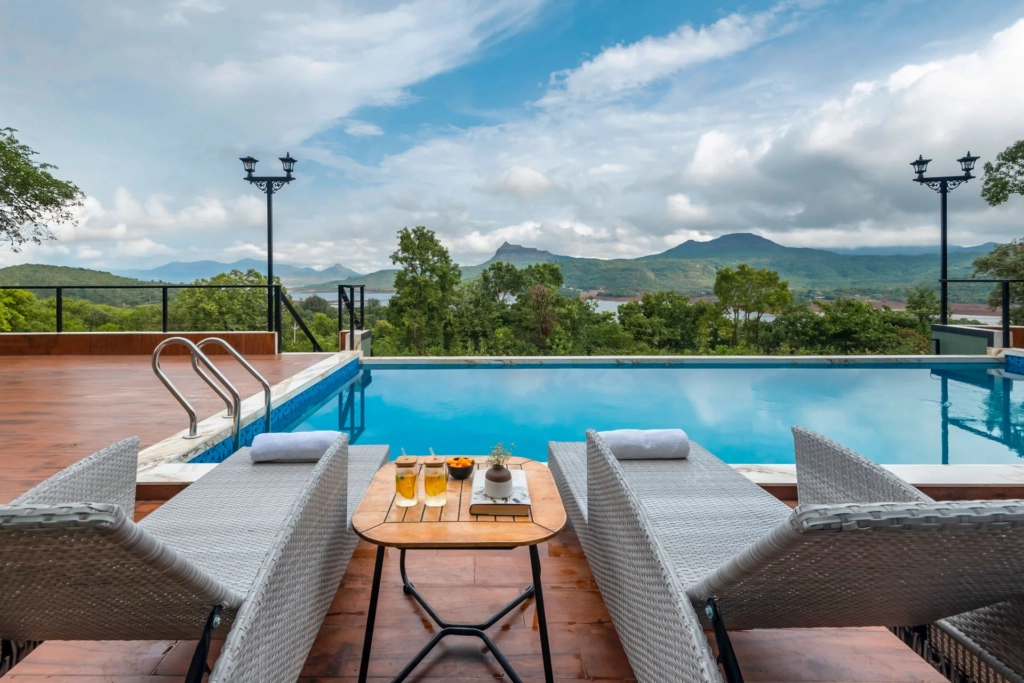
- Waterfront Villa, Pune (3BHK) — A 3-bedroom lakeside villa with an infinity-edge pool, BBQ grill, and views over the Mulshi reservoir and the Western Ghat ridges. ~40 km from Pune city — perfect base for Sinhagad and Tikona.
- The Chirping Villa, Mulshi (Pune) — A modern villa with a private pool, spa, and Wi-Fi in Pune’s Mulshi belt — chosen by weekenders who want a city-near monsoon escape that’s still rural enough for ridge views.
- Asanjo Villa, near Pawna (Pune) — A pet-friendly villa set in Mulshi’s lush green mountains with expansive valley views, pool, and spa. The name translates to “Humara Apna” in Sindhi — a quiet family-style base for trekkers who don’t want to leave the dog at home.
We recommend booking these properties at least 3 weeks ahead for monsoon weekends — Lonavala and Karjat sell out fastest between mid-June and mid-August.
What’s the Best 1-Day, 2-Day, or Weekend Itinerary?
1-Day Plan from Mumbai (Lowest Commitment)
Lohagad solo, or Lohagad + Visapur combo. Catch the 6:00 AM train from Mumbai CSMT or Dadar to Lonavala, transfer to the local for Malavli (5:30 hours total commute if you time it right), summit Lohagad by 9:30 AM, descend by 1 PM, eat at a Malavli dhaba, and you’re back in Mumbai by 6 PM. Fit beginners can squeeze Visapur in after lunch — start by 6 AM from Mumbai to do both.
2-Day Weekend From Mumbai
Friday evening to Sunday night. Drive or train to Lonavala on Friday evening, check into V Square or Bella Vista. Saturday morning: Lohagad + Visapur. Saturday afternoon: villa pool and downtime. Sunday morning: Rajmachi via the Lonavala route as far as you’re comfortable (turn back at any point — the trail is forgiving).
2-Day Weekend From Pune
Saturday morning, Sinhagad — early start. Take the 5:30 AM PMPML Route 50 from Swargate to Sinhgad Paytha. Climb by 7 AM, eat pithla-bhakri at the summit, back to Pune by 11 AM. Afternoon drive to The Chirping Villa or Waterfront Villa in Mulshi for the night. Sunday morning: Tikona Fort. Done by lunch.
Long Weekend (3 Days)
Karjat-based plan. Friday evening: check into Vine & Splash or Ferias Vita. Saturday: Rajmachi via Karjat route (only for confident beginners; otherwise, drive over to Lonavala and do the Lonavala route). Sunday: Garbett Point from Bhivpuri Road station — a 40-minute drive from Karjat villas. Monday: pool day and slow drive back to Mumbai or Pune.
Frequently Asked Questions
Yes — if you stick to gradual fort trails like Lohagad, Visapur, Korigad, Sinhagad, and Tikona, and trek in the first three weeks after monsoon onset. Avoid Harihar, Andharban, Devkund, and Kalsubai for your first monsoon trek. IMD’s 2026 forecast classifies the season as below normal, which means lighter, more predictable rain windows than typical years (Skymet).
Lohagad Fort. The trail is reached via Malavli railway station (5 km from base village), takes 2–3 hours one-way on gradual stone steps, has no entry fee, and stays open daily from 9 AM to 6 PM. It is 96 km from Mumbai and 77 km from Pune, both connected by hourly trains to Lonavala. Karnala is closer to Mumbai (~1.5 hours) but the upper trail can be slippery in heavy rain.
IMD projects the southwest monsoon will reach Mumbai around June 5, 2026, with Pune following by June 10–12 (Free Press Journal). The state as a whole sees the onset around June 2 over Konkan, with Vidarbha and Marathwada receiving rain by the third week of June. Overall, 2026 seasonal rainfall is forecast at 92% of the long-period average.
The non-negotiables are waterproof hiking shoes with deep tread, a rain poncho (better than a jacket in humid 30°C weather), a 10–15L daypack with a rain cover, synthetic quick-dry clothing (skip cotton), 1.5–2 litres of water, one electrolyte sachet, a phone in a waterproof pouch, and a headlamp. Add anti-leech salt or Odomos for forest treks like Karnala and Garbett Point.
Yes for Lohagad, Visapur, Korigad, Garbett Point, Karnala, Sinhagad, and Tikona — all are well-marked and reasonably crowded on weekends, so a first-timer can do them without a paid guide. Rajmachi is also fine without a guide on the Lonavala route. We’d hire a guide for Andharban, Devkund, and any Karjat-side jungle trail.
Aim to reach the trail base by 7:00 AM and start climbing by 7:30 AM. For Sinhagad and Lohagad — both notoriously crowded on weekends — start by 6:30 AM. Early starts cut crowd density significantly and give you a buffer before afternoon rain showers settle in. For Garbett Point, the 6:10 AM Karjat Fast Local from Mumbai CSMT to Bhivpuri Road is the standard local-operator pickup.
Trail entry is free on seven of the eight treks; Karnala charges ₹50 sanctuary entry + ₹60 trek fee. Add ₹200–400 for shared transport from the nearest station, and ₹100–300 for food at the summit or base village. If you book through a trek operator (Treks and Trails, Mumbai Trekkers, Adventure Geek), expect ₹699–₹2,500 per person for a single-day trek including transport, breakfast, and a guide.
Final Thoughts — Your First Monsoon Trek
Late June 2026 is a genuinely good time to start trekking. The rain has arrived but trails aren’t yet at peak-July intensity, and the eight forts above give you a beginner curriculum that scales from a gentle Lohagad day-trek to a longer Rajmachi weekend. The Lonavala triangle — Lohagad + Visapur + Korigad — is the lowest-friction starter weekend from Mumbai. Pune-based beginners have Sinhagad and Tikona within ninety minutes of city limits, which is rare for any Indian metro.
A few quick takeaways:
- Pick weekdays over weekends if you can — Sinhagad, Lohagad, and Visapur get genuinely crowded between Friday and Sunday.
- Start by 7 AM — afternoon rain is heavier, trails are emptier in the morning, and you’ll be back at your villa or hotel by lunch.
- Don’t trek when the monsoon is actively breaking — if your phone is showing red on the rain radar, swap the trek for a villa pool day. Wait for a green window.
Planning a 2-day trek weekend?
Browse our villas in Lonavala, Karjat, and Mulshi near Pune — all within 45 minutes of the trek base villages on this list. Once your first monsoon trek is under your belt, our complete monsoon trek guide and night treks near Mumbai cover the step-up routes.
Related reading: The Top Monsoon Treks in Maharashtra · Maharashtra Weather Guide for Monsoon Travel · 10 Best Pre-Monsoon Treks Near Mumbai (April 2026) · Weekend Monsoon Getaways: Lonavala & Khandala · First Monsoon Rain in India 2026: Kerala Onset Tracker · Best Places to Visit Near Pune in Monsoon