
Maharashtra Monsoon Weather Guide 2026 + 12 Best Places to Visit
Last updated: June 2026
TL;DR: Maharashtra’s monsoon runs June to early October, but it falls very unevenly. The Konkan coast (Alibaug, Ganpatipule, Tarkarli) and the Sahyadri ghats (Lonavala, Mahabaleshwar, Bhandardara, Amboli) get the heaviest rain and the best waterfall-and-mist scenery; Pune is milder; the Marathwada and Vidarbha interior sits in a rain shadow and stays hot and dry. The monsoon reached Mumbai on 23 June 2026, about two weeks late, and IMD has forecast a below-normal season (~90% of the long-period average) — so expect green hills with patchier, less predictable rain than usual. Never enter fast-flowing water at dams or waterfalls; Pune and Lonavala impose legal bans on it every monsoon.
In this Blog
Maharashtra monsoon at a glance
| Best time | July–Aug for peak waterfalls/mist; September for lush green with fewer total washouts |
| How to reach | Mumbai & Pune are the two gateways; ghats and Konkan radiate out from both |
| Nearest airport/station | Mumbai (CSMIA) & Pune airports; CSMT/Pune/Lonavala on rail; Konkan Railway for the coast |
| Ideal duration | A weekend (2–3 days) per region; a week to combine coast + ghats |
| 2026 monsoon note | below-normal (~90% of LPA per IMD); late onset (Mumbai 23 June); plan around patchy spells |
What is Maharashtra’s weather like in the monsoon?
In one line: the same state can be flooding on the coast, fogged-in on a ghat, and bone-dry in the interior on the same July afternoon. Maharashtra straddles the Western Ghats (the Sahyadris), and that ridge decides everything. Moisture-laden winds blow in off the Arabian Sea, dump their rain on the windward Konkan coast and the ghat crest, and arrive over the eastern interior already wrung out. So the honest answer to “what’s the weather like?” is: it depends entirely on which side of the hills you stand on.
For 2026 there are two facts worth planning around. First, the southwest monsoon reached Mumbai on 23 June — roughly two weeks later than the city’s normal date of around 11 June — after stalling over western India for nearly a fortnight. Second, the India Meteorological Department has forecast a below-normal season at about 90% of the long-period average. In plain terms: the rains are real, the hills will green up, and the waterfalls will run — but spells are likely to be more broken and less reliable than a textbook monsoon, with hot, humid gaps between them. That actually suits a traveller who would rather chase clear-ish mornings than sit through a week of grey.
Below we break the state into the regions that behave differently, then give you a month-by-month read, the festivals that fall in this window, and 12 places worth the trip.
Monsoon safety in Maharashtra (StayVista’s signature box — read before you go)
– Never enter fast-flowing or rising water at any dam or waterfall. After the 2024 Bhushi Dam tragedy near Lonavala, where five people including four children were swept away by a sudden surge, Pune Rural Police impose prohibitory orders every monsoon (under the BNSS, the successor to Section 144) banning gatherings, entering deep water and edge selfies at spots like Bhushi Dam, Tiger Point, Lion’s Point, Pawana Dam, Lohagad and Visapur — typically in force through 31 August. Obey them; they exist because people die here.
– Devkund Falls (Bhira, Raigad) is officially closed to entry across the core monsoon (a Section-163 order covering roughly mid-June to end-September). Do not attempt it in spate.
– Check ghat-road status before you drive. The Mumbai–Pune Expressway and ghat sections see rockfall and landslides every monsoon; Malshej Ghat has been shut to tourists after slides in past years.
– Drive ghats in daylight only. Visibility on the crest can drop to near zero in heavy rain. Carry fog-usable lights, keep a buffer day, and don’t push a slippery ghat after dark.
– The coast is for looking, not swimming. Seas are rough June–September; swimming and water sports (including Tarkarli scuba) are unsafe and largely suspended until October. Heed red flags and tide timings.
Region 1: The Konkan coast (heavy rain, high drama)
This is where the monsoon hits hardest and first. The Konkan — Alibaug, Murud, Kashid, Ratnagiri, Ganpatipule, and down to Tarkarli and Malvan in Sindhudurg — sees some of the heaviest rainfall in the state, with the coastal division averaging in the region of 2,000–2,500 mm a year and July as the wettest month. Temperatures stay warm and narrow (roughly 26–31°C), but it’s the humidity that defines the experience: often in the mid-80s to 90s, the kind of mugginess where a short walk leaves you damp.
What’s it like to travel in? The landscape turns electric green, the laterite cliffs darken, and the rice paddies fill — genuinely beautiful from a balcony or a car. But the sea is angry. Swimming is unsafe, water sports are suspended, and Tarkarli’s scuba season is shut until October. The Mumbai–Alibaug ferries and Sindhudurg-fort boats run on the weather’s terms and can be cancelled at short notice. The smart way to do the Konkan in monsoon is to treat it as a slow, food-and-views trip: Malvani thalis, Alphonso-country drives, temple visits at Ganpatipule, and long verandah afternoons — not a beach holiday.
Region 2: The Sahyadri / Western Ghats hill belt (the main event)
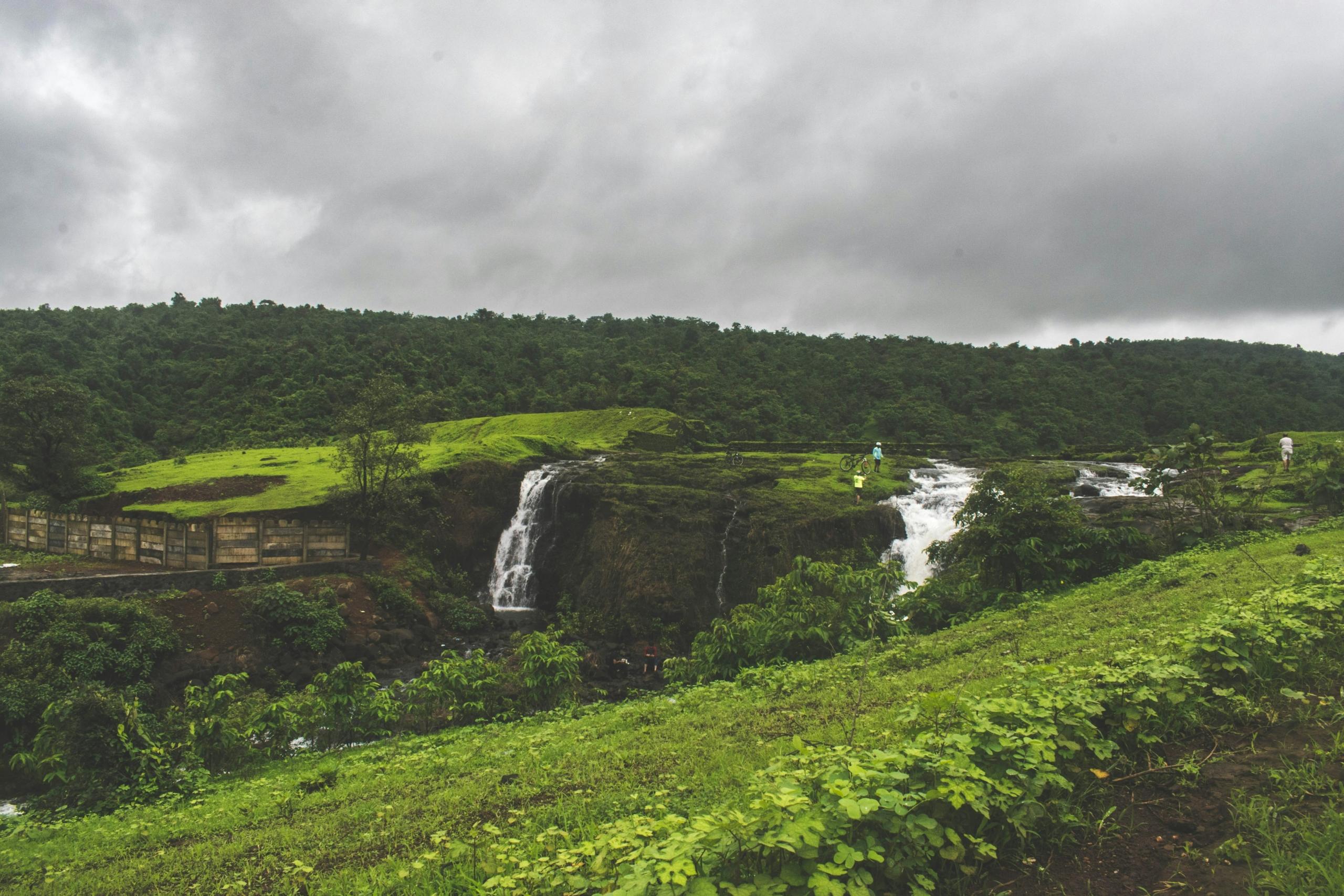
If you came to Maharashtra for the postcard monsoon, this is it. The ghat crest — Lonavala–Khandala, Mahabaleshwar–Panchgani, Bhandardara, Igatpuri, Malshej Ghat, Matheran and, further south, Amboli — catches the full orographic force of the sea winds. Waterfalls appear on bare rock faces within hours of a downpour, cloud rolls through valleys at eye level, and the whole belt smells of wet earth. Rainfall here is in a different league from the interior: Mahabaleshwar is among the wettest places in the state, and Amboli, in Sindhudurg, is often called the “Cherrapunji of Maharashtra” as its highest-rainfall hill station.
Temperatures are cool and comfortable — frequently in the low-to-mid 20s°C, feeling cooler under permanent cloud — which is the relief Mumbai and Pune escape to. The catch is visibility: in peak July–August, famous viewpoints (Wilson Point, Arthur’s Seat, Lion’s Point) routinely fog over completely, so come for the green, the mist and the waterfalls rather than for panoramas. Roads are the other catch — slick, foggy and prone to slides — which is why the safety rules above matter most in this belt. Late September is the sweet spot, when rain eases but everything is still drenched in green.
Region 3: Mumbai (the city in the rain)
Mumbai’s monsoon is its own genre. July is the rainiest month, average temperatures sit around 28°C, humidity peaks near the mid-80s, and the city gets only a couple of hours of sun a day at the height of the season. Heavy spells — the 200 mm-plus days — flood low-lying areas, slow the suburban trains and snarl traffic, as the late-June 2026 downpours showed once again.
But Mumbai in the rain is also a mood worth catching. Rainy-day plans that don’t depend on dry weather: chai and bhajiya at a sea-facing spot as the waves crash over Marine Drive or Bandstand; the museums and galleries of Kala Ghoda; the cafés and bookshops of Fort and Colaba; a long South Indian breakfast in Matunga. If you base yourself in or just outside the city, you’re also within two to three hours of the entire ghat belt — Mumbai makes a fine launchpad for a monsoon weekend, even if the city itself is a wash.
Region 4: Pune (the mild middle)
Pune sits just east of the ghat crest, so it gets the monsoon — but with far less ferocity than Lonavala or Mahabaleshwar an hour to its west. Temperatures stay pleasant (broadly 22–29°C), evenings turn cool, and the rain tends to come in late-afternoon and night showers rather than all-day deluges. Areas near the hills and water — Mulshi, Khadakwasla, Lavasa — feel wetter and greener than the city core.
Pune’s real monsoon superpower is access. Within a one-to-two-hour drive you reach Tamhini Ghat and Mulshi, Lonavala and Lohagad, Bhushi Dam and a dozen waterfalls. That makes Pune the most convenient base in the state for waterfall day-trips — with the standing caveat that the moment you leave the city for the ghats, you inherit all the fog, slippery-trail and prohibitory-order rules covered above.
Region 5: Marathwada & Vidarbha (the dry interior)
Here’s the part most monsoon listicles skip. East of the Ghats, in the rain shadow, lie Marathwada (around Chhatrapati Sambhajinagar, formerly Aurangabad) and Vidarbha (around Nagpur). These regions are markedly drier — Marathwada is drought-prone, with annual rainfall often under 600 mm against the coast’s 2,000 mm-plus — and they stay hotter and more humid-sticky through the monsoon, with frequent rainfall deficits. More than a third of the state falls in this rain-shadow zone.
For a traveller, that’s not all bad news. If your trip is about the Ajanta and Ellora caves, the forts of Vidarbha, or simply seeing sights without a daily soaking, the interior is the practical monsoon choice — overcast and warm rather than washed out. Carry sun protection as readily as a poncho, because the interior can serve up a hot, bright afternoon while the ghats two hours away are fogged solid.
Maharashtra monsoon, month by month
June (onset). The build-up. The sea winds arrive, the first big showers break the pre-monsoon heat, and the hills start greening. In 2026 specifically, onset was late — Mumbai only on 23 June — so early June stayed hot and humid before the rains landed. Good for watching the first waterfalls switch on; trails are still finding their feet.
July–August (peak). The heaviest, most continuous rain. This is peak waterfall-and-fog season in the ghats and the wettest stretch on the coast, with July the rainiest month almost everywhere west of the crest. It’s also the highest-risk window for flooding, landslides and dangerous spate water — which is exactly when the prohibitory orders are in force. Spectacular, but plan conservatively and keep buffer days.
September (retreat). Rain eases as withdrawal approaches (the monsoon typically begins pulling out of Maharashtra around the first week of October). The hills are at their lushest, total-washout days thin out late in the month, and the light returns for viewpoints — and it’s when the Kaas Plateau begins its famous bloom. For most travellers, September is the most forgiving time to visit.
12 best places to visit in Maharashtra in the monsoon
Every entry below lists what it costs, when it’s open, how to get there, how long to spend and a safety-minded pro tip. Where a fee or timing shifts seasonally, confirm it locally — monsoon throws curveballs.
1. Lonavala & Khandala (the classic)
The poster child of the Maharashtra monsoon, and deservedly so: Bhushi Dam overflowing down its steps, Tiger’s Leap vanishing into cloud, and Lohagad fort floating above the mist. Entry: free for the town and viewpoints (Bhushi Dam included). Timings: Bhushi Dam roughly 9 am–5 pm, but it can close on heavy-rain days and is crowd-controlled on weekends. Best time: July–September for full flow. How to reach: Lonavala is on the Mumbai–Pune rail line (direct trains; Lonavala station), ~83 km from Mumbai and ~64 km from Pune via the Expressway; nearest airport Pune. Time required: a full day, or a weekend with stays. Ideal for: first-time monsoon visitors, families, couples. Pro tip: go early on a weekday, and respect the prohibitory order — entering fast water here is banned and has been fatal.
2. Tamhini Ghat & Mulshi (Pune’s closest waterfalls)
A green, waterfall-laced ghat road between Pune and the Konkan, with the calm Mulshi Dam backwaters alongside — the nearest serious monsoon scenery to Pune. Entry: free (public road and viewpoints). Timings: daylight hours; this is a drive-and-stop, not a ticketed site. Best time: July–September, avoiding the very heaviest rain days. How to reach: ~50–60 km / 1–2 hours west of Pune via Paud; ~150 km from Mumbai; nearest airport/station Pune. Time required: a half to full day. Ideal for: Pune day-trippers, bikers, photographers. Pro tip: view waterfalls from a distance — currents are lethal in spate — and note that nearby Devkund Falls is officially closed through the monsoon.
3. Bhandardara (dam, lake and the Umbrella Falls)
A quieter pick around Wilson Dam and Arthur Lake in Ahilyanagar (Ahmednagar) district, with the photogenic Umbrella Falls that appears only when the dam overflows, and the ~170 ft Randha Falls nearby. Entry: no general entry fee for the lake/dam area (confirm any local parking charge). Timings: daytime; open landscape. Best time: July–August once the dam is overflowing. How to reach: ~185 km from Mumbai, ~161 km from Pune, ~72 km from Nashik; nearest station Igatpuri (~45 km), nearest airport Nashik. Time required: an overnight / 2-day trip. Ideal for: couples, photographers, offbeat weekenders. Pro tip: check whether Wilson Dam is actually overflowing before you go — in a weak-monsoon year the Umbrella Falls may simply not run.
4. Mahabaleshwar & Panchgani (the cloud belt)
The best-known hill duo in the state: Venna Lake, Panchgani’s Table Land plateau, strawberry-country drives and a wall of cloud most monsoon mornings. Entry: Venna Lake free (boating ~₹250 rowboat / ~₹440 pedal, often suspended in heavy rain); Table Land a nominal ~₹15. Timings: Venna Lake ~8 am–8 pm. Best time: late September for lush greenery with returning views. How to reach: ~120 km / ~3 hours from Pune, ~260 km from Mumbai; nearest practical rail hub Pune (or Satara/Wathar), nearest airport Pune. Time required: a weekend for both towns. Ideal for: families, couples, honeymooners. Pro tip: come for mist and waterfalls, not panoramas — viewpoints fog over in July–August — and stay well back from unrailed cliff edges on wet rock.
5. Matheran (car-free in the clouds)
A toy-train hill station where no vehicles are allowed beyond Dasturi Naka, so you arrive on foot, horse or hand-rickshaw through red-laterite trails and dripping forest. Entry: a small toll at the town gate; Charlotte Lake free. Timings: the Neral–Aman Lodge toy-train stretch is suspended 15 June–15 October 2026, but the shorter Aman Lodge–Matheran shuttle still runs. Best time: late September, when clouds lift but greenery stays. How to reach: train to Neral (Mumbai–Pune line), then road to Dasturi and walk in (~40 min); nearest airport Mumbai or Pune. Time required: ideally an overnight. Ideal for: families and couples wanting a slow, car-free retreat. Pro tip: wear grippy shoes — the trails turn to slick mud — book a horse for kids or elders, and carry cash, as ATMs are scarce.
6. Malshej Ghat (waterfalls on the road)
A misty mountain pass on the Pune–Thane border where waterfalls spill straight onto the road and, with luck, flamingoes gather near Pimpalgaon Joga Dam. Entry: free (open ghat road). Timings: daylight driving only. Best time: July–September for the falls; flamingo sightings are seasonal and never guaranteed. How to reach: ~120 km / 3–4 hours from Pune; from the Mumbai side, train to Kalyan then road (~1.5 hrs); nearest airport Pune or Mumbai. Time required: a day trip. Ideal for: nature lovers, photographers, day-trippers. Pro tip: roadside falls make the shoulders slippery and traffic stops sudden — park fully off the road, drive slow with fog lights, and check that the ghat is open before setting out.
7. Amboli (the wettest hill station)
Maharashtra’s rain champion, deep in Sindhudurg — full-throated waterfalls, the Hiranyakeshi temple and river source, and the famous wind-blown “reverse” waterfall. Entry: free (Amboli Falls and Hiranyakeshi are public sites). Timings: open landscape; temple year-round. Best time: June–August for peak rain and full falls. How to reach: best anchored from Belgaum (~68 km), Kolhapur (~113 km) or Goa (~90 km); nearest station Sawantwadi Road (~37 km), nearest airport Dabolim, Goa. Time required: 1–2 days. Ideal for: serious monsoon-chasers, birders and biodiversity enthusiasts (endemic frogs and snakes emerge in the rains). Pro tip: whiteout fog is common — do the ghat in daylight, and don’t handle the wildlife you’ll see after dark.
8. Igatpuri (mist, dams and stillness)
A green Sahyadri base on the Mumbai–Nashik line, ringed by dams (Vaitarna) and cloud, and home to the Dhamma Giri Vipassana centre. Entry: free for the town and ghats; the Vipassana academy is a meditation centre requiring advance registration, not a walk-in sight. Timings: open landscape. Best time: June–September for waterfalls and mist. How to reach: Igatpuri railway station (Mumbai–Nashik line), ~2 hours from Mumbai and ~45 min from Nashik; nearest airport Nashik. Time required: a day trip to a weekend. Ideal for: weekenders from Mumbai/Nashik, trekkers, peace-seekers. Pro tip: trails and railway-line areas get dangerously slippery — never walk on the tracks for photos, and check Dhamma Giri’s rules before assuming you can visit.
9. Lohagad & Rajmachi (beginner monsoon treks)
Two of the safest, most popular monsoon forts near Lonavala — short climbs that reward you with cloud-wrapped ramparts and, at Lohagad, the Vinchu Kata “scorpion’s tail” ridge. Entry: free (open forts). Timings: daylight; start early. Best time: late June into the season, before peak-July flooding. How to reach: nearest station Malavli (Lonavala–Pune local), then ~45 min–1 hour walk to the base; nearest airport Pune. Time required: a half to full day each. Ideal for: beginner and intermediate trekkers. Pro tip: both fall under the monsoon prohibitory order — no entering water, no edge selfies — so start by 6–8 am, carry grip shoes and a poncho, and never trek solo in heavy rain.
10. Alibaug & Kashid (the nearest coast)
The closest Konkan escape to Mumbai — laterite forts, casuarina-backed beaches and Konkan food, reached by a quick ferry. Entry: free (beaches). Timings: beaches best in daylight; water sports suspended in monsoon. Best time: for monsoon, treat it as a scenic-and-food trip; the swim-and-watersports season is October–February. How to reach: ferry Gateway of India → Mandwa (~45 min, weather permitting), then road; Kashid ~133 km from Mumbai; nearest station Pen, nearest airport Mumbai. Time required: a weekend. Ideal for: couples and families wanting a short, comfortable coastal break. Pro tip: seas are rough and currents strong — admire the surf from the sand, heed red flags and tide timings, and book ferries flexibly.
11. Ratnagiri & Ganpatipule (temple coast)
Deeper down the Konkan, this is Alphonso country and home to the 400-year-old Swayambhu Ganpati temple right on the Ganpatipule shore — lush and emptied of crowds in the rains. Entry: free (beach and temple; beach hours ~6 am–6 pm). Timings: temple open through the day. Best time: June–September for green calm; the big fair and best beach weather come Oct–March. How to reach: nearest station Ratnagiri (Konkan Railway), ~45 min–1 hour to Ganpatipule by road; nearest airport Kolhapur or Goa (confirm current flights). Time required: 1–2 days. Ideal for: pilgrims and families wanting a quiet temple-and-coast combination. Pro tip: visit the temple early, and enjoy the sea only from the shore — there’s open surf with no safe swimming zone in the monsoon.
12. Kaas Plateau (the September finale)
Maharashtra’s “Valley of Flowers” — a UNESCO-listed plateau near Satara that erupts in carpets of seasonal wildflowers. Crucially, this is a post-monsoon sight: the bloom runs roughly late August to mid-October, peaking in September, so it’s the payoff at the tail of the season rather than a June–July spot. Entry: around ₹150 per person (confirm the current rate when you book). Timings: online booking is mandatory via the official Kaas Management Committee site, with a daily cap of 3,000 visitors split across three time slots; a printout is checked at the gate. Best time: September into early October. How to reach: ~25 km / under an hour from Satara, ~140 km / ~3 hours from Pune; nearest station Satara, nearest airport Pune. Time required: a half day on the plateau. Ideal for: flower-lovers, photographers, families. Pro tip: book your slot well ahead online (screenshots aren’t accepted), stick to marked paths, and go in the cooler morning slot.
Festivals in the Maharashtra monsoon (and what’s open)
The monsoon is not a dead season here — two of the state’s biggest events fall squarely inside it.
Pandharpur Wari / Ashadhi Ekadashi — 25 July 2026. Hundreds of thousands of warkari pilgrims walk for around three weeks, carrying the palkhis of Sant Dnyaneshwar (from Alandi) and Sant Tukaram (from Dehu), to reach Pandharpur’s Vitthal temple on Ashadhi Ekadashi. If you’re on the Pune–Solapur corridor in July, you’ll see the processions; it’s a profound thing to witness, but expect crowds and traffic along the route.
Nag Panchami — 17 August 2026. A snake-worship festival marked across rural Maharashtra in Shravan, with particular fervour at Battis Shirala in Sangli district.
Ganesh Chaturthi — 14 September 2026, ending with Anant Chaturdashi (visarjan) on 23 September. This is the Maharashtra festival, and Mumbai and Pune are the epicentres. For the ten days of Ganeshotsav the cities fill with pandals, music and processions, ending in the great immersion. It overlaps the monsoon’s retreat, so you get festival energy with easing rain — but book stays early, as both cities run full.
What’s open vs affected: temples, museums, the Ajanta/Ellora caves and most cities run normally (check listings on Maharashtra Tourism). Waterfall and dam spots are the exception — many are legally restricted (see the safety box), the Matheran main toy-train stretch is suspended until mid-October, coastal water sports and Tarkarli scuba are shut until October, and Kaas only opens for its bloom from late August.
Planning your monsoon trip: three easy templates
One day from Pune. Drive out early to Tamhini Ghat and Mulshi for waterfalls and lake views, eat a long lunch, and be back before the evening showers and ghat fog set in. Closest, simplest, lowest-risk.
A weekend from Mumbai. Base in Lonavala–Khandala (2–2.5 hours away): Bhushi Dam and the viewpoints on day one, an easy Lohagad or Rajmachi climb on day two. Swap in Karjat if you’d rather have riverside quiet than a tourist town.
A longer green week. Combine a coast leg (Alibaug or Ganpatipule for slow, food-led days) with a ghat leg (Mahabaleshwar–Panchgani or Bhandardara for mist and waterfalls), then time the finish for early October at the Kaas Plateau if the bloom has started. Build in a buffer day for weather.
Where to stay (StayVista)
For a monsoon trip, a private villa beats a hotel for one simple reason: when the rain shuts the outdoors down, you want a great indoors — a covered deck over a valley, a games room, a warm kitchen. StayVista has deep inventory across the exact belt this guide covers. A few verified picks:
- Villa 41, Lonavala (/villa/villa-41-6-bhk-villa-in-lonavala-with-private-pool-and-spacious-rooms) — a 6-BHK with a private pool, jacuzzi, in-house theatre and gaming zone; built for a group that’s happy to stay in when the rain rolls through.
- Aqua and Sage, Karjat (/villa/aqua-and-sage-4-bhk-villa-in-karjat-with-private-pool-and-spacious-rooms) — a 4-BHK riverside villa with lawns running down to the water and a private pool; Karjat’s monsoon mornings are the quietest near Mumbai.
- Villa Sereno, Alibaug (/villa/villa-sereno-5-bhk-villa-in-alibaug-with-private-pool-and-spacious-rooms) — a 5-BHK with a private pool and roomy interiors for a coast-side weekend that doesn’t depend on the beach being swimmable.
- Sunset on the Lake, Igatpuri (/villa/sunset-on-the-lake-igatpuri-5-bhk-villa-in-nashik-with-private-pool-and-spacious-rooms) — a whitewashed 5-BHK on a hilltop with lake views and a pool; perfect for watching the cloud move across the Sahyadris.
You can also browse the full spread by destination — villas in Lonavala, villas in Karjat, villas in Alibaug, villas in Mahabaleshwar and villas in Panchgani — to match a property to the region you’re heading for.
CTA box — Travelling with a group this monsoon? A valley-facing villa with a covered deck and a games room turns a rained-out afternoon into the best part of the trip. Pick a property on higher ground with parking, and you’ll ride out the heaviest spells in comfort. (CTA 1 of 3 max.)
For more on planning around the rain, see our guides to the safest places to visit in monsoon, the landslide-prone hill stations to avoid, the 20 best places to visit in Maharashtra in monsoon, the best monsoon getaways near Pune for 2 days and weekend getaways near Mumbai under 5 hours.
FAQ: Maharashtra weather in the monsoon
When does the monsoon start in Maharashtra?
The southwest monsoon usually reaches the Maharashtra coast and Mumbai in the first half of June and covers the whole state by mid-to-late June. In 2026 it was late — it reached Mumbai on 23 June, about two weeks after the normal date — and IMD forecast a below-normal season at roughly 90% of the long-period average.
Which is the best month to visit Maharashtra in the monsoon?
July and August deliver the most dramatic waterfalls and mist but the highest risk of washouts, flooding and road closures. September is generally the best balance: the hills are at their greenest, viewpoints clear up, total-washout days thin out, and the Kaas Plateau begins to bloom.
Is it safe to visit waterfalls and dams in Maharashtra during the monsoon?
Only with caution and from a safe distance. Never enter fast-flowing or rising water. After the 2024 Bhushi Dam tragedy, Pune Rural Police impose prohibitory orders every monsoon banning entering deep water and edge selfies at spots like Bhushi Dam, Tiger Point and Pawana Dam, usually through 31 August, and Devkund Falls is closed outright. Obey local orders and lifeguard warnings.
Where does it rain the most in Maharashtra?
The Konkan coast and the Western Ghats crest. Mahabaleshwar is among the wettest spots, and Amboli in Sindhudurg — the “Cherrapunji of Maharashtra” — is the state’s highest-rainfall hill station. By contrast, the Marathwada and Vidarbha interior sits in a rain shadow and stays comparatively dry.
Can you go to the beach in Maharashtra during the monsoon?
You can visit and enjoy the scenery and Konkan food, but swimming is unsafe — seas are rough from June to September, and water sports (including Tarkarli scuba diving) are largely suspended until October. Treat Alibaug, Kashid, Ganpatipule and Tarkarli as scenic and culinary trips in the rains, not swim-and-watersport ones.
Is the Matheran toy train running in the monsoon?
The main Neral–Aman Lodge stretch is suspended from 15 June to 15 October 2026 because of the steep, landslide-prone gradient, but the shorter Aman Lodge–Matheran shuttle continues to run through the monsoon.
Do I need to book in advance for the Kaas Plateau?
Yes. Online booking is mandatory through the official Kaas Management Committee website, with a daily cap of 3,000 visitors split across three time slots, and a printout is checked at the gate. The flowering season runs roughly late August to mid-October, so it’s a post-monsoon visit.
What should I pack for Maharashtra in the monsoon?
Quick-dry clothes, a poncho or sturdy umbrella, grippy waterproof footwear for slippery trails, a dry bag for electronics, basic first aid and mosquito repellent. For the ghats, carry a light layer for the cool, foggy evenings; for the interior, pack sun protection too, as it can stay hot and bright.
Conclusion
Maharashtra in the monsoon isn’t one weather — it’s at least five. Read the region before you read the calendar: the Konkan coast and the Sahyadri ghats for heavy rain and waterfall drama, Pune for an easy mild base, Mumbai for rainy-city moods, and the Marathwada–Vidarbha interior when you want sights without the soaking. In a below-normal year like 2026, lean into September, chase clear-ish mornings, build in a buffer day — and, above all, treat the water with respect. The hills will still be greener than any other time of year.