

Autumn in India: 10 Places Where the Leaves Turn Gold in October and November
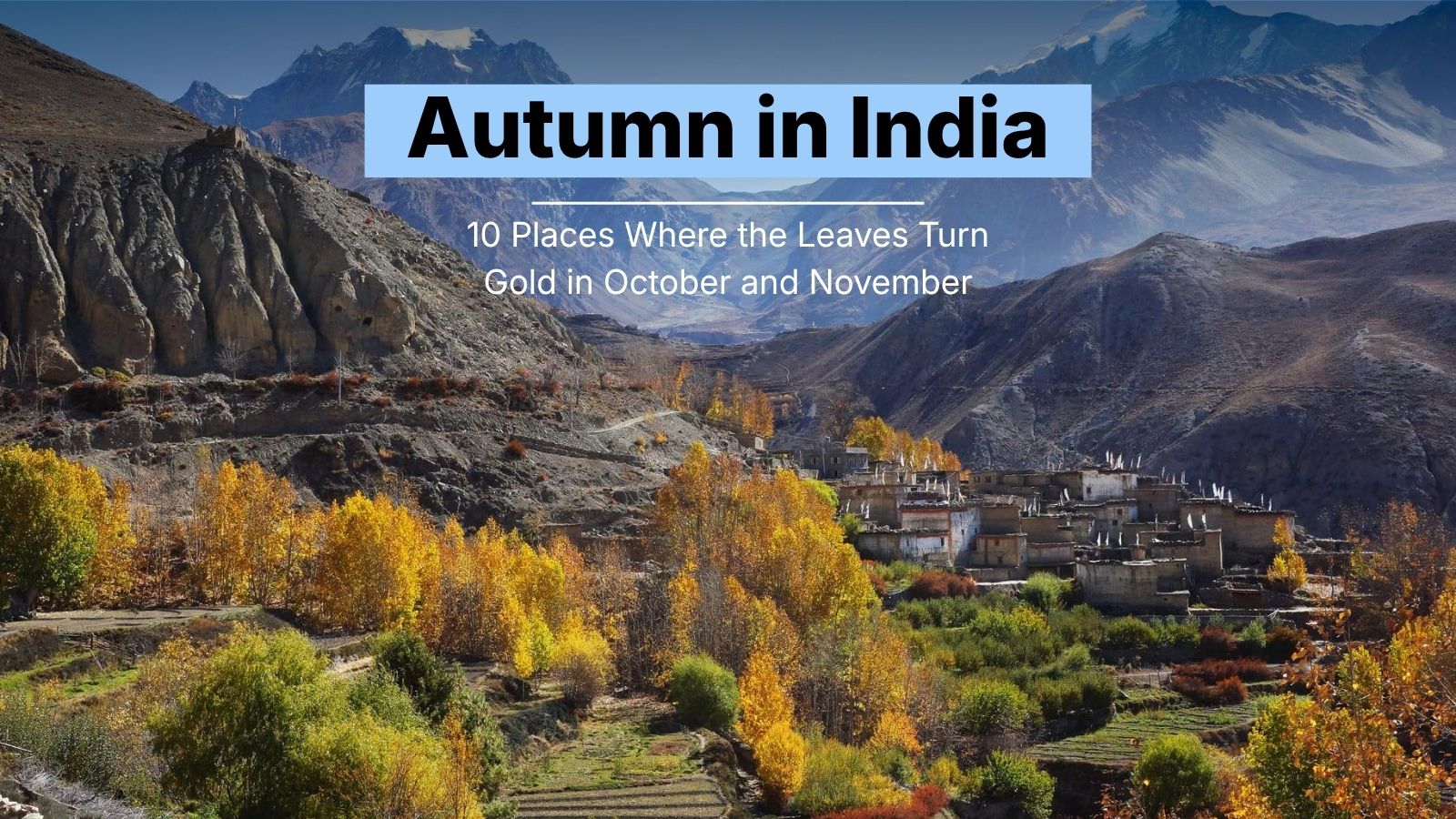
Most people think of North America or Japan when someone mentions autumn foliage. The idea that India has its own version of this season, complete with colour-changing trees, crisp air, and amber light in the afternoons, is still not as widely known as it deserves to be. But autumn in India is real, and in certain parts of the country it is genuinely spectacular. From the century-old chinar trees of Kashmir to the golden poplars lining the streams of Spiti Valley, several Indian destinations put on a colour show between October and November that rivals anything visitors travel abroad to see. This blog covers ten of the best autumn destinations in India and what makes each one worth visiting during this specific season.
Autumn in India happens primarily between October and November, with the most dramatic fall colours in India concentrated in the Himalayan north. The top ten places where to see autumn in India are Kashmir (Srinagar and Pahalgam), Spiti Valley, Munsiyari and Binsar in Kumaon, Dalhousie and Khajjiar in Himachal, Tawang in Arunachal Pradesh, Yuksom in Sikkim, Lansdowne in Uttarakhand, and Chikmagalur in Karnataka. Kashmir’s chinar leaves peak around mid-October and remain vivid through early November.
In this Blog
What Makes Autumn in India Different From Other Seasons
Autumn in India is not a single event happening in one place. It is a sequence that moves across latitudes and altitudes through October and November. The highest-altitude locations, like Spiti and Tawang, see their colour change earliest, often beginning in late September. Kashmir’s iconic chinar leaves peak around mid-October. Kumaon’s oak and rhododendron forests follow through late October and into November. And the coffee hills of Karnataka catch the season’s tail end in November with their own quieter version of seasonal colour.
What these places share is a change in the quality of light that comes only in autumn. The post-monsoon clarity in the Himalayas in October means visibility stretches for tens of kilometres on most days. The low angle of the sun in the afternoon turns everything amber and copper. And the air, cooler and drier than the summer months, carries a sharpness that makes being outdoors feel genuinely restorative. This combination of factors is what draws photographers, writers, and slow travellers to the mountains every October, even though it is a season that Indian tourism marketing has historically underplayed.
1. Kashmir (Srinagar and Pahalgam): The Home of Chinar Leaves

Kashmir is where autumn in India is most theatrical. The season is called Harud in Kashmiri, a word that appears in poetry going back centuries, and the chinar leaves Kashmir is famous for belong to trees that were, in many cases, planted during the Mughal period. The chinar tree is botanically Platanus orientalis, the oriental plane tree, and it is not native to India. Its seeds were brought into the Kashmir Valley by Central Asian traders and mystics travelling the Silk Road, which means the trees standing in Nishat Bagh and along the banks of Dal Lake today carry the history of that movement within them.
The chinar, locally called the flame of Kashmir, turns from deep green to gold, then to orange, then to a deep copper red between early October and early November. A single mature tree can reach heights of 30 to 40 metres and is wide enough to provide shade to a large courtyard below. The Mughal Gardens, particularly Nishat Bagh and Shalimar Bagh along Dal Lake, are the most photographed locations for chinar leaves in Kashmir, but Naseem Bagh on the shores of Dal Lake has a grove of chanars that Akbar is said to have planted himself in the 16th century and is less crowded than the formal gardens.
When do the chinar leaves change in Kashmir? The colour begins in early October and reaches its peak around the third week of October. By early November, the leaves begin to fall and carpet the paths of the gardens in a layer of rust and gold that is beautiful in its own right. Places to visit in Kashmir during this season include the Mughal Gardens, the Old City’s saffron fields in Pampore where harvest coincides with the colour change, and Gulmarg, where the birch and maple forest on the way up to the gondola turns a vivid yellow.
A villa near Kashmir in Srinagar is best experienced on a houseboat on Dal Lake, where the autumn light on the water in the early morning is a sight specific to the season.
2. Spiti Valley, Himachal Pradesh: Golden Poplars Against a Desert Sky
Spiti Valley in the cold desert of Himachal Pradesh has its own distinct version of fall colours in India, one that looks nothing like Kashmir but is equally compelling. The valley sits in the rain shadow of the Great Himalayan Range, which means it receives almost no monsoon rain. The vegetation is sparse: willows and poplars line the streams, barley grows in terraced fields, and the mountains themselves are bare grey-brown rock. When those willows and poplars turn yellow in late September and early October, the contrast between the golden foliage and the bone-dry grey mountains behind them is extraordinary.
The Manali-Kaza route via Kunzum Pass becomes unreliable after mid-October due to early snowfall, so the window for seeing autumn colour in Spiti before the road closes is genuinely short. Places to visit in Spiti during this season include Dhankar Monastery, perched above the confluence of the Spiti and Pin rivers, and the Tabo Monastery complex, which contains 1,000-year-old frescoes and is sometimes called the Ajanta of the Himalayas. Villas near Spiti Valley are homestays in the villages of Kaza and Langza, most of which are family-run with local food and firewood-heated rooms.
3. Munsiyari, Uttarakhand: Autumn at the Foot of Panchachuli
Munsiyari sits at 2,200 metres in the Pithoragarh district of Uttarakhand and faces the Panchachuli range, a group of five pyramid-shaped Himalayan peaks whose name means “the five hearths” in Hindi, referring to the Pandavas’ final cooking fires before their ascent to heaven in the Mahabharata. In October and November, the post-monsoon skies give the clearest views of these peaks that are possible all year, and the oak and rhododendron forests surrounding the town change colour in shades of amber and rust.
Places to visit in Munsiyari during autumn include Khaliya Top for sunrise, the Birthi Waterfall about 35 km from town, and the Tribal Heritage Museum, which documents the culture of the Bhotiya community who have historically used this valley as a trade route between India and Tibet. Villas near Munsiyari are available in village homestays above the main market, most of them with direct Panchachuli views from the sitting room.
4. Binsar, Uttarakhand: A Wildlife Sanctuary Where Autumn Arrives Quietly
Binsar, at 2,412 metres in the Almora district of Uttarakhand, is a hill station where a significant portion of the town and its surroundings are contained within the Binsar Wildlife Sanctuary. The sanctuary covers 47 square kilometres of primarily oak and rhododendron forest, and October to November is when these forests change colour with the least crowding of any season.
The key feature of autumn in India at Binsar is the Himalayan panorama from Zero Point, the highest accessible point within the sanctuary. On a clear October day, the view from here includes 300 kilometres of the Himalayan chain, from Kedarnath and Nanda Devi in the west to Nepal’s peaks in the east. The forests of the sanctuary at this altitude contain over 200 species of birds, and October sees the arrival of migratory species including several flycatchers and thrushes not seen in summer. Binsar is also one of the better-kept secrets among autumn destinations in India because it has no cable cars, no overcrowded viewpoints, and no commercial main street. The sanctuary is entered through a gate, and the roads inside are quiet enough to walk comfortably in the early morning.
Places to visit in Binsar include the Binsar Mahadev Temple 5 km from the main gate, the Zero Point viewpoint, and the walking trails through the oak forest that require no trekking experience to manage. Villas near Binsar within and around the sanctuary include the KMVN tourist bungalow at Zero Point, which sits directly inside the forest.
5. Dalhousie and Khajjiar, Himachal Pradesh: Two Faces of the Same Autumn
Dalhousie and Khajjiar, linked by an 8.6-kilometre trek through the deodar and oak forests of the Kalatop Wildlife Sanctuary, together form one of the most compact autumn destinations in India in Himachal Pradesh. Dalhousie was established as a British hill station in 1854 and sits at five different hilltops ranging between 1,525 and 2,378 metres, giving the town an unusual topography where the views from each ridge face a different direction. In October, the forests around the town turn shades of gold and copper, and the air coming off the Dhauladhar range is dry and clear.
Places to visit in Dalhousie in autumn include the Subhash Baoli nature walk, the St. Francis Church (1894), and the Dainkund Peak above Khajjiar for a 360-degree view. Villas near Dalhousie include colonial bungalow conversions and forest-facing cottages on the quieter ridges outside the town centre.

6. Tawang, Arunachal Pradesh: Autumn at the Edge of Tibet
Tawang, at 3,048 metres in Arunachal Pradesh’s westernmost corner, is where autumn in India arrives earliest and most dramatically. The town sits close to the borders of Tibet and Bhutan, and its forests of Himalayan blue pine, fir, and birch begin their colour change in late September, giving the valley a golden wash that lasts well into October. The Tawang Monastery, founded in 1680 and the largest Buddhist monastery in India outside Leh, sits above the town at 3,400 metres and is surrounded by these autumn trees during this season.
What makes Tawang distinct among autumn destinations in India is the combination of altitude, forest type, and historical depth. The Sela Pass at 4,170 metres, which must be crossed to reach Tawang from Guwahati, has its own dramatic October character: the alpine meadows around the pass turn brown and gold, the lake at the summit sometimes begins to show its first thin ice of the winter, and the views of the Himalayan chain to the north stretch into Tibet.
Places to visit in Tawang in this season include the monastery, Bum La, Madhuri Lake, and the Nuranang waterfall. Villas near Tawang are basic in the town itself, with a few newer guesthouses near the monastery.
7. Yuksom, Sikkim: The Gateway to Kanchenjunga That Autumn Forgot to Pass Over
Yuksom, in western Sikkim, was the first capital of Sikkim when it was crowned as a kingdom in 1642. Today it is best known as the starting point for the Goecha La trek, which approaches the southern face of Kanchenjunga at close range, but in October it is also one of the most peaceful autumn destinations in India in the northeast. The forests around the town are dense with oak, alder, magnolia, and rhododendron, and October brings a colour shift that fills the valleys in warm shades of amber and brown.
Places to visit in Yuksom during autumn include the Norbugang Throne, Dubdi Monastery (the oldest in Sikkim, built in 1701), and the Kanchenjunga Conservation Area along the Rathong Chu River. Accommodation near Yuksom is available in small lodge-style guesthouses in the town that serve local Sikkimese meals.
8. Lansdowne, Uttarakhand: Autumn in a Military Hill Station
Lansdowne in the Pauri district of Uttarakhand, at 1,706 metres, is one of the quieter places to see autumn in India because the town itself is partially under military administration as the headquarters of the Garhwal Rifles regiment. That administration has meant the surrounding forests of oak and blue pine have been preserved from commercial encroachment, and the autumn colour that arrives in October spreads across an intact forest rather than a patchy one.
The Bhulla Lake in the town is surrounded by trees that turn golden in October, and the Tip-in-Top viewpoint above the town gives a clear sightline to the Himalayan snowline on the one side and the Gangetic plains on the other. Lansdowne’s October character is defined by quiet mornings, empty paths through the regimental forests, and the sound of birds in the oak canopy that has not been thinned by construction or footfall. The Tarkeshwar Mahadev Temple, 38 km from the town and surrounded by ancient deodar trees, is specifically worth visiting in late October when the deodar forest around it takes on a deeper, drier colour before the winter.
Places to visit in Lansdowne include Bhulla Lake, Tip-in-Top, the Garhwali Museum, and the Tarkeshwar temple drive. Villas near Lansdowne are available on the quieter edges of the town, within easy walking distance of the main viewpoints.
9. Chikmagalur, Karnataka: South India’s Own Autumn Season
Autumn in India is not exclusively a Himalayan experience. Chikmagalur, in the coffee-growing hills of Karnataka at about 900 to 1,300 metres above sea level, has its own quieter version of seasonal colour change in October and November, when the coffee plants ripen and the hillside forests transition from their monsoon green to drier, warmer tones. The coffee cherries ripen from green to deep red between October and January, which gives the plantations a colour that is distinct from any conventional leaf-turning but is visually rich in its own way.
Places to visit in Chikmagalur during this season include the coffee estate trails around Aldur and Kalasa, Kemmanagundi, Mullayanagundi Peak, and Hebbe Falls, which run at a more manageable volume in October than in the heavy monsoon. Villas near Chikmagalur on working coffee estates are widely available and give a first-hand experience of the harvest season.
10. Chopta, Uttarakhand: Bugyals Turning Gold Before the Snow
Chopta in the Rudraprayag district of Uttarakhand, at 2,600 metres within the Kedarnath Wildlife Sanctuary, rounds off this list with a different version of fall colours in India. The high-altitude meadows here, called bugyals, turn from summer green to a deep, dry gold in October, and the rhododendron and oak forests below the meadow line take on their own warm tones at the same time. Tungnath Temple, the highest Shiva temple in the world at 3,680 metres, is reached by a 4-kilometre trek from Chopta, and the path through the forest in October is one of the more quietly beautiful walks in the Garhwal Himalayas.
The reason Chopta works so well as an autumn destination in India is that the season here is the last window before the snowfall that typically arrives in November or December closes the Tungnath trail entirely for the winter. The sense that something is about to end gives October at Chopta an intensity that mid-year visits do not have.
Places to visit in Chopta during this season include the Tungnath trek, Deoriatal lake (a 2-km walk from Sari village), and Ukhimath, the winter seat of Tungnath, where the deity is brought down for the cold months. Villas near Chopta are in village homestays in Sari and Ukhimath, both within a short drive of the meadows.

The Season India Has Not Fully Claimed Yet
The ten destinations above represent a version of autumn in India that exists across the country’s varied altitude and ecology, from the 3,048-metre heights of Tawang to the coffee hills of Karnataka. What they share is an October and November character that is distinct from any other time of year and genuinely worth planning a trip around. Unlike the cherry blossom tourism of Japan or the leaf-peeping circuits of New England, India’s fall colours have not yet been fully packaged and sold. That is, for now, part of the appeal. The chinar leaves Kashmir sees in October still fall on quieter paths than they did a decade ago. The golden poplars of Spiti still line roads that carry a fraction of the summer traffic. Going in autumn in 2026 means arriving before the crowds catch up.
FAQs
The best places where to see autumn in India are concentrated in the Himalayan north and northeast. Kashmir, Spiti Valley, Munsiyari, Binsar, Dalhousie, Tawang, Yuksom, Lansdowne, and Chopta all see genuine fall colours in India between October and November. South India has a quieter version of seasonal colour change in places like Chikmagalur, where the coffee harvest season in October and November gives the hillsides warm red and green tones that are distinct from anything in the Himalayan north.
The chinar leaves Kashmir is famous for begin to turn in early October and reach their peak colour around the third week of October. By early November, the leaves have mostly fallen and carpeted the ground of the Mughal Gardens and Naseem Bagh in layers of rust and gold. The Harud season, as autumn in India is locally called in Kashmir, typically runs from September through November, with mid-October being the single best week for the deepest red and copper tones.
Yes. Autumn in India is a genuine and distinct season in the Himalayan states of Jammu and Kashmir, Himachal Pradesh, Uttarakhand, Sikkim, and Arunachal Pradesh. It runs primarily from late September to November depending on altitude. The fall colours in India are produced by the same chlorophyll breakdown process that drives foliage seasons in North America and Japan: as days shorten and temperatures drop, chlorophyll production slows, and the underlying pigments of gold, orange, and red are revealed.
October is the single best month for autumn in India across most destinations. Early October suits Spiti and Tawang, where the colour peaks before mid-month. Mid to late October is the prime window in Kashmir and the Kumaon Himalayas. November still works well in Lansdowne, Chikmagalur, and for the quieter end of the season in Kashmir. Travelling in October also means post-monsoon road clarity in all Himalayan states, which makes driving safer and more enjoyable than the summer or monsoon months.
It is widely considered the best time to visit Kashmir by many who have been during multiple seasons. The chinar leaves that Kashmir produces in October create an atmosphere around Dal Lake and the Mughal Gardens that is specific to this season. The saffron harvest in Pampore also happens in October, which adds a cultural dimension to the visit. Temperatures in Srinagar in October are cool but manageable, ranging from around 5°C at night to 18°C during the day.
The primary contributors to fall colours in India are the chinar, which produces the deepest reds and coppers; the poplar and willow, which turn bright yellow and are especially striking in Spiti and Ladakh; the birch, which turns gold at high altitudes in Tawang and Sikkim; the oak, which turns amber and brown across the Kumaon Himalayas and Himachal Pradesh; and the rhododendron, whose leaves do not produce dramatic colour but whose dying season creates warm brown tones in the forests of Uttarakhand and the northeast.
Most autumn destinations in India are significantly less crowded in October than they are in the summer peak season of May and June. Kashmir is the main exception, where October has become increasingly popular, and houseboats and hotels book up quickly. Spiti and Tawang remain genuinely uncrowded in October, as does Binsar in Uttarakhand, where the sanctuary itself limits footfall. Booking accommodation at least three to four weeks in advance is advisable for Kashmir specifically; for all other destinations on this list, one to two weeks ahead is usually sufficient.
South India does not have the same leaf-turning deciduous trees that drive the dramatic fall colours in India in the north, but Chikmagalur in Karnataka has its own seasonal character in October and November. The coffee cherry harvest turns the plantation hillsides deep red, and the shola forests of the Bhadra Tiger Reserve area see some colour change in their canopy. The Nilgiri Hills and the Brahmagiri range in Coorg also see forest colour shift in October, though it is subtler than the Himalayan north. For a classic autumn spectacle in India, the northern Himalayas between October and early November remain the most rewarding destinations.
Written By: Ruben Saha