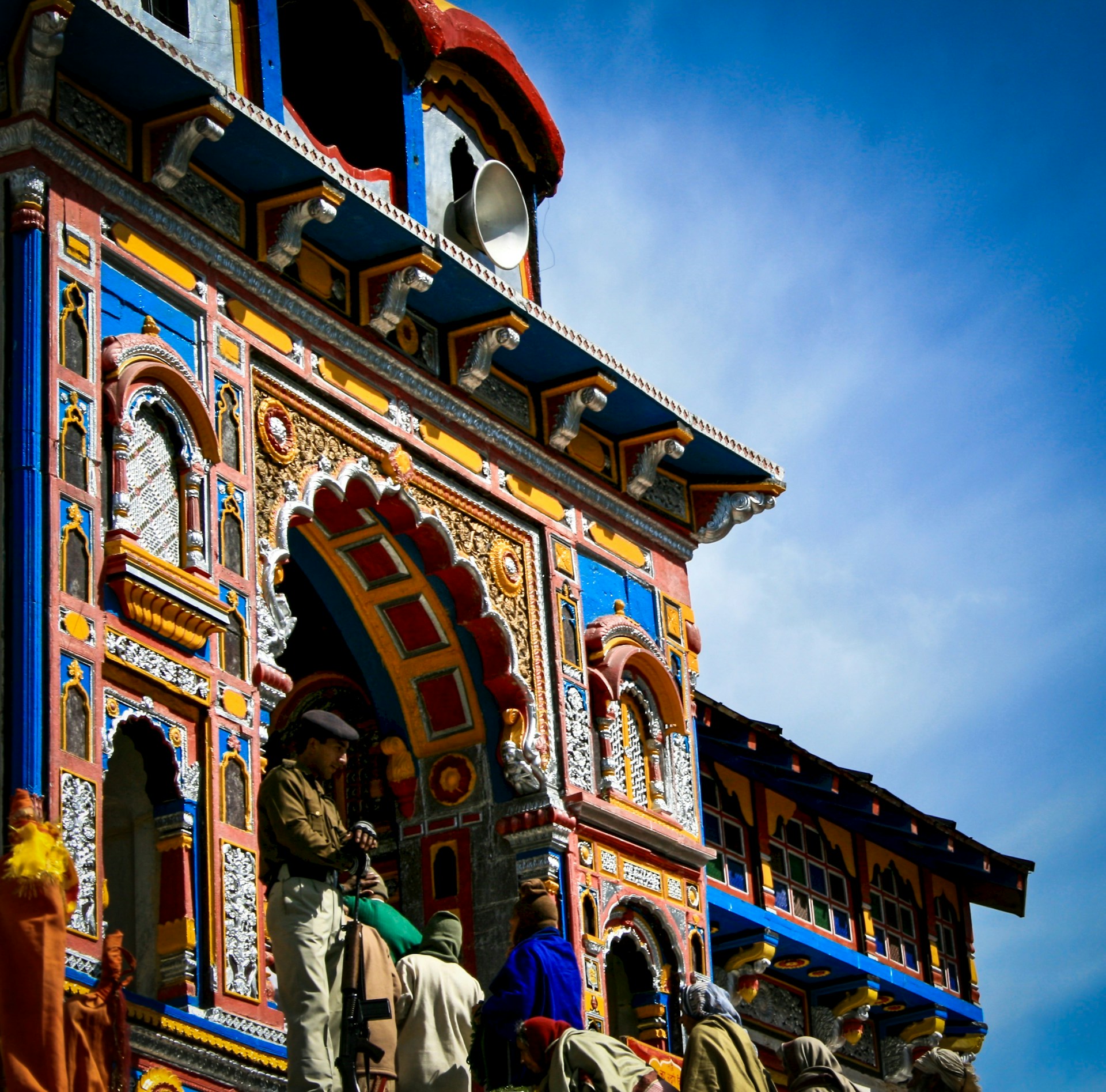
Badrinath Dham, at 3,133m in Chamoli district (Uttarakhand), is one of the Char Dham pilgrimage sites. The temple runs a seasonal calendar — opens on a Basant Panchami–announced date in late April or early May, closes on a Vijayadashami–announced date in mid-November. The yatra route runs Rishikesh (or Haridwar) → Devprayag → Rudraprayag → Karnaprayag → Chamoli → Joshimath → Govindghat → Badrinath. Online registration through the Uttarakhand Char Dham Devasthanam Management Board is mandatory. For 2026 pilgrims, the final darshan window closes approximately 13 November 2026; for 2027 planners, tentative opening around 13 May 2027.
Last updated: October 2026
Over 17.8 lakh pilgrims have already completed their Char Dham Yatra registration as of mid-April 2026 — and Badrinath Dham’s 23 April opening has triggered the busiest yatra booking window in the last five years (Uttarakhand Tourism / NDTV Profit, April 2026). If you are planning the journey for yourself, your parents, or a family group from Delhi, Mumbai, Bangalore or Ahmedabad, the details below have been verified against government portals and our own ground observations from travellers hosted at StayVista homestays in Rishikesh, Haridwar, and Dehradun this season. Use this guide alongside our complete Char Dham Yatra 2026 guide for the full pilgrimage picture.
In this Blog
Current Badrinath season status (October 2026):
2026 season closing: The Badrinath Dham 2026 season closes approximately 13 November 2026 (Bhai Dooj). The official closing date is announced each year on Vijayadashami by the Badrinath-Kedarnath Temple Committee — Vijayadashami 2026 falls on 20 October, so the confirmed closing date will be announced in the next few days. If you’re planning a 2026 visit, the final darshan window is roughly 4–5 weeks from now.
2027 season outlook: The 2027 opening date for Badrinath will be announced on Basant Panchami 2027. Current operator reporting suggests a tentative opening around 13 May 2027, but this is unconfirmed until the Rawal and the temple committee finalise. Yamunotri and Gangotri typically open on Akshaya Tritiya (expected 8 May 2027); Kedarnath follows roughly 2–3 days later.
Badrinath Temple opens for pilgrims on 23 April 2026 at 06:15 AM and remains open until approximately 13 November 2026 (coinciding with Bhai Dooj), as confirmed by the Uttarakhand Char Dham Devasthanam Management Board. The opening date was set on Basant Panchami earlier this year after consultation with the temple’s hereditary priests (the Rawals), and the 2026 season aligns with the Akshaya Tritiya window, considered one of the most auspicious times to begin the journey.
The temple is dedicated to Lord Vishnu in his Badri-Narayan form and sits in Chamoli district of Uttarakhand, between the Nar and Narayana mountain ranges, on the banks of the Alaknanda river. For six months of winter (late November to late April), the idol is moved to the Narasimha Temple in Joshimath, where worship continues while Badrinath itself remains snowbound and largely uninhabited.
Key 2026 dates at a glance
Basant Panchami 2026 (opening date announcement): completed February 2026
Phase 1 online registration: opened 6 March 2026
Temple kapat opening: 23 April 2026, 06:15 AM
Peak pilgrim flow: May 1 – June 20, 2026
Monsoon pause window (pilgrims strongly discouraged): 5 July – 25 August 2026
Shoulder season (quieter, cooler): 15 September – 25 October 2026
Kapat closing: ~13 November 2026
What Are the Badrinath Darshan Timings and Aarti Schedule in 2026?
Badrinath Temple offers daily darshan from 4:30 AM to 1:00 PM in the morning and 4:00 PM to 9:00 PM in the evening, with the morning Maha Abhishek Aarti beginning at 4:30 AM and the Shayan Aarti (bedtime aarti) closing the day at 8:30 PM. The temple breaks for midday bhog and rituals, so plan morning darshan between 7 AM and noon to avoid long queues, particularly on weekends.
Full day of rituals
Time
Ritual
Notes
4:30 AM
Maha Abhishek Aarti
VIP window — Mahabhishek Puja pilgrims only
6:00 AM – 6:30 AM
Abhishek Puja
Included in VIP darshan packages
7:00 AM – 9:00 AM
General darshan opens fully
Prime photography window
11:30 AM – 12:00 PM
Bhog Prasad offering
Temple temporarily closes
1:00 PM
Midday break begins
Temple closes until 4:00 PM
4:00 PM
Evening darshan reopens
Cooler, slightly quieter
6:00 PM – 7:00 PM
Evening Aarti & Geet Govind
Most photographed ritual of the day
8:30 PM
Shayan Aarti (bedtime aarti)
Temple closes after this
VIP darshan and Mahabhishek Puja
The Mahabhishek Puja, widely referred to as VIP darshan, is booked online via https://badrinath-kedarnath.gov.in/ Deep Darshan (VIP) passes are available through the Badrinath-Kedarnath Temple Committee. Current fees and the registration process are periodically revised — check the official portal (badrinath-kedarnath.gov.in) for the current rate and application format before travel.
Practical details:
Best time to visit (inside the day): 7 AM–10 AM and 6 PM (evening aarti)
Time required: 2–3 hours, including Tapt Kund dip
Ideal for: All pilgrims — wheelchair access available at the entrance via the ramp on the left
Pro tip: Carry a plastic bag for shoes (no designated stand in peak hours) and avoid Saturdays for quieter queues
How Do I Register for Badrinath Yatra 2026 Online?
Registration for the Badrinath Yatra 2026 is free and mandatory for every pilgrim, issued as a QR-code e-pass through the Uttarakhand government’s registrationandtouristcare.uk.gov.in portal or the Uttarakhand Tourist Care app. The e-pass is checked at three fixed checkpoints — Rishikesh, Sonprayag, and Joshimath — and no one is allowed past these points without a valid QR code. Over 17.8 lakh pilgrims had completed registration by mid-April 2026, which means popular early-May dates are already running at capacity. Book at least 2–3 weeks in advance for May–June travel.
Step-by-step registration (online)
Visit the portal or open the Uttarakhand Tourist Care app. Create an account with your mobile number and verify via OTP. Foreign nationals use their passport number.
Choose “Badrinath” from the dham selection screen. Select your date of visit from the available phased slots — if your preferred date shows “full,” try ±2 days as a backup.
Upload identity proof (Aadhaar card, Voter ID, or passport) and a recent passport-size photograph. File size limit is 2 MB.
Add co-travellers one by one — every pilgrim needs individual registration, including children. Pilgrims aged 70 or above must upload a medical fitness certificate from a licensed physician.
Download and print your QR e-pass. Carry both the printed copy and the app screenshot — mobile network drops are common beyond Joshimath.
Offline registration centres
If you haven’t been able to register online, these counters accept walk-ins:
Haridwar: Rishikul Parisar, near Railway Station
Rishikesh: Transit Campus, Yatra Office
Joshimath: Tourist Rest House, opposite ITBP Gate
Documents checklist
Government photo ID (Aadhaar / Voter ID / Passport / Driving Licence)
Passport-size photograph
Medical fitness certificate (mandatory for pilgrims aged 70 and above, strongly recommended for anyone with cardiac, respiratory, or hypertension conditions)
Vehicle Green Card (for private vehicles entering the yatra route)
If your date is full: Avoid panic. Slots open in waves as earlier registrations expire or are cancelled. Check the portal daily at 11 AM and 8 PM, when the system typically refreshes.
How Do You Reach Badrinath in 2026 from Delhi, Mumbai, or Dehradun?
Badrinath is 320 km from Haridwar (10–12 hours by road via NH-58), 525 km from Delhi (14–16 hours), and sits at an altitude of 3,133 m. Joshimath is the last major night-halt town before the final 45 km climb to the temple. Most Indian pilgrims reach Badrinath by road from Haridwar or Rishikesh — but flyers from Mumbai, Bangalore, Hyderabad, and Ahmedabad typically start with a flight into Jolly Grant Airport, Dehradun, saving almost a full day.
By road from Haridwar (the classic route)
Leg
Distance
Drive time
Key stop notes
Haridwar → Rishikesh
24 km
45 min
Overnight acclimatisation recommended
Rishikesh → Devprayag
74 km
2.5 hrs
Confluence of Bhagirathi and Alaknanda
Devprayag → Srinagar (Garhwal)
34 km
1 hr
Lunch halt
Srinagar → Rudraprayag
33 km
1 hr
Suitable overnight halt for seniors
Rudraprayag → Karnaprayag
27 km
1 hr
Weather-check point
Karnaprayag → Joshimath
45 km
2 hrs
Last major town before Badrinath
Joshimath → Badrinath
45 km
1.5 hrs
Final climb via Vishnuprayag
Total
~282 km
~10 hrs
Excluding breaks
By road from Delhi
Delhi to Badrinath is 525 km via NH-58 and takes 14–16 hours with normal traffic. Most Delhi pilgrims split this into a two-day drive: Delhi → Rishikesh (230 km, 6–7 hrs) on day one, then Rishikesh → Joshimath (290 km) on day two.
By road from Mumbai / Bangalore / Hyderabad
The sensible route for southern and western pilgrims is a flight to Dehradun (Jolly Grant Airport) + road. A typical plan:
Direct flight Mumbai/Bangalore/Hyderabad → Dehradun (2–3 hours)
Dehradun → Rishikesh: 35 km, 1 hour
Rishikesh → Joshimath: 290 km, 9 hours with stops
The Joshimath to Badrinath drive is approximately 42 km but typically takes 3 to 4 hours on the Chamoli district mountain stretch (Govindghat, Pandukeshwar, Hanuman Chatti). Factor in security checkpoints and seasonal landslide-clearance stops. The 1.5-hour estimate reflects best-case non-season driving, which rarely applies during the yatra window.
Total door-to-darshan: roughly 2 full days, or 1 day if you book a helicopter transfer.
By air
Jolly Grant Airport, Dehradun — 301 km from Badrinath; daily flights from Delhi, Mumbai, Bangalore, Hyderabad, Ahmedabad, Lucknow, Jaipur.
Pantnagar Airport — secondary option; add ~50 km but useful for pilgrims combining Jim Corbett or Nainital.
By train
Haridwar Junction — best-connected station; daily trains from New Delhi (Shatabdi), Mumbai, Ahmedabad, Howrah, Varanasi.
Rishikesh Railway Station — limited connections; onward travel by road. The two main railheads for the Badrinath yatra are Rishikesh (RKSH) and Haridwar (HW). Rishikesh is closer to the yatra start point (NH-7 begins at Rishikesh) and skips the Haridwar–Rishikesh ghat drive, but has limited direct train connectivity from major cities. Haridwar has the strongest train connectivity (Shatabdi, Dehradun Express, Jan Shatabdi from Delhi) and most yatra operators organise pickups from Haridwar. Pick based on your origin city’s train connectivity.
By helicopter (fastest option)
Helicopter services from Sahastradhara Helipad, Dehradun, take 30–45 minutes each way and cost ₹80,000–₹1,50,000 per person for Badrinath-only sectors. Operators include Himalayan Heli, Heritage Aviation, Syandana Aviation, and Kestrel. Full Char Dham helicopter packages (all four shrines) cost ₹2.2–₹3 lakh per person across 5–6 days. Helicopter slots for the Mahabhishek Puja window (4:30 AM darshan) sell out first — book within 24 hours of opening your e-pass registration.
What Are the Road Conditions and Traffic on the Badrinath Route in 2026?
NH-58 is motorable after the 23 April opening, but the Joshimath–Badrinath stretch still has rough patches at Lambagad, Kanchan Nala, and near Pipalkoti from ongoing land-subsidence repair work. Weekends in May and June see 1–3 hour jams at Tapovan and Nepali Farm (just past Rishikesh) where the checkpoint bottleneck begins. Active landslide zones are flagged near Vishnuprayag, Helang and Pipalkoti, and night travel on NH-58 is banned by the district administration between 7 PM and 5 AM.
A group of pilgrims who stayed at our Rishikesh homestay on 25 April 2026 reported that an early 4:30 AM departure reached Joshimath in 8 hours flat, while a family that left at 8:30 AM the same day took just under 12 hours — a 3.5-hour difference explained entirely by weekend traffic at Tapovan and post-10 AM convoy slowdowns near Rudraprayag. The lesson: start before first light if you can.
Essentials for the drive
Carry printed QR e-pass + ID + Green Card (for private vehicles); digital-only copies fail at checkpoints if there’s no signal
Fuel up at Rishikesh and again at Joshimath — petrol pumps between these are unreliable
Download offline Google Maps of Uttarakhand hill roads before leaving Rishikesh
Sample 5-Day Badrinath Itinerary from Delhi or Mumbai
A comfortable 5-day Badrinath itinerary balances altitude acclimatisation, darshan, and one slow day — with per-person costs ranging from ₹12,000 (budget) to ₹30,000 (mid-luxury with a StayVista homestay in Rishikesh). The rule we suggest to every guest: never attempt the Joshimath-to-Badrinath climb (1,875 m → 3,133 m in four hours) without at least one night at a lower altitude first.
Day-by-day plan
Day 1 — Arrive Rishikesh or Haridwar Fly into Dehradun (from Mumbai / Bangalore / Hyderabad) or drive from Delhi. Overnight in Rishikesh at 375 m altitude — a Ganga-facing homestay like Vista Divine or Echoes of Ease works well for families. Light walk along the Ganga; early dinner. An overnight here does real physiological work — it’s the single biggest protective factor against altitude sickness on day three.
Day 2 — Rishikesh to Joshimath (253 km) Leave by 5:30 AM. Break for breakfast at Devprayag, lunch at Srinagar or Rudraprayag, overnight at Joshimath (1,875 m). Evening walk to Auli ropeway base; early dinner.
Day 3 — Joshimath to Badrinath via temple darshan Depart by 6 AM for Badrinath. Holy dip at Tapt Kund → temple darshan (allow 2–3 hours) → afternoon to Mana Village, the last Indian village before the Tibet border. Return to Joshimath by 7 PM.
Day 4 — Joshimath to Auli ropeway, then Karnaprayag or back to Rishikesh If you’re tight on time, drive straight back to Rishikesh (290 km). If you have a flexible day, ride the Auli ropeway (India’s longest cable car at 4 km) for Himalayan views and overnight at Karnaprayag.
Day 5 — Return to Delhi / fly home from Dehradun Optional second night at Cottage in the Clouds, Mussoorie, before flying out of Dehradun the next morning — a gentle recovery day after four days on Himalayan roads. Alternatively, many pilgrims use this day for Ganga Aarti at Triveni Ghat in Rishikesh before flying out.
Budget range (per person, excluding flights)
Tier
Cost
What’s included
Budget
₹12,000 – ₹15,000
Shared sedan, 3-star hotels, self-guided
Mid
₹18,000 – ₹25,000
SUV, Rishikesh homestay, Joshimath hotel, driver
Premium
₹28,000 – ₹40,000
StayVista homestay + AC Tempo, Auli add-on
Helicopter
₹80,000 – ₹1,50,000
Sahastradhara → Badrinath return + VIP darshan
What Are the Best Things to Do Near Badrinath? 8 Must-Visit Attractions
Once you’ve had darshan, the area around Badrinath has some of the richest mythological and natural landscapes in the entire Char Dham circuit. These are the eight stops worth the time.
1. Tapt Kund — Sacred Hot Springs
A natural sulphur hot spring right below the temple steps, traditionally bathed in before temple darshan. Water temperature hovers around 45°C year-round.
How to reach: 30 m from the temple entrance, within the temple complex
Time required: 30–45 minutes
Ideal for: All pilgrims (separate enclosures for men and women)
Pro tip: Carry a change of clothes; the bath is mandatory for many traditional families before entering the sanctum
2. Mana Village — The Last Indian Village
A culturally fascinating Bhotia village 3 km from Badrinath, traditionally known as the last Indian settlement before the Indo-Tibet border. The Saraswati River emerges from beneath a boulder here.
How to reach: 3 km by taxi or shared jeep from Badrinath; ₹300–₹500 round trip
Time required: 2–3 hours
Ideal for: Families, solo travellers, photographers
Pro tip: Buy the hand-knit wool sweaters from village women — income stays local, and quality is outstanding
3. Vyas Gufa & Ganesh Gufa — The Mahabharata Caves
Twin caves where, per tradition, Sage Vyas dictated the Mahabharata to Ganesha. Vyas Gufa is believed to be over 5,000 years old.
How to reach: Short uphill walk inside Mana Village
Time required: 30–45 minutes
Ideal for: Spiritual travellers, history enthusiasts
Pro tip: Early morning light makes the stone carvings visible — later in the day, the interior is quite dark
4. Bhim Pul — The Bridge Bhima Built
A natural stone arch over the Saraswati river, said to have been placed there by Bhima during the Pandavas’ final ascent. The water roars below at full force in May and June.
How to reach: 100 m walk from Vyas Gufa within Mana Village
Time required: 15–20 minutes
Ideal for: Everyone, including seniors with basic mobility
Pro tip: The best photograph is from the small platform on the far side of the arch — mornings have fewer crowds
5. Vasudhara Falls — The 145-Metre Sacred Cascade
A towering waterfall believed to drop water only on the pure of heart. The full round-trip trek is 9 km and crosses alpine meadows.
How to reach: 4.5 km trek one-way from Mana Village
Time required: 4–5 hours, including rests
Ideal for: Fit pilgrims, couples, trekkers
Pro tip: Carry 2 litres of water per person, sunblock, and a light jacket — weather shifts fast above Mana
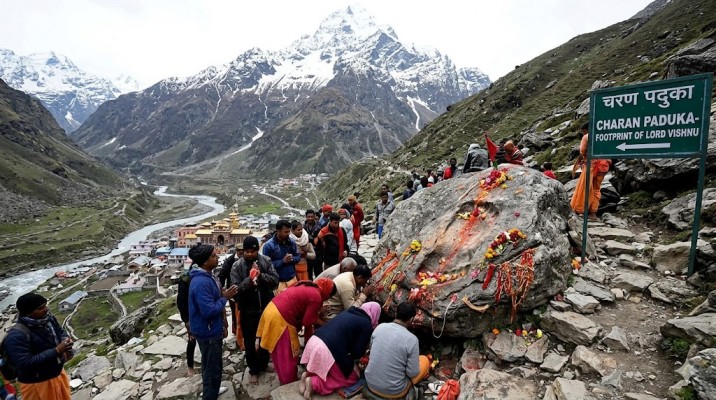
6. Charan Paduka — Vishnu’s Footprints on Stone
A 3 km uphill trek from the temple to a rock bearing what pilgrims believe are Lord Vishnu’s footprints, preserved in stone.
How to reach: Uphill trail from behind the temple complex
Time required: 1.5–2 hours round trip
Ideal for: Devotees, moderate-fitness trekkers
Pro tip: Start early (7 AM) to avoid midday sun on the exposed sections
7. Brahma Kapal — Pind Daan Ghat
A flat platform behind the temple where Hindus perform pind daan rituals for ancestors. Widely considered more sacred for this rite than Gaya itself.
How to reach: Behind the main temple, reached via a short walk along the Alaknanda
Time required: 30–60 minutes
Ideal for: Pilgrims performing ancestral rituals
Pro tip: Book a temple-approved pandit in advance through the Devasthanam Board to avoid on-site touts
8. Neelkanth Peak Viewpoint
The 6,597 m Neelkanth peak is Badrinath’s dramatic backdrop and glows golden at sunrise.
How to reach: Visible directly from the temple courtyard
Time required: 15 minutes
Ideal for: Photographers, early risers
Pro tip: On clear mornings in mid-May and late September, the first light on Neelkanth is one of the most photographed moments in the Himalayas — get your camera position by 5:15 AM
When Is the Best Time to Visit Badrinath in 2026?
The best time to visit Badrinath in 2026 is mid-May to mid-June (for warm, stable weather) or mid-September to late October (for quieter crowds and crisp Himalayan views). Avoid July and August entirely — monsoon rains across Chamoli district trigger landslides, road closures, and route suspensions almost every year, and the temple remains open mostly for hardy local pilgrims who can wait out the disruptions.
Month-by-month snapshot (2026)
Month
Day temp
Night temp
What to expect
Late April
7–15°C
0–5°C
Opening rush, occasional late snow, clear skies
May
10–20°C
2–8°C
Best month overall — warm, dry, all services active
June
15–25°C
5–10°C
Warmest; acclimatise in Rishikesh first
July
12–20°C
8–12°C
Avoid — landslides, heavy rain, delays
August
12–20°C
8–12°C
Avoid — road closures common
September
10–18°C
5–10°C
Shoulder season; quiet and clear
October
5–15°C
0–5°C
Second-best month — fewer crowds, crisp views
Early November
2–10°C
-3 to 3°C
Pre-closure rush; early snow possible
Late April vs May — which is better?
The first week after the kapat opens (23 April–1 May) draws a heavy religious crowd because of the Akshaya Tritiya auspicious window, and the weather can be unpredictable — late snow is not uncommon. If you can wait ten days and travel in the second and third weeks of May, you get stable 10–20°C weather, fully operational helicopter services, cleared roads, and slightly shorter queues.
Where to Stay Before & After the Badrinath Yatra
The smartest overnight strategy for the Badrinath Yatra 2026 is two nights in Rishikesh for acclimatisation, one night in Joshimath at the base of the climb, and an optional post-yatra night in Mussoorie or Haridwar to recover before heading home. StayVista’s Uttarakhand collection is built precisely for this kind of journey — quiet, family-friendly homestays and villas across Rishikesh, Haridwar, Dehradun and Mussoorie, with home-cooked sattvik meals, heated water through the night, and drivers who know every switchback of NH-58 by heart.
Badrinath itself has no luxury private stays — the town has only basic dharamshalas and GMVN rest houses during the yatra season. That is precisely why your pre-yatra acclimatisation stay matters. A proper two nights at 375 m in Rishikesh before the ascent to 3,133 m does more for your body than any altitude pill, especially if you are travelling with parents or grandparents.
Best StayVista homestays in Rishikesh for Badrinath pilgrims
Rishikesh is the single best base for pilgrimage planners — low altitude, easy NH-58 access, morning Ganga aarti, and sattvik food traditions that match what most pilgrims eat through the yatra.
1. Vista Divine, Rishikesh — A spacious riverside villa overlooking the Ganga, tucked into a green corner of Rishikesh away from the main bazaar crowds. Ideal for multi-generational families travelling for the yatra: ground-floor bedrooms, private lawn for early-morning pranayama, and a location quiet enough for pre-dawn departures to Joshimath. Ganga views from the verandah let seniors experience the river without the ghat crowds.
2. Echoes of Ease, Rishikesh — A mountain-view villa in a peaceful Rishikesh pocket with Himalayan foothill vistas from the balcony. Good for couples and small families planning the Char Dham circuit; the natural quiet supports genuine rest before two long days on the road.
3. Ganga’s Jewel, Rishikesh — A premium riverside homestay for pilgrims who want indulgence bracketing the austerity of the yatra itself. Well-suited for a post-yatra night on the way back, when most guests tell us they crave a proper hot shower and a home-cooked dal-chawal dinner.
4. The Pali, Rishikesh — A hillside Rishikesh homestay with forested surroundings and good airflow. Good pick for a summer (May–June) stay when the plains below are already hot.
Best StayVista villas in Haridwar
Haridwar is the traditional starting point of Char Dham — begin with a Har-ki-Pauri darshan and an early Ganga Aarti, then turn north to Rishikesh and Joshimath.
5. Mango Trails, Haridwar — A 5-acre holiday farmhouse set inside a working mango orchard adjoining Rajaji National Park. One of the most unusual stays in the Char Dham circuit — pilgrims often extend a night here for an early-morning safari before heading to Rishikesh. Lawns, orchard walks, and home-cooked Garhwali meals make this an especially gentle pre-yatra base for seniors.
Best StayVista homestay in Dehradun
Dehradun is the most efficient arrival city for pilgrims flying in from Mumbai, Bangalore, Hyderabad and Ahmedabad. Jolly Grant Airport lands you 35 km from Rishikesh and just under an hour from any of these homes.
6. Villa Vaari, Dehradun — A comfortable, hill-view Dehradun villa within easy reach of both Jolly Grant Airport and the Rishikesh turn-off. Use it as a one-night landing stop if your flight comes in late and you want to start fresh on day two.
Best StayVista homestays in Mussoorie (for post-yatra recovery)
After four days on Himalayan roads and a climb to 3,133 m, most families crave one slow day before the journey home. Mussoorie (2,000 m) is the natural recovery stop — cooler than the plains, scenic, and only 35 km from Dehradun airport.
7. Cottage in the Clouds, Mussoorie — A classic colonial-era Mussoorie cottage with cloud-level views, fireplaces, and wrap-around garden. An unhurried post-yatra night here — with a late breakfast, a short Camel’s Back Road walk, and an early Dehradun airport transfer the next morning — is how our Mussoorie hosts end most guests’ Char Dham trips.
8. Cloudview Villa, Mussoorie — A modern Mussoorie villa with panoramic Doon Valley views and spacious layouts for families. Work-friendly Wi-Fi if you need to catch up on email before flying home.
Browse the full StayVista Uttarakhand collection → Our on-ground managers in Rishikesh, Haridwar, Dehradun and Mussoorie host yatra-bound guests through every month of the 2026 season, and can help plan the drive to Badrinath if you’re travelling with elderly parents or first-time pilgrims.
Badrinath Yatra 2026 for Senior Citizens: Safety Checklist
Pilgrims above 70 must upload a medical fitness certificate during registration, and anyone with cardiac, respiratory or uncontrolled blood-pressure conditions should seriously consider the 30–45 minute helicopter flight from Sahastradhara, Dehradun (₹80,000–₹1,50,000 per person) instead of the 10–12 hour road journey. Badrinath sits at 3,133 m — that’s nearly 2,800 m higher than Rishikesh, and altitude-related symptoms begin for most unacclimatised travellers above 2,500 m.
Pre-yatra preparation
Acclimatisation plan: Minimum one night at Rishikesh (375 m) → one night at Joshimath (1,875 m) → day trip to Badrinath (3,133 m) with return to Joshimath for a second night
Medical kit: Diamox (acetazolamide, 125 mg twice daily starting 24 hours before ascent — consult your physician), oxygen can, BP monitor, personal daily medications, thermal layers
Fitness certificate: From any registered MBBS physician; valid for 30 days from date of issue
Palki and porter services are available at the entrance — ₹1,500–₹2,500 per trip covers the 100 m climb to the sanctum
Wheelchair ramp on the left side of the main entrance
Hydration — drink warm water, not cold; altitude accelerates dehydration
Emergency contacts
Joshimath CHC (Community Health Centre): +91-1389-222-222
Badrinath Temple Medical Post (seasonal): on-site during yatra
Yatra Mitra Helpline: 1364 (Uttarakhand Tourism)
Frequently Asked Questions
When does Badrinath Temple open in 2026?
Badrinath Temple opens on 23 April 2026 at 06:15 AM and is expected to close around 13 November 2026 (Bhai Dooj). Dates are confirmed by the Uttarakhand Char Dham Devasthanam Management Board.
Is Badrinath Yatra registration free?
Yes. Registration is free and mandatory via registrationandtouristcare.uk.gov.in or the Uttarakhand Tourist Care app. You will receive a QR-code e-pass that is checked at Rishikesh, Sonprayag and Joshimath.
How far is Badrinath from Haridwar and Delhi?
Badrinath is 320 km from Haridwar (10–12 hours by road via NH-58) and 525 km from Delhi (14–16 hours). Most Delhi pilgrims split the journey over two days with an overnight in Rishikesh or Joshimath.
How much does a Badrinath helicopter package cost?
Helicopter packages from Sahastradhara, Dehradun, cost ₹80,000 to ₹1,50,000 per person for Badrinath-only sectors (30–45 minute flight). Full Char Dham helicopter packages cost ₹2.2–₹3 lakh per person across 5–6 days.
What is the best month to visit Badrinath?
Mid-May to mid-June offers the warmest and most stable weather (day temperatures 10–20°C). Mid-September to late October is the second-best window — fewer crowds and crisp Himalayan views. Avoid July and August due to monsoon landslides.
Is Badrinath Yatra safe for senior citizens?
Yes, with two conditions: pilgrims aged 70+ must upload a medical fitness certificate during registration, and anyone with cardiac or respiratory issues should opt for the helicopter flight from Dehradun. Acclimatisation in Rishikesh (375 m) and Joshimath (1,875 m) before the climb significantly reduces altitude sickness risk.
Can I visit Mana Village from Badrinath?
Yes. Mana Village is 3 km from Badrinath Temple, has free entry, and takes 2–3 hours to explore. It was traditionally called India’s last village before the Tibet border and is home to Vyas Gufa, Ganesh Gufa, Bhim Pul and the Saraswati origin point.
Do I need a separate permit for Badrinath beyond the yatra e-pass?
No. The Char Dham Yatra e-pass is sufficient for Indian nationals. Foreign nationals may need an Inner Line Permit for travel beyond Mana Village toward the Tibet border, but not for the temple itself.
Final Word
The Badrinath Yatra 2026 is an entirely plannable journey once you have the right facts. Register early at registrationandtouristcare.uk.gov.in, build in two acclimatisation nights in Rishikesh before the climb, travel in mid-May to mid-June or mid-September to late October, and carry both printed and digital copies of your QR e-pass. If you are travelling with elderly parents, budget for the helicopter flight from Dehradun — it turns a physically demanding two-day drive into a 45-minute transfer and lets your family focus on the darshan rather than the road.
For the wider picture across all four shrines, our complete Char Dham Yatra 2026 guide covers Yamunotri, Gangotri, and Kedarnath in the same level of detail, and our 2026 Kedarnath darshan guide pairs naturally with this one for Do Dham planners combining both shrines.
When you’re ready to plan the pre-yatra rest stops, explore StayVista’s Uttarakhand homestay collection in Rishikesh, Haridwar, Dehradun and Mussoorie. Our team can help map the drive, suggest breakfast stops, and connect you with drivers who know every turn of NH-58.
They may say that I talk too much, but hey, that’s the extrovert life (think Hermione trying to explain Hogwarts History to fellow witches and wizards). When I’m not chatting travel dreams into existence, I’m brewing up blog adventures for StayVista. With chai in one hand and wanderlust in my heart; travelling and shaping vacation concepts into great itineraries is something that thrills me. Writing a perfectly planned getaway for someone? It’s like sharing a delicious box of Bertie Bott’s Every-Flavour Beans – you never know what reaction you’ll get (but hopefully, mostly happy surprises!). So, buckle up fellow explorers, and grab your broomsticks – because we’re off to explore somewhere incredible with every post!