
Kurseong: 8 Things to Do in the Land of White Orchids + Siliguri Route
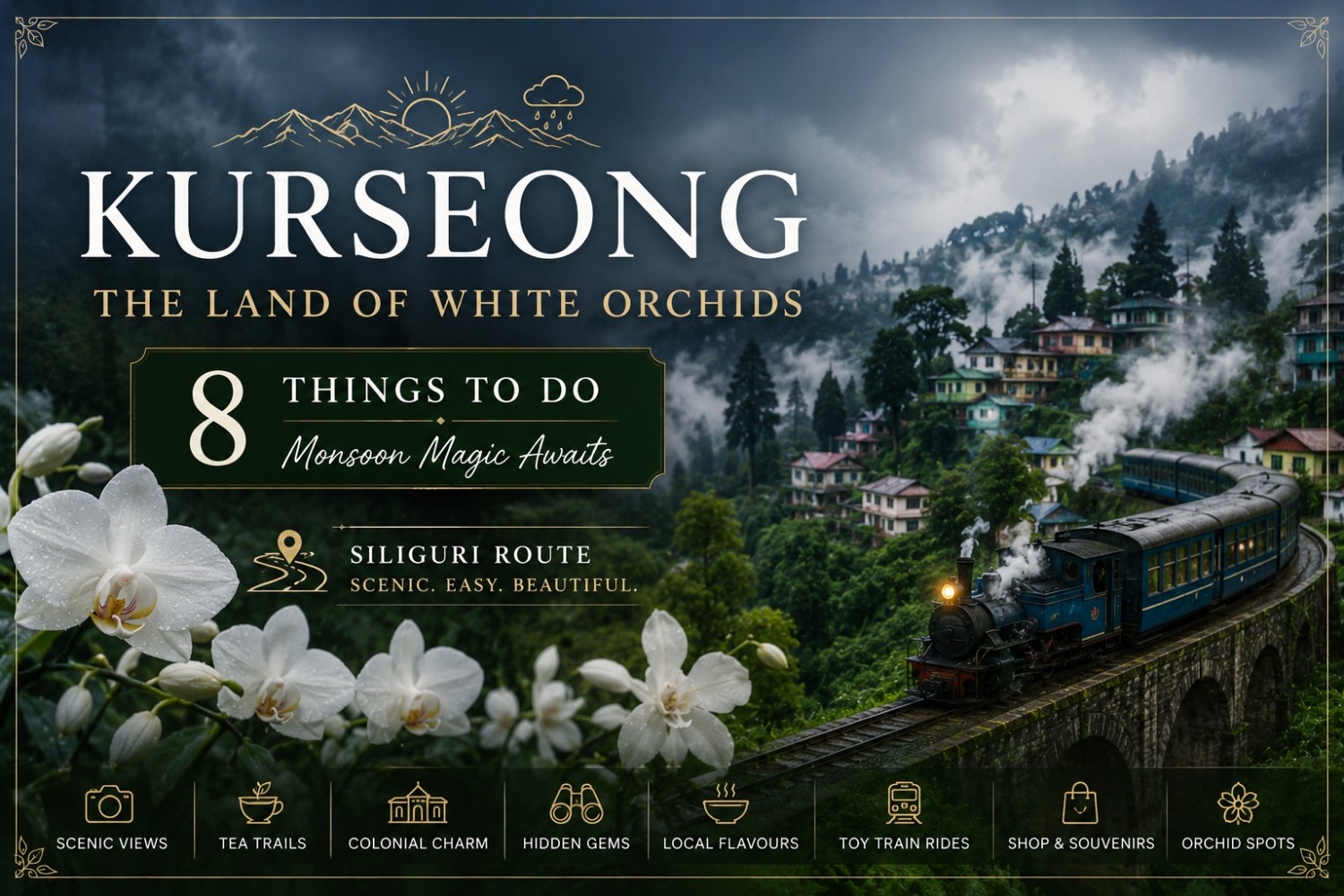
Quick Answer: The best things to do in Kurseong this monsoon include sunrise at Eagle’s Crag, tea tastings at Makaibari and Ambootia estates, a mist-soaked walk through Dow Hill, and the UNESCO Toy Train ride from Kurseong Station. Kurseong sits 32 km from Siliguri on NH-110 and is best reached via Bagdogra airport (New Jalpaiguri railway station is 47 km away). Plan a 2-day monsoon trip between July and September when white orchids and Himalayan wildflowers bloom across the ridges.
In this Blog
Kurseong at a Glance: Quick Info Table
| Destination | Kurseong, Darjeeling District, West Bengal, India |
|---|---|
| Altitude | 1,458 m (4,864 ft) above sea level |
| Best time to visit | September–November (post-monsoon clarity); July–August for green landscapes and cheaper stays |
| How to reach | Road: 32 km from Siliguri via NH-110 · Train: 47 km from New Jalpaiguri (NJP) · Air: 42 km from Bagdogra (IXB) |
| Nearest airport | Bagdogra International Airport (IXB) — 42 km / 1 hr 45 min drive |
| Nearest railway station | New Jalpaiguri Junction (NJP) — 47 km / 2 hr drive |
| Ideal duration | 2 nights / 3 days (extendable to Darjeeling & Mirik) |
| Budget range | ₹4,500–₹9,000 per person for a weekend (mid-range stay + local sightseeing) |
Monsoon Special: Introducing Kurseong, the Land of White Orchids

Locals call Kurseong “Kharsang” — the land of white orchids — a Lepcha name for the wild Coelogyne cristata that carpets the surrounding forests each monsoon. Between July and September, this quiet ridge town in the Darjeeling hills turns into a rain-soaked green corridor of tea estates, cardamom groves, colonial-era boarding schools and cloud-swept viewpoints. If Darjeeling feels crowded and Sikkim feels far, Kurseong is the middle path — closer to Siliguri, calmer than its famous neighbour, and dramatically beautiful once the clouds roll in.
The best things to do in Kurseong during monsoon are quieter, slower, and more sensory than the standard hill-station checklist: watching mist crawl over a tea garden at Ambootia, sipping second-flush Darjeeling at Makaibari, walking the haunted-forest trails of Dow Hill in a drizzle, and catching a break in the clouds at Eagle’s Crag before the next shower rolls in. The town has been a summer retreat since the 1880s, when the British opened boarding schools like Dow Hill and Goethals Memorial, and much of that colonial architecture still survives along the ridge.
The town is also a crucial stop on the Darjeeling Himalayan Railway — the UNESCO World Heritage narrow-gauge “toy train” — which climbs from New Jalpaiguri and pauses at Kurseong before continuing on to Ghum and Darjeeling. That single railway line, combined with the tea, the orchids and the light, is what makes Kurseong one of the most photogenic places to see in Kurseong-lovers keep coming back to.
Weather of Kurseong: What to Expect Month by Month
Kurseong has a subtropical highland climate. Temperatures rarely cross 26 °C even in peak summer, and monsoon rainfall averages around 3,000 mm annually — one of the wettest zones in the Eastern Himalayas. Understanding the weather is the difference between a magical Kurseong monsoon trip and a washed-out one.
| Season | Months | Temperature | What to Expect |
|---|---|---|---|
| Spring | March–May | 10 °C – 22 °C | Clear skies, blooming rhododendrons, best Kanchenjunga views |
| Monsoon | June–September | 15 °C – 24 °C | Heavy rain, mist, waterfalls, lush green tea estates, occasional landslides |
| Post-monsoon | October–November | 8 °C – 20 °C | Crystal-clear mountain views, festival season, ideal for photography |
| Winter | December–February | 3 °C – 15 °C | Cold, foggy mornings, occasional frost, quiet season |
For monsoon-specific planning: expect at least one heavy rain spell every day between mid-June and mid-September, usually in the afternoon or evening. Mornings are often clear enough for viewpoints and tea walks. Roads on NH-110 between Siliguri and Kurseong can face short landslide closures — usually cleared within a few hours by the Border Roads Organisation — so build a buffer day into your trip. The things to do in Kurseong during monsoon are best planned in the morning window; evenings are for hot momos, ginger tea and a book by the window.
Monsoon travel note: Carry a proper waterproof jacket (not a thin poncho), non-slip walking shoes, a dry-bag for electronics and repellent for leeches, which are common on forest trails between July and mid-September.
How to Reach Kurseong in Monsoon — The Siliguri Route Explained

Almost every traveller heading to Kurseong passes through Siliguri, the transport hub of North Bengal. Whether you’re flying into Bagdogra, arriving at New Jalpaiguri railway station, or driving from Kolkata, Siliguri is where your Kurseong journey really begins. Here is the exact route, distances and monsoon-specific advice for the Siliguri to Kurseong route.
The Siliguri to Kurseong Route (32 km, ~1 hr 30 min)
The classic route takes NH-110 (formerly NH-55), also known as the Hill Cart Road, which was built in 1861 and still runs parallel to the Darjeeling Himalayan Railway. From Siliguri, you’ll pass Sukna (foothills), Rongtong (railway loop), and Tindharia (the DHR workshop town) before climbing steadily to Kurseong. The road gains nearly 1,300 m of elevation in 32 km.
| Milestone | Distance from Siliguri | What to Notice |
|---|---|---|
| Sukna | 13 km | Entry to Mahananda Wildlife Sanctuary — the road starts climbing here |
| Rongtong | 19 km | Famous Agony Point railway loop; great photo stop |
| Tindharia | 24 km | Historic DHR workshop where toy trains are still maintained |
| Kurseong | 32 km | Ridge town — arrival at Hill Cart Road and Kurseong Station |
By Air
The nearest airport is Bagdogra International Airport (IXB), 42 km / roughly 1 hr 45 min from Kurseong. Bagdogra has daily direct flights from Delhi, Mumbai, Bengaluru, Chennai, Kolkata and Guwahati. Pre-paid taxis at the airport cost approximately ₹1,800–₹2,500 for a one-way drop to Kurseong. In monsoon, morning flights are more reliable — afternoon flights are frequently delayed by low visibility.
By Train
New Jalpaiguri Junction (NJP), 47 km from Kurseong, is the primary railhead. Major trains include the Darjeeling Mail (from Kolkata), Kanchankanya Express (from Sealdah) and Vande Bharat Express (from Howrah). From NJP, shared taxis to Kurseong cost around ₹250–₹350 per seat; a private cab is ₹1,800–₹2,200. For a slower, more scenic option, the Darjeeling Himalayan Railway toy train from NJP also passes through Kurseong — but during heavy monsoon spells (typically July), some sections may be suspended for safety.
By Road
Shared sumos and jeeps from Siliguri’s Panitanki More or Tenzing Norgay bus stand run to Kurseong every 20–30 minutes between 6 AM and 5 PM. Fares are ₹120–₹150 per person and the drive takes 1.5–2 hours depending on traffic and weather. Private cabs from Siliguri to Kurseong cost around ₹1,500–₹1,800 one-way. Self-drive is possible if you’re comfortable with narrow hill roads — avoid attempting it for the first time in monsoon.
Pro tip for monsoon: Start from Siliguri before 10 AM. Afternoon rain intensifies road-slip zones between Rongtong and Tindharia, and shared jeeps sometimes stop plying after 3 PM if landslide alerts are issued by the district administration. Check the West Bengal Tourism travel advisory a day before you travel.
1. Watch the Clouds Roll In at Eagle’s Crag Viewpoint

Eagle’s Crag is Kurseong’s signature viewpoint — a small rocky promontory just above St. Mary’s Grotto that opens out onto the Balasan valley, the plains of North Bengal, and (on a clear morning) the eastern Himalayas. In monsoon, the whole valley disappears under a soft grey cloud sea, and you get about a 20-minute clear window at sunrise when the town below emerges through the mist. Of all the things to do in Kurseong, this one is best experienced at first light, ideally before 6 AM.
- Entry fee: Free entry
- Timings: Open 24 hours (best 5:30–7 AM)
- Best time to visit: Early morning; September–November for clarity
- How to reach: 800 m walk uphill from Kurseong Station via St. Mary’s Grotto road
- Time required: 45 minutes to 1 hour
- Ideal for: Photographers, couples, solo travellers
- Pro tip: Carry a torch — the walk up is unlit before dawn. Also bring a wind-cheater; the ridge is exposed and much colder than town.
2. Tour Makaibari — the World’s First Biodynamic Tea Estate

Makaibari, established in 1859, is not just Kurseong’s most famous tea garden — it holds the world record for the most expensive tea ever sold at auction (₹1.85 lakh per kilogram in 2014, for its Silver Tips Imperial). The estate offers 60-minute guided factory tours, tea tastings, and a walk-through of its biodynamic farming beds. Visiting Makaibari is one of those kurseong sightseeing places that pays back in flavour and story more than views. Monsoon is the second-flush season — the peak muscatel harvest — so timing your visit here in July or August is a win.
- Entry fee: ₹200 per person for factory tour + tasting (₹500 for premium tasting flight) [VERIFY: current 2026 pricing on makaibari.com]
- Timings: 9 AM – 4 PM, closed on Sundays
- Best time to visit: March–April (first flush) or May–August (second flush)
- How to reach: 3 km from Kurseong town centre; ₹150 shared taxi or 15-minute drive
- Time required: 2 hours (tour + tasting + walk-around)
- Ideal for: Slow travellers, tea enthusiasts, couples, families
- Pro tip: Book the tour a day in advance via the Makaibari estate office. Buy loose-leaf tea on-site — it’s noticeably fresher than the packed retail version sold in Siliguri or Kolkata.
3. Walk Through Ambootia Tea Estate and Shiva Temple

Ambootia, spread across 344 hectares, is one of Darjeeling’s largest organic tea estates and possibly the prettiest during monsoon — its terraces cling to a steep hillside beneath the Ambootia Shiva Mandir, a hilltop temple with 360-degree valley views. The estate welcomes visitors for tea-garden walks and short factory tours, and the temple is a five-minute climb from the road. Between the two, you’ll cover a piece of Kurseong that feels genuinely untouristed.
- Entry fee: Free (temple); tea garden walk ₹100 per person if guided
- Timings: Temple 6 AM – 6 PM daily; tea estate 8 AM – 4 PM Mon–Sat
- Best time to visit: July–September for the greenest tea gardens
- How to reach: 12 km from Kurseong on the Ambootia road; ₹500 private cab round-trip
- Time required: 2.5 to 3 hours including drive
- Ideal for: Families, photography lovers, offbeat travellers
- Pro tip: Combine this with a stop at Ambootia’s small landslide-recovery park; the estate has spent 30 years reforesting one of North Bengal’s largest historic landslide zones.
4. Explore Dow Hill and Its Deer Park

Dow Hill, 3 km above Kurseong town, is a dense pine and cypress forest surrounding two of India’s oldest boarding schools — Victoria Boys’ School and Dow Hill Girls’ School. Inside the forest area sits a small deer park and the Dow Hill Forest Museum. In monsoon, the whole area drips with moss, mist and mystery — locals have colourful ghost stories about the forest road, which only add to the mood. This is one of the more atmospheric places to visit in Kurseong and is essential on any monsoon itinerary.
- Entry fee: Deer Park ₹20 adults, ₹10 children; Forest Museum ₹10
- Timings: 8 AM – 4:30 PM; closed on Thursdays
- Best time to visit: Late morning (10 AM–12 PM) for best light through mist
- How to reach: 3 km uphill from Kurseong Station; ₹250 shared cab, ₹600 private return
- Time required: 2 hours
- Ideal for: Families with kids, forest lovers, ghost-story enthusiasts
- Pro tip: Do not walk the forest road alone after 4 PM — not because of ghosts, but because leopards are occasionally reported and mist reduces visibility to a few metres.
5. Ride the Darjeeling Himalayan Railway from Kurseong Station

Kurseong Station is the mid-point of the UNESCO World Heritage Darjeeling Himalayan Railway — the 88-km narrow-gauge line built between 1879 and 1881 that still runs today. You can board the daily DHR “Joyride” up to Darjeeling (about 30 km, 3 hours) or take the shorter Kurseong–Tung–Kurseong monsoon jungle safari service when scheduled. The station itself, with its 19th-century wooden waiting rooms and cast-iron signage, is arguably one of the most soulful kurseong tourist spot experiences you’ll have on this trip.
- Entry fee: Station access free; DHR ride ₹1,500 (First Class) or ₹1,000 (Second Class) [VERIFY: 2026 IRCTC fare]
- Timings: Joyride departs Kurseong 10:15 AM (subject to change in monsoon)
- Best time to visit: Post-monsoon October–November; some monsoon services may be suspended
- How to reach: Kurseong Station is in the town centre, walkable from most hotels
- Time required: 4 hours (if riding to Darjeeling)
- Ideal for: Families, rail enthusiasts, first-time hill visitors
- Pro tip: Book through the official IRCTC portal at least 30 days in advance; DHR seats sell out fast during long weekends.
6. Visit Netaji Museum at Giddha Pahar

Between 1936 and 1937, Netaji Subhas Chandra Bose was held under house arrest at Giddha Pahar, 4 km from Kurseong, in a small wooden bungalow that has since been converted into the Netaji Museum. The building preserves his living room, writing desk, letters and photographs. It’s a small museum but genuinely moving, and the ridge view outside the bungalow — down to the Balasan river — is worth the drive on its own. This ranks among the most educational things to do in Kurseong for travellers with kids or history-minded parents.
- Entry fee: ₹20 per person
- Timings: 10 AM – 4 PM; closed Mondays
- Best time to visit: Any morning; monsoon adds atmosphere to the bungalow’s wood-and-glass verandah
- How to reach: 4 km from Kurseong town; ₹300 return by shared taxi
- Time required: 1 to 1.5 hours
- Ideal for: History buffs, families, school groups
- Pro tip: Photography is allowed inside the museum but flash is prohibited. Combine this visit with a stop at the nearby Giddha Pahar viewpoint.
7. Picnic at Salamander Lake (Bhanu Bhakta Sarani)

Salamander Lake, tucked below the Kurseong ridge on the way to Rohini, is a small forested lake best known for its resident amphibians and its calm, unhurried atmosphere. There are gazebos, a short lakeside walking track and a few local food stalls that serve momos and Maggi. It’s family-friendly, low-effort, and in monsoon the surrounding forest glows an almost fluorescent green. Amongst all the places to see in Kurseong, this is the one people almost always skip — and regret skipping.
- Entry fee: ₹30 per person; ₹50 for cameras
- Timings: 9 AM – 5 PM; open all week
- Best time to visit: July–August when the surrounding forest is fully green
- How to reach: 6 km from Kurseong on the Rohini road; ₹400 return cab
- Time required: 1.5 hours
- Ideal for: Families with young kids, couples looking for a quiet stop
- Pro tip: Carry your own snacks and water — the stalls run out early on rainy weekdays.
8. Sunset Walk on Pankhabari Road

Pankhabari Road is the older, steeper alternative to NH-110 — a beautifully engineered 1840s British road that drops from Kurseong to the plains through some of the most spectacular tea country in the world. You don’t have to drive the full route to enjoy it; even a short 45-minute walk downhill from Kurseong along Pankhabari gives you sweeping views of Castleton and Margaret’s Hope tea estates, and (if the sky clears) a fiery Himalayan sunset. This is a fitting finish to the day’s kurseong sightseeing and a favourite of our travel team on every trip.
- Entry fee: Free
- Timings: Best 4:30 PM – 6:30 PM
- Best time to visit: October–November for clear sunsets; monsoon walks are moody but rewarding
- How to reach: Start point is at the Kurseong Y-junction; walk downhill 1–3 km and return by shared jeep
- Time required: 1.5 to 2 hours
- Ideal for: Couples, walkers, photographers
- Pro tip: Wear shoes with good grip — Pankhabari’s stone-slab sections get slick in the rain. Time your walk so you’re back at the top before dark.
Best Time to Visit Kurseong (Beyond Monsoon)
While kurseong in monsoon is a specific mood — misty, green and cinematic — Kurseong is a genuine year-round destination, and the things to do in Kurseong shift meaningfully with the seasons. Post-monsoon (October to November) is when you get Kanchenjunga views on a clear morning, the tea gardens still look green, and hotel rates rise slightly with the festival season. Winter (December to February) is cold, quiet and cheap, with occasional frost but no snow at Kurseong’s altitude. Spring (March to May) brings rhododendrons and the first-flush tea harvest, making it a peak season for tea tourism. Choose your season based on what you want most — clarity, colour, cold, or clouds.
Suggested Itineraries: How to Sequence Your Days
1-Day Kurseong Itinerary (Day Trip from Siliguri)
- 7:00 AM — Leave Siliguri by cab or shared jeep via NH-110
- 8:30 AM — Reach Kurseong, breakfast at Kurseong Tourist Lodge or Cochrane Place
- 9:30 AM — Makaibari factory tour + tasting (2 hours)
- 12:00 PM — Lunch on Hill Cart Road
- 1:30 PM — Dow Hill deer park + forest museum
- 3:30 PM — Netaji Museum at Giddha Pahar
- 5:00 PM — Short Pankhabari sunset walk, then return to Siliguri
2-Day / Weekend Itinerary (Recommended)
Two days is the sweet spot for the best places to visit in Kurseong without rushing. Day 1: Arrival + Makaibari + Dow Hill + Eagle’s Crag at sunset. Day 2: Sunrise at Eagle’s Crag (again — it’s that good), Ambootia estate + Shiva Temple, Salamander Lake, Pankhabari sunset walk, dinner in town. Cover the 8 headline things to do in Kurseong at a comfortable pace, and leave energy for a slow morning of tea and reading.
3-Day Extended Itinerary (with Mirik or Darjeeling)
Add a third day to loop out to Mirik Lake (49 km, 2 hours) via Simana Viewpoint, or ride the DHR toy train up to Darjeeling for a night. This works especially well post-monsoon when the roads are drier and Kanchenjunga is visible. A three-day plan also lets you revisit any of the eight core things to do in Kurseong at a slower pace, without the standard morning rush.
Where to Stay Near Kurseong — Handpicked StayVista Homestays
StayVista curates private homestays and boutique villas across the Darjeeling hills — many with tea-garden views, private lawns, and in-house cooks who serve Bengali–Nepali fusion meals. Popular options for a Kurseong or Kurseong-plus-Darjeeling trip:
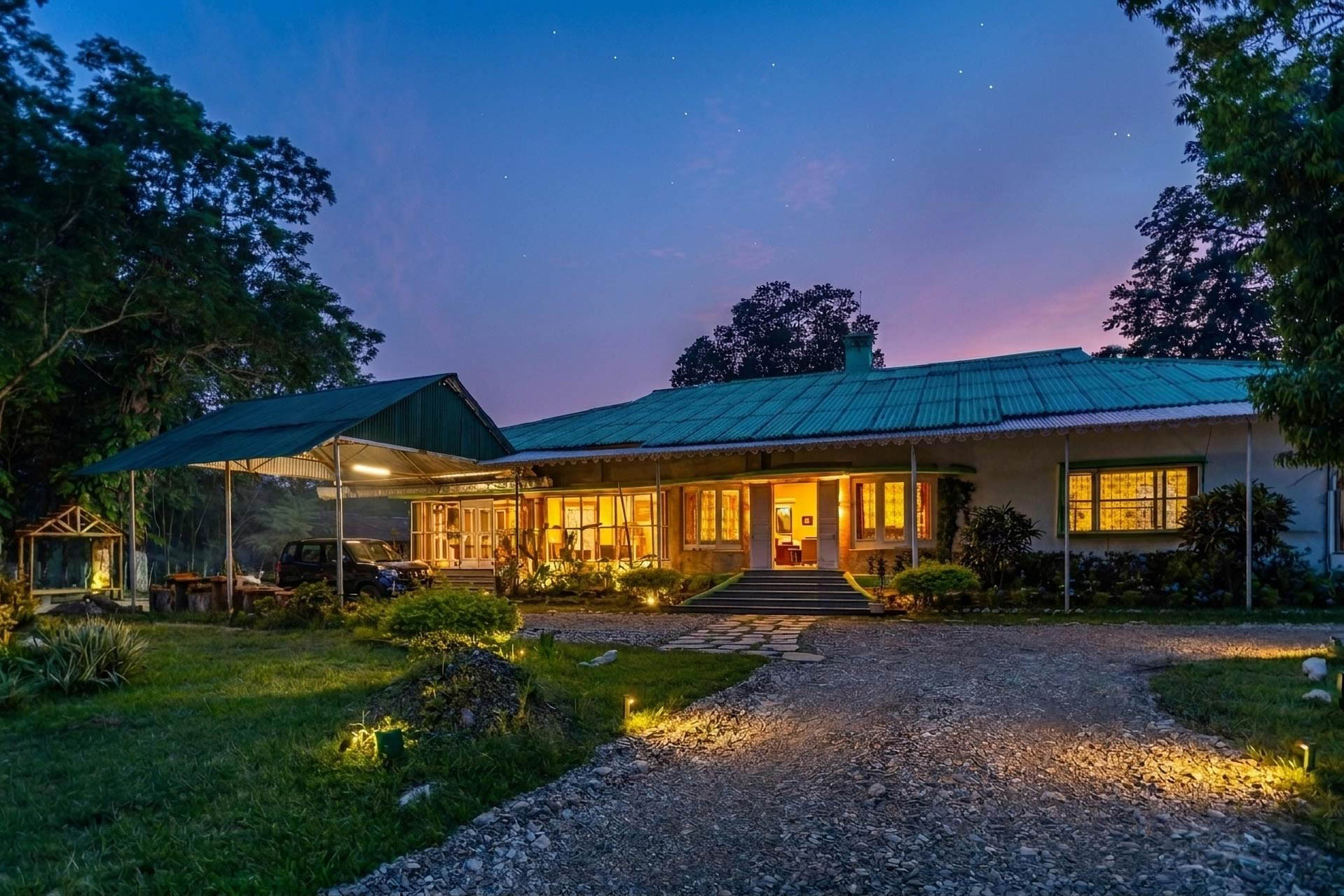
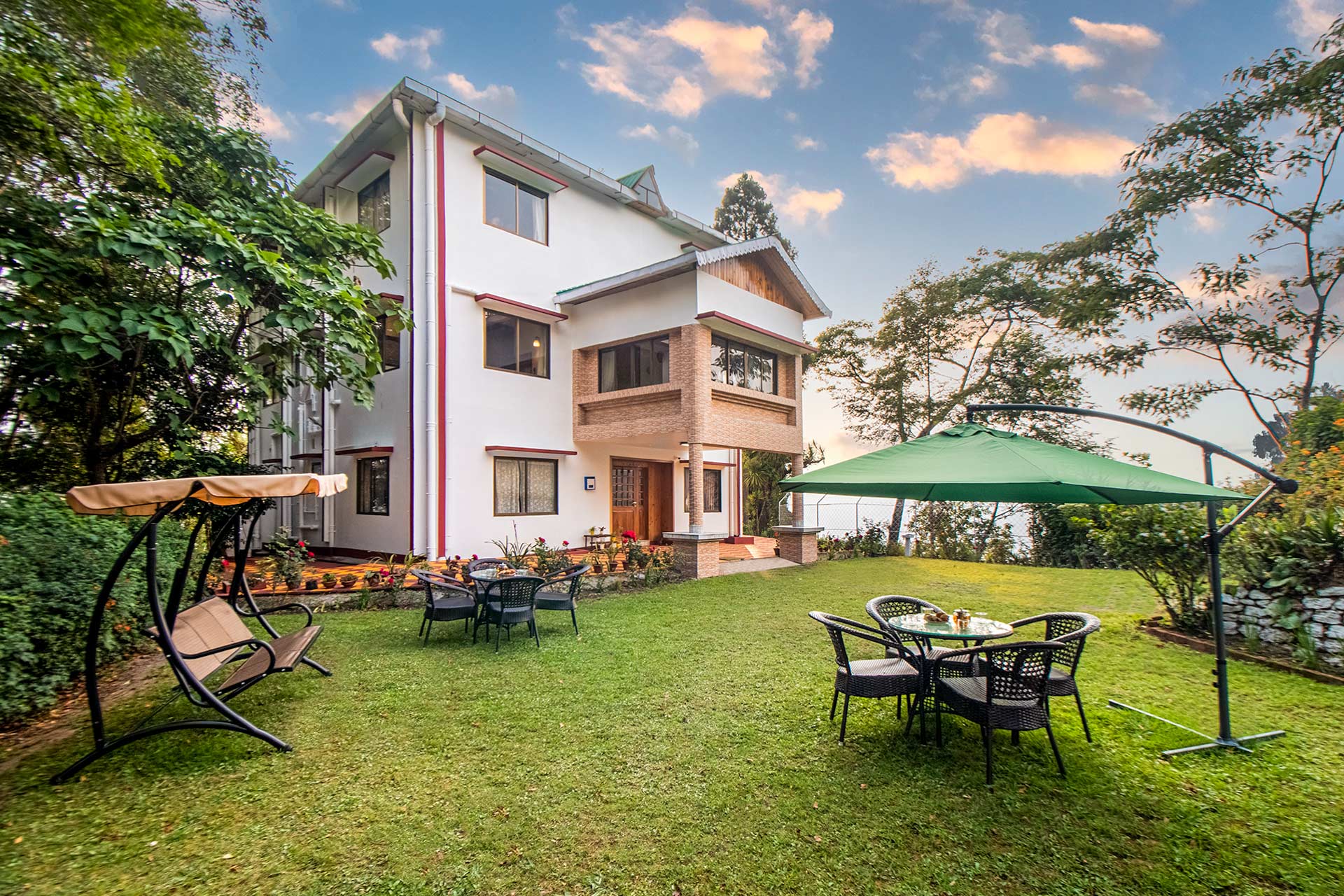
Explore all Kurseong & Darjeeling homestays curated for weekend trips, family stays and monsoon getaways.
Monsoon Travel Tips: Getting the Most From Your Kurseong Trip
A short list of things we’ve learned from repeated monsoon visits — meant to make your things to do in Kurseong planning easier and your trip smoother.
- Front-load mornings. Almost every worthwhile activity — Eagle’s Crag, tea walks, sunrise views — is clearer before noon. Rain intensifies after 2 PM most days, so cluster the outdoor things to do in Kurseong into the 6 AM – 1 PM window.
- Bring layers, not just a raincoat. Temperatures drop 5–7 °C when it rains. A quick-dry base layer and a light fleece beat a bulky sweater.
- Cash still matters. Card machines are unreliable in monsoon due to intermittent connectivity. Carry ₹5,000–₹8,000 in cash for a 2-day trip.
- Book accommodation in the town, not on the outskirts. Landslides sometimes cut off outer roads for a few hours; you don’t want to be stuck 5 km from the nearest restaurant.
- Insurance and buffer days. Add one buffer day to your itinerary — flights out of Bagdogra and DHR services can be delayed or cancelled during heavy rain.
- Best photo hours: 5:30–7 AM and 5–6:30 PM. Mid-day light is usually flat and grey.
Why Kurseong Deserves a Spot on Your 2026 Travel List

Between the toy train station, the tea estates, the orchid forests and Eagle’s Crag, Kurseong offers a version of the Darjeeling experience that feels almost private. It’s small enough to walk in a day, close enough to Siliguri to make a long weekend feasible, and old enough that its character — the boarding schools, the DHR, the colonial-era churches — is still visible in every corner. Whether you’re planning a monsoon escape, a slow tea holiday, or a stop en route to Sikkim, the things to do in Kurseong listed here should give you a full, layered trip without the crowds of the big-name hill stations. Add the best places to visit in Kurseong to your monsoon shortlist and you’ll leave with damp shoes, a bag full of loose-leaf tea, and a photo folder that keeps giving.
Frequently Asked Questions About Kurseong
Yes — Kurseong is one of the most rewarding Darjeeling-district destinations in monsoon. Tea gardens are at their greenest, white orchids bloom in surrounding forests, hotel rates drop 20–30% compared to peak season, and viewpoints like Eagle’s Crag offer dramatic cloud-sea vistas most mornings. Plan trips for July to early September, keep a buffer day for possible landslides, and travel during morning windows for clearer weather.
Two nights and three days is the ideal duration for Kurseong. That gives you enough time to visit the top eight attractions — Eagle’s Crag, Makaibari, Ambootia, Dow Hill, Salamander Lake, Netaji Museum, Pankhabari Road and Kurseong Station — plus one relaxed morning at your homestay. If combining with Darjeeling or Mirik, plan for 4 to 5 days total.
Kurseong is 32 km from Siliguri via NH-110 (Hill Cart Road) and the drive takes approximately 1 hour 30 minutes in normal conditions. During monsoon, allow 2 hours as landslide clearance and slower descending traffic can delay the journey. Shared jeeps from Siliguri’s Panitanki More cost ₹120–₹150 per person; private cabs cost around ₹1,500–₹1,800.
Bagdogra International Airport (IXB), 42 km from Kurseong, is the nearest airport. It has daily direct flights from Delhi, Mumbai, Bengaluru, Chennai and Kolkata. A pre-paid taxi from Bagdogra to Kurseong costs approximately ₹1,800–₹2,500 and takes 1 hour 45 minutes.
Yes, though with caveats. The Darjeeling Himalayan Railway Joyride between Kurseong and Darjeeling typically operates in monsoon but is subject to weather-related cancellations, especially during heavy July rainfall. Check the IRCTC portal or the DHR ticketing office one day before travel, and book in Second Class if you want a more affordable ₹1,000 fare.
Kurseong is famous for four things: white orchids (the Lepcha name Kharsang means “land of white orchids”), premium Darjeeling tea from estates like Makaibari and Ambootia, the Darjeeling Himalayan Railway (UNESCO World Heritage), and its colonial-era boarding schools including Dow Hill and Goethals Memorial. It also holds cultural importance as the site of Netaji Subhas Chandra Bose’s house arrest between 1936 and 1937.
Yes — Ambootia Shiva Temple and its tea estate, Salamander Lake on the Rohini road, and the older Pankhabari Road walk are three genuinely offbeat spots that most day-trippers miss. Adding Rohini village (16 km away) and Chimney village (a homestay cluster near Kurseong) makes for a slower, more authentic trip beyond the usual sightseeing list.
Kurseong is considered one of the safer hill destinations in North Bengal for solo female travellers. The town is compact, well-lit along the main Hill Cart Road, and locals are used to travellers. Standard precautions apply — avoid isolated forest walks after dark, book accommodation in the town centre rather than remote outskirts, and keep the local police helpline (100) saved. Homestays are often a better choice than budget hotels for solo travellers.