
Coorg Photography Guide 2026: 12 Best Monsoon Spots
Last updated: June 2026
TL;DR: The 12 best photography spots in Coorg during the monsoon are Mandalpatti (sunrise above the clouds), Raja’s Seat (sunset over the valley), Abbey and Iruppu Falls (long-exposure water at full force), the misty coffee estates, the Tadiandamol and Kotebetta ridgelines, Nisargadhama’s bamboo groves, Namdroling Monastery’s golden statues, Talacauvery on the Brahmagiri ridge, the paddy terraces, and the Dubare riverbank. Shoot in the soft light of the first and last hour of daylight, carry rain protection for your gear, and use a tripod plus an ND filter for the waterfalls. The 2026 monsoon is forecast below-normal, so rain comes in spells rather than non-stop sheets — good news for chasing breaks of light.
In this Blog
Coorg monsoon photography at a glance
| Best time | June to September for mist, waterfalls and saturated green; mornings and the golden hour for light |
| How to reach | ~245 km / 5–6 hrs from Bengaluru by road; ~135 km / 3.5 hrs from Mysuru |
| Nearest airport/station | Mysuru Airport (~140 km) or Mangaluru (~135 km); nearest railhead Mysuru |
| Ideal duration | 3–4 days to cover the spots below without rushing the light |
| 2026 monsoon note | Below-normal; rain falls in spells, so plan for cloud breaks and shoot early before the afternoon build-up |
The 12 best photography spots in Coorg for the monsoon
Coorg (Kodagu) in the monsoon is less a place you photograph and more a set of weather conditions you wait for. The Western Ghats catch the southwest monsoon head-on, so between June and September the hills disappear into moving fog, the waterfalls roughly triple in volume, and the coffee slopes turn a deep, wet green that no dry-season visit can match. This guide is the photography spoke of our wider monsoon in Coorg complete guide — if you want the full things-to-do itinerary, start there; here we go location by location for the best frames.
A note on 2026: the India Meteorological Department has forecast a below-normal southwest monsoon at around 90% of the long-period average. For photographers that is quietly good news. Below-normal usually means rain in spells with clearer gaps in between, rather than a permanent grey ceiling — and those gaps, especially at first light, are exactly when the mist lifts off the valleys and the sky opens for a few minutes. Watch the morning, shoot fast, and be ready to pack up when the next band rolls in.
1. Mandalpatti — sunrise above the sea of clouds
Mandalpatti is the single best sunrise frame in Coorg. At roughly 1,600 m on the edge of the Pushpagiri Wildlife Sanctuary, the viewpoint sits above the valley fog, so on a good monsoon morning you shoot down onto a white sea of clouds with ridgelines poking through. What to shoot: the layered ridges at dawn, a lone tree or person on the rocks for scale, and the moment the sun burns a gold rim along the cloud line. Composition/settings tip: use a wide lens, place the horizon on the lower third to give the sky room, bracket your exposures (the cloud-to-shadow range is huge at sunrise), and keep ISO low on a tripod. The last stretch is a rough track you reach by hired 4×4 jeep from Madikeri (private vehicles aren’t allowed up the final climb), so budget time to be at the top before first light. Entry fee: around ₹50 per person plus the shared jeep cost (commonly ₹1,500–₹2,500 per jeep — confirm the rate before you board). Timings: roughly 6:00 AM to 6:00 PM. Best time: be at the top by 6:00 AM for sunrise. How to reach: ~20 km from Madikeri, the last leg by jeep. Time required: 2–3 hrs including the ride. Ideal for: keen photographers and couples who don’t mind a pre-dawn start. Pro tip: the rocks are slick after rain — the Mandalpatti viewpoint edges drop away fast, so set your tripod back from the lip and never walk backwards while framing.
2. Raja’s Seat — sunset over the misty valley
If Mandalpatti owns the sunrise, Raja’s Seat owns the sunset. This landscaped garden viewpoint in Madikeri was built for the Kodava kings to watch the sun go down over the western hills, and in the monsoon the valley below fills with drifting mist that catches the last light. What to shoot: the sun dropping behind layered ridges, silhouettes of visitors along the railing, and the colour wash on low cloud. Composition/settings tip: arrive 45 minutes before sunset to claim a clean spot at the wall, use a mid-telephoto to compress the ridges, and expose for the bright sky so the foreground reads as silhouette. Entry fee: a nominal ₹5 per person, with paid parking. Timings: about 6:00 AM to 8:00 PM, per Raja’s Seat visitor information; the evening musical fountain runs after dark. Best time: 5:30–7:30 PM for the sunset and fountain. How to reach: in Madikeri town, walkable from most central stays. Time required: 1–1.5 hrs. Ideal for: families and first-timers — it is the easiest “wow” frame in Coorg. Pro tip: there’s a small toy-train ride beside the garden; shoot it in motion at a slow shutter for a fun, candid frame while you wait for the light.
3. Abbey Falls — long-exposure water at full force
Abbey Falls is the classic Coorg waterfall, set in a coffee and spice estate just outside Madikeri, and the monsoon is when it earns its reputation. The flow swells dramatically and a hanging footbridge gives you a head-on view across the gorge. What to shoot: the full curtain of water with the bridge for scale, and tight detail shots of spray hitting the rocks. Composition/settings tip: this is the spot for long exposure — mount the camera on a tripod, drop to a slow shutter (around 0.5–2 seconds) with a small aperture, and add an ND filter to silk the water without blowing highlights. A polariser cuts the wet-leaf glare. Entry fee: a small ticket (around ₹50 per person — confirm at the gate). Timings: roughly 8:00 AM to 5:00 PM. Best time: early morning, before tour buses arrive and while soft light filters through the mist. How to reach: ~8 km from Madikeri, then a short walk down steps to the viewing bridge. Time required: about 1 hr. Ideal for: photographers and couples. Pro tip: spray drifts constantly onto the bridge — keep a microfibre cloth in your pocket and wipe the front element between every few frames, or you’ll get soft, hazy spots you won’t notice until later.
4. Iruppu Falls — the southern cascade in spate
Quieter and more dramatic than Abbey, Iruppu Falls drops about 170 feet through the Brahmagiri range in southern Coorg and runs hardest in the monsoon. A short forest path and a temple en route make for a more atmospheric approach. What to shoot: the tall, narrow cascade framed by dripping forest, and long-exposure detail of the lower tiers. Composition/settings tip: shoot vertical to capture the height, use the wet rocks as a leading line, and bring an ND filter again for the silky-water look; the forest canopy keeps light low, which actually helps long exposures. Entry fee: around ₹50 per person, per Iruppu Falls visitor details. Timings: roughly 8:00 AM to 5:00 PM. Best time: monsoon, mid-morning for the cleanest light on the falls. How to reach: ~48 km from Madikeri near Srimangala; a 15-minute walk from the parking. Time required: 1.5–2 hrs including the walk. Ideal for: photographers who want fewer crowds than Abbey. Pro tip: the flow is powerful and there are no lifeguards — photograph from the railed platforms, not from the rocks at the base.
5. The misty coffee estates — Coorg’s signature frame
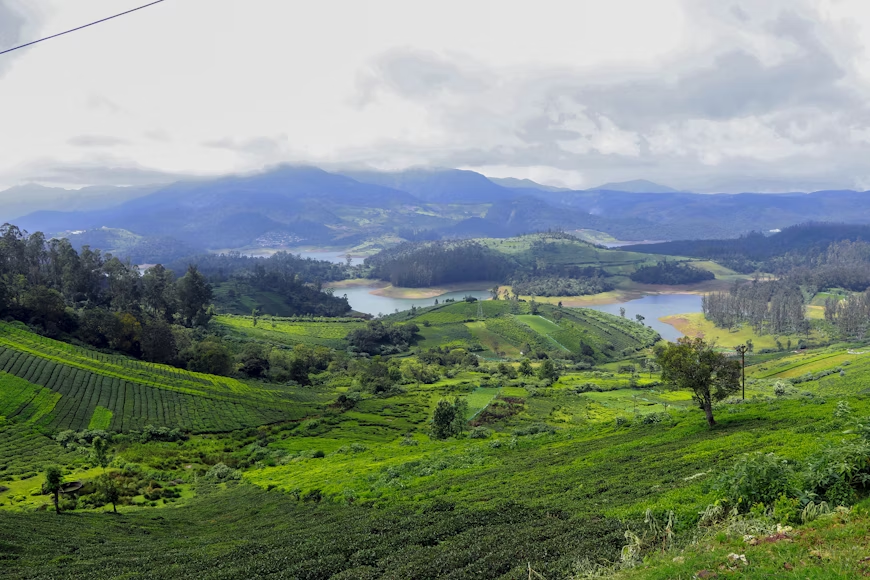
The coffee slopes are the most photographed and least over-photographed subject in Coorg, because they look completely different every hour. Wet, dark-green coffee bushes under tall silver-oak shade trees, wrapped in low fog, are the image people mean when they say “Coorg in the rain.” What to shoot: rows of coffee receding into mist, red coffee cherries and water droplets in macro, and a workers’ path vanishing into fog. Composition/settings tip: mid-morning fog is your softbox — shoot wide open for separation, look for a single tree or figure to anchor the soft background, and slightly overexpose so the mist reads bright rather than muddy grey. Entry fee: free if you stay on an estate; many estates offer guided plantation walks for a small fee. Timings: early morning has the heaviest, most photogenic mist. Best time: 6:30–9:00 AM before the fog thins. How to reach: estates ring Madikeri, Suntikoppa, Pollibetta and Virajpet — easiest if you base yourself on one. Time required: a slow 1–2 hr walk. Ideal for: everyone, from phone shooters to macro specialists. Pro tip: for the deeper story of the estates in the rains — the harvest cycle, the smell of wet coffee blossom — see our companion guide to Coorg’s coffee plantations during the monsoon.
6. Tadiandamol ridgeline — Coorg’s highest grasslands
Tadiandamol, at about 1,748 m, is the highest peak in Coorg, and the upper trail opens from forest into rolling grassland and a long ridge walk with huge panoramas. In the monsoon those grasslands turn emerald and the ridge floats in and out of cloud. What to shoot: the curving ridgeline disappearing into fog, wildflowers in the foreground, and the layered grassland hills. Composition/settings tip: wait at the ridge for a cloud break, then use the trail itself as a leading line into the frame; a graduated ND helps balance bright sky against dark slopes. Entry fee: a nominal forest/entry charge at the base. Timings: start early; aim to be off the exposed ridge well before afternoon. Best time: clear monsoon mornings — but see the safety note below, as the trail gets very slippery. How to reach: ~35 km from Madikeri to the Kakkabe base, then a moderate trek. Time required: half a day for the round trip. Ideal for: fit hikers and serious landscape shooters. Pro tip: the trail is steep, muddy and exposed in the rain — go with a local guide, pack your camera in a dry bag for the climb, and only bring it out at the top.
7. Kotebetta ridge — fort-hill fog and dramatic slopes
Kotebetta (“fort hill”), at roughly 1,620 m, is Coorg’s third-highest peak and a less-crowded alternative to Tadiandamol. The trek climbs through coffee estates and forest before opening onto a dramatic, often fog-wrapped ridge near the summit. What to shoot: dense forest on the lower slopes, the open grass ridge above, and shifting fog that reveals and hides the view minute to minute. Composition/settings tip: embrace the fog rather than fighting it — minimal, high-key compositions with one strong subject (a tree, a boulder, a hiker) work far better than trying to force a clear vista. Entry fee: nominal/local guide charge. Timings: dawn start recommended. Best time: monsoon mornings for the most atmospheric mist, conditions permitting. How to reach: the base is near Hattihole/Madapura, between Somwarpet and Madikeri. Time required: most of a day. Ideal for: hikers who want the ridge drama without the Tadiandamol crowds. Pro tip: visibility can collapse to a few metres on the ridge — keep your group together and don’t wander off-trail chasing a frame.
8. Nisargadhama — bamboo groves on a river island
Nisargadhama is a forested island in the Cauvery, reached by a hanging bridge, and its tall bamboo groves are a completely different kind of photography from the open viewpoints. In the monsoon the river runs high and the bamboo canopy turns the light a soft green. What to shoot: the tunnel of bamboo overhead, the hanging bridge over the swollen river, and deer in the park. Composition/settings tip: shoot straight up into the bamboo for a graphic, symmetrical frame, or down the bridge for a leading-line shot; a polariser tames reflections off the wet leaves and river. Entry fee: around ₹80 per adult and ₹40 per child. Timings: roughly 9:00 AM to 5:00 PM, open daily. Best time: mid-morning when light filters through the canopy. How to reach: ~28 km from Madikeri near Kushalnagar. Time required: 1–1.5 hrs. Ideal for: families and macro/pattern shooters. Pro tip: in heavy rain the island access can be limited when the river is in spate — check locally before driving out.
9. Namdroling Monastery — golden statues and Tibetan colour
The Namdroling Monastery at Bylakuppe, known as the Golden Temple, is the largest teaching centre of the Nyingma school of Tibetan Buddhism outside Tibet — and a gift for photographers when the rain sends you indoors. The main hall holds three towering gilded statues and richly painted murals. What to shoot: the golden Buddhas, monks in maroon robes against bright murals, and the symmetry of the prayer hall. Composition/settings tip: light indoors is low, so brace against a pillar or use a small tripod where allowed, push ISO and shoot wide open; respect the posted rules and photograph people only with a sense of where rituals are happening. Entry fee: free; donations support upkeep, per Karnataka Tourism’s Golden Temple listing. Timings: generally around 9:00 AM to 6:00 PM — confirm locally, as ceremonies can restrict access. Best time: a rainy afternoon, or morning prayers for atmosphere. How to reach: ~34 km from Madikeri near Kushalnagar. Time required: 1–1.5 hrs. Ideal for: culture and portrait photographers. Pro tip: photography is generally fine in the outer areas but restricted inside some prayer halls during rituals — look for posted signs and put the camera down when in doubt; dress modestly with shoulders and knees covered.
10. Talacauvery — clouds on the Brahmagiri ridge
Talacauvery, the source of the Kaveri river, sits at about 1,276 m on the Brahmagiri hills near Bhagamandala — and the drive up the ridge in the monsoon is a cloud-chaser’s dream, with banks of fog rolling across the road and temple. What to shoot: the temple tank and steps against moving cloud, the long view from the ridge stairs when fog clears, and pilgrims under umbrellas. Composition/settings tip: this is a patience game — set up and wait for the cloud to part for the wider shot, and in the meantime work the moody, close-in frames the fog gives you. Entry fee: free (it is a temple site). Timings: open through the day; arrive earlier for calmer weather. Best time: the monsoon stream is at its fullest July–September, but the ridge is also at its mistiest. How to reach: ~48 km from Madikeri via Bhagamandala; the last stretch is a winding ghat climb. Time required: 1.5–2 hrs plus drive time. Ideal for: atmosphere-led shooters who like working the weather. Pro tip: the ghat road can vanish into fog — drive in daylight, use low beams, and read about the origin of the Kaveri at Talacauvery before you go so the place means more through the lens.
11. The paddy terraces — green geometry in the valleys
Between Coorg’s coffee hills lie bright-green paddy fields, and in the monsoon they are at their most saturated, often mirror-flooded and stitched with mud bunds. They are the easiest “stop the car” frame in Kodagu. What to shoot: the geometry of flooded terraces, a farmer or a lone hut for scale, and reflections of cloud in the water. Composition/settings tip: find a slightly higher vantage (a road bend or a ridge) to flatten the pattern, shoot in flat overcast light for even green, and use the bunds as leading lines. Entry fee: free — these are working fields, so shoot from the roadside or with the farmer’s permission. Timings: any time; soft overcast or golden hour both work. Best time: July–September when the fields are flooded and greenest. How to reach: scattered across the Madikeri–Virajpet and Kushalnagar valleys — keep your camera ready on the drives. Time required: opportunistic, 15–30 min stops. Ideal for: everyone, especially drone and pattern shooters. Pro tip: ask before pointing a lens at people working the fields; a smile and a moment’s chat almost always gets you a better, more natural portrait than a grab shot.
12. Dubare riverbank — elephants and the swollen Cauvery
Dubare, on the bank of the Cauvery, is best known for its elephant camp, and the riverbank itself is a strong monsoon subject as the river runs wide and fast. What to shoot: the river in spate, elephants at the water’s edge during interaction hours, and reflections in calmer shallows. Composition/settings tip: a telephoto lets you frame the elephants and the far bank without crossing; for the river, a slow shutter on a tripod turns the flow milky. Entry fee: around ₹50 per person for the camp, with extra charges for the river crossing and elephant interactions. Timings: elephant interaction is usually 9:00–11:00 AM and 4:30–5:30 PM. Best time: the morning slot for soft light and active elephants. How to reach: ~30 km from Madikeri near Kushalnagar; you cross the river by boat to the main camp. Time required: 2–3 hrs. Ideal for: wildlife and family shooters. Pro tip: in heavy rain the Cauvery swells and the island/boat crossing and activities can be suspended — call ahead, as a high river often means a cancelled visit.
How to shoot the Coorg monsoon: a craft guide
Great Coorg monsoon images come down to two things — protecting your gear, and using the weather instead of waiting it out. Here’s the practical craft, learned the wet way.
Protect your gear from the rain. Treat water as the default, not the exception. Carry a proper rain cover for your camera and lens (a shower cap or a clear plastic bag with a hole works in a pinch), keep everything in a dry bag inside your backpack between locations, and stash several microfibre cloths in different pockets so you always have a dry one to wipe the front element. Silica gel sachets in the bag overnight pull out the damp that fogs lenses by morning. A lens hood does double duty, keeping drizzle off the glass. And let cold gear acclimatise before you uncap it indoors, or condensation will mist the lens from the inside.
Use fog and low light, don’t fight them. Mist is Coorg’s gift — it simplifies cluttered scenes into clean, minimal frames. Meter for the fog so it stays bright (dial in positive exposure compensation; left alone, your camera will render mist as dull grey). Look for one strong subject — a tree, a person, a boulder — to anchor an otherwise soft background. On dark, overcast days, raise ISO without fear; a slightly grainy sharp frame beats a clean blurry one.
Long exposures for the waterfalls. Abbey, Iruppu and the seasonal cascades are made for silky water. You need a sturdy tripod, a small aperture (f/11–f/16), and a slow shutter (roughly 0.5–2 seconds); in monsoon daylight that usually means an ND filter to avoid overexposing. A polariser cuts glare off wet rock and leaves and deepens the greens. Use a remote release or the 2-second timer so you don’t shake the camera, and shoot several frames as the flow varies.
Lens choices. A wide-angle (around 16–35mm) handles the big viewpoint vistas at Mandalpatti and the ridgelines; a mid-telephoto (70–200mm) compresses ridges, picks elephants out across the river at Dubare, and isolates subjects in fog; and a macro or a close-focusing lens captures coffee cherries, dewdrops and bamboo detail. If you carry one lens, a 24–105mm-style zoom covers most of this list.
Drones — caution and the rules. Coorg’s misty valleys are tempting for aerial work, but fly within the law. Under India’s DGCA Drone Rules, any drone over 250 g must be registered on the Digital Sky platform and carry a Unique Identification Number, and you must avoid red (no-fly) zones and respect height limits; DGCA’s drone framework sets out the zone map and permissions. Foreign nationals are currently not permitted to operate drones in India. Beyond the law, common sense applies: don’t fly over crowds at viewpoints or near the monastery, and remember that gusty, wet monsoon conditions are hard on small drones — wind and moisture bring many of them down.
Golden-hour timing. The first hour after sunrise and the last before sunset give the warm, low, directional light that makes the green glow and the mist turn gold. In the monsoon those windows are short and unpredictable, so be on location early and set up before the light arrives — the magic often lasts only a few minutes between cloud bands.
Monsoon safety in Coorg (for photographers especially)
– Slippery viewpoints and trails. Rocks at Mandalpatti and Raja’s Seat and the Tadiandamol/Kotebetta ridges get genuinely treacherous when wet. Wear grippy shoes, set tripods back from edges, and never step backwards while looking through the viewfinder.
– Don’t risk gear — or yourself — at waterfall edges. Abbey, Iruppu and Dubare’s river all run hard in the rain with no lifeguards. Shoot from the railed platforms; a wet rock at the base is not worth a frame.
– Ghat-road caution. The climbs to Talacauvery, Bhagamandala and Mandalpatti fog over fast. Drive only in daylight, keep speeds low on the bends, and use low beams in fog — high beams just bounce back at you.
– Plan a buffer day. The best monsoon light is unpredictable. Build one flexible day into the trip so a wash-out morning doesn’t cost you the shot.
A 3-day photography itinerary for monsoon Coorg
Day 1 — Madikeri core. Sunrise at Mandalpatti (pre-dawn jeep), back for breakfast, then Abbey Falls mid-morning before the crowds. Spend the misty afternoon walking your estate, and close with sunset at Raja’s Seat.
Day 2 — North and culture. Morning at Nisargadhama for the bamboo groves and Dubare for the elephants and river, then Namdroling Monastery in the afternoon — ideal if the rain sets in, since the best frames there are indoors. Shoot paddy terraces on the drives between.
Day 3 — South and high ground. Pick one big effort: the Tadiandamol or Kotebetta ridge on a clear morning with a guide, or the cloud-chasing drive to Talacauvery and Iruppu Falls in the south. Keep this day flexible and weather-led.
Where to stay (StayVista)
Basing yourself on a coffee estate means the misty mornings happen on your doorstep — you can shoot the best light before breakfast without a drive.
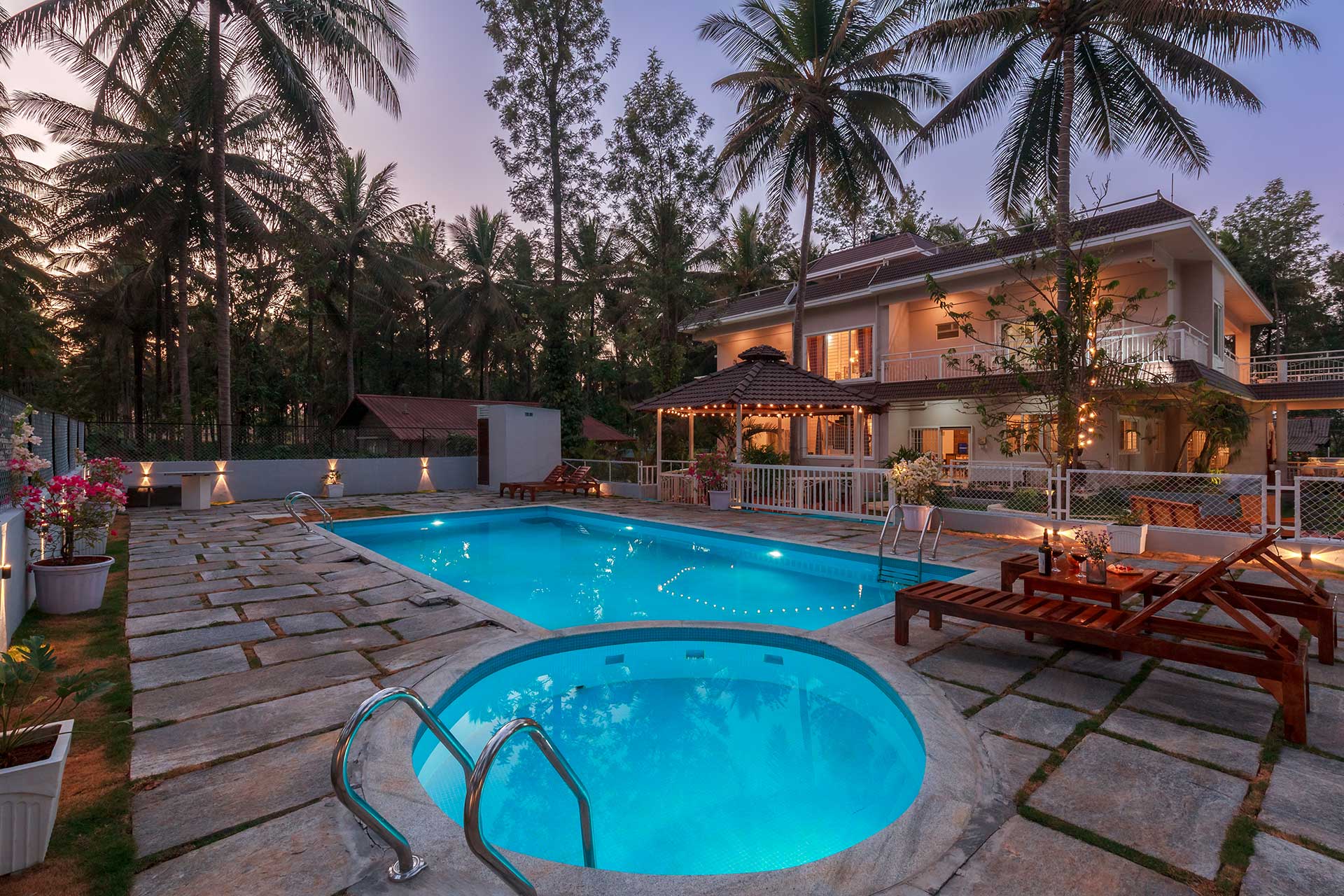
- Coffee & Mist (/villa/coffee-and-mist-5-bhk-villa-in-coorg-with-private-pool-and-spacious-rooms) — a 5-BHK home set on five acres of working coffee plantation near Virajpet, wrapped in mist most mornings, with balconies opening onto the estate and 25-plus bird species around the grounds. The on-property fog and plantation views alone are worth several frames before you go anywhere.
- The Estate Villa (/villa/the-estate-villa) — a 4-BHK villa near Suntikoppa with a pool and a crisp modern design set against the green; a quieter, more secluded base for early-morning estate walks and a good run to the northern spots around Kushalnagar.
CTA box — Photographers, book a 3–4 night estate stay so the monsoon mist works for you: shoot the golden hour on the plantation, then head out to the viewpoints. (CTA 1 of 3 max.)
FAQ: Coorg monsoon photography
Is the monsoon a good time for photography in Coorg?
Yes — the monsoon (June to September) is arguably the best time for landscape photography in Coorg. The waterfalls run at full force, the coffee hills turn deep green, and the valleys fill with the moving mist that defines Coorg images. The trade-off is rain and slippery trails, so you protect your gear and shoot around the cloud breaks, which are most reliable in the early morning.
What are the best photography spots in Coorg?
The standout spots are Mandalpatti for sunrise above the clouds, Raja’s Seat for sunset, Abbey and Iruppu Falls for long-exposure water, the misty coffee estates, the Tadiandamol and Kotebetta ridgelines, Nisargadhama’s bamboo groves, Namdroling Monastery for golden statues, Talacauvery on the Brahmagiri ridge, the flooded paddy terraces, and the Dubare riverbank.
What is the best time of day to photograph Coorg in the monsoon?
The first hour after sunrise and the last before sunset give the warmest, softest light, and mornings have the heaviest mist before it thins. Mandalpatti and Raja’s Seat are best at sunrise and sunset respectively. Waterfalls photograph well in the soft light of mid-morning before the crowds arrive.
How do I protect my camera from rain in Coorg?
Use a rain cover or a clear plastic bag for the camera and lens, keep your kit in a dry bag inside your backpack between locations, carry several microfibre cloths to wipe the front element, and add silica gel sachets to your bag to fight overnight damp. Let cold gear warm up before uncapping it indoors to avoid internal condensation.
Do I need an ND filter for Coorg’s waterfalls?
For the silky long-exposure look at Abbey and Iruppu Falls, an ND filter helps because monsoon daylight is otherwise too bright for a slow shutter at a small aperture. A polariser is also useful to cut glare off wet rocks and leaves. Both, plus a sturdy tripod, are the core waterfall kit.
Can I fly a drone for photography in Coorg?
Indian residents can, within the DGCA Drone Rules: drones over 250 g must be registered on the Digital Sky platform with a Unique Identification Number, and you must avoid no-fly (red) zones and observe height limits. Foreign nationals are currently not permitted to operate drones in India. Avoid flying over crowds or the monastery, and remember wet, gusty monsoon weather is risky for small drones.
How many days do I need to photograph Coorg?
Plan 3–4 days. That gives you a sunrise and a sunset shoot, time for the waterfalls and coffee estates, a culture day at Namdroling and Nisargadhama, one ridge trek or cloud-chasing drive, and a buffer day for weather — which the monsoon makes essential.
Conclusion
Coorg in the monsoon rewards photographers who plan around the weather rather than against it. Be at Mandalpatti before dawn, work the misty estates while the fog is thick, save the long exposures for Abbey and Iruppu, and keep a buffer day for the light to cooperate. Protect your gear, respect the slippery edges and ghat roads, and let the rain do what it does best — turn Kodagu deep green and wrap it in cloud. For the wider trip beyond the lens, pair this with our monsoon in Coorg complete guide and the coffee-plantation monsoon guide.