

Chitai Golu Devta Temple, Almora: The Court of Justice Where Devotees Write Letters to God
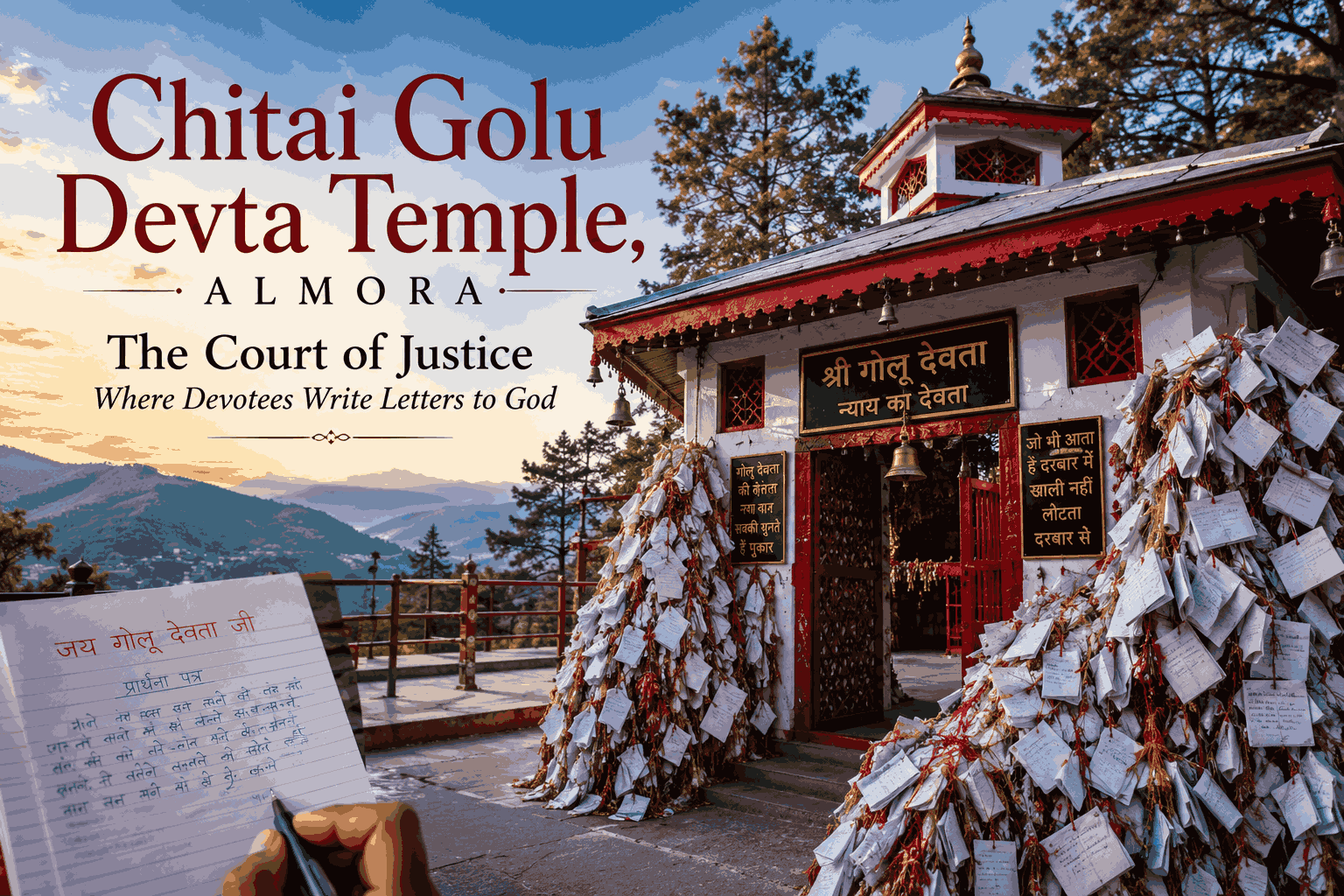
Chitai Golu Devta Temple is a shrine roughly 8–10 km from Almora town in Uttarakhand’s Kumaon region, dedicated to Golu Devta, worshipped as the “god of justice.” Devotees seeking fair resolution write letters and petitions to the deity, then return to tie a bell once their wish is granted (Wikipedia).
Chitai Golu Devta Temple, about 9 km from Almora on the Almora–Pithoragarh road, is dedicated to Golu Devta — an incarnation of Gaur Bhairav and Kumaon’s “god of justice.” People hang handwritten petitions, often on legal stamp paper, and offer one of the temple’s thousands of bells when justice is delivered (euttaranchal).
There are few places in India where faith looks quite this literal. Walk into the Chitai courtyard and you don’t find silence — you find paper. Thousands of letters flutter from the railings, and overhead, thousands of bells answer the wind. This is less a temple of hushed prayer and more a working courtroom, where the petitioner is a villager with a property dispute and the judge is a deity on a white horse.

In this Blog
What is Chitai Golu Devta Temple famous for?
Chitai Golu Devta Temple is famous as a “court of justice” where devotees submit written petitions to Golu Devta, the Kumaoni god believed to settle disputes fairly (Wikipedia). The shrine’s walls and railings are covered with thousands of letters, and its grounds hang heavy with bells offered in gratitude.
What sets the temple apart is the form devotion takes. Elsewhere people light a lamp or whisper a wish; at Chitai they file an application. Some write on plain paper. Many write on the same court stamp paper used for legal petitions, addressing Golu Devta as one would address a magistrate (trawell).
The grievances are real and ordinary — a contested inheritance, an unpaid debt, a court case that has dragged on for years, a job withheld, a marriage gone wrong. The belief is simple: when human courts stall, Goljyu does not.
Local note: Regulars in Almora will tell you that lawyers and litigants sometimes visit before a hearing — not instead of the courthouse, but as a kind of moral insurance. Whether or not that sways a verdict, it tells you how seriously the “god of justice” reputation is taken in Kumaon.
Why is Golu Devta called the god of justice?
Golu Devta is called the god of justice because Kumaoni tradition holds that he himself was a victim of injustice as a child and later became the deity who delivers fair judgment (Wikipedia). He is revered as an incarnation of Gaur Bhairav, a fierce form of Lord Shiva, and is depicted riding a white horse.
According to the most widely retold legend, a king married a woman he met while hunting. His jealous senior queens stole her newborn son, replaced the baby with a stone, and set the child adrift in a river. A fisherman found and raised the boy. Years later, the child exposed the deception with a wooden horse: when villagers mocked that a wooden horse cannot drink water, he answered that a woman likewise cannot give birth to a stone — proving his mother’s innocence. Recognized at last, he was deified as the dispenser of justice (trawell).
He is known across the hills by several names — Goljyu, Golju, Gwel, and Gaur Bhairav among them (Wikipedia).
In Kumaoni belief, Golu Devta is an incarnation of Gaur Bhairav, a form of Shiva, and is honoured as the god of justice — the deity to whom the wronged appeal when earthly courts fail them. Worship of Golu is recorded across the Kumaon region, with major shrines at Chitai near Almora, Ghorakhal near Bhowali, and Champawat (Wikipedia).
What is the history and legend behind the temple?
The history of Chitai Golu Devta Temple rests on oral tradition rather than firm records, and the deity is traditionally linked to the warrior-rulers of medieval Kumaon (Wikipedia). Two accounts circulate, and they do not fully agree — a useful thing to know before you treat any single date as fact.
The two traditional accounts of Golu Devta’s origin:
- The Katyuri version — Golu was the brave son of King Jhal Rai and Queen Kalinka and served as a general of the Katyuri kings, who are said to have invoked him before passing judgments. The Katyuri dynasty ruled Kumaon roughly between the 7th and 12th centuries (Wikipedia).
- The Chand version — Golu was a valiant general of the later Chand dynasty who died in battle; some travel accounts name him a commander under the Chand king Baj Bahadur (1638–1678) and credit a Chand ruler with building the Chitai shrine around the 12th century (trawell).
These versions disagree on both the dynasty and the dates, so the precise founding century of the temple is best treated as traditional rather than documented. What is consistent across every telling is the core idea: a wronged figure who grows into the guarantor of justice.
Worth knowing: Because the strongest written source for the deity is encyclopedic rather than archaeological, dates and dynastic links should be read as living folklore. That uncertainty is part of the story — this is a faith carried by memory and retelling, not by inscription.
Why do devotees write letters to Golu Devta?
Devotees write letters to Golu Devta because the temple functions, in popular belief, as a divine court where written petitions are formally “filed” for justice (srimandir). People facing disputes, prolonged litigation, or personal grievances submit their case in writing and ask the deity to intervene.
The practice mirrors a legal process on purpose. Petitions are written on plain paper, on letterheads, and frequently on court stamp paper — the legal-grade paper used for real applications — then pinned, tied, and hung across the temple’s walls, railings, and ceilings (trawell). The result is a courtyard papered in handwritten pleas.
How the petition ritual typically works:
- Write your grievance or wish as a letter addressed to Golu Devta — plain paper or stamp paper.
- State your case plainly: who wronged you, what justice or outcome you seek.
- Hang or tie the letter at the temple alongside thousands of others.
- Seek the deity’s blessing and return home.
- When the wish is granted, come back to offer a bell as thanks.
At Chitai Golu Devta Temple, petitions are written on plain or legal stamp paper and hung across the shrine’s walls and railings, framing the deity as a judge of last resort. Devotees believe Golu Devta delivers verdicts the human system cannot — which is why the same court stamp paper used for civil suits reappears here, addressed to a god (trawell).
Why are there so many bells at Chitai Golu Devta Temple?
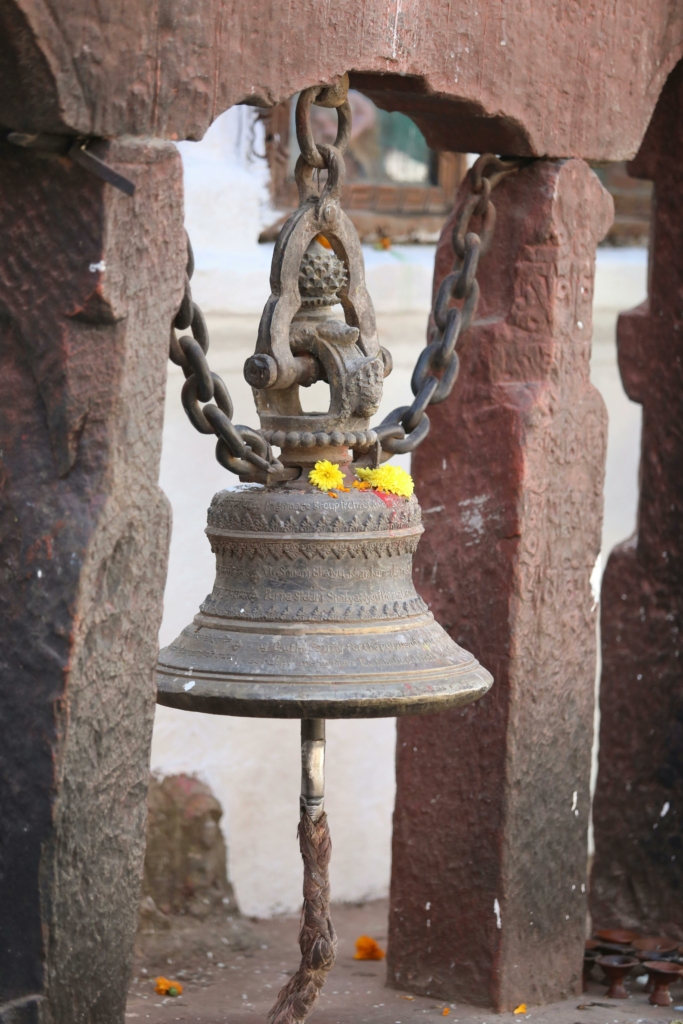
The thousands of bells at Chitai Golu Devta Temple are thanksgiving offerings — devotees tie a bell after their petition is answered and their wish or justice is delivered (euttaranchal). Over generations, these gratitude offerings have grown into a canopy of brass that chimes constantly in the hill breeze.
The bells range from tiny hand bells to large cast pieces, mostly brass, strung along every path and overhead beam (transformingtravels). Their number is usually described as “thousands”; some travel writers reach for “lakhs,” but exact counts are anecdotal, so treat the precise figure as folklore rather than census.
The logic is a complete loop. The letter opens the case; the bell closes it. A petition goes up when you need justice, and a bell goes up when you’ve received it — a visible, ringing receipt of a prayer fulfilled. Visitors also leave white cloth and small brass figurines as additional tokens of gratitude (trawell).
The bells of Chitai Golu Devta Temple are offered as thanks once a wish is fulfilled, not as a request, which is why locals read the sheer density of bells as a tally of answered prayers accumulated over centuries.
Where is Chitai Golu Devta Temple located?
Chitai Golu Devta Temple is located about 8–10 km from Almora town, on the Almora–Pithoragarh road in the Almora district of Uttarakhand’s Kumaon region (euttaranchal). It sits near Falsima village, roughly 4 km short of the Binsar Wildlife Sanctuary gate (Wikipedia).
Sources differ slightly on the exact distance — you’ll see 8 km, 9 km, and 10 km quoted — so plan for a short 20–30 minute drive from Almora rather than a fixed figure. Reported altitude also varies across travel pages (commonly cited around 1,600–2,000 m), so treat elevation as approximate.
The setting is classic Kumaon: oak and pine forest, terraced slopes, and on clear days a line of Himalayan peaks on the horizon. The shrine’s hillside location is part of the experience — the drive itself is half the pilgrimage.

How do you reach Chitai Golu Devta Temple from Almora and beyond?
You reach Chitai Golu Devta Temple by road, with Almora as the base — local taxis cover the 8–10 km from town in well under half an hour (euttaranchal). The nearest railhead is Kathgodam (about 90 km) and the nearest airport is Pantnagar (about 123 km).
The table below summarizes approximate distances and travel options to the temple.
| From | Approx. distance | How to get there |
|---|---|---|
| Almora town | 8–10 km | Local taxi / shared cab (~20–30 min) |
| Nainital | ~60–65 km | Taxi or bus to Almora, then local cab |
| Kathgodam (railway) | ~90 km | Train to Kathgodam, then taxi via Almora |
| Pantnagar (airport) | ~123 km | Fly to Pantnagar, then 3–4 hr drive |
| Delhi | ~375 km | Road, or train to Kathgodam (overnight) |
Distances are approximate and compiled from regional travel sources (euttaranchal). The smart route from most cities is the same: get to Kathgodam by rail, continue by road to Almora, then take a local cab to the shrine.
The chart below puts those distances in visual perspective.
What are the temple timings, entry fee, and best time to visit?
Chitai Golu Devta Temple is open through daylight hours, commonly cited as around 6:00 AM to 7:00 PM, with no entry fee, and the best months to visit are April–June and September–November (euttaranchal). A visit usually takes one to two hours.
Here are the practical details at a glance.
| Detail | Information |
|---|---|
| Darshan timings | ~6:00 AM – 7:00 PM (verify locally; hours can vary) |
| Entry fee | Free |
| Time needed | 1–2 hours |
| Best seasons | April–June (mild summer), September–November (clear autumn) |
| Avoid | July–August (monsoon, landslides), peak winter cold |
| Festival | Golu Devta fair, traditionally in Chaitra (March–April) |
Exact opening hours are not confirmed by an official tourism source, so confirm on arrival, especially in winter. The monsoon between July and August brings heavy rain and occasional landslides to the Almora–Pithoragarh road, which is the main reason most travellers avoid those months (manchalamushafir).
If you can, time your visit around the Golu Devta fair, when pilgrim activity peaks and the courtyard’s letter-and-bell ritual is at its most vivid.
What are the best places to visit near Chitai Golu Devta Temple?
Several major Kumaon attractions sit within an hour or two of Chitai Golu Devta Temple, making it an easy stop on a wider Almora itinerary (euttaranchal). The most popular are Kasar Devi, Binsar, Jageshwar Dham, and Almora’s own old town.
Nearby places worth pairing with your visit:
- Kasar Devi Temple — ~9 km from Almora; a hilltop shrine known for its panoramic Himalayan views and bohemian history.
- Binsar Wildlife Sanctuary — ~30 km from Almora; the Chitai shrine is only about 4 km from the sanctuary gate, so the two combine naturally.
- Jageshwar Dham — roughly 35–41 km (sources vary); a cluster of over a hundred ancient stone Shiva temples set in deodar forest.
- Katarmal Sun Temple — near Almora (~17 km); a rare medieval sun temple.
- Almora town & Nanda Devi Temple — the district headquarters, with its old bazaar and hilltop shrine.
Frequently Asked Questions
It is famous as a “court of justice” near Almora where devotees write letters and petitions to Golu Devta seeking fair resolution, then offer a bell once their wish is granted. Its grounds hold thousands of letters and bells.
Devotees write letters because the shrine is believed to act as a divine court. People facing disputes or injustice submit written petitions — often on legal stamp paper — addressing Golu Devta as a judge who delivers verdicts when human courts fail.
Kumaoni tradition holds that Golu Devta, an incarnation of Gaur Bhairav (a form of Shiva), was wronged as a child and grew up to expose the deception and prove his mother’s innocence. He is therefore revered as the dispenser of fair justice.
The temple is about 8–10 km from Almora town, on the Almora–Pithoragarh road in Almora district, Kumaon region, Uttarakhand. It lies near Falsima village, roughly 4 km from the Binsar Wildlife Sanctuary gate.
The shrine is generally open through daylight hours, commonly cited as around 6:00 AM to 7:00 PM, with no entry fee. Exact hours are not officially confirmed, so verify locally, particularly during winter.
Reach it by road from Almora — a 20–30 minute local taxi ride. The nearest railway station is Kathgodam (~90 km) and the nearest airport is Pantnagar (~123 km); Delhi lies about 375 km away.
The bells are thanksgiving offerings. Devotees tie a bell after their petition is answered and their wish is fulfilled. Over generations these gratitude offerings have grown into the canopy of thousands of bells seen today.
April–June and September–November offer the most pleasant weather. Avoid July–August, when monsoon rain and landslides affect hill roads. The Golu Devta fair, traditionally in March–April, is the peak pilgrim season.
Jageshwar Dham is roughly 35–41 km away, depending on the source and route — about a 1.5-hour drive. Many visitors combine Chitai, Kasar Devi, and Jageshwar into a single Almora-based itinerary.
No. Entry is free for all visitors. A typical visit lasts one to two hours, enough time to walk the courtyard, read the petitions, and see the bells offered in gratitude.
Conclusion
Chitai Golu Devta Temple endures because it makes an abstract idea — justice — tangible. The petition you can hold, the bell you can ring, the white horse the deity rides: faith here is documented, filed, and answered.
Key takeaways:
- The temple sits ~8–10 km from Almora on the Almora–Pithoragarh road; entry is free, and the best months are April–June and September–November.
- Golu Devta is revered as the “god of justice,” an incarnation of Gaur Bhairav, honoured through written petitions.
- The thousands of bells are not requests but receipts — offered only after a wish is fulfilled.
- Pair the visit with Kasar Devi, Binsar, or Jageshwar Dham for a fuller Kumaon trip.