
Madhyamaheshwar Trek 2026: Itinerary, Best Season & Why It’s the Quietest Panch Kedar
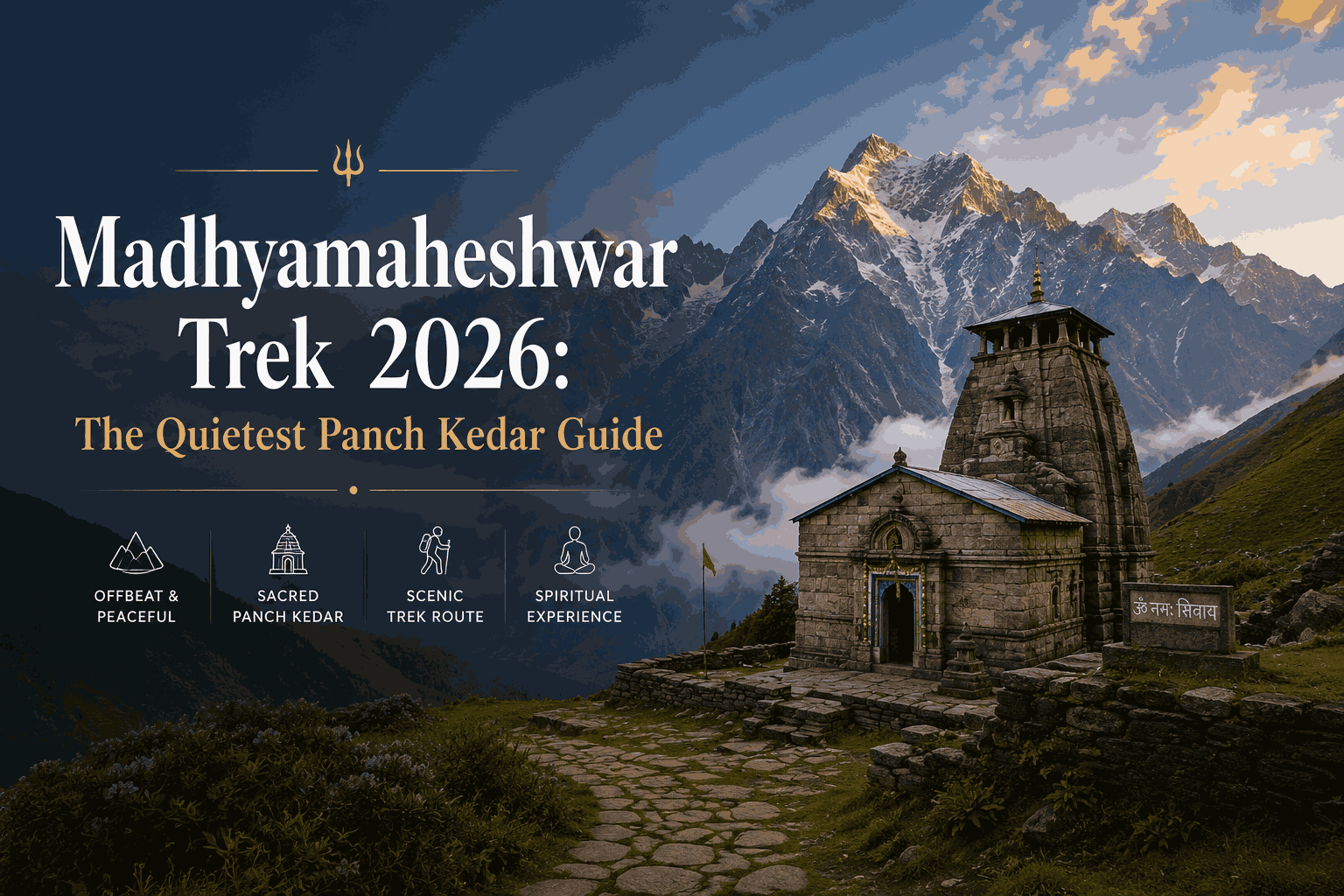
While 16,56,000 pilgrims queued for Kedarnath in 2025, Madhyamaheshwar — the fourth Panch Kedar shrine, where Shiva’s navel is said to have surfaced — saw fewer visitors in the entire season than Kedarnath does in a single weekend. It’s the quietest of the five Kedar temples, sits at 3,497 m below the Chaukhamba peaks, and requires no Char Dham registration, no helicopter quota, and no fight for a slot. If you’ve been looking for the spiritual weight of Panch Kedar without the Kedarnath crush, this is the one to plan first. We’ll walk you through the 2026 opening dates, the day-wise itinerary from Rishikesh and Delhi, the real cost from your origin city, and exactly what the trek feels like on the ground.
The Madhyamaheshwar Trek is a 16–18 km moderate Himalayan hike to the fourth Panch Kedar shrine at 3,497 m. The temple opens 21 May 2026 and closes 20 November 2026. Best windows are mid-May–June (clear pre-monsoon, wildflowers) and mid-September–October (post-monsoon, sharp Chaukhamba views). Plan 4 days from Rishikesh (₹7,500–₹12,000 per person) or 5 days from Delhi (₹12,000–₹18,000). Unlike Kedarnath, which crossed 16.56 lakh pilgrims in 2025, Madhyamaheshwar sees only a few thousand a year and needs no Char Dham registration. Source: Tirth Yatra / Uttarakhand Tourism, 2025.
In this Blog
Quick Info — Madhyamaheshwar Trek at a Glance

| Trek length | 16–18 km one-way (32–36 km round trip) |
| Altitude | 3,497 m (11,473 ft) |
| Difficulty | Easy-Moderate (per Indiahikes) |
| Duration | 4 days from Rishikesh; 5 days from Delhi |
| Best months | May–June & September–October |
| 2026 opening | 21 May 2026 (closes 20 Nov 2026) |
| Roadhead | Ransi village, Rudraprayag district |
| Nearest airport | Jolly Grant, Dehradun (210–220 km) |
| Nearest railhead | Haridwar (250 km) |
| Permit required | None (not part of Char Dham registration) |
Why Madhyamaheshwar Is the Quietest of the Panch Kedar
Madhyamaheshwar sees only a few thousand pilgrims each season, while Kedarnath crossed 16,56,000 visitors in 2025 alone, per Uttarakhand Tourism data compiled by Tirth Yatra. The trek to Madhyamaheshwar requires no Char Dham registration, runs no helicopter shuttles, and ends at a 12th-century stone temple at 3,497 m that’s still tended by a single local priest.
That gap isn’t an accident. Kedarnath sits on the standard Char Dham route, so it absorbs the bulk of pilgrim flow — and the helicopter ecosystem out of Sirsi, Phata, and Sersi has industrialised that demand. Madhyamaheshwar sits one valley over, behind a 32 km drive from Ukhimath and a 16 km walk that no chopper services. The geography filters the crowd for you.
The four-year Kedarnath count tells the same story. Between 2022 and 2025, Kedarnath drew 6.945 million pilgrims ( Sacred Yatra, 2025). Madhyamaheshwar’s footfall in the same window is reported in low five-figure numbers across the four seasons combined.
There’s a second reason to choose it deliberately. Madhyamaheshwar is not part of the mandatory Char Dham registration that Kedarnath, Badrinath, Gangotri, and Yamunotri now require ( Uttarakhand Tourism, 2026). No biometric form, no time-slot allotment, no Aadhaar-linked queue. You drive to Ransi, you start walking. Compare that to the full Char Dham Yatra 2026 route and the difference is stark.
Pilgrims doing the complete Panch Kedar circuit usually save Madhyamaheshwar for second or third in the sequence — not last. It’s the most rewarding “warm-up” before Rudranath (which is genuinely tough), and it sets the tempo for the rest of the circuit without burning your legs out.
The Panch Kedar Story — Where Madhyamaheshwar Fits
Madhyamaheshwar is the fourth of the five Panch Kedar shrines, marking the spot where Shiva’s navel (nabhi) is believed to have surfaced after he fled the Pandavas in bull form following the Kurukshetra war ( Wikipedia). The other four shrines mark the rest of his body, scattered across the Garhwal Himalayas.
The legend itself is what gives this trek its weight. After the war, the Pandavas sought Shiva’s blessings to absolve themselves of the bloodshed at Kurukshetra. Shiva, unwilling to forgive easily, took the form of a bull and tried to disappear into the earth at Guptkashi. The Pandavas pursued him. As he sank, different parts of his body re-emerged at five locations — and those five became the Panch Kedar.
The Panch Kedar at a glance
| Shrine | Body part | Altitude | Trek distance (one-way) | Crowd level |
| Kedarnath | Hump | 3,583 m | 16 km from Gaurikund | Very high (Char Dham) |
| Tungnath | Arms | 3,680 m | 3.5 km from Chopta | High (easy access) |
| Rudranath | Face | 3,610 m | 20 km from Sagar | Low (hardest trek) |
| Madhyamaheshwar | Navel | 3,497 m | 16–18 km from Ransi | Very low |
| Kalpeshwar | Hair (jata) | 2,200 m | ~0.5 km from Helang | Low (year-round) |
The 12th-century stone temple at Madhyamaheshwar is small. There’s no shop-lined paved path leading up to it. The priest who opens the doors each morning is from the local Mansona village. If you’ve done Kedarnath in the last few seasons and felt the spirituality drowned out by helicopters and selfie queues, Madhyamaheshwar is the antidote.
When Does Madhyamaheshwar Open in 2026? The Best Time to Trek
Madhyamaheshwar temple opens for the 2026 yatra season on 21 May 2026 and closes on 20 November 2026 ( Sacred Yatra, 2026). The best trekking windows are mid-May to late June (pre-monsoon, clear skies, alpine wildflowers) and mid-September to mid-October (post-monsoon, sharp Chaukhamba peak views). Avoid July and August — the Garhwal monsoon turns the trail slippery and brings leeches.
The decision usually comes down to what you want from the trek. Pre-monsoon June gives you the green meadows, the wildflower bloom on the Bantoli stretch, and daytime temperatures of 10–20°C with nights at 2–5°C ( Holidify). Post-monsoon September strips the clouds away — that’s when you get the postcard view of Chaukhamba, Mandani Parvat, and the Kedar Dome from the temple courtyard.
Month-by-month conditions
| Month | Day temp | Night temp | Rain | Trail condition | Verdict |
| May | 8–18°C | 0–5°C | Light | Snow patches near temple early in month | Good (after 21st) |
| June | 10–20°C | 2–5°C | Light, occasional | Green, wildflowers | Best (pre-monsoon) |
| July | 14–22°C | 8–12°C | Heavy | Slippery, leeches, landslide risk on roads | Avoid |
| August | 14–22°C | 8–12°C | Heavy | Same as July | Avoid |
| September | 10–18°C | 5–10°C | Tapering | Drying out, sharp visibility | Best (post-monsoon) |
| October | 5–15°C | 0–5°C | None | Crisp, clear | Excellent |
| November | 0–10°C | -5 to 0°C | Possible early snow | Cold; temple closes 20 Nov | Brisk window only |
The Bantoli–Madhyamaheshwar stretch bursts into wildflowers through June — the strongest argument for a pre-monsoon visit.
StayVista’s Rishikesh-based concierge partners report that pre-monsoon June groups consistently rate the wildflower bloom higher than the post-monsoon October groups — though October groups always come back raving about the clarity of the Chaukhamba sunrise. If photography is the priority, choose October. If the alpine-summer feel is what you want, choose June.
The Madhyamaheshwar Trek Route — Ransi to the Temple

The Madhyamaheshwar trek begins at Ransi village, 32 km from Ukhimath, and runs 16–18 km one-way to the temple via Goundar and Bantoli. Most trekkers split it across two days: Ransi → Bantoli (9 km, 4–5 hours) and Bantoli → Madhyamaheshwar (7–9 km, 3–4 hours with a steep climb in the final stretch). Indiahikes grades the trek as Easy-Moderate with a total altitude gain of about 5,930 ft on the ascent ( Indiahikes).
Why some sources say 16 km and others say 24 km
The distance debate confuses every first-timer. Here’s the resolution: 16 km is the standard Ransi → Bantoli → Madhyamaheshwar route. The 24 km figure includes the optional Buda Madhyamaheshwar add-on — a 1.5–2 km climb above the main temple to a viewpoint at roughly 3,800 m, where the Chaukhamba sunrise is unmatched. Some operators also count the alternate Goundar variant when they quote 24 km. Both are correct, depending on what’s in your itinerary.
Stage-by-stage route breakdown
Ransi village (roadhead)
- Distance from Ukhimath: 32 km
- How to reach: Shared taxi or private cab from Ukhimath (₹1,800–₹3,500)
- Best time to start trek: By 8 am
- Stay options: Basic GMVN tourist rest house, local homestays
- Time required: Overnight halt before trek
- Ideal for: All trek groups (mandatory roadhead)
- Pro tip: Leave heavy luggage at your Ukhimath/Ransi base; carry only essentials for the trail.
Bantoli (day 1 halt)
- Distance from Ransi: 9 km
- Time on trail: 4–5 hours (gradual to moderate ascent)
- Terrain: Pine and rhododendron forest, river crossings on the Madmaheshwar Ganga
- Stay options: Basic dhabas with tented or shared-room accommodation
- Best time to arrive: By 2–3 pm to settle before evening cold
- Ideal for: First-time trekkers — the gradient is forgiving
- Pro tip: Carry your own water bottle; refills are available but plastic-bottle waste is a problem.
Madhyamaheshwar Dham (day 2 destination)
- Distance from Bantoli: 7–9 km
- Time on trail: 3–4 hours (the final stretch is steep)
- Altitude: 3,497 m (11,473 ft)
- Entry fee: Free (no temple entry charge)
- Timings: Temple is open 6 am–7 pm during yatra season (21 May–20 Nov 2026)
- Stay options: GMVN tourist rest house, Dharamshala managed by the temple committee
- Time required: Half a day for darshan + Buda Madhyamaheshwar viewpoint add-on
- Ideal for: Pilgrims, intermediate trekkers, photographers
- Pro tip: Wake up by 5 am for the Chaukhamba sunrise from Buda Madhyamaheshwar — it’s a 45-minute climb above the temple.
Day-by-Day Itinerary: 4 Days from Rishikesh, 5 Days from Delhi
The standard Madhyamaheshwar trek itinerary is 4 days/3 nights from Rishikesh or 5 days/4 nights from Delhi, with two days of road travel and two days on the trail. Don’t try to compress it into a 3-day rush — the road from Rishikesh to Ransi takes 8–9 hours and you’ll start the trek exhausted.
The 4-day Rishikesh itinerary
| Day | Plan | Distance / Time | Stay | Notes |
| Day 1 | Rishikesh → Rudraprayag → Ukhimath → Ransi | 220 km / 8–9 hr by road | Ransi homestay or GMVN | Start by 5–6 am to reach Ransi before dark. |
| Day 2 | Ransi → Bantoli (on foot) | 9 km / 4–5 hr | Bantoli dhaba/tent | Pack light; leave heavy bags at Ransi. |
| Day 3 | Bantoli → Madhyamaheshwar → Buda viewpoint → Bantoli | 14–18 km return / 6–8 hr | Bantoli or Madhyamaheshwar GMVN | Darshan + Buda Madhyamaheshwar sunrise next morning. |
| Day 4 | Trek down to Ransi → drive to Rishikesh/Haridwar | 9 km trek + 220 km drive | Rishikesh hotel/homestay | Long day; plan return train/flight for Day 5 morning. |
The 5-day Delhi itinerary (recommended for first-timers)
Add a Day 0: Delhi → Haridwar by overnight train (Dehradun Shatabdi, Mussoorie Express) or a 6-hour drive. Stay overnight in Rishikesh and then follow the 4-day plan above. The relaxed pace adds a buffer for road delays around Rudraprayag, which are common in the monsoon shoulder weeks.
The Kanchani Tal extension
If you have an extra two days and a stronger fitness base, add Kanchani Tal — a glacial lake about 6 km beyond Madhyamaheshwar. It’s a steep, unmarked route, recommended only with a local guide. Most operators run it as a 6D/5N package out of Rishikesh. The lake itself is surrounded by Chaukhamba on one side and the Kedar massif on the other — easily the most rewarding side-trek in the Panch Kedar region.
How to Reach Madhyamaheshwar from Delhi, Mumbai, Bangalore & Dehradun
The trek roadhead is Ransi village in Rudraprayag district. The nearest airport is Jolly Grant (Dehradun), about 210–220 km / 7–8 hours by road ( euttaranchal). The nearest railhead is Haridwar, 250 km away. From Ransi, you walk the final 16–18 km.
From Delhi
- By train: Overnight to Haridwar (Mussoorie Express, Dehradun Shatabdi). 6–8 hours. Then cab to Ukhimath (220 km, 8–9 hours).
- By road: Delhi → Rishikesh (240 km, 6 hours) → Rudraprayag → Ukhimath → Ransi.
- Recommended halt: One night at Rishikesh before the long drive to Ransi.
From Mumbai
- By air: Mumbai → Dehradun (Jolly Grant) direct, ~2.5 hours. Then cab to Ransi (210 km, 7–8 hours).
- Alternative: Mumbai → Delhi (flight or Rajdhani) → continue overland.
- Recommended halt: One night at Dehradun or Rishikesh before the drive in.
From Bangalore
- By air: Bangalore → Delhi (3 hours) → Jolly Grant Dehradun (1 hour) or 6-hour overland drive.
- Direct option: Limited Bangalore–Dehradun direct flights; check IndiGo / Air India seasonal schedules.
- Recommended halt: One night at Dehradun.
From Dehradun / Haridwar / Rishikesh
- By road: Direct cab/shared taxi to Ukhimath. Distance: 200–230 km depending on origin. Time: 7–9 hours.
- Public transport: Bus from Rishikesh ISBT to Ukhimath (limited daily services).
- Recommended: This is the most efficient base — skip the long Delhi drive.
If you’re flying in or arriving by overnight train, a quality pre-trek night helps. StayVista’s Rishikesh homestays sit on the Ganga and put you 6–8 hours from the trail with hot meals and proper bedding — the kind of base where you actually sleep before a long road day. Mussoorie homestays work as the recovery night when you come back down.
Madhyamaheshwar Trek Cost in 2026 — Budget by Origin City
A 4-day Madhyamaheshwar trek package from Rishikesh costs ₹7,500–₹12,000 per person (budget), ₹12,000–₹18,000 (mid-range), and ₹18,000+ (premium). From Delhi, add ₹2,500–₹6,000 for inbound transport. From Mumbai or Bangalore, expect ₹15,000–₹25,000 total because of the inbound flight ( TourMyHoliday, Himalayan Dream Treks, 2026).
Budget by origin city — full breakdown
| Origin city | Budget | Mid-range | Premium | Notes |
| Rishikesh / Haridwar | ₹7,500–₹10,000 | ₹12,000–₹15,000 | ₹18,000+ | No inbound transport cost |
| Dehradun | ₹8,500–₹11,000 | ₹13,000–₹16,000 | ₹19,000+ | Jolly Grant airport adds flexibility |
| Delhi | ₹10,000–₹13,000 | ₹15,000–₹18,000 | ₹22,000+ | Overnight train/drive to Haridwar |
| Mumbai | ₹15,000–₹19,000 | ₹19,000–₹24,000 | ₹28,000+ | Inbound flight to Dehradun |
| Bangalore | ₹15,000–₹19,000 | ₹19,000–₹24,000 | ₹28,000+ | Inbound flight to Delhi or Dehradun |
What’s usually included in a package
- Road transfers from base city (Rishikesh / Dehradun)
- Accommodation at Ransi, Bantoli, and Madhyamaheshwar (basic to mid)
- All meals on the trail (vegetarian)
- Trek guide and permits (where required)
- Basic first-aid and oximeter checks
What’s usually extra
- Personal gear (rented separately if needed)
- Porter charges (₹500–₹800 per day if you hire one)
- Inbound flight / train to Dehradun/Haridwar/Rishikesh
- Travel insurance (strongly recommended; not always bundled)
- Pre-trek and post-trek hotel stays at your base city
DIY trekkers can save 25–30% by booking Ukhimath–Ransi cabs directly, walking in with their own gear, and using GMVN bookings on gmvnonline.com. The catch: you lose the guide’s local navigation knowledge, which matters in the monsoon shoulder weeks when trail markers fade.
How Difficult Is the Trek, and What Should You Pack?
Indiahikes grades the Madhyamaheshwar trek as Easy-Moderate — accessible to first-time trekkers with moderate fitness, but with one steep ascent (Bantoli → temple) gaining about 1,000 m in 7–9 km. The total altitude gain over the trek is around 5,930 ft ( Indiahikes). If you can jog 5 km in 30 minutes without stopping, you’re trek-fit for this.
What makes it harder than the rating suggests: the road day. Eight to nine hours of mountain switchbacks before you even start walking takes a toll. Build in a pre-trek night at Ransi, sleep well, and start day 2 fresh. The trail itself isn’t technical — there’s no scrambling, no rope work, no exposure.
Packing checklist for the Madhyamaheshwar trek
- Waterproof trekking shoes (broken in over 2+ weeks before the trip)
- Three layers: thermal base + fleece middle + waterproof shell
- Rain cover for the backpack (not optional in June or September)
- Headlamp with spare batteries — no street lighting past Ukhimath
- 1L water bottle + electrolyte sachets (ORS, Enerzal)
- Basic medication: painkillers, ORS, blister tape, Diamox if prescribed
- Trekking pole — recommended for the descent more than the ascent
- Power bank (10,000 mAh+); charging is unreliable past Ransi
- Cash — no UPI, no ATMs past Ukhimath. Carry ₹5,000–₹8,000 in small notes.
- Sunscreen, sunglasses, lip balm — the UV at altitude is real even on cloudy days.
- Personal ID copies (Aadhaar/passport) for GMVN check-in
- Light snacks: dry fruits, energy bars, chocolate (for the steep day)
The final stretch from Bantoli climbs about 1,000 m in 7–9 km — the only genuinely steep section of the trek.
Where to Stay — Ransi, Bantoli, and Pre-Trek Bases
On the trail, accommodation is basic but functional: GMVN tourist rest houses and local homestays at Ransi, dhaba-style tents at Bantoli, and a small Dharamshala plus GMVN cottage near the Madhyamaheshwar temple. Off-trail, the most comfortable bases are Rishikesh, Dehradun, or Mussoorie — book a quality stay here for the night before and the night after the trek.
On-trail facilities are limited by design. You won’t find Wi-Fi past Ukhimath. Electricity at Bantoli runs on small solar setups and stops by 8 pm. Bathrooms are shared. Food is vegetarian — typically dal, rice, roti, sabzi, and chai. The dhabas at Bantoli get crowded in May and September, so reach early to claim a bed.
After four days on the trail, the recovery night matters. StayVista’s homestays in Rishikesh sit close to the Ganga and most have hot tubs, dedicated cooks, and concierge teams who handle the Ukhimath cab booking for you. If you want a quieter post-trek night, the Mussoorie homestays are a 2-hour drive from Rishikesh and give you proper hill weather to wind down in.
Best stay in Rishikesh
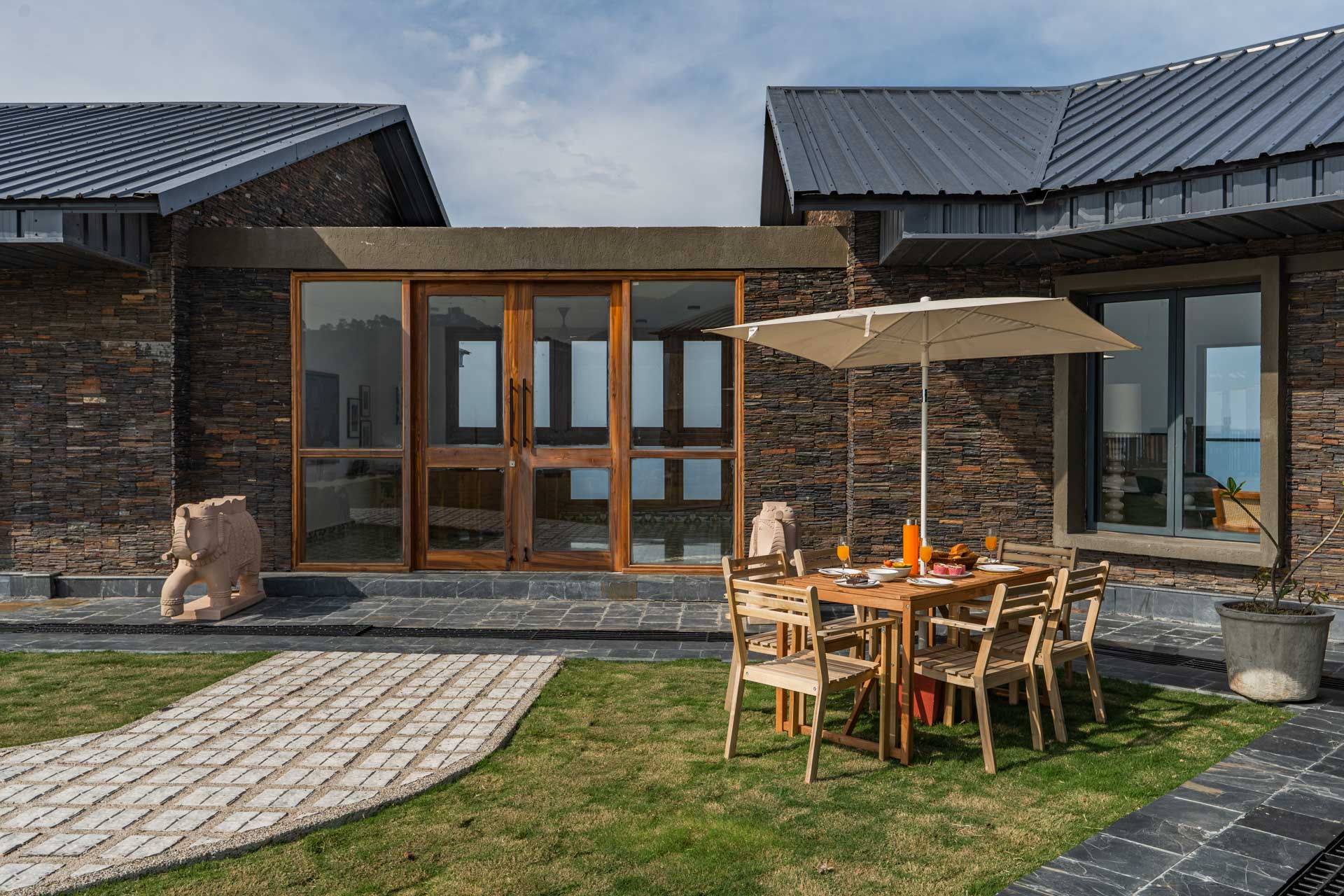
Villa Mirador
Frequently Asked Questions — Madhyamaheshwar Trek 2026
Indiahikes grades the Madhyamaheshwar trek as Easy-Moderate. The trail runs 16–18 km one-way over two days with one steep ascent of about 1,000 m between Bantoli and the temple. It’s suitable for first-time trekkers with basic fitness — a 5 km jog in 30 minutes is the rough benchmark.
The temple opens on 21 May 2026 and closes on 20 November 2026. The two best trekking windows are mid-May to late June (pre-monsoon, wildflowers, 10–20°C days) and mid-September to mid-October (post-monsoon, sharp Chaukhamba views, 5–15°C days). Avoid July and August because of monsoon rain and landslides.
The trek is 16–18 km one-way from Ransi via Goundar and Bantoli, typically completed across two days with an overnight halt at Bantoli. Some sources quote 24 km — that figure includes the optional Buda Madhyamaheshwar viewpoint (1.5–2 km above the temple) or the alternate Goundar route.
The Madhyamaheshwar temple sits at 3,497 m (11,473 ft) above sea level. The trek gains about 5,930 ft from the Ransi roadhead. The Buda Madhyamaheshwar viewpoint above the temple sits at roughly 3,800 m.
From Delhi, a 4-day Madhyamaheshwar trek costs ₹10,000–₹13,000 per person (budget), ₹15,000–₹18,000 (mid-range), or ₹22,000+ (premium). The price includes transport, stay, meals, and a guide. Inbound train or drive from Delhi to Rishikesh adds ₹2,500–₹6,000.
Madhyamaheshwar is the fourth of the five Panch Kedar shrines, marking the spot where Shiva’s navel (nabhi) is believed to have manifested after he fled the Pandavas in bull form following the Kurukshetra war. The other four shrines — Kedarnath, Tungnath, Rudranath, and Kalpeshwar — mark the rest of his body.
Not recommended. The Garhwal monsoon (early July to mid-September) makes the trail slippery, brings leeches, and increases the risk of landslides on the road to Ransi. Several operators suspend Madhyamaheshwar packages in July and August. Choose June or September for a safer window.
No. Unlike Kedarnath, Madhyamaheshwar is not part of the mandatory Char Dham registration required by the Uttarakhand government. There’s no biometric form, no time-slot allotment, no helicopter quota. You can drive to Ransi and start walking the same day.
Plan Your 2026 Madhyamaheshwar Trek
If Kedarnath has started to feel less like a pilgrimage and more like an airport queue, Madhyamaheshwar is the corrective. Here’s what to remember when you plan:
Open the dates first: Temple opens 21 May 2026, closes 20 November 2026.
Pick June or September: Both work; June for wildflowers, September for visibility.
Plan 4 days from Rishikesh, 5 from Delhi: Don’t try to compress it.
Budget ₹7,500–₹25,000 per person depending on your origin city and comfort level.
Skip the registration anxiety: No Char Dham paperwork, no helicopter battle.
Book the recovery night: Come back to a proper bed in Rishikesh or Mussoorie.
After four days on the trail and two long road days, the recovery night is the one detail most trekkers underestimate. StayVista’s curated homestays in Rishikesh, Dehradun, and Mussoorie sit close to the road back and run with the kind of in-house service — hot meals on arrival, hot showers, hot water bottles — that turns a long trek into a clean memory.
For what to read next: pair this with our Char Dham Yatra 2026 guide if you’re planning the full pilgrimage route, or browse more places to visit in Uttarakhand for the broader Garhwal trip.