
16 Best Things to Do in Munnar in Monsoon 2026
Last updated: June 2026
TL;DR: The best things to do in Munnar in monsoon are slow, green and view-led: walk the Kanan Devan tea gardens, tour the Tea Museum (₹75 adults, 9 AM–4 PM, closed Mondays), boat at Mattupetty Dam (~₹10 entry; boats pause in heavy rain), chase Attukal and Lakkam waterfalls at full spate, and catch sunrise above the clouds at Kolukkumalai (the world’s highest tea estate, ~₹120 factory entry). Carry a poncho and grippy shoes, drive the ghats only in daylight, and treat Eravikulam National Park as weather-dependent — it stays open in monsoon but shuts on heavy-rain days (and is closed every Feb 1–Mar 31 for tahr calving).
In this Blog
Munnar in monsoon at a glance
| Best time | June–September for mist, waterfalls and green tea slopes; September tapers to clearer skies |
| How to reach | ~130 km / 3.5–4.5 hrs by road from Kochi via the NH-85 ghat; ~165 km from Coimbatore |
| Nearest airport/station | Cochin International Airport (COK), ~110 km; nearest railhead Aluva (~108 km) or Ernakulam |
| Ideal duration | 2–3 days (one full day for tea + lakes, one for waterfalls + a viewpoint dawn) |
| 2026 monsoon note | Below-normal; the southwest monsoon reached Kerala on 4 June 2026, slightly late. Rain comes in spells, so plan flexible, indoor-friendly mornings |
What are the best things to do in Munnar in monsoon?
In the monsoon, Munnar trades its dry-season crowds for mist, birdsong and tea slopes that look almost backlit green. The short answer: build your days around tea gardens, waterfalls and viewpoints, keep wildlife parks and high treks flexible (rain closes them fast), and treat boating and sunrise trips as bonuses that depend on the morning sky. Rain here usually arrives in spells rather than all-day downpours, so a misty 7 AM can clear into a bright noon — pack for both and start early.
Below are 16 things to do, each with what it costs, when it’s open, how to reach it and a monsoon-specific tip. We’ve ordered them roughly from “always works in the rain” to “go only on a clear morning,” so you can read the sky and pick.
Monsoon safety in Munnar (StayVista’s signature box)
– Drive the ghats only in daylight. The Kochi–Munnar NH-85 and the internal roads to Top Station, Kolukkumalai and Marayoor are steep, single-lane in places and prone to slips and falling rock after rain. Aim to finish all hill driving by 5–5:30 PM.
– Stay back from waterfalls in spate. Attukal and Lakkam swell hard in July–August; rocks are slick and currents deceptive. View from the marked platforms, never wade or swim during rain.
– Eravikulam closes on bad-weather days. It is open through monsoon but shuts when rain is heavy or visibility is low (and is fully closed Feb 1–Mar 31 for tahr calving). Check status the morning you go.
– Carry for leeches and damp. A poncho, quick-dry clothes, grippy shoes, a little salt or anti-leech spray for grassy/forest trails, and a dry bag for your phone and camera.
– Build a buffer day. Roads, boating and sunrise jeeps all stand down in heavy rain — keep one flexible day so a washout doesn’t sink the trip.
1. Walk the Kanan Devan tea gardens
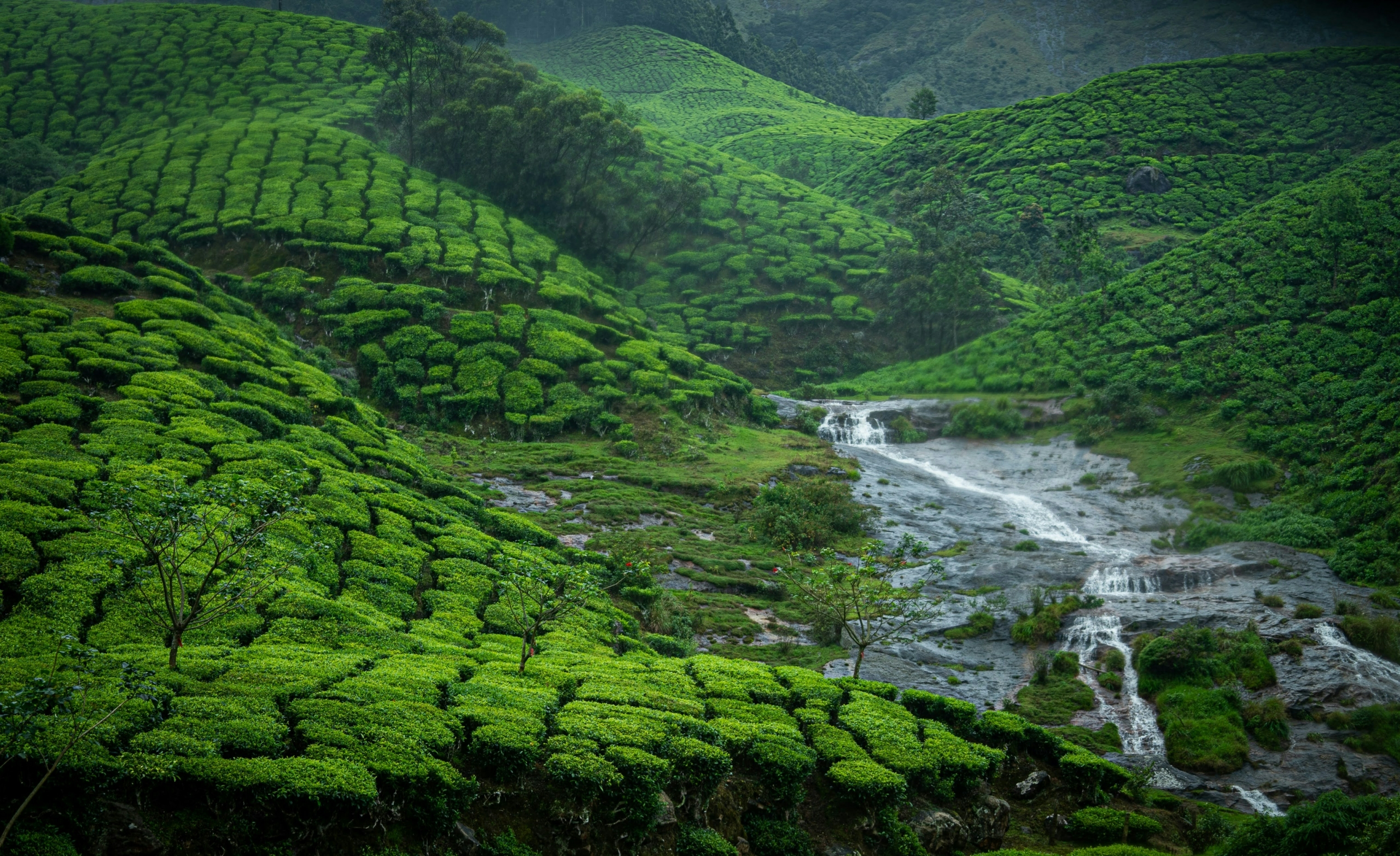
The single most monsoon-proof thing to do in Munnar is also the simplest: walk a tea-estate road early, when the slopes are wet, the pluckers are out and the mist drifts between rows. The Kanan Devan Hills carpet the whole region, so you don’t need a ticket — just a quiet lane off the main road around Lockhart, Gundumalai or the Munnar–Mattupetty stretch.
– Entry fee: Free to walk the public estate roads; guided estate walks, where offered, run roughly ₹100–₹200 per person.
– Timings: Daylight; best 7–10 AM when light is soft and pluckers are working.
– Best time to visit: Early monsoon mornings, before the day’s rain.
– How to reach: Tea slopes line the roads from Munnar town in every direction; the Mattupetty road (3–10 km out) is the easiest scenic stretch.
– Time required: 1–2 hours.
– Ideal for: Couples, photographers, slow travellers.
– Pro tip: Wet leaves smell incredible after rain but the red estate mud stains shoes — wear something you don’t mind ruining, and stay on the road, not the bushes (pluckers’ rows are working land).
2. Tour the Tea Museum (Kanan Devan / Tata Tea Museum)
When rain settles in, head indoors to the Tea Museum at KDHP’s Nullatanni Estate, a five-minute drive from town. It tells the story of Munnar’s tea — old machinery, photos, a working demonstration of how leaf becomes cup — and ends with a complimentary glass of cardamom tea. It’s the best wet-weather hour in Munnar.
– Entry fee: ₹75 adults; ₹35 children (6–12); ₹20 for a camera.
– Timings: 9:00 AM–4:00 PM; closed Mondays.
– Best time to visit: A rainy morning or early afternoon.
– How to reach: ~2 km from Munnar town on the Nullatanni Estate road; 5-minute drive or short auto ride.
– Time required: 1–1.5 hours.
– Ideal for: Families, first-timers, anyone curious about tea.
– Pro tip: Go on a wet day deliberately — this is your rain-plan attraction. The tea-processing demo runs through the day; ask staff when the next one starts so you don’t miss it.
3. Boat at Mattupetty Dam
About 13 km from town, Mattupetty Dam holds a long reservoir framed by tea hills and the Indo-Swiss dairy farm. The draw is a boat ride over still, green water with mist hanging low — pedal, row, speed or shared 20-seater. It’s one of the few water activities that often still runs in light monsoon rain.
– Entry fee: ~₹10 per person to enter; boating extra — roughly ₹300 for a 15-minute shared ordinary boat, ~₹500 for a speedboat, ~₹700 for the larger 20-seater (per boat).
– Timings: ~9:00 AM–5:00 PM; boating winds down by late afternoon.
– Best time to visit: Mid-morning, between rain spells.
– How to reach: ~13 km from Munnar on the Top Station road; 30-minute drive.
– Time required: 1.5–2 hours with a boat ride.
– Ideal for: Families, couples, groups.
– Pro tip: Boating pauses when rain or wind picks up and life jackets are mandatory — don’t pre-pay a packaged ticket; buy at the counter once you’ve seen the weather and the water.
4. Stop at Echo Point
Roughly 15 km out, on the road between Mattupetty and Kundala, Echo Point sits beside a lake ringed by hills that bounce your shout back. In monsoon the setting turns moody and cinematic — low cloud on the water, green ridges fading into grey. There’s also small-boat boating here when conditions allow.
– Entry fee: Nominal (a few rupees at the viewpoint); boating charged separately.
– Timings: Daylight hours; best mid-morning.
– Best time to visit: Between showers, when cloud sits on the lake.
– How to reach: ~15 km from Munnar on the Top Station road, past Mattupetty.
– Time required: 30–45 minutes.
– Ideal for: Couples, families with kids (the echo is a hit).
– Pro tip: It gets busy and a little commercial midday; arrive early for the quiet, photogenic version before the tour buses.
5. Take in Kundala Lake
A few kilometres further, Kundala is a calm dam lake set among shola forest and tea, famous for shikara and pedal boats. Entry is free, and the monsoon greens here are some of the lushest around Munnar. When the kurinji blooms (next expected 2030) the slopes turn blue — but even in an ordinary year the misted water is reason enough.
– Entry fee: Free to enter; boating ~₹100 (3-seat pedal), ~₹150 (4-seat row), ~₹200 (shikara for two), about 30 minutes each.
– Timings: 9:00 AM–5:00 PM; boating ends ~4:30 PM.
– Best time to visit: Morning, for stiller water and softer light.
– How to reach: ~20 km from Munnar on the Top Station road.
– Time required: 1 hour.
– Ideal for: Couples, families, photographers.
– Pro tip: Pair Kundala, Echo Point and Mattupetty into one half-day along the Top Station road — they’re strung along the same route, so you halve the driving.
6. Drive up to Top Station
At the Kerala–Tamil Nadu border, Top Station is the highest point on the Munnar plateau and the classic viewpoint over the Theni valley. In monsoon you’re often looking at a sea of cloud rather than a view — which is its own spectacle — and on clear breaks the layered hills run for miles.
– Entry fee: Free; small parking/local charges may apply.
– Timings: Best 6:00 AM–6:00 PM; go early for clearer skies and be down before dark.
– Best time to visit: Early morning, before cloud thickens.
– How to reach: ~32 km from Munnar via Mattupetty and Kundala; 60–90-minute drive on a winding road.
– Time required: Half a day with stops along the route.
– Ideal for: Couples, photographers, road-trippers.
– Pro tip: The view is a lottery in the rains — accept that you may get whiteout, and enjoy the drive and the roadside tea stalls regardless. Don’t attempt this road late in the day.
7. Catch sunrise at Kolukkumalai, the world’s highest tea estate
For many travellers this is the trip’s highlight: a pre-dawn jeep up a rough track to Kolukkumalai (around 7,130 ft), reputedly the world’s highest tea estate, to watch the sun rise over a cloud sea and tour a vintage British-era tea factory still working by orthodox methods.
– Entry fee: Tea-factory visit ~₹120 per person; the 4×4 jeep is booked separately (shared/private rates vary).
– Timings: Sunrise trips leave around 4:30 AM from the Suryanelli side; factory open ~5 AM–7 PM, closed Sundays.
– Best time to visit: A clear monsoon dawn — ask your host the night before.
– How to reach: Via Suryanelli (~35–40 km from Munnar), then a 4×4-only track; do not self-drive.
– Time required: Half a day (back by ~10 AM).
– Ideal for: Couples, photographers, adventurous groups.
– Pro tip: From March 2026 the Kolukkumalai jeep entry is managed online through the Kerala Forest Department, so book ahead. The track gets badly rutted in heavy rain and trips are cancelled on washout mornings — keep it flexible and only commit when the sky’s clear.
8. Chase Attukal Waterfalls
On the Munnar–Pallivasal road, Attukal is a wide, multi-tiered cascade that turns thunderous in the rains. It’s an easy stop close to town, and from the viewpoints you can take in the full sweep of water tumbling through green. This one is squarely a monsoon attraction — it’s at its loudest and fullest now.
– Entry fee: Free to view; guided walks to the base may charge ~₹100.
– Timings: Daylight, roughly 10 AM–6 PM for safe viewing.
– Best time to visit: Monsoon and just after, when flow peaks.
– How to reach: ~9 km from Munnar town on the Pallivasal road.
– Time required: 30–45 minutes.
– Ideal for: Couples, families, photographers.
– Pro tip: In peak rain, access to the rocks is closed for safety and you’ll view from the road/platform — that’s the right call, so don’t try to scramble closer. Rocks here are dangerously slick.
9. See Lakkam Waterfalls
On the Munnar–Marayoor road, inside the Eravikulam plateau, Lakkam is a powerful, clean fall set in dense forest. In the rains it swells to its maximum, framed by shola greenery and birdsong — one of the most photogenic waterfalls in the district.
– Entry fee: ~₹50 per person.
– Timings: 8:00 AM–4:00 PM, all days.
– Best time to visit: July–October for full flow (within reason — very heavy rain can close access).
– How to reach: ~22 km from Munnar on the road to Marayoor.
– Time required: 45 minutes–1 hour.
– Ideal for: Couples, families, nature lovers.
– Pro tip: During spates the bathing area is roped off and the surrounding forest path can flood — check at the entry whether it’s open before driving out, since it’s a fair way from town.
10. Visit Eravikulam National Park (Rajamala)
Munnar’s flagship park protects the endangered Nilgiri tahr on the slopes below Anamudi, and a shuttle bus takes you into the Rajamala tourism zone. In monsoon the grasslands are emerald and rich, though wildlife is harder to spot in mist and rain — go for the dripping shola scenery as much as the tahr.
– Entry fee: ~₹200 for Indian adults; ~₹500 for foreign nationals; cameras ~₹50 (video higher). Daily ticket cap applies, with most sold online.
– Timings: Open through the day (commonly cited windows range from ~7:30 AM and ~8 AM, closing early–to–mid afternoon) — confirm the day’s timing on the official booking site, as it shifts seasonally.
– Best time to visit: A clear morning slot; the park shuts on heavy-rain days.
– How to reach: ~13 km from Munnar via Rajamala; private vehicles park at the base and a forest shuttle runs the last stretch.
– Time required: 2–3 hours including the shuttle.
– Ideal for: Families, wildlife and nature lovers.
– Pro tip: The park is closed every year from Feb 1 to Mar 31 for tahr calving and reopened on 1 April in 2026, so monsoon is fine for timing — but book online early (counters sell only a small share) and have a backup plan for rain closures. See our note on whether Eravikulam National Park is open and how to book.
11. Look up at Anamudi, South India’s highest peak
At 2,695 m, Anamudi is the tallest mountain south of the Himalayas, rising inside Eravikulam. Full summit treks are tightly permit-controlled by the Forest Department and generally suspended in the wet, slippery monsoon — but you can admire it superbly from the Rajamala/Eravikulam grasslands, where it forms the backdrop.
– Entry fee: Viewing is via the Eravikulam ticket (above); organised treks, when permitted, are separately licensed.
– Timings: As per Eravikulam park hours.
– Best time to visit: Post-monsoon to spring (Nov–May) for any trekking; monsoon for misty views only.
– How to reach: Viewed from within Eravikulam, ~13 km from Munnar.
– Time required: Built into the Eravikulam visit.
– Ideal for: Nature lovers, photographers; serious trekkers (in season, with permits).
– Pro tip: Don’t expect to “climb Anamudi” on a casual monsoon trip — access is restricted year-round and especially in the rains. Treat it as a viewpoint and a story, not a summit.
12. Cross to Marayoor for sandalwood and dolmens
About 40 km north of Munnar towards Udumalpet, Marayoor is the only place in India with naturally growing sandalwood forest, plus jaggery farms, prehistoric dolmens and rock art. The drive descends out of the cloud into a drier, sunnier belt — a clever monsoon move when Munnar itself is socked in.
– Entry fee: Free to drive through; the protected sandalwood reserve and rock-art sites may require a forest pass/guide.
– Timings: Daylight; start early to be back before dark.
– Best time to visit: Any monsoon day — it’s often clearer here than Munnar.
– How to reach: ~40 km / ~1.5 hrs north of Munnar on the Marayoor road (passes Lakkam falls).
– Time required: Half to full day.
– Ideal for: History buffs, families, anyone wanting sun on a wet day.
– Pro tip: Buy fresh Marayoor jaggery (sold roadside) — it’s a regional specialty. Hire a local guide for the dolmens; they’re hard to find unmarked.
13. Stop at Pothamedu Viewpoint
Just ~3 km from town, Pothamedu is the most photographed viewpoint in Munnar, opening onto tea, coffee and cardamom slopes rolling into the valley. It’s close, quick and dramatic in monsoon when cloud streams through the gap — a perfect first-evening or fill-an-hour stop.
– Entry fee: Free (small parking charge possible).
– Timings: Daylight; sunrise and late afternoon are best.
– Best time to visit: A clear-ish evening, or early before rain.
– How to reach: ~3 km from Munnar town on the Kochi road side.
– Time required: 30 minutes.
– Ideal for: Couples, photographers, families.
– Pro tip: Because it’s so close to town you can dash here whenever the sky breaks — keep it as your “clearing weather” backup rather than a fixed plan.
14. Wander Blossom International Park
By the Muthirappuzha river near the Pallivasal project, Blossom is a 16-acre landscaped park with flowering plants, cycling paths, an artificial waterfall, ropeway and walking trails. In gentle rain it’s a pleasant, low-effort outing close to town — good with kids or older travellers.
– Entry fee: ~₹10 adults; ~₹2 children (under 12); activities like cycling/ropeway charged separately.
– Timings: Roughly 9 AM–6 PM (evenings are pleasant); confirm locally.
– Best time to visit: A light-drizzle afternoon.
– How to reach: ~3 km from Munnar town.
– Time required: 1–1.5 hours.
– Ideal for: Families, casual strollers.
– Pro tip: It’s more manicured garden than wilderness — go for an easy leg-stretch and river views, not for “untouched nature.” Pair it with the Tea Museum nearby.
15. Take a spice plantation walk
Munnar and its lower slopes grow cardamom, pepper, cinnamon, nutmeg and clove, and small estates around Pallivasal, Bison Valley and Chinnakanal run guided spice walks. The monsoon is when the plantations are at their most fragrant and green, and the canopy keeps light rain off you.
– Entry fee: Roughly ₹100–₹300 per person for a guided plantation tour (varies by estate).
– Timings: Typically 9 AM–5 PM by appointment.
– Best time to visit: Mid-monsoon, when growth and aromas peak.
– How to reach: Estates lie 8–20 km from town towards Bison Valley/Chinnakanal; many homestays arrange visits.
– Time required: 1–2 hours.
– Ideal for: Couples, families, food and garden lovers.
– Pro tip: Buy spices at the source — fresh Munnar cardamom and pepper are far better than the packaged stuff in town shops. Ask your host to set up a small private walk rather than a rushed group tour.
16. Stop for Photo Point and a tea-stall chai
“Photo Point” is the well-known roadside stretch on the Mattupetty road where tea rows, a stream and (in season) flowers make an easy postcard frame — touristy, yes, but genuinely pretty in the mist. Better still, treat any small roadside tea stall as the real Munnar monsoon experience: hot chai, fried snacks and rain on a tin roof.
– Entry fee: Free (Photo Point); tea ~₹10–₹20 a glass.
– Timings: Daylight; the stalls run into the evening.
– Best time to visit: Any time you need to wait out a shower.
– How to reach: Photo Point is ~3–4 km out on the Mattupetty road; tea stalls are everywhere.
– Time required: 20–40 minutes.
– Ideal for: Everyone — couples, families, groups.
– Pro tip: Ask for chukku kaapi (dry-ginger coffee) at local stalls — it’s the regional monsoon warmer, and far more interesting than another touristy photo.
A simple monsoon itinerary for Munnar
Rain rewards a relaxed plan. Here’s how we’d shape a short trip, leaving room for the weather to change its mind.
One full day: Start with a tea-garden walk near Mattupetty at first light, boat at Mattupetty Dam, then loop Echo Point and Kundala on the Top Station road. Save the indoor Tea Museum for the afternoon if rain sets in, and end at Pothamedu for whatever sky you get.
Two days: Day 1 as above. Day 2, pick your weather — a clear dawn means Kolukkumalai sunrise or Top Station; a wet one means Attukal and Lakkam waterfalls at full spate, then a spice walk under the canopy.
Weekend (3 days): Add Eravikulam (Rajamala) on a clear morning, and on the third day drive down to Marayoor for sandalwood, dolmens and a sunnier change of scene before heading home. For the drive in and out, our Kochi to Munnar route guide maps the ghat stops and timing.
If you’re still deciding whether the rains are worth it at all, our Kerala-in-monsoon weather guide gives the honest verdict, and our roundup of the best monsoon destinations in Kerala for 2026 puts Munnar in context with the rest of the state. Travelling around Onam? See the best places to visit in Kerala in August.
Where to stay (StayVista)
In monsoon, where you base yourself matters more than usual — a good villa with hot food, a view and a caretaker who knows the day’s road and weather can rescue a rained-out afternoon.
- Vale Echoes (/villa/vale-echoes) — a 4-bedroom villa in Pallivasal, ~4 km from Munnar town and barely a kilometre from Attukal Waterfalls, with mountain-and-garden balcony views and home-cooked meals. It’s an easy base for the Mattupetty–Top Station loop and the in-town attractions, and the kind of place you’re happy to be stuck in when it pours.
- Paradise Valley (/villa/paradise-valley) — also in Pallivasal, near Pothamedu, set among tea slopes with valley views; a comfortable option if Vale Echoes is booked out on your dates.
CTA box — Travelling in the rains? Book a villa with covered seating, a working kitchen and a caretaker on site, so a washout morning becomes a slow tea-and-view morning instead. (CTA 1 of 3 max.)
FAQ: Munnar in monsoon
Is Munnar good to visit in monsoon?
Yes — Munnar is one of the most rewarding monsoon hill stations in Kerala, with green tea slopes, waterfalls in full spate and far fewer crowds and lower rates than peak season. The trade-offs are frequent rain, occasional view washouts and some weather closures, so keep the plan flexible and prioritise tea gardens, waterfalls and viewpoints over wildlife spotting.
What are the best things to do in Munnar during the rains?
Walk the Kanan Devan tea gardens, tour the Tea Museum (a perfect rainy-hour stop), boat at Mattupetty Dam and Kundala Lake, see Attukal and Lakkam waterfalls at full flow, and — on a clear dawn — drive up for sunrise at Kolukkumalai, the world’s highest tea estate. Indoor and short-trip options (Tea Museum, spice walks, Blossom Park) are your rain-day backups.
Is Eravikulam National Park open during monsoon?
Eravikulam (Rajamala) generally stays open through the monsoon, but it shuts on heavy-rain or low-visibility days, so check status the morning you plan to go. It is fully closed every year from 1 February to 31 March for Nilgiri tahr calving and reopened on 1 April in 2026; most tickets sell online with a daily cap.
Do waterfalls near Munnar flow well in monsoon?
Yes — Attukal and Lakkam are at their fullest and most dramatic during the rains. The flip side is safety: in peak spate, access to the rocks and bathing areas is closed and you’ll view from platforms only. Never wade or swim near a monsoon waterfall, as currents and slick rocks are dangerous.
Is it safe to drive in Munnar during monsoon?
It’s manageable if you drive only in daylight and go slow. The Kochi–Munnar ghat and the roads to Top Station, Kolukkumalai and Marayoor are steep and prone to slips, fog and falling rock after rain. Finish all hill driving by early evening, keep buffer time, and let an experienced local driver handle the rougher tracks.
Will I get leeches in Munnar in the rains?
On grassy and forest trails (tea-garden edges, shola paths, waterfall walks) leeches are common in monsoon. Wear closed shoes and long socks, carry a little salt or anti-leech spray, and check ankles after walks — they’re harmless but a nuisance.
How many days are enough for a Munnar monsoon trip?
Two to three days is ideal: one full day for tea gardens and the Mattupetty–Echo Point–Kundala loop, one for waterfalls or a clear-dawn viewpoint, and a spare day as a weather buffer. A weekend lets you add Eravikulam and a drive to Marayoor.
When does the monsoon start in Munnar in 2026?
The southwest monsoon reached Kerala on 4 June 2026, slightly later than usual, and IMD has forecast a below-normal season (~90% of the long-period average). In practice that means rain in spells through June–September rather than constant downpours — good news for travellers willing to plan around clear breaks.
Conclusion
Munnar in the monsoon isn’t about ticking off a checklist in the sun — it’s about reading the sky and going with it. Walk the tea slopes when the mist lifts, duck into the Tea Museum when it pours, stand back and watch the waterfalls roar, and chase one good clear dawn at Kolukkumalai or Top Station. Drive in daylight, carry a poncho, keep a buffer day, and base yourself somewhere with a warm kitchen and a view. Do that, and the rains turn from a problem into the whole point.