

Should You Visit Kerala in Monsoon? 2026 Weather Guide & Verdict
Last updated: June 2026
TL;DR: Yes — Kerala in monsoon is worth it, with caveats. The southwest monsoon (roughly June to September, with July the wettest) turns the state green, fills the waterfalls, drops tariffs and empties the crowds — and it’s the traditional season for Ayurveda. It’s ideal for couples, slow travellers, photographers and wellness seekers who don’t mind rain. Skip it if you want guaranteed beach days, calm seas or non-stop sightseeing. For 2026, IMD forecasts a below-normal monsoon (~90% of the long-period average nationally, below normal over the south peninsula), so expect rain in spells rather than wash-outs — but always check IMD and district advisories before you travel.
In this Blog
Kerala in monsoon at a glance
| Monsoon months | Southwest: June–September (July wettest); Northeast (lighter “second” rains): October–November |
| Onset 2026 | Southwest monsoon reached Kerala on 4 June 2026 (about 3 days late) |
| Weather | Warm-humid coast (~25–32°C, 75–90% humidity); cool-misty high ranges like Munnar (~18–26°C, 90%+ humidity) |
| Best monsoon months to choose | June (fresh, friendlier rain) and September (tapering, greenest) for an easier trip; July–August for peak drama |
| Nearest airports | Kochi (COK), Trivandrum (TRV), Kozhikode (CCJ) |
| Ideal duration | 4–7 days |
| 2026 monsoon note | Below-normal; ~90% of LPA nationally, below normal over the south peninsula — rain in spells, not wash-outs. Check advisories. |
Should you visit Kerala in monsoon? The honest verdict
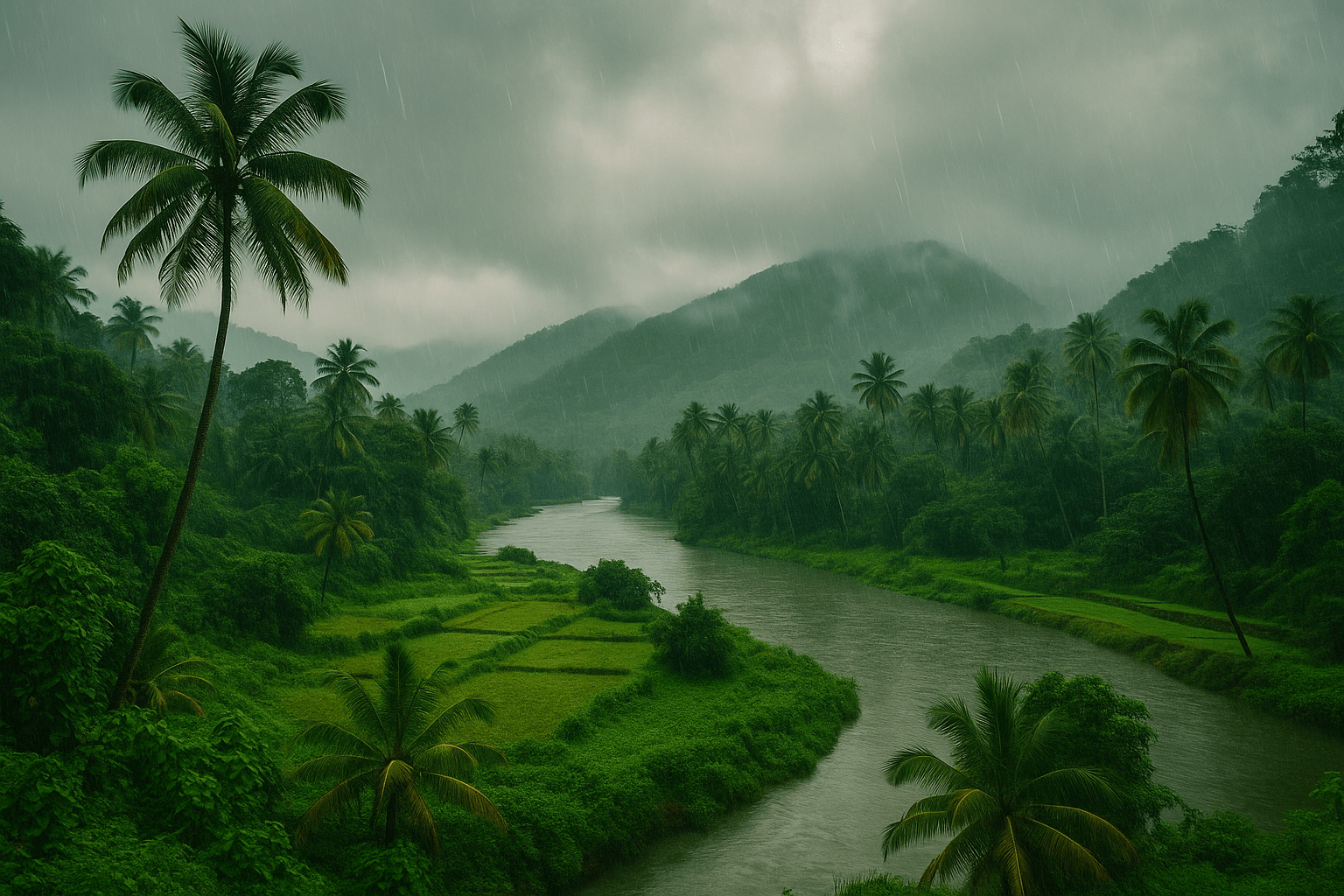
Yes — if you come for the rains rather than in spite of them. Monsoon is when Kerala looks the way the postcards promise: tea slopes glow, the backwaters brim, waterfalls run at full volume, and room rates fall to their lowest of the year while the crowds thin out. It’s also the traditional Ayurveda season, when the cool, humid air is considered ideal for treatments, and many wellness resorts run their best monsoon packages.
But it is a genuine monsoon, not a light drizzle, so the honest answer depends on who you are.
Kerala in monsoon is great for you if you are: a couple or honeymooner after atmosphere over activity; a slow traveller happy to watch rain from a verandah; a photographer chasing mist and full waterfalls; a wellness seeker booking an Ayurveda retreat; or a value traveller who wants Kerala at off-season prices.
You should probably skip it (or wait for the dry season, December–February) if you: are set on guaranteed sunshine and swimmable beaches; want to pack many outdoor sights into a tight, fixed itinerary; get seasick easily (open backwater stretches can be choppy); or are travelling with very young children or anyone who struggles with damp, humid heat.
If you fall in the second group, our Kerala in August guide and the broader best monsoon destinations in Kerala 2026 can help you pick the rain-friendliest pockets and the few sights that shine in the wet.
Monsoon safety in Kerala (StayVista’s signature box — read before you book)
– The sea is for watching, not swimming. Arabian Sea swells and rip currents peak in the southwest monsoon at Varkala, Kovalam and most beaches — swim only where lifeguards have flagged it safe, and never in rough surf.
– Treat waterfalls with respect. Athirappilly, Soochipara and Meenmutty run at their most dangerous in July–August; view from official points only, as base treks and rock pools close in heavy rain because of flash-flood risk.
– Drive ghat roads by daylight. Roads up to Munnar, Thekkady, Vagamon and Wayanad fog over and see occasional slips — hire experienced local drivers, avoid night driving, and skip high viewpoints after heavy showers.
– Mind the leeches and the wet trails. Leeches are common on Western Ghats walks in the rains — carry salt or repellent and tuck trousers into socks.
– Check advisories, every time. Kerala’s catastrophic 2018 floods (16 August 2018) were a once-in-a-century event, and 2026’s below-normal forecast makes a repeat unlikely — but dam shutters do open in heavy spells. Follow IMD alerts and district / Kerala Disaster Management advisories before and during your trip, keep a buffer day, and avoid river and dam catchment areas during red alerts.
Kerala’s two monsoons — and what the 2026 forecast means for you
Most people picture one rainy season, but Kerala actually gets two.
The southwest monsoon is the big one. It is the first to break over India, usually arriving on the Kerala coast around 1 June — in 2026 it reached Kerala on 4 June, about three days late. It runs through to roughly the end of September and delivers the lion’s share of the state’s rain, driven by moisture-laden winds slamming into the Western Ghats. This is the “monsoon” almost every traveller means.
The northeast monsoon, also called the retreating monsoon, is Kerala’s quieter “second” rainy spell. As the southwest winds withdraw, the wind reverses and brings showers off the Bay of Bengal mainly to Tamil Nadu and southern Kerala in October and November. It’s lighter and patchier than the southwest monsoon, which is why October onward starts to feel like the shoulder season — greener than ever, but with the heaviest rain easing off.
The 2026 outlook, in plain terms: IMD’s seasonal forecast puts national rainfall at about 90% of the long-period average — a below-normal monsoon — with the south peninsula (which includes Kerala) expected to come in below normal too, and El Niño conditions developing through the season. For a traveller, “below normal” is not a washout warning; it means you should expect rain in concentrated spells with drier windows in between, rather than relentless day-after-day downpours. It also lowers (without eliminating) the odds of the extreme, flood-level rainfall that disrupts travel. The practical takeaway is unchanged: pack for rain, keep plans flexible, and watch the short-range IMD forecast in the days before you go rather than relying on any seasonal average.
Kerala monsoon weather, month by month
Rain in Kerala isn’t uniform — it builds, peaks and tapers, and the high ranges behave very differently from the coast.
June — the onset. The monsoon bursts in, usually in the first week (4 June in 2026). Early showers are dramatic but often broken by sunny spells, the landscape turns instantly green, and rates are already low. June is one of the friendliest monsoon months to visit: the rain is enthusiastic but not yet relentless, and the backwaters are calm enough that houseboat cruises run comfortably. Coastal temperatures sit around 25–32°C; Munnar and the hills are cool and freshly washed.
July — the wettest month. This is peak southwest monsoon. Rain is frequent and can be heavy for days at a stretch, humidity is at its highest (90%+ in the hills), and the Western Ghats districts — Idukki, Wayanad, Pathanamthitta — see the most intense downpours. The payoff is Kerala at its most spectacularly green, with every waterfall thundering. July suits travellers who actively want the full monsoon experience and are happy to build their days around the weather.
August — fierce but tapering, and festive. August stays very wet, especially early in the month, but the rains often begin to ease toward its end. It’s also Onam season, Kerala’s biggest festival, which makes August the most culturally rewarding monsoon month despite the rain — expect snake-boat races, flower carpets and grand feasts. (For the festival calendar and the best places to be, see our dedicated Kerala in August guide.) Note that August is historically when Kerala has seen its most severe flood events, so advisory-checking matters most this month.
September — the sweet spot for many. The southwest monsoon weakens through September, the rain becomes gentler and more intermittent, and the state is at its greenest after three months of rain. Seas begin to calm, ghat roads are less hazardous, and crowds are still thin. For travellers who want monsoon lushness without peak-July intensity, September is arguably the best month of the season.
October–November — the retreating monsoon. The northeast monsoon brings lighter, patchier showers, mostly to the south. Days are increasingly sunny between spells, humidity eases, and this transitions into the start of Kerala’s prime dry-season tourism. If “monsoon green, less monsoon rain” is what you want, late October is a lovely time to come.
Coast vs. Munnar vs. Wayanad: how the rain changes by region
Where you go matters as much as when. The same week can feel like three different climates.
The coast and backwaters (Kochi, Alleppey, Kovalam, Varkala, Kollam): warm and humid, around 25–32°C with humidity of 75–90%. Rain arrives in heavy bursts, often clearing to bright, steamy spells. The sea is rough and not for swimming, but Fort Kochi’s lanes and the backwaters are genuinely lovely in the rain — this is the most rain-friendly base in the state, with the most to do under cover.
The high ranges (Munnar, Vagamon, Ponmudi, Nelliampathy): cool and misty, around 18–26°C in Munnar with humidity often above 90%. Expect cloud, drizzle and limited visibility at the highest viewpoints, punctuated by glorious clear windows. Evenings are genuinely chilly — pack a light layer. The tea country is at its most photogenic here, but ghat roads demand daytime caution.
Wayanad and the northern Ghats: lush spice-and-forest country that takes some of the heaviest rain in the state. It is stunning in the monsoon, but it must be enjoyed responsibly after the 2024 Mundakkai–Chooralmala landslides: that belt remains a restricted no-go zone. Base yourself on the Vythiri–Kalpetta side, follow district advisories, and choose safer wet-weather spots like Edakkal Caves and Pookode Lake. Our Kochi to Munnar monsoon route guide covers the most common ghat drive in detail.
Pros and cons of a monsoon trip to Kerala
The case for going:
– Peak greenery. Tea estates, paddy fields and forests are at their most vivid — this is the Kerala of the brochures.
– Lowest prices of the year. Off-season tariffs on stays and houseboats, and far fewer tourists at the big sights.
– Full waterfalls and brimming backwaters. Athirappilly and the Wayanad falls run at full volume; Vembanad and the canals are at their fullest.
– Ayurveda season. The cool, humid weather is considered the ideal time for traditional treatments, and resorts run their best monsoon wellness packages.
– Atmosphere. Rain on a backwater verandah, mist rolling through tea hills, Fort Kochi’s grey-sky drama — it’s a mood the dry season simply can’t match.
The trade-offs to plan around:
– Rain can disrupt plans. Heavy spells, the odd road slip and reduced visibility mean fixed, packed itineraries don’t work well — build in buffer time.
– Rough seas, no beach days. Swimming is unsafe at most beaches, and some watersports pause.
– Houseboats can be limited in peak spells. Cruises run through the monsoon, but operators move to sheltered canals in squalls and suspend sailings entirely during red alerts — heavy July–August downpours can cut a cruise short.
– Leeches, mud and humidity. Western Ghats trails get leechy and slippery, and the constant damp heat tires some travellers.
– A few attractions close or restrict access. Some park zones, treks and high viewpoints shut in heavy rain (see below).
What’s open and what’s affected in the rains
A quick reality check on Kerala’s headline experiences during the southwest monsoon:
- Backwaters and houseboats (Alleppey, Kumarakom): Open and lovely. Houseboats operate through the monsoon under Kerala Port Department rules, but expect captains to shift to calm village canals in squalls, and bookings to be paused during red alerts. June and September are the smoothest; mid-August can be choppy. Cost: overnight cruises broadly ₹10,000–₹20,000 with meals (confirm current rates with your operator). Book a reputable, licensed operator.
- Fort Kochi and the cities: Fully open and at their atmospheric best. Kathakali shows, museums, galleries, cafés and colonial walks are all rainy-day friendly — your safest bet for a packed-but-dry day.
- Hill stations (Munnar, Vagamon, Ponmudi): Open, with caveats. Roads and stays operate, but high viewpoints and some trails close in heavy rain, and visibility can be poor. Travel by day.
- Eravikulam National Park (Munnar): Often restricted in peak monsoon. The park is best September–March; during heavy June–August rain, access may be restricted or closed for safety, and it has a separate fixed closure for the Nilgiri Tahr calving season (roughly February–March). Timings are about 7:30 AM–4:00 PM when open. Check before you go.
- Periyar Tiger Reserve, Thekkady: Open year-round, including monsoon. The lake boat cruise — the signature experience — runs through the rains, and the reserve is lush and quieter; conditions ease as August progresses. Book the early cruise via the official reserve site, and carry rain gear. A nominal forest entry fee plus a per-person boat charge applies, payable on booking — confirm current rates on the official site.
- Waterfalls (Athirappilly, Soochipara, Meenmutty): Open to view, treks closed in heavy rain. The falls are spectacular and run at full volume, but base treks and rock-pool access shut during heavy spells for flash-flood safety. View from official upper points only. Athirappilly typically charges a small entry fee and is open through the day.
- Beaches (Varkala, Kovalam, Bekal): Open for walks, not for swimming. Cliff-top cafés and the moody coastline are a draw; the water is rough and currents are strong, so heed lifeguard flags.
Who should go — and which months to choose
If you’ve decided Kerala in the rains is for you, match the month to your trip:
- Want the easiest monsoon trip? Choose June (fresh greenery, friendlier rain, calm backwaters) or September (tapering rain, the greenest landscape, calmer seas). These bookend the season and give you lush Kerala with the least disruption.
- Want the full, dramatic monsoon — and don’t mind being rained in? July is peak intensity: thundering waterfalls, deep mist, the lowest crowds.
- Want culture with your rain? August for Onam, the state’s biggest festival, with the famous snake-boat races and feasts — just plan around the heaviest spells.
- Want monsoon green with the rain easing off? Late October–November, when the lighter northeast-monsoon showers take over and the dry season begins.
- Want guaranteed sun and swimmable beaches? Don’t come in monsoon at all — visit in the dry season, December–February.
A simple framework: coast and cities for rainy days, hills and waterfalls for the clear windows, and a buffer day for the weather to misbehave. A 4–5 day trip pairing Kochi or Alleppey with one hill or waterfall day is the most reliable monsoon itinerary; stretch to 6–7 days if you want to add Munnar or the Wayanad estates.
Getting to Kerala in monsoon (the short version)
Kerala has three convenient airports — Kochi (COK), Trivandrum (TRV) and Kozhikode (CCJ) — and a reliable coastal rail line linking Thiruvananthapuram, Kollam, Alleppey, Ernakulam, Thrissur and Kozhikode, which is the most weather-proof way to move between towns in the rains. Within the state, save the ghat roads (to Munnar, Thekkady, Wayanad) for daylight and leave the hill drives to experienced local drivers.
For a detailed flights-and-logistics breakdown — including the popular Mumbai connection, Ayurveda planning and a monsoon route map — see our companion guide, Mumbai to Kerala in July: the best of Kerala’s monsoon destinations. For the wider picture across the state, the canonical best monsoon destinations in Kerala 2026 and the pan-India where to travel in India in monsoon hub are good next reads. Worried about conditions? Our safe places to visit in monsoon guide is built for exactly that.
Where to stay in Kerala in monsoon (StayVista)
The right base turns rain from an inconvenience into the whole point — look for covered verandahs, reliable power and a view worth watching the weather from. A few StayVista homes that suit a monsoon trip:
- Alleppey: The Rain — a four-bedroom backwater homestay named for the season, with an infinity pool melting into Punnamada Kayal, lake-facing Jacuzzis and on-site Ayurvedic massage. About 92 km from Kochi airport; the backwater monsoon base.
- Fort Kochi: Skyville A — a heritage-styled home in the middle of Fort Kochi, walking distance to the Chinese fishing nets and Mattancherry, and an ideal rainy-day base for the most weather-proof part of the state.
- Wayanad: Princess of Wayanad — a four-bedroom villa amid the greenery on the Vythiri–Kalpetta side, well away from the restricted landslide zone, with big windows and lawns for the misty estate views.
Planning a monsoon Kerala escape? Pick June or September for the easiest weather, base yourself near the backwaters or Fort Kochi for rainy days, and book a stay with covered outdoor space so the rain becomes part of the experience. (CTA 1 of 3.)
FAQ: visiting Kerala in monsoon
Is monsoon a good time to visit Kerala?
Yes, with caveats. Monsoon (June–September) brings peak greenery, full waterfalls, brimming backwaters, the lowest prices of the year and the traditional Ayurveda season, with very few crowds. It is genuine, heavy rain, though, so it suits couples, slow travellers, photographers and wellness seekers more than anyone set on beach days or a tightly packed sightseeing itinerary.
What are the monsoon months in Kerala?
Kerala has two monsoons. The main southwest monsoon runs roughly June to September, with July the wettest month. A lighter “second” rainy spell, the northeast or retreating monsoon, brings patchier showers mainly to the south in October and November.
When does the monsoon start in Kerala in 2026?
The southwest monsoon reached the Kerala coast on 4 June 2026, about three days later than the typical 1 June onset. IMD forecasts a below-normal 2026 monsoon overall, around 90% of the long-period average nationally and below normal over the south peninsula.
Which is the best month to visit Kerala in monsoon?
For the easiest trip, choose June (fresh greenery, friendlier rain) or September (rain tapering, the landscape at its greenest and seas calming). July offers the most dramatic full monsoon, and August adds the Onam festival but the heaviest rain. For guaranteed sun, visit in the dry season (December–February) instead.
Is it safe to travel to Kerala during monsoon?
Generally yes, with sensible monsoon caution. Don’t swim in the rough sea, view waterfalls only from official points, drive ghat roads by daylight, watch for leeches on trails, and — most importantly — follow IMD and district advisories, especially during red alerts when dam shutters may open. The below-normal 2026 forecast lowers the odds of extreme flooding, but checking advisories is essential.
Are the Alleppey backwaters and houseboats available in monsoon?
Yes. Houseboats operate through the monsoon under Kerala Port Department rules, and full backwaters at off-season prices make it a beautiful time to cruise. In heavy squalls, operators move to sheltered canals, and sailings are suspended during red alerts — so June and September are smoother than peak July–August. Book a licensed operator.
Does it rain all day, every day in Kerala during monsoon?
Not usually. Even in peak season, rain typically comes in heavy spells with drier, brighter windows in between, especially in June and September. A below-normal year like 2026 is expected to bring rain in concentrated bursts rather than relentless all-day downpours — plan flexible days and use the clear windows for hills and waterfalls.
Conclusion
Should you visit Kerala in monsoon? For most travellers chasing atmosphere, greenery and value — yes, and gladly. Come in June or September for the smoothest experience, July for the full drama, or August for Onam, and base yourself near the backwaters or in Fort Kochi so a wet day is still a good day. Respect the sea, the waterfalls and the ghat roads, keep an eye on IMD and district advisories, and Kerala in the rains rewards you with a version of “God’s Own Country” the dry-season crowds never get to see. A comfortable StayVista home with a covered verandah makes the monsoon something to settle in and savour.