
Pachmarhi in Monsoon 2026: 14 Sights, Waterfalls & Safety Guide
Last updated: June 2026
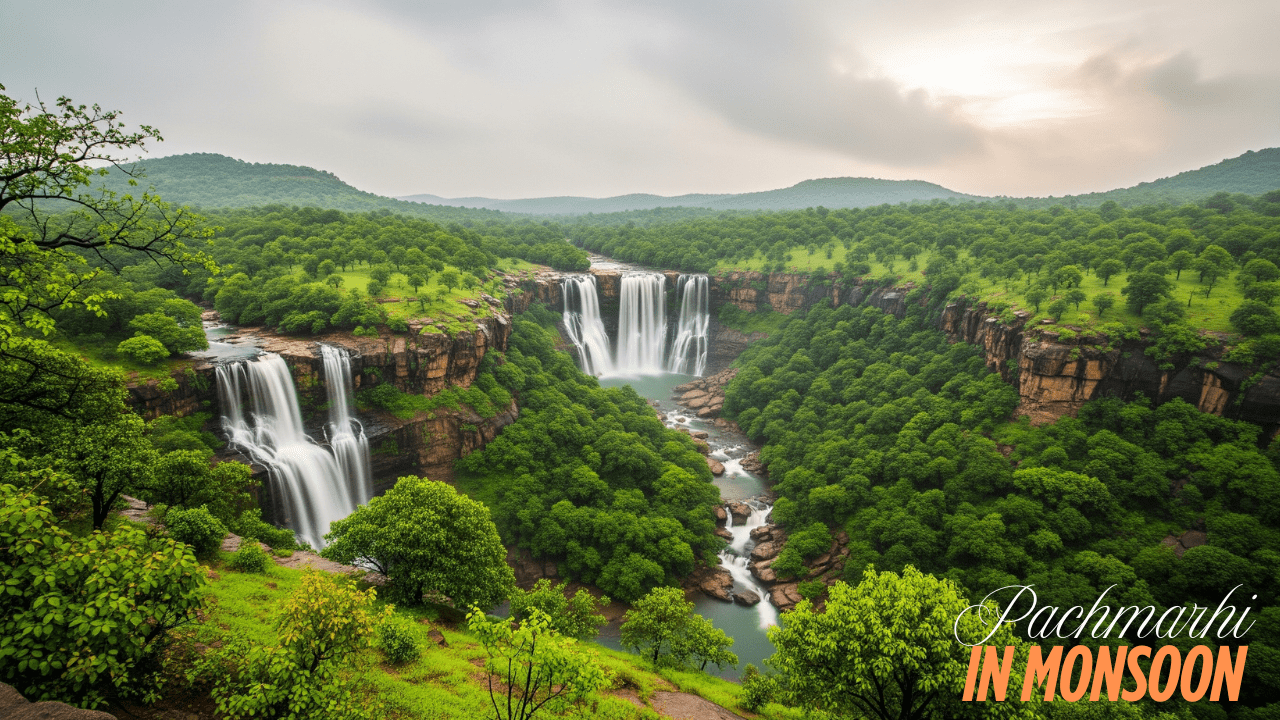
TL;DR: Pachmarhi — the “Queen of Satpura” and Madhya Pradesh’s only hill station — is one of central India’s finest monsoon destinations, when its waterfalls run at full force and the Satpura hills turn emerald. The key thing to know for 2026: Pachmarhi town and its sightseeing circuit stay open all monsoon, but the Satpura Tiger Reserve core safari zone is closed 1 July–30 September (it reopens 1 October). So come in July–August for waterfalls, viewpoints and misty treks — not for a tiger safari. Most forest-side sights need a day-permit from Bison Lodge and a hired gypsy, as private vehicles aren’t allowed inside the reserve.
In this Blog
Pachmarhi in monsoon at a glance
| Best time | July–September for full waterfalls and mist (official MP Tourism recommends monsoon) |
| Open in monsoon | Town, all waterfalls, viewpoints, caves, buffer-zone safari |
| Closed in monsoon | Satpura core safari + boating (1 Jul–30 Sep) |
| Getting around | Forest day-permit (Bison Lodge) + hired gypsy — private vehicles banned inside the reserve |
| Nearest railway / airport | Pipariya (~50 km) / Bhopal (~200–220 km) |
| Ideal duration | 2–3 days |
Why visit Pachmarhi in the monsoon?
Most of India’s wildlife parks shut their gates in the rains, and travellers assume Pachmarhi does too. It doesn’t. The Madhya Pradesh Tourism board itself calls Pachmarhi “a round-the-year destination” and notes that “during monsoon and winter the beauty of the hill station multiplies” — a rare official endorsement of monsoon travel.
The reason is simple: rain is when Pachmarhi comes alive. Waterfalls like Rajat Prapat and Duchess Falls thunder at full volume, the Satpura ranges disappear into cloud, and Dhoopgarh — the highest point in Madhya Pradesh at 1,352 metres — delivers its most dramatic, mist-wrapped sunsets. Daytime temperatures sit at a comfortable 19–25°C.
One honest caveat up front: the Satpura Tiger Reserve’s core safari and boating close for the monsoon (1 July to 30 September), reopening on 1 October. Buffer-zone safaris may still run. So if a tiger safari is your goal, visit October–March instead; if waterfalls, viewpoints and green treks are what you’re after, the monsoon is perfect. For the wider picture, see our safe places to visit in monsoon guide.
Pachmarhi monsoon safety — read first
– Don’t bathe in fast or muddy water. Bee Falls and pools run high and slippery in the rains; Rajat Prapat is a viewpoint-only fall (swimming prohibited year-round).
– Rain peaks roughly 2–6 PM — do your waterfall sightseeing in the morning.
– Wear grippy footwear on the wet stone steps and trek paths.
– Follow forest-staff instructions; some pools (like Apsara Vihar) may close during heavy rain.
How to get around Pachmarhi (permits & gypsies)
Many of Pachmarhi’s best sights sit inside the Satpura forest boundary, so there’s a system to know:
- Day-visit forest permit: issued at the Bison Lodge Museum (Pachmarhi’s oldest building and a small natural-history museum worth a look). A consolidated permit covers the museum and the main forest-side falls and viewpoints.
- Hired gypsy is mandatory: private and outside vehicles are not allowed to the forest-side points (Bee Falls, Dhoopgarh, Rajat Prapat, Apsara Vihar, Handi Khoh, Reechgarh). You hire a local 4×4 gypsy, usually shared.
- Budget roughly ₹600–₹1,000 per person for the forest permit, plus ₹2,500–₹4,000 per gypsy for a half- to full-day circuit. [VERIFY: current Bison Lodge day-permit and gypsy rates for 2026.]
This system actually makes monsoon sightseeing safer and easier — local drivers know which tracks are passable after heavy rain.
12 best things to see in Pachmarhi in the monsoon
Waterfalls
1. Rajat Prapat (Silver / Big Fall)
At around 107 metres, Rajat Prapat is Pachmarhi’s tallest and most spectacular waterfall — a silver ribbon that roars to life in the monsoon.
– Timings: 8:00 AM–6:00 PM (covered by the forest permit). Best time: July–August for full flow.
– Safety note: Viewpoint only — swimming is prohibited here year-round. Ideal for: Photographers, couples.
– Pro tip: Morning light and fewer clouds give the clearest view across the valley.
2. Duchess Falls
A magnificent multi-tiered cascade of about 100 metres, Duchess Falls is the reward at the end of a steep forest trek — at its most powerful in the rains.
– Best time: July–September. How to reach: A demanding 4 km descent and climb — only for fit trekkers.
– Safety note: The trek is slippery and tough in monsoon; go with a guide and start early. Ideal for: Adventurous trekkers.
– Pro tip: Carry water and grippy shoes; allow most of a morning.
3. Bee Falls (Jamuna Prapat)
The most accessible and popular of Pachmarhi’s falls, Bee Falls doubles as a source of the town’s drinking water and a favourite picnic spot.
– Timings: 9:00 AM–5:00 PM. How to reach: ~5 km from the bus stand, then a short stepped descent.
– Safety note: Bathing is not advised in monsoon — high flow, muddy water and slippery steps; not suitable for children or seniors in the rains.
– Pro tip: Go early to beat both crowds and the afternoon downpour.
4. Apsara Vihar (Fairy Pool)
A gentle, shallow pool below a small waterfall, Apsara Vihar is the prettiest easy walk in Pachmarhi — a 1.5 km downhill stroll through forest.
– Timings: 8:00 AM–6:00 PM. Best time: Monsoon, for the lush surrounds.
– Safety note: Generally calm, but it may close to visitors during heavy rainfall — check on the day. Ideal for: Families, couples.
– Pro tip: The light filtering through the canopy here is magical after a shower.
Viewpoints
5. Dhoopgarh
The highest point in Madhya Pradesh (1,352 m) and Pachmarhi’s celebrated sunset point — and the monsoon is explicitly its best season, when clouds drift below your feet.
– Timings: 6:00 AM–6:00 PM. Entry: Free (reached by gypsy + permit). Ideal for: Sunset-seekers, photographers.
– Safety note: Stay behind railings; the edge is sheer. Pro tip: On a clear evening this is the best sunset in central India — but cloud cover is part of the monsoon charm.
6. Handi Khoh
A dramatic, roughly 300-foot-deep V-shaped ravine cloaked in dense forest, Handi Khoh is Pachmarhi’s most striking gorge viewpoint.
– Timings: 7:00 AM–5:00 PM. Entry: Free. Ideal for: Photographers, couples.
– Safety note: Viewpoint only — mind the wet, slippery edges. Pro tip: Local legend ties it to a slain serpent; the mist makes it suitably eerie.
7. Priyadarshini (Forsyth) Point
The viewpoint from which Captain James Forsyth “discovered” Pachmarhi in 1857, with sweeping views over the plateau and surrounding peaks.
– Timings: Daylight hours. Entry: Free / nominal. Ideal for: First-timers, photographers.
– Pro tip: A good orientation stop early in your circuit to understand Pachmarhi’s layout.
Caves & temples
8. Pandava Caves
A group of five ancient rock-cut caves, traditionally linked to the Pandavas of the Mahabharata, set in a neat garden.
– Timings: 8:00 AM–6:00 PM. Entry: Free. Ideal for: History lovers, families.
– Pro tip: Easy and central — a good rain-friendly stop between waterfalls.
9. Jata Shankar Caves
A sacred Shiva cave-shrine in a cool, stream-fed gorge, with natural rock formations resembling a shivling.
– Timings: 7:00 AM–7:00 PM. Entry: Free. How to reach: ~1.5 km from the bus stand.
– Safety note: Being a stream gorge, it can be affected by heavy rain — check access on the day. Ideal for: Pilgrims, culture travellers.
10. Gupt Mahadeo & Bada Mahadeo
Two revered cave-temples — Gupt Mahadeo is a narrow rock cleft that admits only a few devotees at a time, while Bada Mahadeo is a larger shrine nearby.
– Timings: Daylight darshan hours. Entry: Free. Ideal for: Pilgrims.
– Pro tip: These are the trailhead for the Chauragarh climb (below).
Treks
11. Chauragarh
A famous pilgrimage trek (around 1,300+ steps) to a hilltop Shiva temple, lined with trishuls left by devotees — lush and atmospheric in the rains.
– Best time: Monsoon for greenery (the big crowds come at Mahashivratri). Time required: 3–4 hours round trip.
– Safety note: Steps are slippery when wet — sturdy footwear, start early. Ideal for: Pilgrims, fit trekkers.
12. Reechgarh
A natural rock amphitheatre and cave once said to shelter bears (“reech”), reached on a short forest walk — cool, mossy and green in monsoon.
– Timings: Daylight hours (permit + gypsy). Entry: Covered by the forest permit. Ideal for: Families, nature walks.
– Pro tip: Pair with the nearby points on your forest-permit circuit to make the most of one gypsy.
Heritage stops (perfect for a rainy afternoon)
13. Bison Lodge Museum
Pachmarhi’s oldest surviving building (dating to the 1860s), Bison Lodge is both the forest permit office and a small but charming natural-history museum on the Satpura ecosystem — a sensible, sheltered first stop to understand the landscape before you head into it.
– Timings: Roughly 9:00 AM–5:30 PM. Entry: Nominal museum fee; this is where you collect the day-visit forest permit.
– Ideal for: Families, first-timers, history lovers. Pro tip: Start your day here to sort the permit and plan your gypsy route around the morning weather.
14. Christ Church & colonial Pachmarhi
Built by the British in the 1870s, the stone-built Christ Church — with its imported stained glass — anchors Pachmarhi’s leafy cantonment, a reminder of the town’s days as a colonial summer retreat.
– Timings: Daylight visiting hours (respect service times). Entry: Free.
– Ideal for: Heritage walkers, photographers. Pro tip: The cantonment’s old bungalows and tree-lined lanes are a lovely, easy stroll between showers.
Pachmarhi weather in the monsoon
Pachmarhi’s elevation keeps it pleasantly cool through the rains, with daytime temperatures typically around 19–25°C and fresh, misty mornings. The southwest monsoon runs from about June to September, with the heaviest rain in July and August, when the waterfalls peak. Showers tend to be heaviest in the afternoon (roughly 2–6 PM), so mornings are your best window for waterfalls and viewpoints. Humidity is high and the forest trails stay damp, so expect leeches on monsoon treks — carry salt or repellent and tuck trousers into socks. By September, the rain begins to taper, the leech pressure eases and the landscape is at its lushest, making early autumn a sweet spot if you’d prefer slightly drier days with the greenery still intact. Cloud and mist are part of the experience here rather than a nuisance — they’re exactly what make Dhoopgarh’s sunsets and the gorge viewpoints so atmospheric.
What to pack for Pachmarhi in the monsoon
Pack for warm, wet days and cool evenings:
- A rain jacket or poncho plus a compact umbrella — Pachmarhi’s showers are frequent but rarely all-day.
- Quick-dry clothing and a light warm layer for breezy evenings at Dhoopgarh.
- Waterproof shoes with good grip — the stone steps to Bee Falls and the Chauragarh climb get slippery.
- A dry bag or zip-locks for your phone and camera.
- Salt or anti-leech spray for forest treks, plus basic first-aid and any personal medication.
- A power bank, as remote stretches and the occasional monsoon power cut are common.
Keep your itinerary flexible — locals plan sightseeing around the morning weather, and so should you.
Local food and culture in Pachmarhi
Pachmarhi sits in the Satpura heartland of the Gond and Korku communities, and that tribal heritage colours its markets, crafts and festivals. The food leans hearty central-Indian: start the day like a local with poha-jalebi, and look out for Madhya Pradesh staples such as dal bafla (a Malwi cousin of dal-baati), bhutte ki kees (grated-corn stir-fry — especially fitting in the corn-growing monsoon months), and simple, satisfying thalis at the town’s eateries and Madhya Pradesh Tourism restaurants. The compact Pachmarhi market is the place to pick up local honey, tribal handicrafts and a hot chai while you wait out a shower. Time your visit around Nagpanchami or a monsoon temple fair and you’ll catch the hill station at its most festive, when pilgrims throng the Mahadeo caves and Chauragarh.
How to reach Pachmarhi
- By train: The nearest railhead is Pipariya (~50 km) on the Itarsi–Jabalpur line, well-connected to Delhi, Mumbai, Bhopal and Jabalpur; taxis and buses run up to Pachmarhi in 1.5–2 hours.
- By air: The nearest airport is Raja Bhoj Airport, Bhopal (~200–220 km, ~5 hours); Jabalpur (~300 km) and Nagpur are alternatives.
- By road: ~110 km from Narmadapuram (Hoshangabad); regular buses from Bhopal, Indore, Jabalpur and Nagpur.
A suggested 2-day monsoon itinerary
- Day 1: Bison Lodge (permit) → Bee Falls → Apsara Vihar → Handi Khoh → Dhoopgarh for sunset.
- Day 2: Rajat Prapat → Pandava Caves → Jata Shankar → Gupt Mahadeo, with a Chauragarh climb for the energetic.
Keep waterfall visits to the mornings and temples/caves for the rainier afternoons.
Where to stay in Pachmarhi
Pachmarhi’s stays range from Madhya Pradesh Tourism’s heritage properties and forest-edge lodges to colonial-era bungalows and family-run homestays. For a monsoon trip, choose somewhere central to the market and Bison Lodge so you can plan your gypsy circuit each morning around the weather, and look for covered verandahs to enjoy the rain. Book ahead on summer-holiday and long weekends, when this compact hill station fills up.
If you’re routing through Nagpur or Bhopal on the way, StayVista has comfortable homes in and around both cities to break the journey. (CTA 1 of 3.)
FAQ: Pachmarhi in monsoon
Is Pachmarhi good to visit in the monsoon?
Yes — monsoon (July–September) is one of the best times for Pachmarhi, when its waterfalls run at full force and the Satpura hills turn green. Madhya Pradesh Tourism officially recommends the season. Just note that the Satpura tiger safari is closed in these months.
Is the Satpura National Park open in monsoon?
The Satpura Tiger Reserve’s core safari zone is closed from 1 July to 30 September and reopens on 1 October; buffer-zone safaris may still operate. Pachmarhi town and its waterfalls and viewpoints stay open year-round.
What are the must-see waterfalls in Pachmarhi?
Rajat Prapat (around 107 m, the tallest), Duchess Falls (around 100 m, a trek), Bee Falls (the most accessible) and the gentle Apsara Vihar pool are the highlights, all at their best in the monsoon.
Do I need a permit to visit Pachmarhi’s sights?
Yes — most forest-side sights need a day-visit permit from the Bison Lodge Museum, and you must hire a local gypsy, as private vehicles aren’t allowed inside the reserve. Budget roughly ₹600–₹1,000 per person plus the gypsy hire.
How do I reach Pachmarhi?
The nearest railway station is Pipariya (~50 km) and the nearest airport is Bhopal (~200–220 km). Taxis and buses connect both to Pachmarhi.
Is it safe to swim in Pachmarhi’s waterfalls during monsoon?
Be cautious. Bathing isn’t advised at Bee Falls in the monsoon (high, muddy flow and slippery steps), and Rajat Prapat is a viewpoint-only fall where swimming is prohibited. Follow forest-staff guidance and avoid fast-moving water.
Conclusion
Pachmarhi is central India’s monsoon secret — a green, waterfall-laced hill station that stays wide open while the safari gates rest. Come for Rajat Prapat in full roar, mist-drowned sunsets at Dhoopgarh and cool walks to forest pools, plan your permit-and-gypsy circuit around the morning weather, and treat the falls with monsoon respect. It’s an easy, rewarding rainy-season escape from Bhopal, Nagpur or Jabalpur.