
Places to visit in Kanatal: Uttarakhand’s Quiet Alternative to a Crowded Mussoorie
Mussoorie gets the crowds. Dhanaulti gets the second mention. And Kanatal, sitting quietly between them at 8,500 feet on the Chamba-Mussoorie road, keeps getting overlooked by people who would likely enjoy it more than either.
That is not an accident. Kanatal sits in the Tehri Garhwal district of Uttarakhand and has, so far, resisted the kind of rapid tourist development that turns a hill town into a long weekend cliché. The Himalayan views are real and wide. The apple orchards are working farms, not decorations. The forests around Kaudia and Surkanda Devi are dense enough that the bird calls carry. And the road into town, which follows the ridge from Mussoorie down toward Chamba, is one of the more pleasant drives in this part of the Garhwal hills.
This guide covers everything needed for a genuine Kanatal travel guide: the places to visit in Kanatal, distances from Delhi, Mussoorie and Haridwar, snowfall in Kanatal and seasonal timing, and what makes this one of the unexplored places in Mussoorie’s wider region worth prioritising in any Uttarakhand itinerary.
Quick Answer: Kanatal is a hill station in Tehri Garhwal, Uttarakhand, at an altitude of 8,500 feet. The Mussoorie to Kanatal distance is 38 km. Delhi to Kanatal distance is around 300 km. Key places to visit in Kanatal include the Surkanda Devi Temple, Kaudia forest, apple orchards, and Tehri Lake. Snowfall in Kanatal occurs from January through February, sometimes into March. Best seasons are March to June and September to December.
In this Blog
What Makes Kanatal One of the Unexplored Places Near Mussoorie
Mussoorie is Uttarakhand’s most visited hill station and consistently among the most visited in all of India. The Mall Road, the cable car, the viewpoints and the food market all attract large numbers of visitors year-round, and during long weekends and school holidays, the town centre can be genuinely crowded. There are very good reasons people go, and none of those reasons need to be diminished to make the case for Kanatal.
The case for Kanatal is simply that it operates on a different scale. The town is small, the roads are relatively narrow, the accommodation is limited enough to keep daily visitor numbers manageable, and the forest that surrounds the ridge has not been significantly disturbed. Standing at Kanatal on a clear October morning with an open view of the Garhwal Himalayan range is a different kind of experience from the same view at a busier station, partly because of the silence around it.
Kanatal sits on the same Chamba-Mussoorie road that connects the two larger towns, which means access is straightforward without the traffic concentration. The Mussoorie to Kanatal distance of 38 km takes about an hour to cover by road. From Chamba, the distance is about 18 km. This placement makes Kanatal a natural base for visiting several places to visit near Mussoorie, including Dhanaulti, Tehri Lake, and the Surkanda Devi Temple, without having to stay in any of those towns.
Places to Visit in Kanatal: What the Area Actually Holds
Surkanda Devi Temple in Kanatal is the single most significant religious site within reach of the town and is one of the 51 Shakti Peethas in Hindu tradition. According to the mythology associated with all Shakti Peethas, when Goddess Sati self-immolated after her father Daksha humiliated her husband Shiva, the grief-stricken Shiva carried her body through the heavens in lamentation. Lord Vishnu intervened by using his Sudarshana Chakra to divide the body, and the pieces fell at various locations across the subcontinent, each becoming a sacred site.
The Surkanda Devi Temple in Kanatal marks the spot where, according to tradition, Sati’s head fell. The temple sits at approximately 2,750 metres and is reached from Kaddukhal, about 8 to 10 km from Kanatal, via a 2 km uphill trek from the motor road. A ropeway service inaugurated in 2022 now provides an alternative to the foot trek, making access easier for visitors who find the incline challenging. The temple is also one of three sites forming the “Devi Darshan Triangle” in Tehri Garhwal, alongside Chandrabadni Temple and Kunjapuri Temple. The annual Surkanda Devi fair held in May and June draws pilgrims from across the region.
The Kaudia forest, also known as Kodia Jungle, is a dense mixed forest covering the hillsides around Kanatal and is one of the more genuinely rewarding short treks in the area. The forest holds oak, deodar, rhododendron and pine, and the tree cover is thick enough that even summer mornings feel cool inside. Birdwatching here is productive across most of the year, with Himalayan species including the Himalayan monal (the state bird of Uttarakhand), various species of pheasant, and woodpeckers recorded regularly. The Kaudia forest trek does not follow a single marked trail but rather a network of forest paths that can be walked with a local guide or explored independently with reasonable care. Jeep safaris into the forest are also popular, particularly with families and those who want a broader view of the terrain without committing to a long walk.
The apple orchards in Kanatal are one of the less-discussed but most distinctly local features of a visit here. The orchards are working farms, and the harvest season from late August through October brings them fully alive. Walking through the rows during harvest, with the smell of ripe apples and the view of the Himalayan range behind the trees, is the kind of simple, unhurried experience that is difficult to find in more developed hill stations. Several camps and stays in Kanatal are set directly within or adjacent to these orchards, which gives the accommodation a character that is specific to this location.
Tehri Lake water sports are accessible from Kanatal via a drive of approximately 35 km. The Tehri reservoir was formed by the Tehri Dam on the Bhagirathi River and is one of Asia’s largest artificial reservoirs. The dam itself is India’s tallest and among the top ten highest dams in the world. The Tehri lake water sports available include jet skiing, banana boat rides, kayaking, shikara-style boat tours, zorbing on the water surface and speed boat rides. The drive from Kanatal to Tehri lake also reveals the dramatic visual of the reservoir’s turquoise water set against the bare hillsides of the Bhagirathi valley, a landscape that is genuinely striking and very different from the forested ridges around Kanatal itself. The Tehri Lake Festival, typically held in October, brings a four-day programme of adventure sports, music, folk performances and local food to the lakeside, and it is worth planning around if visiting in autumn.
The Mussoorie to Tehri dam drive, which passes through Kanatal along the way, is one of the better road trips in this part of Uttarakhand. The Mussoorie to Tehri dam distance is about 65 to 70 km, and the road from Mussoorie through Dhanaulti and Kanatal to Chamba and then down to Tehri is a well-maintained route with consistent views and minimal traffic outside peak season.
Snowfall in Kanatal and the Best Time to Visit
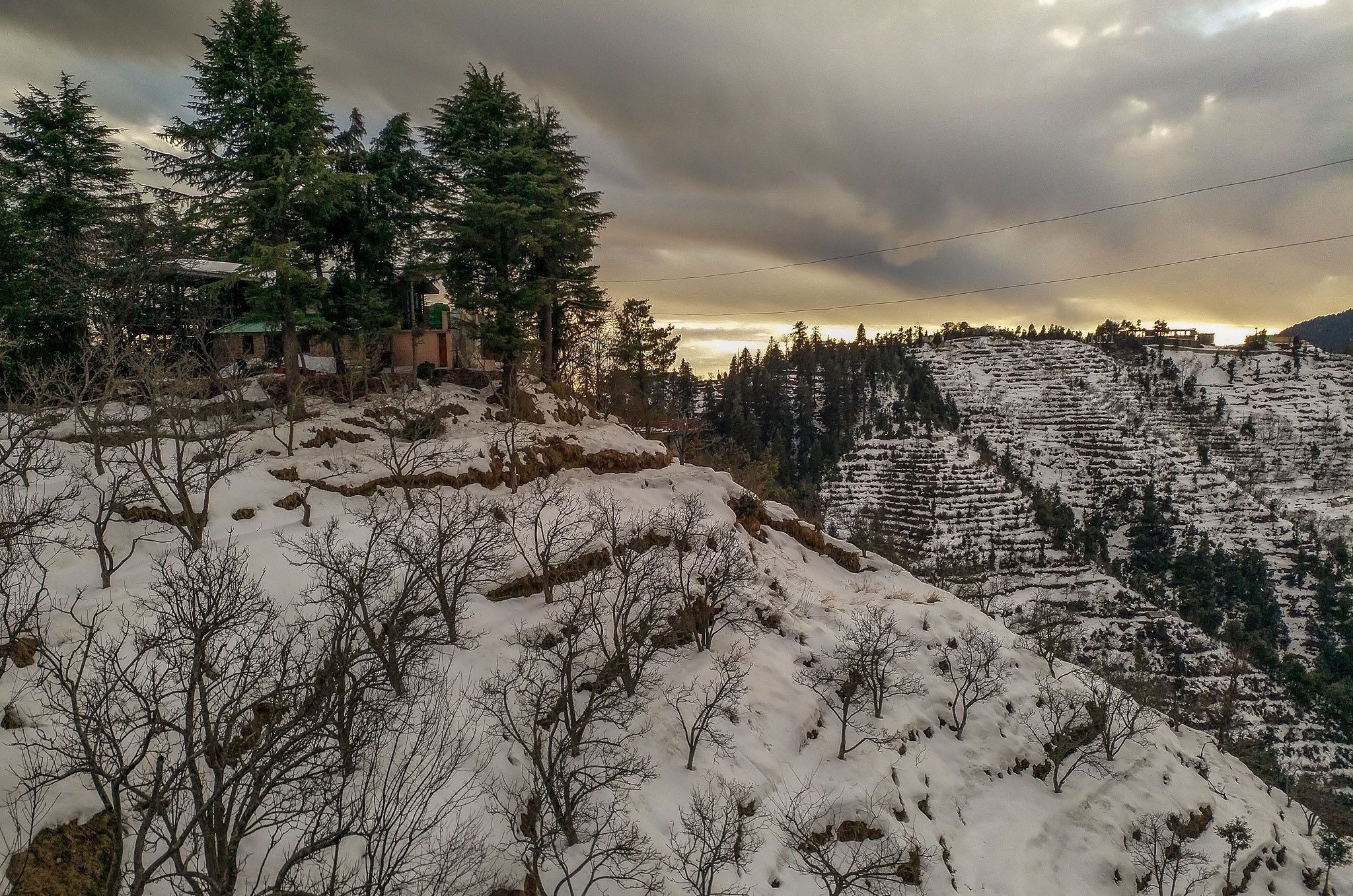
Snowfall in Kanatal is one of the primary reasons people visit specifically in winter. Kanatal snowfall time begins in earnest from late December and peak snowfall occurs in January and February. The altitude of 8,500 feet means that Kanatal receives snowfall more reliably and more heavily than Mussoorie, which sits at a lower elevation and closer to the valley heat. This makes Kanatal one of the more reliable places near Mussoorie for snowfall during winter trips.
During snowfall in Kanatal, the apple orchards, the deodar forests and the mountain views take on a completely different quality. The Himalayan peaks visible from the ridge become more sharply defined against a clearer winter sky, and the forest paths through Kaudia are walkable even under snow with appropriate footwear. Camping in Kanatal during the winter months requires operators with proper insulated tents and heating equipment, and several established camps in the area are set up specifically for winter stays including bonfire areas and snow-compatible dining setups.
For those visiting to see the Garhwal Himalayan range at its clearest, October and November are ideal. October is also the month of the Tehri Lake Festival, which aligns well with a Kanatal base. Spring, from March to May, brings rhododendron bloom to the Kaudia forest and reasonable trekking conditions around the Surkanda Devi Temple approach.
Places to visit in Mussoorie in winter often lead people toward Dhanaulti and then Kanatal as an extension, since both places are reliably snowier than Mussoorie town itself during peak winter. The Kanatal snowfall time window from December to February overlaps well with the school winter holiday period, making it a practical option for families who want a genuine snow experience within a manageable drive.
Things to Do in Kanatal: Beyond the Main Attractions
Things to do in Kanatal include a range of activities across multiple categories, and the range is wider than a small hill station might suggest.
Camping in Kanatal is the activity most strongly associated with the town, and the number of established camps in and around the area reflects this. Camps range from fixed-tent setups with bonfire areas and mountain-facing dining to glamping operations with proper beds, attached bathrooms and panoramic windows. Most camps include activities like rappelling, valley crossing, zip-lining and nature walks as part of their packages. A night sky at Kanatal, away from significant light pollution, is particularly good for stargazing between October and February when the air is dry and the visibility is at its clearest.
Nag Tibba, Uttarakhand’s highest peak in the lower Himalayan range at 3,022 metres, is accessible as a two-to-three-day trek with Kanatal as a starting base. The trail goes through dense forest before opening onto open grassland near the summit, with views of Bandarpoonch, Kedarnath and Gangotri peaks on clear days. This is a genuine mountain trek rather than a short walk, and it suits those who want something more demanding than the Surkanda Devi Temple approach.
Village walks through the small settlements near Kanatal give visitors access to traditional Garhwali architecture, local spice and herb gardens, and the rhythms of hill farming life. Many local families grow ginger, turmeric and garlic in the same plots that produce apples, and the combination of cultivation types gives the agricultural land here a variety that is unusual.
Haridwar to Kanatal Distance and How to Reach
The Haridwar to Kanatal distance is approximately 100 km, typically taking 3 to 3.5 hours by road via Rishikesh and Chamba. This route follows the Rishikesh-Narendra Nagar-Chamba road before climbing up to Kanatal on the ridge. It is a well-maintained route and the approach through Narendra Nagar and the views of the Ganga valley below are particularly good in the early morning.
The Delhi to Kanatal distance is approximately 300 km, typically taking 7 to 8 hours by road. The most common route from Delhi goes via Haridwar, Rishikesh, Chamba and then up to Kanatal. An alternative comes from the Mussoorie side: Delhi to Dehradun, then Mussoorie, then along the ridge road toward Dhanaulti and Kanatal, a route that adds some distance but rewards it with a different set of views. Delhi to Kanatal by road in a private vehicle is the most practical option, as direct public transport to Kanatal requires changing at Chamba or Mussoorie. The nearest railway station is Dehradun, about 75 km from Kanatal, and the nearest airport is Jolly Grant Airport in Dehradun at approximately 90 km.
Where to Stay
A villa in Kanatal gives the best combination of mountain view access and privacy in an area where large hotels are not the dominant accommodation type. Several well-appointed private properties are set within the apple orchards in Kanatal or on the ridge above the Kaudia forest, offering multi-bedroom layouts, outdoor decks with Himalayan views, and access to in-house or affiliated camp activities.
The range of stays includes basic camp setups suitable for budget groups, mid-range orchard cottages, and larger private villas that work for families and corporate offsites. A villa in Kanatal with a private outdoor space works especially well during the October-to-December window, when the mountain air is sharp, the sky is clear after sunset, and the apple harvest has just ended, leaving the orchards open and quiet.
For those using Kanatal as a base for Tehri Lake water sports and the Surkanda Devi Temple, a central location on the Chamba-Mussoorie road keeps driving distances to all these points manageable within a day-trip format.
Conclusion: Why Kanatal Travel Guide Searches Keep Growing
Kanatal has been benefiting from a quiet but consistent growth in interest among people who have already visited Mussoorie and want something different on the next trip, as well as those who specifically seek out places to visit near Mussoorie that still feel unhurried.
What makes Kanatal work as a destination is the combination it offers without trying to be comprehensive: the Surkanda Devi Temple in Kanatal for a religious and trekking component, Kaudia forest for birdwatching and trail walking, apple orchards in Kanatal for a distinctly local agricultural experience, Tehri lake water sports for a contrasting afternoon, and camping in Kanatal for the evenings. The snowfall in Kanatal gives winter visitors a reliable white-landscape experience that requires less planning than a high-altitude snow destination.
The Mussoorie to Kanatal distance of 38 km is short enough that a day trip from Mussoorie is possible, but Kanatal genuinely rewards an overnight or longer stay. The views from the ridge at sunrise, the silence of the Kaudia forest in the early morning, and the night sky over the orchard are all things that a day trip misses. Among places near Mussoorie for snowfall and as one of the most genuinely unexplored places in Mussoorie’s surrounding region, Kanatal holds its own very well.
Frequently Asked Questions
Snowfall in Kanatal is most reliable from late December through February, with January being the peak month. The Kanatal snowfall time window overlaps with the winter holiday period, making it accessible for families. For those who want snow but also clear mountain views, late November and early December offer early snowfall on the upper ridges with relatively good driving conditions. Kanatal sits higher than Mussoorie and receives snowfall more reliably during this window.
The Mussoorie to Kanatal distance is approximately 38 km by road along the Chamba-Mussoorie ridge road. The drive takes around 1 to 1.5 hours depending on traffic. This route passes through Dhanaulti, making a stop there easy to add. From the Mussoorie side, the road is well-maintained and offers consistent valley views throughout the drive.
The Delhi to Kanatal distance is approximately 300 km by road, typically taking 7 to 8 hours. The most common route goes via Haridwar, Rishikesh and Chamba before climbing to Kanatal. An alternative route via Dehradun and Mussoorie adds some distance but offers a different approach from the ridge side. A private vehicle is the most practical option for this journey.
The best things to do in Kanatal include trekking to the Surkanda Devi Temple, walking through Kaudia forest, visiting the apple orchards in Kanatal during harvest season, making a day trip to Tehri lake water sports, and spending evenings at a camp bonfire with mountain views. Camping in Kanatal with stargazing in the winter months is particularly popular. The Nag Tibba trek from Kanatal suits those wanting a more demanding overnight trail.
The Surkanda Devi Temple in Kanatal is one of the 51 Shakti Peethas in Hindu tradition, believed to mark the spot where Goddess Sati’s head fell, and is also part of the “Devi Darshan Triangle” of Tehri Garhwal. It sits at approximately 2,750 metres near Kaddukhal, about 8 to 10 km from Kanatal. Visitors drive to Kaddukhal and then either trek 2 km uphill or take the ropeway inaugurated in 2022. The annual fair in May draws large numbers of pilgrims from the region.
The Haridwar to Kanatal distance is approximately 100 km by road, typically taking 3 to 3.5 hours via Rishikesh, Narendra Nagar and Chamba. This is a well-maintained route and is the most direct approach for those arriving by train at Haridwar station. The road through Narendra Nagar offers views of the Ganga valley on the climb toward the Tehri Garhwal hills.
Tehri Lake water sports available from the jetty areas include jet skiing, banana boat rides, kayaking, shikara-style boat tours, zorbing, and speedboat rides. Tehri Lake is one of Asia’s largest artificial reservoirs and is approximately 35 km from Kanatal. The Mussoorie to Tehri dam drive via Kanatal covers around 65 to 70 km and the road passes through Dhanaulti and Chamba, with consistent Himalayan views along the route. Photography restrictions apply near the dam structure itself.
Yes. A villa in Kanatal within an apple orchard or on the Himalayan-facing ridge is the most distinctive accommodation option in the area. Stays range from basic camps to fully serviced private villas with outdoor decks. Many properties are set within the apple orchards in Kanatal or adjacent to Kaudia forest, giving them a character specific to this location. Camping in Kanatal with bonfire setups and activity packages is the most widely available stay format and is well-developed across multiple price points.
Written By: Ruben Saha