

Seven Sisters Waterfall, Meghalaya: 2026 Monsoon Guide + 9 Nearby Sights
Last updated: June 2026
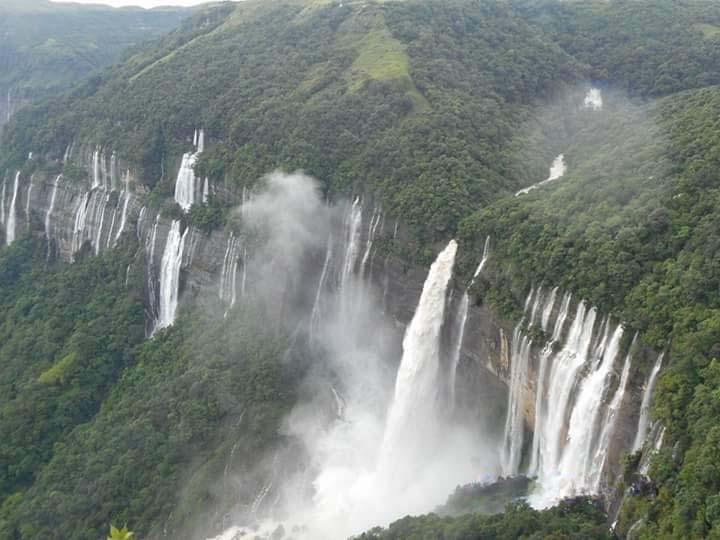
TL;DR: The Seven Sisters Waterfall (Nohsngithiang Falls) near Cherrapunji (Sohra), Meghalaya is a seven-segment cliff fall that drops about 315 m (1,033 ft) over the Khasi Hills and flows hard only during the monsoon (June–September). The catch: that same monsoon often wraps the cliff in cloud, so the falls can be at full power yet invisible. For the best odds of actually seeing all seven streams, aim for a clear monsoon morning (6–9 AM) or the post-monsoon window of late September to November, when flow is still strong but skies clear. The viewpoint sits on the Mawsmai plateau, roughly 4 km from Cherrapunji town, with a nominal eco-park entry fee payable at the gate.
In this Blog
Seven Sisters Waterfall at a glance
| What it is | Seven-segment cliff waterfall, ~315 m (1,033 ft), avg width ~70 m, on the Mawsmai plateau near Cherrapunji |
| Best time to see it | Clear monsoon mornings (Jun–Sep, 6–9 AM) or post-monsoon Sep–Nov for flow + visibility |
| How to reach | Shillong → Cherrapunji ~55 km (NH-6, ~2–2.5 hrs); viewpoint ~4 km from Sohra town |
| Nearest airport/station | Shillong (Umroi) ~65 km; Guwahati airport & railway ~180 km / 4–5 hrs by road |
| Ideal duration | 30–60 min at the viewpoint; 2–3 days for Cherrapunji as a base |
| 2026 monsoon note | Below-normal nationally (~90% of LPA), but the Northeast is forecast near-normal — expect a full, lively monsoon in the Sohra belt |
Where exactly is the Seven Sisters Waterfall, and what makes it special?
The Seven Sisters Waterfall — locally Nohsngithiang Falls, and sometimes called Mawsmai Falls — sits about 1 km south of Mawsmai village and roughly 4 km from Cherrapunji (Sohra) town in the East Khasi Hills of Meghalaya. It is a seven-segmented waterfall that drops over the edge of the limestone Khasi Hills from a height of about 315 metres (1,033 feet), spreading to an average width of around 70 metres when it is in full flow. On a clear, full day you see seven distinct ribbons of water falling side by side off the same cliff — which is exactly where the name comes from.
What makes it genuinely different from a roadside waterfall is the geology and the rain. Cherrapunji sits on a high plateau that catches some of the heaviest rainfall on Earth, and the falls are essentially the plateau emptying itself over a sheer escarpment that drops towards the plains. As Wikipedia notes, the falls “plunge over the top of the limestone cliffs of the Khasi Hills only during the rainy season” — meaning what you are looking at is seasonal, weather-made drama, not a year-round trickle. In the dry months the cliff can be reduced to faint streaks or nothing at all.
There is a Khasi folk legend attached to the falls about seven sisters who turned to water, and it is a lovely story to know before you stand at the edge. But the practical truth most visitors need is simpler: this is a monsoon waterfall, and timing your visit around the rain — and around the cloud — matters more than anything else.
Monsoon safety in Cherrapunji (Sohra)
– Cliff edges are unfenced or lightly fenced and slick with spray and moss at the Seven Sisters and Nohkalikai viewpoints — stay back from the lip, especially for photos. Most serious incidents here are slips, not the water itself.
– Drive the Shillong–Sohra ghat road in daylight. Fog can drop visibility to a few metres within minutes; landslides and brief roadblocks happen after heavy spells. Use an experienced local driver and don’t plan to arrive after dark.
– Leeches are real on every forest trail and around the root-bridge treks in monsoon. Carry leech socks or salt, wear closed shoes, and tuck trousers in.
– Carry a full rain kit — waterproof jacket, dry bags for phone and camera, quick-dry layers, and a torch (power and network both drop out in patches). Build in a buffer day: if the cliff is socked in with cloud, you’ll want a second morning to try again.
The monsoon paradox: fullest in the rains, but often hidden
Here is the honest part that most guides skip. The Seven Sisters Waterfall is at its absolute most powerful in the peak monsoon, roughly June to September, when all seven streams thunder off the cliff together. That is also, unfortunately, when the viewpoint is most likely to be buried in cloud and fog, with mist rising from the valley floor and weather rolling across the plateau in waves. Travellers regularly report standing at the railing seeing nothing but white — and then watching the whole curtain of falls appear for ten minutes when the cloud lifts, before it closes again.
So you are managing a trade-off between water volume and visibility:
- Peak monsoon (June–September): maximum flow, maximum atmosphere, but a real chance of a whited-out view. If you come now, go early (6–9 AM), when the cliff is most often clear before the day’s clouds build, and be ready to wait out a fog bank. A short walk and a return visit half an hour later genuinely works — the fog moves.
- Post-monsoon (late September–November): in our experience the best all-round window. The heaviest rain has eased, flow is still strong and the seven segments are usually distinct, and skies are far clearer — which means you actually see what you came for, and photography is dramatically better. Water volume is starting to drop by late November but the view is reliable.
- Winter and pre-monsoon (December–May): the cliff thins out and can be reduced to faint streaks; come for Cherrapunji’s caves, canyons and root bridges rather than for the falls at full strength.
For 2026 specifically: the India Meteorological Department has forecast a below-normal monsoon nationally (around 90% of the long-period average), but the Northeast is the exception, pencilled in for near-normal rain (96–104% of average). In plain terms, the Sohra belt should still get a proper, lively monsoon this year — so the volume will be there. The cloud is the variable you plan around, not the rain.
Best time to visit, and the best time of day
Best overall: late September to November for the surest combination of strong flow and clear views. Best for raw monsoon power: June to September, accepting the fog gamble. Best time of day, year-round: early morning, 6–9 AM, before the plateau’s daytime clouds build; clear evenings can also throw beautiful low light across the cliff when a storm breaks, but mornings are the safer bet.
If your whole reason for the trip is the waterfall, don’t make it a one-shot stop. Base yourself in Cherrapunji for at least a night so you can hit the viewpoint on two different mornings — the difference between a blank wall of cloud and all seven streams blazing can come down to which day you turned up.
Entry fee, timings and the Mawsmai viewpoint
The Seven Sisters Falls are viewed from a viewpoint / eco-park on the Mawsmai plateau rather than from the base — you are looking across at the cliff, not standing under it. The viewpoint area carries a nominal entry fee payable at the gate (a small per-head charge, typically with a separate small charge for vehicles and sometimes a camera fee); rates are modest and are revised locally, so carry cash and confirm the current amount at the counter. The viewing area is generally open through the daylight hours, roughly 8 AM to around 5 PM — confirm current timings locally, as gates can close earlier in heavy weather.
Plan on 30 to 60 minutes here, longer if you are waiting for cloud to clear. The nearby Mawsmai Nongthymmai Eco Park (about 3 km from Cherrapunji bus stand) is an easy add-on — landscaped gardens and viewpoints that look out towards the cliffs and, on clear days, all the way to the Bangladesh plains. The same Mawsmai area is also where you’ll find the popular Mawsmai Cave, covered below.
- Entry fee: nominal, payable at the gate (small per-person charge; vehicle/camera charges may apply)
- Timings: roughly 8 AM–5 PM, daylight hours — confirm locally
- Best time: clear monsoon mornings or post-monsoon Sep–Nov; arrive 6–9 AM
- How to reach: ~4 km from Cherrapunji town; ~55 km from Shillong via NH-6
- Time required: 30–60 min
- Ideal for: couples, families, photographers, first-time Meghalaya visitors
- Pro tip: if the cliff is in cloud, walk the eco-park for 20–30 minutes and come back — the fog usually shifts
How to reach the Seven Sisters Waterfall
By air: The nearest airport is Shillong (Umroi), about 65 km away, but it has limited, irregular connectivity. Most travellers fly into Guwahati’s Lokpriya Gopinath Bordoloi International Airport (~180 km), which is well connected to Delhi, Kolkata, Mumbai and Bengaluru, and then drive on.
By rail: The nearest major railhead is Guwahati Railway Station, connected to cities across India. From Guwahati it’s a scenic 4–5 hour road journey to Cherrapunji, routed through Shillong.
By road: From Shillong, Cherrapunji is roughly 55 km on NH-6, around 2–2.5 hours through hills and tea-coloured valleys. Shared taxis (sumos) run from Shillong’s Bara Bazar area; a private cab or self-drive gives you the flexibility to chase clear mornings. The viewpoint itself is a short hop (~4 km) from Sohra town. Note that Meghalaya is an Inner Line–free state for Indian nationals (no special permit needed), but always carry a government photo ID; for current travel info, see Meghalaya Tourism.
9 nearby sights in Cherrapunji (Sohra) worth your trip
The waterfall is a 30-minute stop; Cherrapunji is a two-to-three-day destination. Here are the sights worth building a Sohra itinerary around — almost all of them within an hour of the Seven Sisters viewpoint.
Nohkalikai Falls
India’s tallest plunge waterfall, dropping around 340 m in a single, uninterrupted column into a plunge pool that shifts from aqua to deep green with the season. It’s about 5–7 km from Cherrapunji town, viewed from a railed gallery and a small set of steps. Like the Seven Sisters, it’s mighty in monsoon but often cloud-hidden — mornings are best. Entry: small per-person fee (~₹20–30) plus a camera charge. Timings: roughly 8/9 AM–5 PM. Time required: 45–60 min. Ideal for: everyone; it’s the signature Cherrapunji shot. Pro tip: the café at the top is a fine place to wait out a fog bank.
Mawsmai Cave
The most accessible limestone cave in the area, right by the Seven Sisters viewpoint. Only about a 150 m section is open to the public — lit, but with low, narrow squeezes that make it fun rather than strenuous. Entry: nominal (~₹20–30 per person) plus a camera fee. Timings: roughly 9:30 AM–5:30 PM. Time required: 30–45 min. Ideal for: families and first-timers; not for the strongly claustrophobic. Pro tip: wear shoes with grip — the floor is wet and slick, and it gets busy by mid-morning.
Arwah Cave (Arwah Lumshynna)
A quieter, often less crowded cave near the Mawsmai area, set in the Law Shynna forest, with fossils — fish bones and shells — embedded in the limestone walls, millions of years old. The accessible stretch runs about 300 m and takes 15–20 minutes. Entry: nominal (~₹20–30). Timings: roughly 9:30 AM–5:30 PM. Time required: 45 min including the short forest walk in. Ideal for: anyone who found Mawsmai too crowded. Pro tip: carry a small torch — the lighting is patchy, and a guide at the entrance can point out the fossils.
Dainthlen Falls
A wide, terraced waterfall a short drive from town, easy to reach and viewable from a short walk — no hike required — which makes it a good monsoon option when trails are slippery. There’s a Khasi legend about a giant serpent attached to it. Entry: free; small parking charge (~₹20). Timings: open through the day. Time required: 30 min. Ideal for: families, anyone short on time or energy. Pro tip: the rocks near the edge are dangerously smooth — admire from the marked area.
Wei Sawdong Falls
A photogenic three-tiered fall dropping into turquoise pools, reached by a steep wooden-and-bamboo stair down the slope. The descent is short but slippery, especially in monsoon. Entry: about ₹50 per person (₹100 for foreign nationals), small parking charge. Timings: roughly 8 AM–5 PM. Time required: 1–1.5 hrs with the climb. Ideal for: active travellers and photographers. Pro tip: go early; the staircase is single-file and backs up later in the day, and the bottom tier is the prettiest.
Thangkharang Park & Kynrem Falls
A landscaped viewpoint park perched on the southern edge of the plateau, looking out towards the plains of Bangladesh, with the three-tiered Kynrem Falls visible across the gorge. Entry: ~₹20 per person, small parking charge. Timings: roughly 7 AM–4 PM. Time required: 45 min. Ideal for: families, easy walkers, sunset-ish light. Pro tip: clearest plains views come on a crisp post-monsoon afternoon.
Mawkdok Dympep Valley View
A dramatic green canyon viewpoint on the Shillong–Cherrapunji road (about 24 km from Sohra), and the spot for the region’s well-known zip-line across the valley. It’s the natural first or last stop on the drive. Entry: free to view; zip-line is paid (a few hundred rupees). Timings: daylight; zip-line operations weather-dependent. Time required: 30–45 min. Ideal for: couples and groups wanting a thrill with a view. Pro tip: in heavy cloud the valley vanishes — stop here on the clearer of your two driving legs.
Double-Decker Living Root Bridge (Nongriat)
The Northeast’s most famous trek: a bioengineered double-decker bridge of woven living roots in Nongriat village, reached by a punishing ~3,500-step descent (and climb back) from Tyrna, about 12–15 km from Sohra. Entry: nominal trail fee (~₹30–50 at Tyrna). Timings: start early — descent 1.5–2 hrs, climb back 2.5–3 hrs. Best time: October–April; in peak monsoon the steps are extremely slippery and leech-heavy, so attempt it only if you’re fit and surefooted, or save it for a drier visit. Ideal for: fit, adventurous travellers. Pro tip: leech socks, trekking poles and an early start are non-negotiable; stay overnight in Nongriat if you can.
Mawlynnong & Dawki/Umngot (day-trips)
About 1.5–2 hours east, Mawlynnong — often called Asia’s cleanest village — and the glass-clear Umngot River at Dawki, famous for boats that appear to float on air over the water, make a classic combined day-trip. Note a 2026 rule: Mawlynnong is closed to day-trippers on Sundays, so plan around it. The Umngot is at its clearest in the drier post-monsoon and winter months; in peak monsoon it can run muddy. For the full plan, see our guide to Mawlynnong, Asia’s cleanest village. Time required: a full day from Cherrapunji or Shillong. Pro tip: combine Mawlynnong, Riwai’s single-decker root bridge and Dawki in one loop, and start at dawn.
Planning your Cherrapunji trip: sample itineraries
One day (waterfalls only): Drive from Shillong early, stopping at Mawkdok Dympep on the way. Do Seven Sisters + Mawsmai Cave, then Nohkalikai Falls, then Dainthlen or Thangkharang Park before heading back to Shillong before dark. Tight but doable in clear weather.
Two days (the comfortable version): Day 1 — arrive, settle in Sohra, afternoon at Thangkharang Park and Dainthlen. Day 2 — early morning at Seven Sisters (best light, best odds of a clear cliff), then Nohkalikai, Mawsmai and Arwah caves, and Wei Sawdong if energy allows. The early start is what buys you the view.
Weekend / 3 days: Add a third day for the Double-Decker Living Root Bridge trek (October–April) or a Mawlynnong–Dawki day-trip (any time except Mawlynnong on Sundays). This is the itinerary that lets Cherrapunji breathe instead of rushing it.
Where to stay
StayVista does not currently operate homes in Meghalaya, so we’ll keep this honest and useful rather than point you at something we don’t run.
Stay in Sohra (Cherrapunji) itself if the waterfalls are your priority — it puts you minutes from the Seven Sisters and Nohkalikai viewpoints, which is the whole game when you want to catch a clear early morning before the cloud builds. Sohra has a small but growing cluster of homestays, family-run guesthouses and a few mid-range resorts, several with valley- or canyon-facing rooms; book ahead in monsoon and over long weekends, as good rooms are limited. Look for places with reliable hot water, a kitchen or in-house meals (options thin out after dark), and a host who can arrange a dependable local driver.
Base yourself in Shillong if you’d rather have more choice of hotels, cafés and restaurants and don’t mind the ~2–2.5 hour drive each way — workable if you’re combining Cherrapunji with Mawlynnong, Dawki and the Shillong sights, but it costs you the crucial early-morning slot at the falls.
For the root-bridge trek, a night in a basic Nongriat homestay below the steps turns a brutal same-day up-and-down into a far more enjoyable trip.
Wherever you land, prioritise location and a good host over luxury here — in the Sohra belt, being close to the viewpoints at dawn is worth more than thread count.
If your Meghalaya plan also takes in the wettest-place-on-earth angle, pair this with our monsoon guide to Mawsynram, about an hour west of Cherrapunji.
Planning tip (not a sales pitch): book your Sohra stay and a trusted local driver before you arrive in monsoon — same-day availability is thin, and a driver who knows the fog windows will get you to the Seven Sisters viewpoint at the right hour.
FAQ: Seven Sisters Waterfall, Meghalaya
Where is the Seven Sisters Waterfall?
It’s near Cherrapunji (Sohra) in the East Khasi Hills of Meghalaya, about 1 km south of Mawsmai village and roughly 4 km from Cherrapunji town. Its local name is Nohsngithiang Falls, and it’s sometimes called Mawsmai Falls. The nearest airport is Shillong (~65 km); most people fly into Guwahati (~180 km) and drive.
How tall is the Seven Sisters Waterfall?
It drops about 315 metres (1,033 feet) over the limestone cliffs of the Khasi Hills, in seven distinct segments with an average combined width of around 70 metres when it’s flowing fully — which is why it’s named for seven sisters.
What is the best time to visit the Seven Sisters Falls?
For raw power, visit during the monsoon (June–September), when all seven streams are at full force — but be ready for fog to hide the cliff. For the best balance of strong flow and clear views, go in the post-monsoon window of late September to November. Whenever you come, arrive early (6–9 AM) before the plateau’s daytime clouds build.
Why couldn’t I see the Seven Sisters Falls even though it was raining?
Because Cherrapunji’s heavy monsoon brings near-constant cloud and rising valley mist that frequently wraps the cliff, so the falls can be at full volume yet completely hidden. This is normal here. The fog moves — take a 20–30 minute walk and return, try again the next morning, and aim for a clear post-monsoon day if visibility matters most to you.
Is there an entry fee for the Seven Sisters Waterfall?
Yes — a nominal entry fee is payable at the viewpoint/eco-park gate, usually a small per-person charge with separate small charges for vehicles and sometimes cameras. Rates are modest and set locally, so carry cash and confirm the current amount at the counter. The viewing area is generally open through daylight hours, roughly 8 AM to 5 PM.
How do I reach Cherrapunji from Shillong?
Cherrapunji is about 55 km from Shillong on NH-6, around 2–2.5 hours by road. Shared sumos run from Shillong’s Bara Bazar, but a private cab or self-drive is better if you want to chase clear mornings at the waterfall viewpoints. Drive in daylight — fog can cut visibility fast on the ghat road.
What else is worth seeing near the Seven Sisters Falls?
Plenty within an hour: Nohkalikai Falls (India’s tallest plunge fall), Mawsmai and Arwah caves, Dainthlen and Wei Sawdong falls, Thangkharang Park, Mawkdok Dympep Valley, and the Double-Decker Living Root Bridge at Nongriat. Mawlynnong village and the Umngot River at Dawki make a good full-day trip — but note Mawlynnong is closed to day-trippers on Sundays as of 2026.
Can I do the living root bridge trek in monsoon?
You can, but it’s hard: the ~3,500 steps each way to Nongriat get extremely slippery and leeches are everywhere from June to September. Only attempt it if you’re fit and surefooted, with leech socks and an early start — otherwise save the trek for the drier October–April window.
Conclusion
The Seven Sisters Waterfall rewards travellers who plan around two things, not one: the rain that gives it power, and the cloud that can hide it. Come in the monsoon for the full thunder and accept the fog gamble with an early start and a buffer day — or come in late September to November for the most dependable mix of strong flow and clear skies. Either way, base yourself in Sohra, give Cherrapunji a couple of days to show you its caves, canyons and root bridges, and you’ll come away with far more than a single waterfall. See you in the clouds — and ideally, on a morning the clouds lift.