

What NOT to Do in Konkan in Monsoon: Scuba, Ferries & Forts That Shut
Konkan in monsoon is one of India’s most rewarding coastal trips — and also one of the easiest to get wrong, because the three things most first-timers plan around are exactly the three things that shut down for the season. Scuba diving needs calm, clear water measured in metres of visibility; sea forts need a safe boat crossing across open water; regional ferries need a sea that isn’t actively trying to sink them. Monsoon takes all three off the table, on dates that rarely make it into the glossy itinerary blogs, and the gap between what Instagram promises and what’s actually running is exactly where most trips go wrong.
This is the honest, detailed version: what’s actually closed across the Konkan coast right now, the real mechanism behind each closure (river silt, port officer orders, or simple tidal physics), when each one is genuinely expected back, and what to do with your trip instead — down to the sanctuary, the beach and the fort that stay open regardless of what the sea is doing.
TL;DR: As of 30 July 2026, Tarkarli/Malvan scuba diving is shut till 1 October, Sindhudurg Fort’s boat access is suspended till 31 August, Murud-Janjira Fort’s crossing is closed till roughly late August, and regional passenger ferries (Mumbai–Alibaug and similar routes) have been suspended since 26 May. Konkan is still very much worth visiting — Phansad Wildlife Sanctuary’s monsoon bird breeding season, land forts like Korlai and Sagargad, and a villa weekend all work perfectly well right now.
In this Blog
Quick Reference: What’s Closed Right Now
| Activity/Site | Status (30 Jul 2026) | Closed since | Expected reopening | Why |
|---|---|---|---|---|
| Tarkarli/Malvan scuba diving | Closed | June 2026 | 1 October 2026 | River-mouth silt runoff kills visibility; monsoon currents unsafe for diving |
| Sindhudurg Fort (boat + water sports) | Closed | 26 May 2026 | 31 August 2026 | Regional Port Officer order — rough sea, unsafe passenger boat crossing |
| Murud-Janjira Fort (boat crossing) | Closed | 26 May 2026 | ~Late August 2026 (est.) | Same — boat crossing unsafe in monsoon swell |
| Vijaydurg Fort (boat from Malvan jetty) | Closed | June 2026 | ~September 2026 | Rough sea + slippery approach roads |
| Kolaba Fort (Alibaug, low-tide walk) | Effectively closed | July–Sept | Around October | Monsoon “low tide” still runs waist-deep — the walking crossing isn’t safe |
| Underi Fort (twin of Khanderi, low-tide only) | Effectively closed | July–Sept | Around October | No jetty — same tidal-danger logic as Kolaba |
| Khanderi Fort (has a jetty) | Check before travel | — | — | Jetty means it isn’t tide-dependent, but Mumbai Port Trust permission is needed year-round |
| Regional passenger ferries (Mumbai–Alibaug: PNP, Maldar, Ajanta) | Suspended | 26 May 2026 | ~Late September 2026 | Rough Arabian Sea swell on the crossing |
| Mumbai–Sindhudurg Ro-Ro (car ferry) | Running | — | — | Larger vessel; suspends only in extreme storms, not routine monsoon swell |
Why Are So Many of These Closures Dated the Same Week?
Notice the pattern: Sindhudurg Fort and Murud-Janjira Fort both closed on 26 May 2026, and the regional passenger ferries suspended on that exact same date. That’s not a coincidence — it’s a coordinated call. Maharashtra’s maritime and port authorities issue these closure orders together each year as the monsoon sets in, because the underlying risk is identical across every one of these sites: small vessels, open sea, and the first heavy swells of the season arriving fast and hard. Once the Regional Port Officer’s office calls it for one crossing, the same wind and wave data applies to every comparable one along the coast — there’s no reason to wait for one jetty to have an incident before closing the next.
That’s genuinely useful to know because it means the reopening dates cluster too — expect most of this list to lift together in the back half of August through late September, once the southwest monsoon properly withdraws, rather than on staggered individual timelines set fort by fort. It’s also exactly why a single missed news alert can leave you standing at a jetty that quietly shut weeks earlier: the closure isn’t announced at the site itself, it’s a port-office order that travel content simply hasn’t caught up with yet.
What NOT to Do #1: Scuba Diving in Tarkarli or Malvan
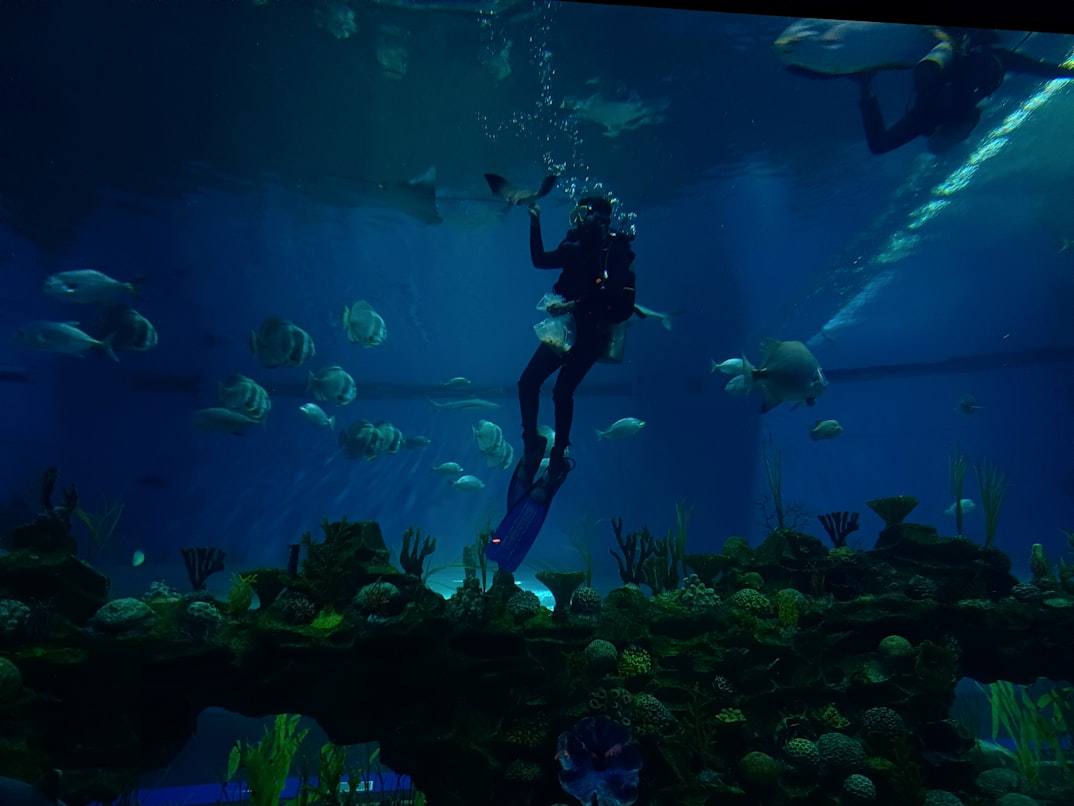
Don’t plan a diving trip to Tarkarli or Malvan between June and September. The sea here runs on a strict two-season split: October to May for diving, with peak visibility in November–December and again in late February through April, and a hard close for the entire monsoon. The mechanism is straightforward — every river and creek feeding into this stretch of coast runs full of silt-laden runoff through the rains, and that sediment doesn’t settle until well after the rain stops. Combine that with stronger monsoon currents, and you get exactly the two conditions recreational diving can’t tolerate: you can’t see, and the water won’t hold still.
In a normal season, Tarkarli’s diving happens across seven named points — King’s Garden, Rewala, Reti, Dharan, Juva, Achara and Chivla — plus three sites right around Sindhudurg Fort’s underwater base, named King World 1, 2 and 3. Depths run a manageable 25–40 ft, which is why this stretch has become India’s most accessible reef-diving destination: a two-day, no-swimming-required “Discover Scuba Diving” introduction runs around ₹3,500, while a single basic recreational dive for a certified diver costs closer to ₹1,000–1,200. None of that is bookable in July regardless of what a listing page says — operators plan their entire calendar around the same October reopening, using the monsoon months for boat maintenance and instructor training rather than customer dives.
Any dive shop still marketing “open” trips through the monsoon should raise questions rather than confidence. The reopening date for 2026 is 1 October — if scuba is the actual reason for your trip, that’s the date to build a Konkan visit around, not the current month.
What to do instead: the monsoon coastline is still spectacular from land — Tarkarli and Devbaug’s beaches run dramatic full monsoon surf (for viewing, not swimming), and the Karli river backwaters that feed this same coastline are at their fullest and greenest exactly when the sea is at its roughest, worth a calm backwater boat ride even when the open sea isn’t an option.
What NOT to Do #2: Rely on Regional Ferries to Get Around the Coast
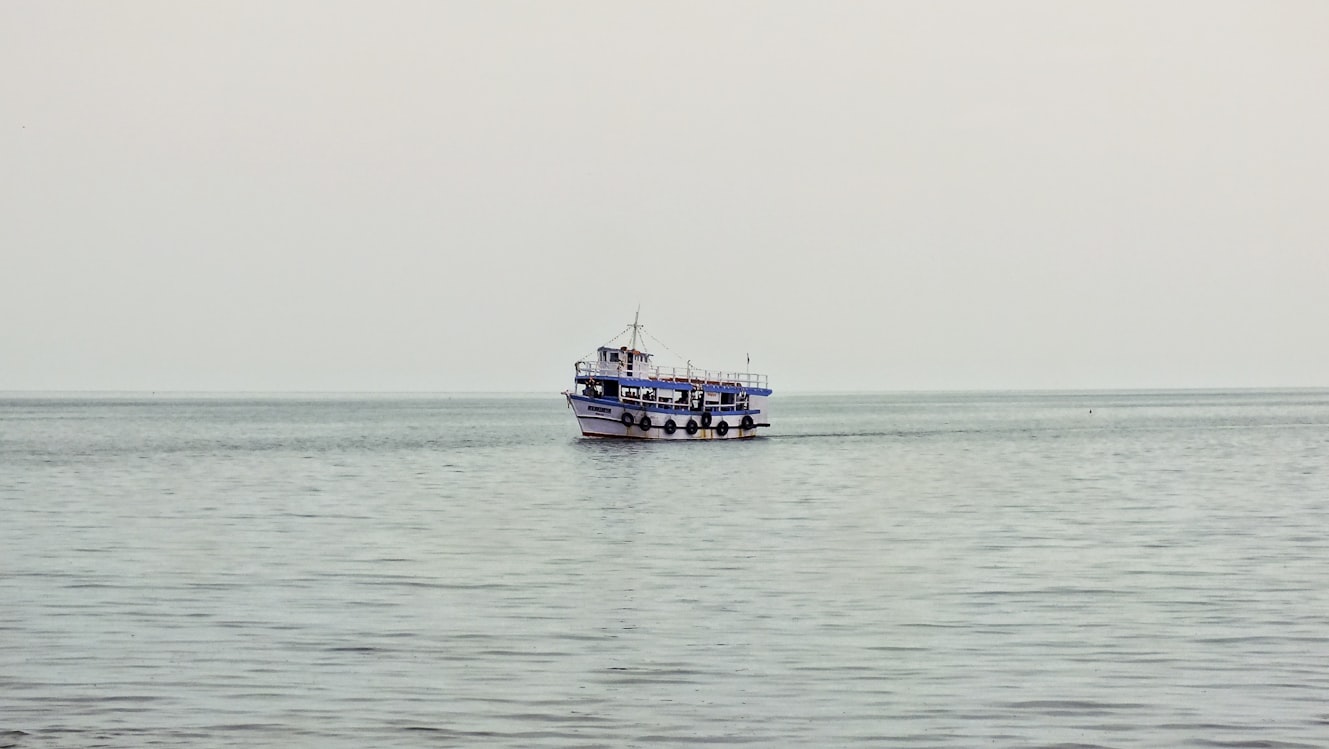
Don’t build a Konkan itinerary around the Mumbai–Alibaug (or similar) passenger ferry routes right now. The regular operators — PNP, Maldar, Ajanta — suspended service on 26 May 2026 and aren’t expected back until late September, once the Arabian Sea calms down enough for the roughly 30–35 km, sub-hour crossing to be routine again rather than a genuine sea-state risk. In season, these boats are the fast, cheap way across — tickets typically run somewhere between ₹185 and ₹420 depending on class and operator — but “in season” is exactly the qualifier that matters here.
There is one meaningful exception worth knowing: the Mumbai–Sindhudurg Ro-Ro car ferry is a larger vessel built for exactly this kind of sea state, and it continues running through most of the monsoon, pausing only for genuinely extreme weather rather than routine swell. If a ferry crossing is central to your plan — say, you’re moving a car down the coast rather than just yourself — that’s the one to check, not the smaller passenger boats.
What to do instead: the Atal Setu–NH66 road route from Mumbai runs all-weather and reaches Alibaug in about 90–100 minutes regardless of sea conditions — for coastal Raigad specifically, driving is simply the more reliable choice for the rest of the season, and it’s the option every villa guest actually ends up using this time of year.
What NOT to Do #3: Plan a Trip Around Sea Fort Visits

Don’t centre a Konkan monsoon trip on Murud-Janjira, Sindhudurg, Vijaydurg, Kolaba or Underi forts — all five are effectively off-limits right now, for two genuinely different reasons. Here’s each one on its own terms, because they’re different enough in history and access logic to deserve it.
Murud-Janjira Fort
Built and held by the Siddis of Janjira — one of the few coastal strongholds in India that never fell to the Marathas, the Mughals, or the Portuguese despite repeated attempts — Janjira sits on its own island off Murud, reachable only by a short boat crossing from Rajapuri jetty. That crossing is exactly what’s closed: authorities suspended the boat service on 26 May 2026, and it’s expected back around late August, once monsoon swell in this stretch settles enough for a small sailboat or speedboat to cross safely.
Sindhudurg Fort
Commissioned by Chhatrapati Shivaji Maharaj in 1664 and built by chief architect Hiroji Indulkar, Sindhudurg took some 3,000 workers and 100 architects roughly three years to complete — a 48-acre island stronghold meant as headquarters for the Maratha navy. Its four-kilometre zigzag rampart runs 9 metres high with 42 bastions, the main Dilli Darwaja gate is deliberately camouflaged into the surrounding wall, and inside sits the Shivrajeshwar Mandir — the only known temple dedicated to Shivaji Maharaj himself built inside a fort. None of that is reachable right now: the Regional Port Officer suspended both water sports and passenger boat traffic here from 26 May to 31 August 2026, on the same rough-sea logic as Janjira.
Vijaydurg Fort
Originally raised by the Shilahar dynasty between 1193 and 1205 and later captured and expanded by Shivaji in 1653 — who renamed it “the Fort of Victory” — Vijaydurg is reached by boat from the Malvan jetty in season. That crossing pauses for the same June-to-around-September window as its neighbours, for the same reason: rough sea plus slippery approach roads make the combination genuinely unsafe rather than just inconvenient.
Kolaba and Underi Forts — the tidal exception
Kolaba Fort near Alibaug and Underi Fort work differently from the three above, because neither needs a boat in the first place — both are normally reachable on foot at low tide, no crossing required. But monsoon “low tide” behaves nothing like the rest-of-year version: locals describe it plainly as behaving more like a normal high tide, meaning the walk that’s ankle-deep from October to May can run waist-deep through July and August. There’s no official closure notice for either, because nobody needs to issue one — the tide itself does the job, and most guides recommend skipping the crossing entirely for the season.
Khanderi Fort — the one partial exception
Khanderi, Underi’s twin, is built differently: it has an actual jetty, developed under Shivaji in 1679, which means it isn’t tied to the same tidal-danger logic as its neighbour. That makes it the one sea fort on this list that isn’t automatically ruled out by monsoon conditions — but it still requires permission from the Mumbai Port Trust to visit in any season, so treat it as a “call ahead” rather than a guaranteed yes.
What to do instead: every one of these forts has a genuinely open land-based alternative nearby. Korlai Fort, on a headland near Revdanda rather than an island, and Sagargad, a hill fort inland from Alibaug, both stay fully accessible by road through the entire monsoon — real Maratha-era forts, zero tidal or boat dependency, and considerably fewer crowds than the famous sea forts even in the dry season.
What You Can Actually Do in Konkan This Monsoon
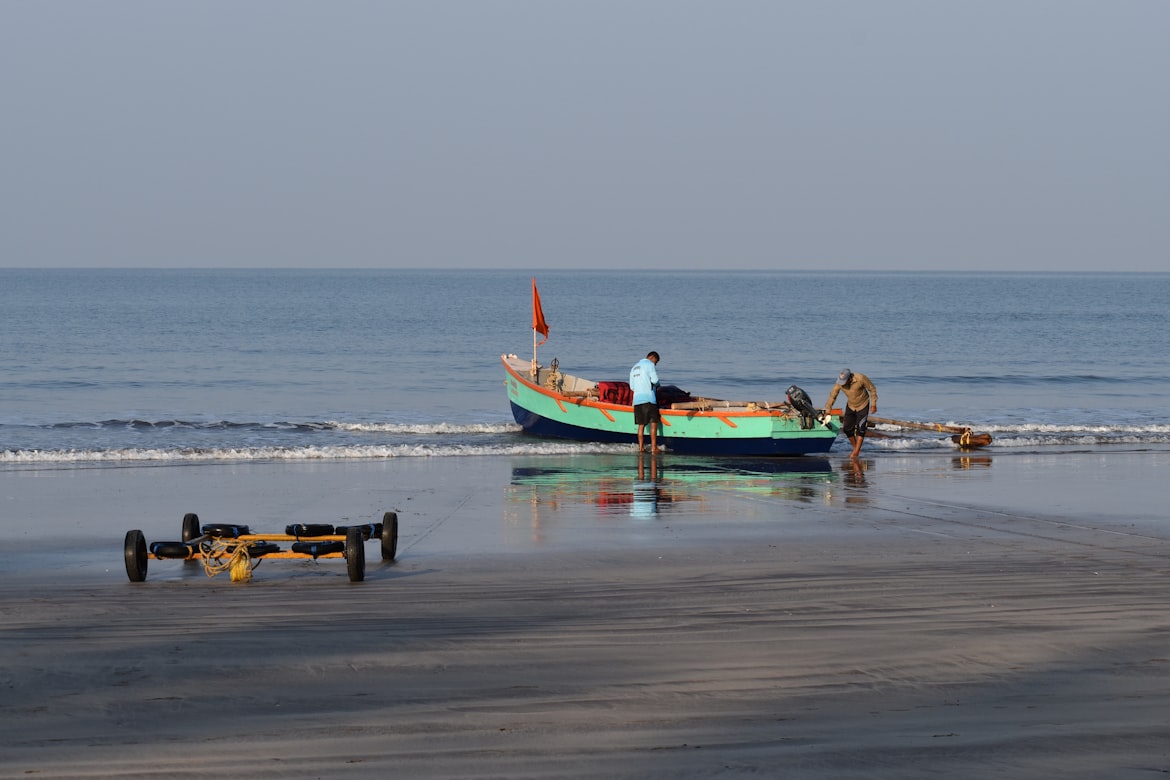
None of the above rules out the trip — it rules out three specific, sea-dependent activities. What’s left standing is arguably Konkan at its best, and it’s worth naming specifically rather than waving at generically.
Phansad Wildlife Sanctuary, spanning the Murud and Roha talukas of Raigad — literally the same taluka as the fort you can’t currently visit by boat — turns into one of coastal Maharashtra’s best monsoon destinations precisely because the rains are on. It records over 200 bird species, and the migratory Oriental Dwarf Kingfisher arrives specifically for its monsoon breeding season alongside residents like the Malabar Pied Hornbill and the rarely-seen Sri Lankan Frogmouth. The sanctuary’s own dam fills and spills over its embankment through the rains, drawing visitors for the sight alone, quite apart from the birding.
Kihim Beach, near Alibaug, is a genuine birding haven in its own right and stays fully walkable through monsoon — no boat, no tide window, just sand, casuarina shade and whatever’s flown in for the season.
Land forts — Korlai and Sagargad, both mentioned above, plus any inland fort reachable entirely by road — operate exactly as they do the rest of the year, since none of them depend on a crossing that monsoon can shut down.
Beach walks and monsoon photography work everywhere on this coast — Alibaug, Kashid, Diveagar, Shrivardhan, Tarkarli and Murud all stay open for walking, sightseeing and photography; it’s specifically swimming and boat crossings that need to wait, not the beaches themselves.
A villa weekend, full stop, remains the single most weather-proof way to do this coast in July and August: a private pool, a covered deck, and a cook handling the day’s meals depend on absolutely nothing the sea decides to do.
Where to Stay for a Monsoon-Proof Konkan Weekend
Of the towns and sites covered in this guide, Alibaug is the one place with real, live StayVista inventory right now — Murud, Diveagar, and the entire Sindhudurg/Malvan belt currently show none (the Malvan category page returns a straightforward 410 error). That actually works in this piece’s favour: Alibaug is reachable all-weather by road, sits a short drive from Kihim Beach and Phansad’s monsoon birding, and needs none of this guide’s closed activities to be worth a weekend.
Jay House — the games-and-garden pick
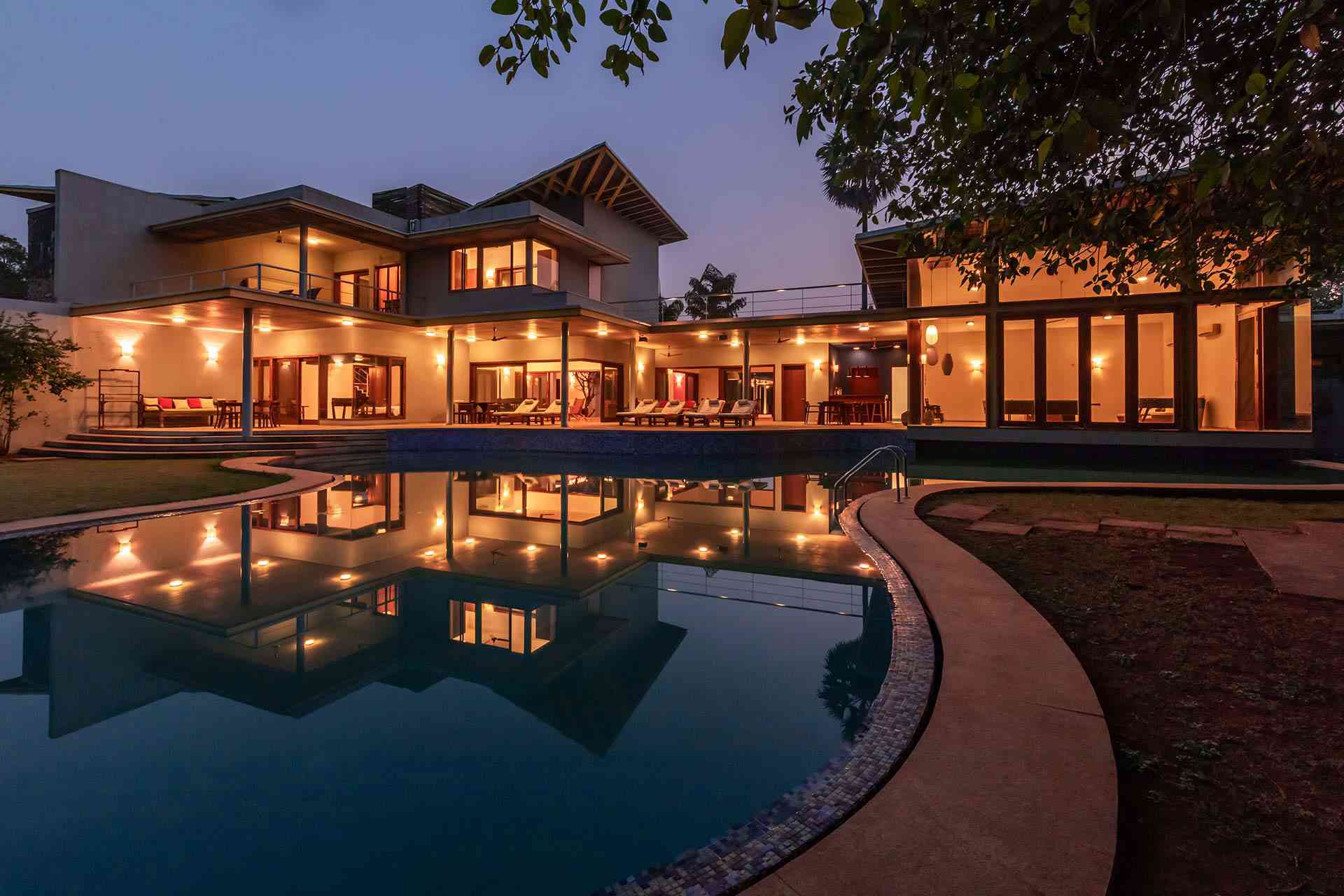
Jay House is a 4-bedroom, 4-bathroom villa rated 4.5/5 across 39 reviews, sleeping up to 12 guests. The centrepiece is a uniquely shaped 30×16 ft private pool, 4 ft deep, with its own seating deck and beach beds tucked under the house’s shade — accessible from 7 AM to 10 PM, so a monsoon dip whenever the rain lets up is always on the table. Beyond the pool, the villa runs a full games room with snooker, table tennis and foosball, a fireplace for cool evenings, an outdoor barbecue and dining area, and a natural-grass lawn for whatever the group wants to do with it. Small design touches — a mini pond around a tree at the entrance, mirrored inside — give the colourful interiors a personality most villas this size don’t bother with.
| Detail | Info |
|---|---|
| Rooms / capacity | 4 bedrooms, 4 baths, up to 12 guests |
| Rating | 4.5/5 (“Exclusive getaway”), 39 reviews |
| The pool | 30×16 ft, 4 ft deep, private, 7 AM–10 PM access, shaded seating deck with beach beds |
| Standout amenities | Games room (snooker, table tennis, foosball), fireplace, EV charging, bonfire, meals available |
| How to reach | ~120 km from Mumbai Airport; Alibaug Bus Stand 15 km; Thal Market 4 km; Mandwa Jetty 7 km |
| Best for | Groups who want an indoor-outdoor split — pool and lawn by day, games room by (rainy) night |
Villa Amaaya — the quiet, green-set option
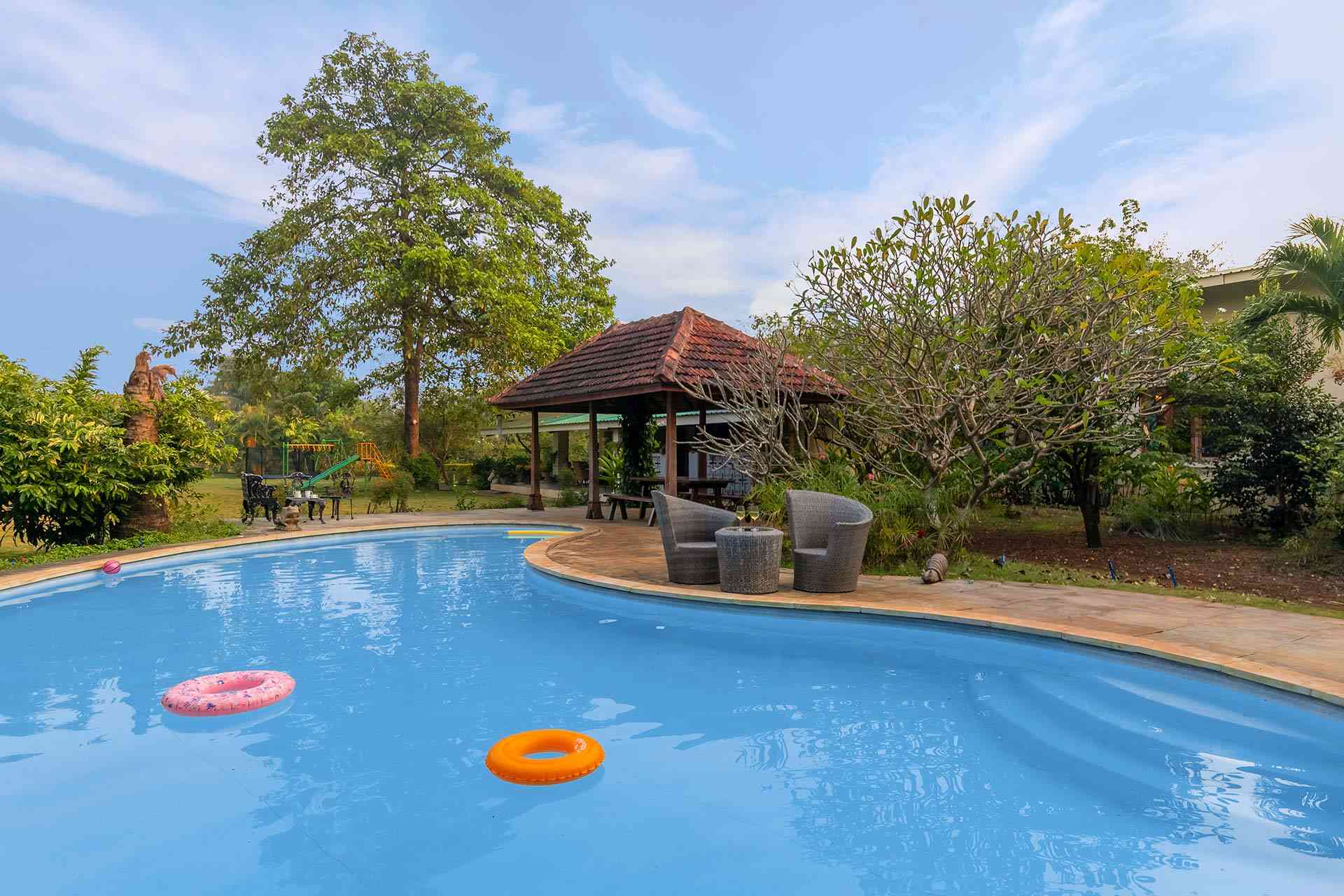
Villa Amaaya is the smaller, calmer counterpart: a 3-bedroom, 3-bathroom villa for up to 6 guests, set amid what its own listing calls “unending expanses of green verdancy” — about 5 km from Kihim Beach, one of this guide’s recommended monsoon birding spots. The pool here is a large oval, framed by sprawling lawns furnished with cane chairs, and the villa adds a gazebo and a dedicated workstation for anyone tempted to turn the trip into a short workation. Interiors lean modern and comfortable rather than showy, which suits a couple or small family looking for a genuinely restful base rather than a group-activity hub.
| Detail | Info |
|---|---|
| Rooms / capacity | 3 bedrooms, 3 baths, up to 6 guests |
| The pool | Large oval-shaped private pool, lawn seating with cane chairs |
| Standout amenities | Gazebo, garden, workstation, meals available |
| How to reach | ~105 km from Mumbai Airport; Mandwa Jetty 9 km (15–20 min); local market 1.5 km; Kihim Beach ~5 km |
| Best for | Couples or small families wanting quiet, greenery, and easy access to Kihim’s monsoon birding |
Both sit on the road side of the coast, reachable via the all-weather Atal Setu route regardless of what the sea is doing, and both are close enough to Kihim Beach and Phansad Wildlife Sanctuary to turn this guide’s “what to do instead” section into an actual day plan rather than a consolation prize.
Frequently Asked Questions
No. Diving operators close for the entire monsoon, typically June through September, because river-mouth silt runoff makes the water turn cloudy with near-zero visibility, and currents pick up to unsafe levels. The 2026 season reopens on 1 October, with peak visibility from November through April, and dive points return to their usual 25–40 ft depth clarity.
No. The boat crossing has been closed since 26 May 2026 for safety, as monsoon swell makes the Rajapuri jetty crossing dangerous. It’s expected to reopen around late August 2026, though exact dates depend on sea conditions and haven’t been officially confirmed.
No. The Regional Port Officer suspended both water sports and passenger boat traffic to Sindhudurg Fort from 26 May to 31 August 2026 due to rough monsoon seas. The same order affected several nearby crossings on the same date.
Not safely. Kolaba Fort near Alibaug is normally reachable on foot at low tide, but monsoon “low tide” runs much higher than usual and can stay waist-deep, turning an easy dry walk into a genuine wading hazard. Most guides recommend avoiding the crossing entirely from July to September.
Regular passenger ferry operators suspended service on 26 May 2026 due to rough sea conditions, and aren’t expected back until around late September. The larger Mumbai–Sindhudurg Ro-Ro car ferry is an exception and continues running through most of the monsoon, pausing only in extreme weather.
A two-day, no-swimming-required “Discover Scuba Diving” introduction runs around ₹3,500, while a single basic recreational dive for a certified diver costs closer to ₹1,000–1,200. Diving happens at seven named points around Tarkarli plus three sites near Sindhudurg Fort, at depths of roughly 25–40 ft — but only from 1 October through May.
Phansad Wildlife Sanctuary, in the Murud and Roha talukas of Raigad, is the standout choice — it records over 200 bird species and draws the migratory Oriental Dwarf Kingfisher specifically for its monsoon breeding season, alongside the Malabar Pied Hornbill and Sri Lankan Frogmouth. Kihim Beach near Alibaug is a reliable second option, walkable year-round.
Beach walks, monsoon photography, Phansad’s monsoon bird breeding season, land-based forts like Korlai and Sagargad, and villa stays with a private pool all work perfectly well — it’s specifically sea-dependent activities (diving, boat-access forts, regional ferries) that pause for the season.
The Short Version
Five things define what NOT to plan around in Konkan this monsoon: scuba diving in Tarkarli/Malvan (shut till October), the boat-access sea forts — Janjira, Sindhudurg, Vijaydurg all suspended by port order, Kolaba and Underi ruled out by tide rather than paperwork — and the regional passenger ferries (suspended since 26 May). All of it comes down to the same honest reason: small vessels and rough seas don’t mix, and most of these closures lift together as the monsoon eases through late August and September.
Everything else about this coast still works, and works well: Phansad’s monsoon birds, Kihim’s beach, Korlai and Sagargad’s land forts, and a villa weekend in Alibaug that never needed the sea to cooperate in the first place.