
Bangalore to Mysore to Coorg Road Trip 2026: A 3-Day Monsoon Itinerary
Last updated: June 2026
TL;DR: The smartest way to do Bangalore to Mysore to Coorg in the 2026 monsoon is over 3 days, treating Mysore as a real overnight stop rather than a fuel-and-go pass-through. Drive Bangalore to Mysore (~145 km, ~3 hours via the Bengaluru–Mysuru Expressway), spend a day on Mysore Palace, Chamundi Hills and Brindavan Gardens, then continue Mysore to Coorg (~120 km, ~3 hours via Hunsur and Kushalnagar) for waterfalls and coffee country. Splitting the trip at Mysore turns one long highway slog into two relaxed, green monsoon days. The 2026 monsoon is forecast below-normal, so rain comes in spells — keep a buffer day for ghat slowdowns near Madikeri.
In this Blog
This road trip at a glance
| Route | Bangalore → Mysore → Coorg (Madikeri/Kushalnagar) |
| Total drive | ~265 km one way · ~6 hours of driving split across 2 legs |
| Best time | Mid-June to September for greenery; October for clear, settled weather |
| How to reach | Self-drive or cab on NH275 (Bengaluru–Mysuru Expressway, then Hunsur road) |
| Nearest airport/station | Kempegowda Airport (Bengaluru); Mysuru Junction rail; Mysore Airport for the Mysore leg |
| Ideal duration | 3 days / 2 nights (1 night Mysore, 1 night Coorg) |
| 2026 monsoon note | Below-normal rainfall; expect rain in spells, ghat slowdowns, daylight-driving discipline |
How to plan the Bangalore to Mysore to Coorg road trip in 3 days
The most common mistake on this route is treating Mysore as a toilet break. People leave Bangalore, blink past Mysore on the Expressway, and arrive in Coorg tired with nothing seen in between. A better monsoon plan splits the journey into two short, scenic legs and gives Mysore a full day of its own. You drive less each day, you arrive in daylight, and you get a heritage city plus coffee country in one trip.
Here is the shape of it. Day 1: drive Bangalore to Mysore (~145 km, roughly 3 hours with stops), check in by early afternoon, and spend the evening on Mysore Palace and a sundowner at Chamundi Hills. Day 2: a full Mysore morning — Brindavan Gardens, St Philomena’s Cathedral, maybe Ranganathittu Bird Sanctuary on the way out — then the short hop Mysore to Coorg (~120 km, ~3 hours) to reach Madikeri or Kushalnagar by evening. Day 3: Coorg’s monsoon highlights — Abbey Falls, Raja’s Seat, the Golden Temple — before heading home. If you have a fourth day, spend the whole of it in Coorg; the coffee estates reward slowness.
This is deliberately the multi-stop version of the journey. If you would rather skip Mysore entirely and drive straight through, we have a separate guide to the direct Bangalore to Coorg monsoon road trip that takes the faster Mysore-bypass line. This page is for travellers who want Mysore to be a destination, not a milestone.
Monsoon safety on the Bangalore–Mysore–Coorg route (StayVista’s signature box)
– Expressway hydroplaning: the Bengaluru–Mysuru Expressway tempts high speeds, but standing water on a 10-lane road is exactly where tyres lose grip. In rain, drop to 60–80 km/h, leave a long gap, and avoid sudden lane changes.
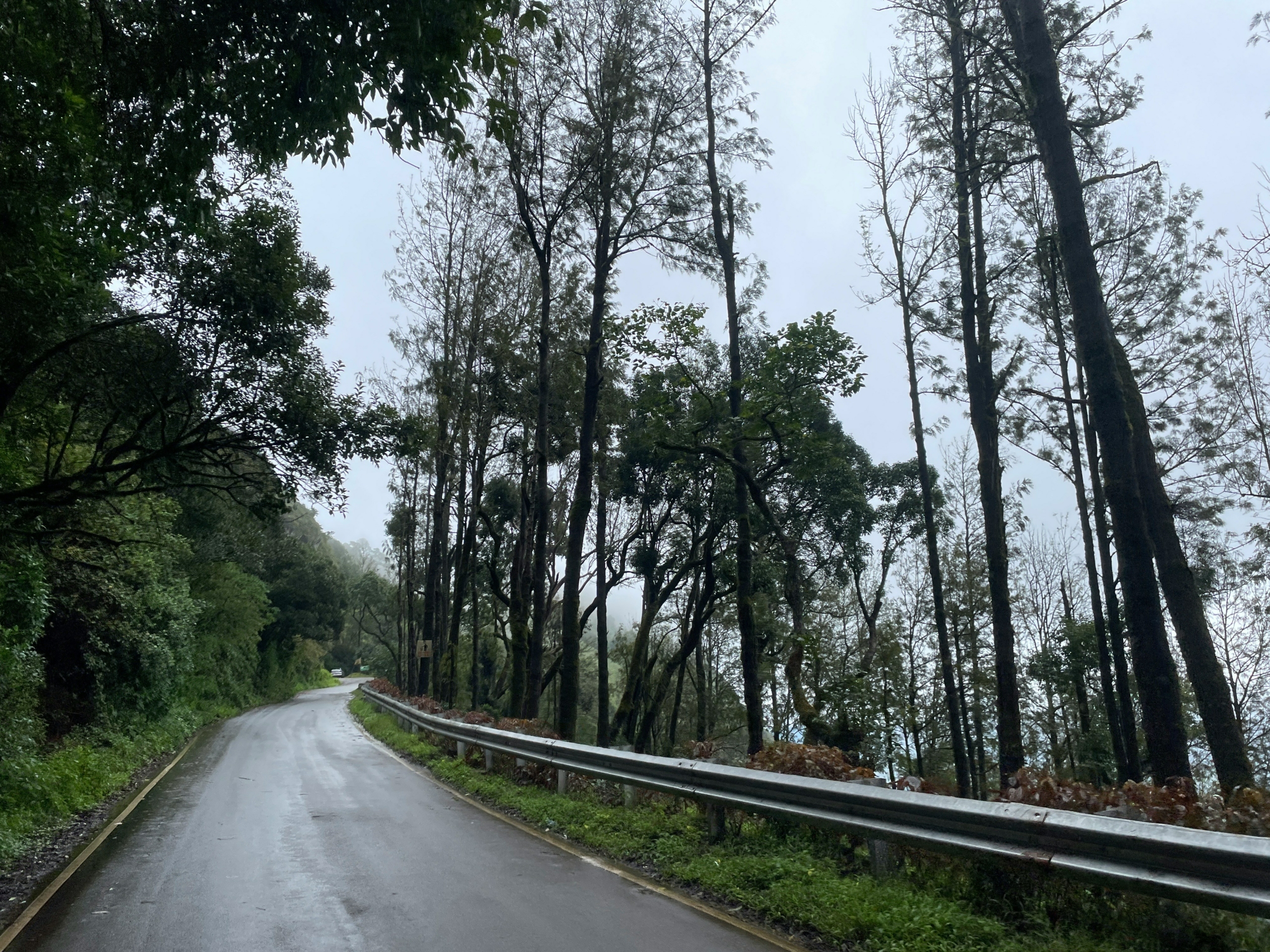
– Ghat slips near Madikeri: the climb after Kushalnagar gets greasy with wet leaves and runoff. Use engine braking on descents, hug the inside of blind bends, and never overtake on the ghats.
– Drive in daylight: finish both legs before dark. Monsoon visibility drops fast, ghat roads are unlit, and falling-branch and landslip risk is highest at dusk.
– Build a buffer: add 30–45 minutes to every estimate for rain and weekend traffic, and keep one flexible day so a washout doesn’t wreck the plan.
– Carry: a real raincoat (not just an umbrella), microfibre cloths to clear foggy glass, offline maps, a power bank, and basic medicines. Coffee-country roads have patchy signal.
Leg 1 — Bangalore to Mysore (~145 km, ~3 hours)
The Bengaluru–Mysuru Expressway changed this drive completely. What used to be a four-hour crawl through small towns is now a roughly 145-km run that most cars cover in under three hours, thanks to the 119-km access-controlled Expressway opened in 2023. You pay two tolls (around ₹165 and ₹155 for a car, so roughly ₹320 the whole way — carry FASTag), and in exchange you get a fast, smooth, largely uninterrupted road.
Smooth and fast is also the catch in monsoon. A wide, empty-looking expressway invites speed, and that is precisely when a sheet of standing water can float your tyres. Treat the Expressway with the respect you’d give a ghat: moderate your speed, keep your distance, and don’t trust the surface just because it looks clear.
If you want one good stop, make it Channapatna, the GI-tagged “Toy Town” about 60 km from Bangalore, right on the old highway alignment. Its lacquered ivory-wood toys, finished with vegetable dyes, make genuinely lovely gifts, and the state handicrafts emporium on the highway is an easy, quick pull-in. Closer to Mysore, Ranganathittu Bird Sanctuary near Srirangapatna is a worthwhile detour — though see the note below about monsoon boating.
- Distance & time: ~145 km from central Bangalore; ~3 hours with a Channapatna stop, ~2 hrs 45 min clean.
- Toll: roughly ₹320 total for a car (both plazas, one way). FASTag essential.
- Best time to drive: leave Bangalore by 7–8 am to reach Mysore for lunch and keep the day open.
- How to reach: NH275 / Bengaluru–Mysuru Expressway, well-signed the whole way.
- Ideal for: families and groups who want an easy, comfortable opening leg.
- Pro tip: fuel up and use the restroom before you join the Expressway — access-controlled means fewer casual exits, and the few fuel stops can have queues on weekends.
Things to do in Mysore: give the city a full day
This is the leg most road trips waste, and the one that makes this itinerary worth choosing. Mysore (officially Mysuru) is a compact, walkable heritage city that looks its best in the rain — washed clean, deep green, and far less crowded than in peak Dasara season. Here is how to spend a day and a half well.
Mysore Palace
The Mysore Palace (Amba Vilas) is the obvious centrepiece, and it earns it — a riot of Indo-Saracenic domes, stained glass and carved doors that is one of India’s most-visited monuments. The palace is open daily, generally 10:00 am to 5:30 pm, with a modest entry fee for Indian visitors (check the current rate on Karnataka Tourism). The real magic is the illumination: on Sundays and public holidays, around 7:00–8:00 pm, the palace is lit by close to 100,000 bulbs, free to view from the grounds. On other evenings there’s a paid sound-and-light show tracing the city’s history. Time your trip to catch one or the other.
- Entry fee: nominal for Indian adults; small charge for children — confirm at the gate or online.
- Timings: 10:00 am–5:30 pm daily; illumination Sun/holidays ~7–8 pm.
- Best time to visit: late afternoon, so you finish the interiors and stay on for the lights.
- How to reach: city centre, ~12 km from Mysore Airport, well inside town.
- Time required: 2–3 hours including the grounds.
- Ideal for: everyone — history lovers, families, photographers.
- Pro tip: socks are mandatory (shoes come off), so carry a clean pair; floors get slick in the wet.
Chamundi Hills
Rising over the city, Chamundi Hills holds the Chamundeshwari Temple and one of India’s largest Nandi monoliths — a 16-foot bull carved on the way up, around the 700th step. The truly fit can climb roughly 1,000 steps; everyone else drives up the hill road. Temple entry is free, with darshan in time-bound sessions (broadly morning, afternoon and evening — confirm current slots locally). In monsoon the hill is wrapped in mist and the city view drifts in and out of cloud, which is half the charm.
- Entry fee: free temple entry; small fee for special darshan/parking.
- Timings: temple open in sessions through the day; closed midday between sessions.
- Best time to visit: early morning for clear views, or evening for city lights.
- How to reach: ~13 km from the palace by the hill road; taxis and buses run up.
- Time required: 1.5–2 hours.
- Ideal for: couples and families; pilgrims.
- Pro tip: the steps are slippery in rain — go up by road and walk down a short stretch to see the Nandi if you want the photo without the climb.
Brindavan Gardens
Below the Krishna Raja Sagar (KRS) Dam, about 21 km from the city, the terraced Brindavan Gardens are best known for their evening musical fountain. Gardens are typically open from morning until late (around 9:00 am to 10:00 pm), with a small entry fee; the musical fountain runs roughly 6:30–7:30 pm on weekdays and to 8:30 pm on weekends (entry to the fountain area closes shortly before the show ends). In a good monsoon the dam is fuller and the whole setting greener.
- Entry fee: small per-person charge.
- Timings: ~9:00 am–10:00 pm; fountain in the evening (see above).
- Best time to visit: arrive by 6 pm to settle in for the fountain.
- How to reach: ~21 km from Mysore city; cabs and buses available.
- Time required: 1.5–2 hours, mostly for the evening show.
- Ideal for: families and groups.
- Pro tip: weekends and holidays get very crowded for the fountain — go on a weekday evening if you can.
St Philomena’s Cathedral
One of India’s tallest churches, St Philomena’s Cathedral is a neo-Gothic landmark whose twin 175-foot spires were modelled on Cologne Cathedral. It’s usually open to visitors from early morning to around 6:00 pm, with free entry. Photography is restricted inside the hall, so be discreet. Lit up after dark, the facade is a striking sight against monsoon clouds.
- Entry fee: free.
- Timings: roughly 5:00 am–6:00 pm; daily Mass in Kannada, Tamil and English.
- Best time to visit: late afternoon, to stay for the evening illumination.
- How to reach: ~3 km from the palace, central Mysore.
- Time required: 30–45 minutes.
- Ideal for: architecture and history lovers.
- Pro tip: dress modestly and switch your phone to silent — it’s an active place of worship.
Ranganathittu Bird Sanctuary (a monsoon caveat)
On the way in or out, Ranganathittu Bird Sanctuary near Srirangapatna (about 16 km from Mysore) is the state’s premier riverine bird sanctuary, open daily around 9:00 am to 6:00 pm. June–September is nesting season, so birdlife is rich — but boating can be restricted during heavy rain or high water on the Kaveri, which is exactly when monsoon swells the river. Treat the boat ride as a bonus, not a guarantee.
- Entry fee: modest entry charge; boating extra when running.
- Timings: ~9:00 am–6:00 pm; boating paused around the 1:30–2:30 pm lunch hour.
- Best time to visit: early morning for birds and calmer water.
- How to reach: ~16 km north of Mysore, off NH275 near Srirangapatna.
- Time required: 1–1.5 hours.
- Ideal for: families and birdwatchers.
- Pro tip: call ahead in heavy rain to check whether boats are operating before you drive out.
For more of the state’s wet-season picks beyond this route, the places to visit in Karnataka in monsoon guide is a good companion read.
Leg 2 — Mysore to Coorg (~120 km, ~3 hours)
From Mysore, the road to Coorg runs ~120 km via Hunsur and Kushalnagar to Madikeri, taking roughly 2.5 to 3 hours in good conditions — and the Mysore–Coorg drive is one of the prettiest stretches in South India. The first half is flat farmland; once you cross Kushalnagar, the road tips into coffee country and starts climbing. The ghat section toward Madikeri alone takes 50 minutes to an hour, and in monsoon it slows further. Plan to leave Mysore by mid-afternoon at the latest so you finish the climb in daylight.
A natural rhythm: do your full Mysore morning, lunch in the city, drive out via Ranganathittu, and aim to reach Coorg by early evening. If you’re staying near Kushalnagar rather than Madikeri itself, you’ll arrive a touch sooner and closer to the Golden Temple and Dubare.
- Distance & time: ~120 km Mysore to Madikeri; ~3 hours, more in heavy rain.
- Route: Mysore → Hunsur → Kushalnagar → Madikeri on NH275.
- Best time to drive: depart by 2–3 pm so the ghats are done before dusk.
- How to reach: continuous well-marked highway; the scenic climb starts past Kushalnagar.
- Ideal for: anyone who wants a short, beautiful second leg rather than a marathon.
- Pro tip: fuel up in Kushalnagar — options thin out as you climb toward Madikeri.
Coorg highlights in monsoon (keep it brief, then linger)
Coorg in the rain is the payoff for splitting the trip. The coffee hills turn emerald, the waterfalls roar, and the air smells of wet earth and cardamom. We keep this short on purpose — for the full deep dive (estate stays, longer treks, where the rain is heaviest), read our complete monsoon in Coorg guide. Here are the highlights worth fitting around your drive.
Abbey Falls is at its thunderous best now — water crashing through coffee and spice plantations, viewed from a hanging bridge. It’s open roughly 9:00 am to 5:00 pm with a small entry fee, about 8 km from Madikeri. Go early to beat both crowds and the afternoon downpour. Raja’s Seat, the old royal sunset viewpoint in Madikeri, charges a token entry (with a small extra for the toy train) and is open through the day; in monsoon you trade the sunset for rolling cloud over the valley, which many travellers like more. Namdroling Monastery (the Golden Temple) at Bylakuppe near Kushalnagar is the largest Nyingma teaching centre in the world — open about 9:00 am to 7:00 pm, free to enter, with the gilded Buddha hall best seen around the 1:00 pm prayers. Add Dubare Elephant Camp on the Kaveri and a wander through any working coffee estate, and you have a full, unhurried Coorg day.
A quick monsoon caveat shared with the rest of the route: some treks (like Tadiandamol) and forest paths get genuinely dangerous with leeches, slippery rock and swollen streams in peak rain — save the serious hikes for after the monsoon, and stick to the falls, viewpoints and estate walks while it’s wet.
Why splitting at Mysore makes a richer monsoon trip
Plenty of people ask whether the Mysore stop is “worth it” when you could drive straight to Coorg. In monsoon, it usually is. You break ~265 km into two ~3-hour legs, so neither day is a slog and you’re never racing dusk on a wet ghat. You get a full heritage city — palace, temple, gardens, cathedral — that’s actively better in the rain because the crowds thin and everything turns green. And you arrive in Coorg relaxed rather than wrung out, with a night’s sleep between the city and the hills.
The direct drive has its place — it’s faster, and if you’ve seen Mysore before, the direct Bangalore to Coorg route gets you to the coffee country in a single push. But for a first trip, or any trip where you’d rather travel slow and see more, the three-stop version wins. Mysore stops being scenery out the window and becomes the reason the trip feels like a holiday instead of a transfer.
Where to stay (StayVista)
Splitting the trip means two very different nights — a city stay near Mysore and a coffee-estate stay in Coorg. That’s the quiet luxury of this itinerary: each leg gets its own kind of home.
In Mysore:
– Shwaas (/villa/shwaas) — a 4-bedroom stone-and-white villa with a private pool, set close to Mysore Palace, Brindavan Gardens and Ranganathittu. A roomy, comfortable base for the city day, ideal for families or two couples travelling together.
In Coorg:
– The Estate Villa (/villa/the-estate-villa) — tucked into Coorg’s plantation country, where rustic charm meets modern comfort. The kind of place where you watch the rain over the coffee with a hot filter coffee in hand.
– Firefly by the River (/villa/firefly-by-the-river-5-bhk-villa-in-coorg-with-spacious-rooms) — a 5-bedroom riverside property near Kushalnagar overlooking the Harangi River, paddy fields and pepper groves. Spacious enough for a larger group, and close to the Golden Temple and Dubare.
CTA box — Travelling in monsoon? Book your Coorg stay early — long weekends fill fast even in a below-normal rain year, and the best estate villas go first. Browse the options above and lock your dates before the crowd does. (CTA 1 of 3 max.)
FAQ: Bangalore to Mysore to Coorg road trip
How many days do you need for a Bangalore to Mysore to Coorg road trip?
Three days is the sweet spot — one night in Mysore and one in Coorg. Day 1 is the drive to Mysore plus an evening at the palace; Day 2 covers Mysore’s sights and the short hop to Coorg; Day 3 is Coorg’s waterfalls and viewpoints before heading home. A fourth day, spent entirely in Coorg’s coffee estates, makes it even better.
What is the distance from Bangalore to Mysore to Coorg?
It’s about 265 km one way. Bangalore to Mysore is roughly 145 km (~3 hours on the Bengaluru–Mysuru Expressway), and Mysore to Coorg/Madikeri is about 120 km (~3 hours via Hunsur and Kushalnagar). Splitting it into two short legs is far more comfortable than driving straight through.
Is the Bangalore to Coorg drive via Mysore better than the direct route?
For a relaxed or first-time trip, yes. Going via Mysore lets you break the journey, see a heritage city at its monsoon best, and arrive in Coorg rested. The direct Bangalore-to-Coorg drive is faster and better if you’ve already done Mysore or are short on time.
Is it safe to do this road trip during the 2026 monsoon?
Yes, with sensible precautions. The 2026 monsoon is forecast below-normal, so rain comes in spells rather than constant downpour. Drive in daylight, slow right down for standing water on the Expressway and wet leaves on the Madikeri ghats, keep a 30–45 minute buffer, and avoid serious treks while it’s raining. Waterfalls and viewpoints are the safe, spectacular monsoon picks.
What are the must-see places in Mysore on this trip?
Mysore Palace (with the Sunday/holiday illumination), Chamundi Hills and its giant Nandi, Brindavan Gardens for the evening musical fountain, and St Philomena’s Cathedral. If time allows, add Ranganathittu Bird Sanctuary on the way out — though monsoon boating can be paused in heavy rain.
Is monsoon a good time to visit Coorg and Mysore?
It’s one of the best for scenery. Coorg’s coffee hills and waterfalls (Abbey Falls especially) are lush and full, and Mysore is greener and far less crowded than in peak Dasara season. The trade-off is wet roads and the occasional washed-out plan, which is exactly why the slower, Mysore-included itinerary works so well.
Where should I stay — Madikeri or Kushalnagar?
Madikeri puts you near Raja’s Seat and Abbey Falls and the misty hill-town feel; Kushalnagar is lower, a little drier, and closer to the Golden Temple and Dubare Elephant Camp. Both work — pick based on which sights top your list, and book early in monsoon’s long-weekend rush.
Conclusion
The Bangalore to Mysore to Coorg road trip is proof that how you drive a route matters as much as where it goes. Strung together as two short legs with Mysore in the middle, this becomes a genuine three-day holiday — a heritage city washed green by the rain, a beautiful climb into coffee country, and waterfalls at full roar. Drive in daylight, respect the wet road, keep a buffer day, and let Mysore be a destination, not a pit stop. Do that, and a below-normal monsoon turns into one of the best times all year to make this drive.