

Pre-Monsoon 2026: 9 Indian Hill Stations Already Getting Rain — Where to Go, Wait, or Avoid
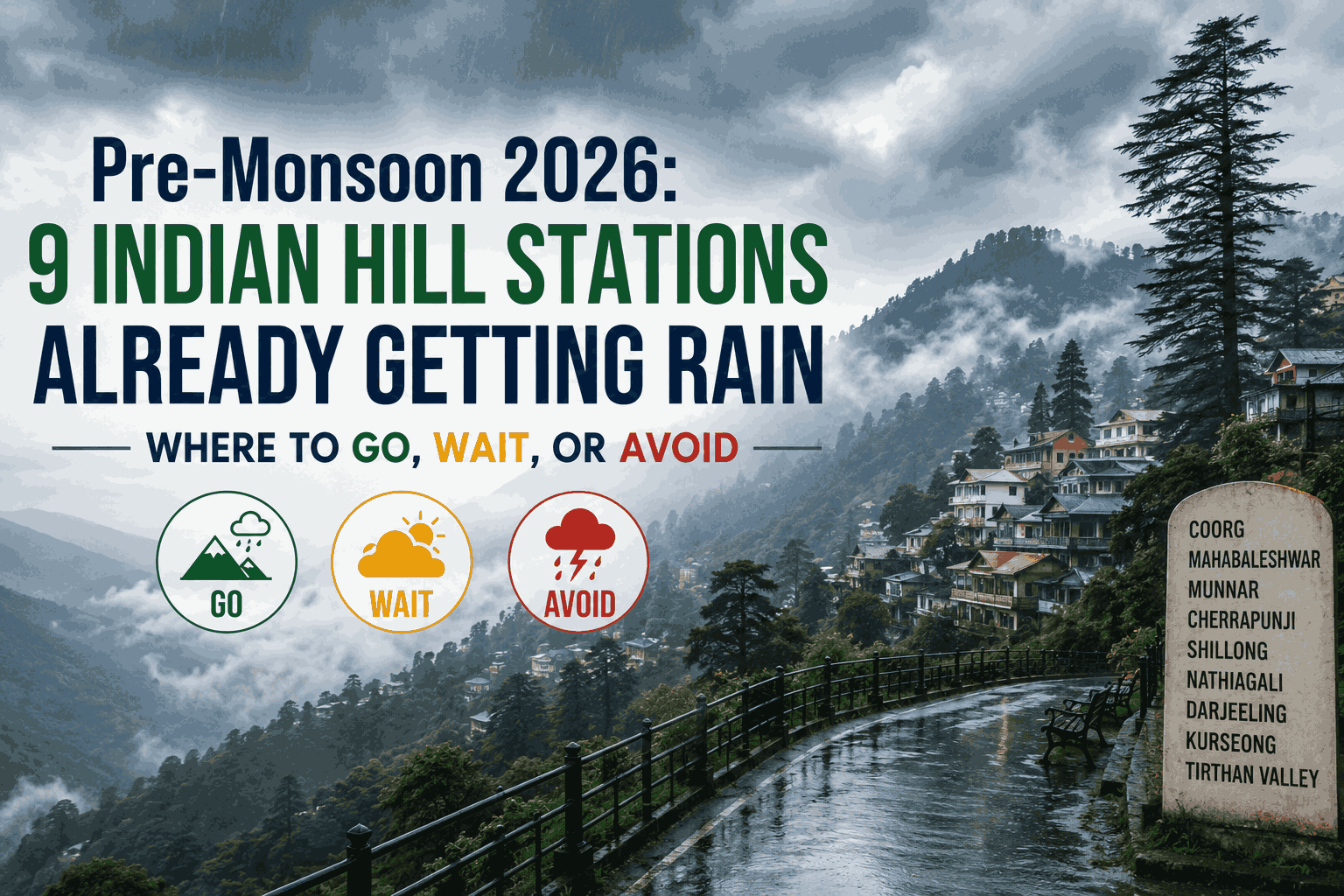
On May 16, 2026, the southwest monsoon entered the Andaman & Nicobar Islands four days ahead of schedule. By May 20, pre-monsoon showers had already reached nine Indian hill stations — and travelers with confirmed weekend plans are scrambling to figure out what to do.
Should you cancel that Coorg trip? Is Mahabaleshwar still worth the drive? Is Wayanad safe after the 2024 landslide? This live tracker answers all three. Our editorial team monitors IMD’s daily updates and tracks rain status across 22+ hill stations through our property network of 1,200+ stays.
As of May 20, 2026, the southwest monsoon has reached the Andaman & Nicobar Islands (4 days early) and pre-monsoon showers are active across nine Indian hill stations — Munnar, Wayanad, Coorg, Chikkamagaluru, Sakleshpur, Mahabaleshwar, Lonavala, Shillong, and Cherrapunji. The IMD forecasts Kerala onset by May 26 (±4 days), with seasonal rainfall at 92% of LPA — below normal but not deficient (IMD April 2026 Long Range Forecast).
In this Blog
Quick Info: Pre-Monsoon 2026 at a Glance
| Item | Value |
| Andaman monsoon arrival | May 16, 2026 (4 days early) |
| Kerala monsoon onset (forecast) | May 26, 2026 (±4 days) |
| Mumbai monsoon arrival (forecast) | June 5, 2026 |
| Delhi monsoon arrival (forecast) | June 27, 2026 |
| 2026 seasonal rainfall forecast | 92% of LPA (below normal, not deficient) |
| Hill stations covered in this advisory | 22 |
| Sweet spot for light rain + waterfalls | May 20 – June 5, 2026 |
| Avoid window for landslide-prone zones | July 1 – August 31, 2026 |
Which Hill Stations Are Already Getting Pre-Monsoon Rains?
As of May 20, 2026, pre-monsoon rainfall is active in nine Indian hill stations: Munnar and Wayanad (Kerala), Coorg, Chikkamagaluru, and Sakleshpur (Karnataka), Mahabaleshwar and Lonavala (Maharashtra), and Shillong and Cherrapunji (Meghalaya). The IMD has issued a yellow alert for Karnataka hill stations through May 23, warning of heavy rain and gusty winds reaching 40 km/h (IMD Monsoon Information).
This isn’t a typical year. India’s average May 2026 rainfall is already exceeding 110% of the Long Period Average, and daytime temperatures across the country are running 2°C–6°C below normal. Translation: the hills aren’t just damp — they’re noticeably cooler, with mist forming earlier in the evenings and waterfalls beginning to fill weeks ahead of schedule.
From our host network: “At our Mahabaleshwar villa, the first pre-monsoon shower hit on May 17 — three days earlier than 2025. The mist now rolls in by 6 PM.” — Property host, Western Ghats region.
The 4-Tier Pre-Monsoon Status Tracker (22 Hill Stations)
We’ve grouped 22 Indian hill stations into four status tiers based on current rainfall, IMD forecasts, and historical onset data. Use this as a decision tree: if your destination is in Tier 1 or Tier 2 and you’re chasing mist and waterfalls, book quickly. If it’s in Tier 4, postpone.
We’ve grouped 22 Indian hill stations into four status tiers based on current rainfall, IMD forecasts, and historical onset data. Use this as a decision tree: if your destination is in Tier 1 or Tier 2 and you’re chasing mist and waterfalls, book quickly. If it’s in Tier 4, postpone.
Tier 1 — Already Raining (Go Now for Mist + First-Showers Magic)
1. Munnar, Kerala — Pre-monsoon showers active since May 18. Best time to visit: May 20 – June 5 for first-rain magic, before heavy spells begin. How to reach: 4 hours from Kochi (135 km); nearest railway Aluva (110 km). Time required: 2–3 nights. Ideal for: couples, tea-estate slow travelers. Pro tip: Skip the Top Station viewpoint after a heavy shower — visibility drops below 20 metres.
2. Wayanad, Kerala — Light showers since May 17. Best time to visit: May 20 – June 8, then pause until September. How to reach: 3.5 hours from Calicut (85 km). Time required: 2–3 nights. Ideal for: nature lovers, slow-travel couples. Pro tip: Stay in the safer Vythiri-Kalpetta belt, not the 2024 landslide-affected Mundakkai-Chooralmala zone.
3. Coorg, Karnataka — Active showers; IMD yellow alert through May 23. Best time to visit: June 1 – June 15 for green waterfalls. How to reach: 5–6 hours from Bangalore (260 km) or Mangalore (135 km). Time required: 2–4 nights. Ideal for: couples, coffee enthusiasts. Pro tip: Abbey Falls peaks 3 days after a major spell — don’t visit on Day 1.
4. Chikkamagaluru, Karnataka — Yellow alert active; intermittent showers since May 16. Best time to visit: May 25 – June 20. How to reach: 6 hours from Bangalore (250 km). Time required: 2–3 nights. Ideal for: coffee estate stays, off-the-beaten-track travelers. Pro tip: Mullayanagiri peak is treacherous in active rain — drive there only on dry mornings.
5. Sakleshpur, Karnataka — Showers since May 17; on the western edge of the alert zone. Best time to visit: May 25 – June 30. How to reach: 4.5 hours from Bangalore (220 km). Time required: 2 nights. Ideal for: weekenders, train-route enthusiasts (the Sakleshpur-Subrahmanya rail trek is famous, but unsafe in heavy monsoon). Pro tip: The Bisle Ghat viewpoint is unbeatable in light pre-monsoon mist.
6. Mahabaleshwar, Maharashtra — Light pre-monsoon showers since May 17. Best time to visit: May 22 – June 10 before heavy monsoon. How to reach: 5–6 hours from Mumbai (260 km), 3 hours from Pune. Time required: 2 nights. Ideal for: Mumbai/Pune weekenders, families. Pro tip: Strawberry season is technically over by mid-May, but rain-watered plants give one last sweet batch — ask local farms.
7. Lonavala, Maharashtra — Intermittent showers; Tiger’s Leap viewpoint already turning misty. Best time to visit: May 22 – June 8, then again post-September. How to reach: 1.5 hours from Pune, 2.5 hours from Mumbai. Time required: 1–2 nights. Ideal for: quick city escapes, romantic weekenders. Pro tip: Bhushi Dam is overcrowded by June 15 — go now or wait until October.
8. Shillong, Meghalaya — Already receiving regular showers; this is one of India’s first true monsoon destinations. Best time to visit: Year-round, but May–September is iconic. How to reach: 3.5 hours from Guwahati airport (100 km). Time required: 3–4 nights. Ideal for: music lovers, photographers, Northeast trail travelers. Pro tip: Pair with Cherrapunji and Dawki for a full Meghalaya monsoon arc.
9. Cherrapunji, Meghalaya — One of the wettest places on Earth — and it’s already wet. Best time to visit: Late May – June for full waterfalls without August’s deluge. How to reach: 2 hours from Shillong (54 km). Time required: 2–3 nights. Ideal for: photographers, waterfall chasers. Pro tip: The Nohkalikai Falls view is best mid-morning before clouds settle in.
Tier 2 — Showers Imminent (Book Within 7 Days, Before the Crowd)

10. Alleppey Backwaters, Kerala — First showers expected May 27 – June 5. Best time to visit: May 25 – June 10 for cool, clear, just-rained backwater cruises. How to reach: 1.5 hours from Kochi (80 km). Time required: 2 nights. Ideal for: houseboat travelers, slow honeymooners. Pro tip: Book houseboats by Wednesday — rates spike sharply once Kerala monsoon is declared.
11. Kodaikanal, Tamil Nadu — Pre-monsoon showers expected May 28 onwards. Best time to visit: May 28 – June 20 for the famous mist around Kodai Lake. How to reach: 3 hours from Madurai (120 km). Time required: 2–3 nights. Ideal for: couples, families with older kids. Pro tip: Pillar Rocks viewpoint clears between 9-11 AM after rain — earliest mornings are usually fogged in.
12. Ooty, Tamil Nadu — Showers expected by May 30. Best time to visit: June 1 – June 25, before peak monsoon’s road closures. How to reach: 2.5 hours from Coimbatore (90 km) on the Nilgiri toy train (book ahead). Time required: 2–3 nights. Ideal for: nostalgic travelers, families. Pro tip: The Kalhatty Ghat road is landslide-prone — use the gentler Mettupalayam route after June 15.
13. Matheran, Maharashtra — First rain expected May 28 – June 2. Best time to visit: May 28 – June 12. How to reach: 2.5 hours from Mumbai (110 km); cars stop at Dasturi — last 2 km is on foot or pony. Time required: 1–2 nights. Ideal for: couples, peace seekers (no vehicles allowed in town). Pro tip: The Charlotte Lake area floods fast — Panorama Point is the safer photography pick.
14. Karjat, Maharashtra — First Sahyadri showers expected by early June. Best time to visit: May 28 – June 15. How to reach: 2.5 hours from Mumbai (85 km), 1.5 hours from Pune. Time required: 1–2 nights. Ideal for: villa weekenders, friend groups. Pro tip: The Kondana Caves trek closes in active monsoon — visit before June 10.
Tier 3 — Still Dry, Monsoon Arrives Mid-June (Last Call for Clear-Weather Trips)

15. Igatpuri, Maharashtra — Currently dry; first rain expected by June 8–12. Best time to visit: Now until June 5 for clear hill views; then again post-September. How to reach: 3 hours from Mumbai (130 km). Time required: 1–2 nights. Ideal for: yoga retreaters, peace seekers. Pro tip: Less crowded than Lonavala, more scenic terrain — book before the rain crowd notices.
16. Bhandardara, Maharashtra — Dry; monsoon arrives mid-June. Best time to visit: Now until June 10 for the green-but-not-soaked sweet spot. How to reach: 4 hours from Mumbai (165 km). Time required: 1–2 nights. Ideal for: photographers, couples seeking solitude. Pro tip: Wilson Dam looks dramatic post-first-spell; the lake reflects mist beautifully on mornings 3-4 of a heavy week.
17. Panchgani, Maharashtra — Light pre-monsoon haze; full showers expected by June 5. Best time to visit: Now until early June. How to reach: 5 hours from Mumbai (240 km), shares routes with Mahabaleshwar. Time required: 1–2 nights. Ideal for: families with kids, table-land picnickers. Pro tip: Sydney Point and Parsi Point are best at sunrise before pre-monsoon haze settles.
18. Nashik Wine Country, Maharashtra — Currently dry; light showers possible early June. Best time to visit: Now until mid-June for vineyard tours without slippery slopes. How to reach: 3.5 hours from Mumbai (165 km). Time required: 2 nights. Ideal for: couples, slow weekenders, food/wine enthusiasts. Pro tip: Sula and Soma vineyard tours go on year-round, but the Trimbakeshwar drive is most scenic in clear pre-monsoon light.
Tier 4 — Postpone to Late September (Heavy Rain or Landslide-Risk Zones)
19. Manali / Kullu Valley, Himachal Pradesh — High landslide history. The Manali-Leh highway typically closes from July through September due to landslides. Advisory: Avoid May 25 – September 15. Safer alternative: Kasol (Parvati Valley, lower landslide profile) or Kasauli (close to Delhi).
20. Nainital / Mussoorie, Uttarakhand — Hill-town congestion + monsoon road blockages make peak season miserable. Advisory: Avoid mid-June through August. Safer alternative: Kanatal — pine-forest stays with low landslide history.
21. Wayanad Landslide Belt (Mundakkai, Chooralmala) — The 2024 Wayanad landslides killed at least 285 people and injured 397 (Wikipedia). Advisory: Avoid this specific belt year-round; rest of Wayanad (Vythiri-Kalpetta) remains safer.
22. Munnar Interior Trek Trails — Town stays are fine, but Eravikulam interior treks become slippery and dangerous within 48 hours of heavy rain. Advisory: Stick to town and tea-estate stays; avoid solo trekking in active showers.
MD’s 2026 Monsoon Forecast — What the Numbers Actually Mean for Your Trip
The India Meteorological Department forecasts 2026 monsoon rainfall at 92% of the long-period average — classified as “below normal” but not “deficient.” For travelers, this translates to fewer landslide closures, drier road conditions, and clearer mornings in popular Western Ghats hill stations compared to the catastrophic 2024 season, when Kerala alone recorded 285+ landslide deaths (IMD, 2026).
Skymet’s parallel forecast pegs the season at 94% of LPA, broadly agreeing with IMD (Skymet Weather). Both forecasters flag the El Niño risk by July as the season’s biggest variable.
The counterintuitive insight: a below-normal monsoon is better for hill station travel. Drier total rainfall means fewer landslide closures, fewer washed-out trekking routes, and far clearer view-mornings. The 2024 disasters happened in a 108% LPA year, when soils were saturated for two months before catastrophic spells hit. 2026’s 92% forecast — assuming El Niño doesn’t disrupt things — should be one of the more travel-friendly monsoons in recent memory.
The 48-Hour Rule: How Pre-Monsoon Rain Spreads Across Western Ghats Hill Stations
Once monsoon onset is declared over Kerala, pre-monsoon showers reach Munnar and Wayanad within 48 hours. Coorg and the Karnataka coast follow within 2–5 days. Mahabaleshwar, Lonavala, and the northern Western Ghats receive their first sustained showers 10–14 days after Kerala onset (IMD historical onset data).
We’ve coined this the “48-Hour Rule” — a practical framework for travelers planning around the rain. If IMD declares Kerala onset on May 26, plan as follows: book Munnar/Wayanad for May 27–28, Coorg for May 30–June 2, and Mahabaleshwar/Lonavala for June 5–10. Outside the Ghats, the rule loosens: Mumbai sees rain about 10 days after Kerala onset, Delhi roughly four weeks after.
Is It Safe to Travel to a Hill Station During Pre-Monsoon?
Pre-monsoon showers in Indian hill stations are generally safe for travel — light, intermittent, and welcome relief from summer heat. The dangerous window is mid-July to August, when prolonged soil saturation triggers landslides. The 2024 Wayanad landslide, which killed at least 285 people, struck on July 30 after two months of sustained monsoon rain — not during pre-monsoon. Wayanad recorded 140mm of rain in 24 hours that day, falling on soils already saturated by prior weeks (ScienceDirect analysis).
A practical safety checklist for any pre-monsoon hill drive:
- Tire pressure and brakes — wet ghat roads punish under-inflated tires
- Mobile network mapping — Western Ghats valleys have spotty coverage; download offline maps
- Travel insurance — confirm landslide and weather-cancellation clauses
- IMD’s real-time alerts — check IMD’s monsoon page the morning of travel
- Skip Western Ghats trekking during active showers — authorities have explicitly warned against it
- Avoid the steepest hairpin routes — Kalhatty Ghat (Ooty) and Shiradi Ghat (Karnataka) are flagged each season
Already decided? Browse StayVista villas in Coorg, Mahabaleshwar, and Wayanad.
Hill Stations to Avoid Right Now (and Where to Go Instead)
Avoid Manali, Nainital, and the Wayanad landslide-affected belt during the 2026 pre-monsoon to peak-monsoon window (May 20 – September 15). Safer alternatives offering similar terrain include Kasol instead of Manali, Kanatal instead of Nainital, and Coorg’s Madikeri instead of Wayanad’s Mundakkai zone. The historical data backs this: Kerala alone accounted for 59% of India’s landslides between 2015 and 2022 (Down to Earth).
SVG Chart:Three explicit swaps for 2026 travelers:
- Instead of Manali → Kasol (Parvati Valley, sheltered, far lower landslide history)
- Instead of Nainital → Kanatal (pine forests, fewer hotels, gentler slopes)
- Instead of Wayanad’s Mundakkai belt → Coorg’s Madikeri (similar Western Ghats vibe, safer terrain)
Best Pre-Monsoon Weekend Trips by Origin City
Travelers want filters by where they’re flying or driving from. Here’s the practical sort.
From Mumbai (3–5 hour drive): Mahabaleshwar (Tier 1, mist already starting), Lonavala (Tier 1, showers intermittent), Matheran (Tier 2, book by next weekend), Karjat (Tier 2, last clear weekend). Skip Bhandardara only if you don’t want to drive 4 hours.
From Bangalore (4–6 hour drive): Chikkamagaluru (Tier 1, yellow alert active — pack waterproofs), Coorg (Tier 1, showers active), Sakleshpur (Tier 1, intermittent showers). For drier weather, fly to Goa for the weekend instead.
From Delhi (5–7 hour drive): Avoid Nainital and Mussoorie this window. Choose Kanatal (safer Uttarakhand option) or Kasauli, Himachal Pradesh (just 5 hours, gentle slopes, low landslide profile). Save Manali for October.
From Pune (1–3 hour drive): Lonavala (1.5 hours), Panchgani (4 hours, mostly dry), Mahabaleshwar (3 hours, showers active). Pune’s proximity to the Ghats makes this the easiest weekend window in India right now.
From Hyderabad (5–8 hour drive or flight): Araku Valley by drive (still dry); fly to Bangalore for Coorg/Chikkamagaluru; fly to Kochi for Munnar. Direct Hyderabad-to-Ghats drives are long enough that flights are usually faster.
Where to Stay Across the Monsoon Belt (StayVista Recommendations)
Every property listed below was selected for one practical reason: it works in active rain. Covered decks, indoor games, heated pools, fireplace lounges, valley-facing glass walls. No “perfect getaway” pitches — just what’s useful when the clouds roll in.
Western Ghats — Maharashtra (Tier 1 / Tier 2)
Emilia Villa, Mahabaleshwar

A heated indoor pool, hot tub, and fitness room make it rain-proof; the valley-facing deck is built for watching pre-monsoon showers roll in from Venna Lake. Ideal for: couples, small families seeking indoor comfort.
Karjat / Igatpuri / Nashik (Tier 3 — Last Call Before Monsoon)
The Den, Karjat

Private pool, forest backdrop, 2.5 hours from Mumbai. Karjat sees the first Sahyadri showers by early June — book the last clear weekend here. Ideal for: 4–6 person weekend getaways.
Western Ghats — Karnataka (Tier 1)
Reflection by the Woods

4BHK with private pool and forest views; the indoor lounge is designed for long, lazy rain afternoons. Ideal for: groups of 8, friends’ reunions.
Kerala (Tier 1)
Mountain Rain Villa, Wayanad

Yoga-focused property with covered meditation deck. Pre-monsoon mornings here are exceptional for slow practice. Ideal for: wellness travelers, solo retreats, couples.
Tamil Nadu (Tier 2)
The Lilly Villa, Ooty

4BHK with pool; Ooty’s cool damp mornings demand a warm indoor base. Ideal for: family weekenders, groups of 6-8.
Northeast (Tier 1)
Meghalaya stays — see our Guwahati-Shillong-Cherrapunji Road Trip guide for the current curated stay list along the full monsoon route. Ideal for: Northeast trail travelers, photographers.
How This Tracker Stays Updated
Our editorial team monitors IMD’s daily monsoon updates and refreshes this advisory every seven days through August 2026. Status tiers, onset dates, and safety advisories are revised when the data shifts. The last update timestamp is visible at the top of this page — if it’s older than a week, we’re working on the next refresh.
Frequently Asked Questions
As of May 20, 2026, pre-monsoon rainfall is active in nine hill stations: Munnar and Wayanad (Kerala), Coorg, Chikkamagaluru, and Sakleshpur (Karnataka), Mahabaleshwar and Lonavala (Maharashtra), and Shillong and Cherrapunji (Meghalaya). IMD has issued a yellow alert for Karnataka hill stations through May 23 (IMD).
The southwest monsoon entered the Andaman Islands on May 16, 2026, four days early. IMD forecasts Kerala onset by May 26 (±4 days). Western Ghats hill stations like Munnar and Wayanad get their first showers within 48 hours of Kerala onset; Mahabaleshwar and Lonavala follow 10–14 days later (Business Today).
Yes — pre-monsoon showers are light, intermittent, and generally safe. The serious risk window is mid-July to August, when prolonged saturation triggers landslides. The 2024 Wayanad landslide that killed 285+ people occurred on July 30 after two months of sustained rain, not during pre-monsoon (Wikipedia).
Pre-monsoon showers (March to early June) are short, intermittent rain spells triggered by local thunderstorms and western disturbances. The southwest monsoon (June to September) is a sustained, large-scale weather system bringing weeks of continuous rainfall. Pre-monsoon adds 5–15% of annual rainfall; the southwest monsoon delivers about 75% (IMD definitions).
Avoid Manali, the Kullu Valley, Nainital, Mussoorie, and the Wayanad landslide-affected belt (Mundakkai and Chooralmala) between May 25 and September 15, 2026. These zones have documented landslide histories. Safer alternatives include Kasol, Kanatal, Kasauli, and Coorg’s Madikeri belt (Down to Earth).
Yes. IMD forecasts 2026 rainfall at 92% of the long-period average — below normal. Skymet pegs it at 94%. For comparison, 2024 ran at 108% of LPA, which contributed to the catastrophic Wayanad landslides. A below-normal monsoon means fewer road closures and clearer view-mornings for travelers (Skymet Weather).
Western Ghats waterfalls — Abbey Falls (Coorg), Athirappilly (Kerala), Dudhsagar (Goa-Karnataka border) — usually peak 7–10 days after Kerala monsoon onset. For 2026, that means peak waterfall flow by approximately June 2–5. Smaller seasonal falls in Lonavala and Mahabaleshwar fill by mid-June.
From Mumbai, your best Tier 1 options are Mahabaleshwar, Lonavala, and Matheran (all 2.5–5 hours by road, all already getting pre-monsoon showers). From Bangalore, Chikkamagaluru, Coorg, and Sakleshpur are all in active pre-monsoon mode within a 4–6 hour drive. Book by Wednesday — rates rise sharply once Kerala onset is officially declared.
The Bottom Line
The 2026 monsoon is arriving early but light. Here’s what to take away:
- Andaman got rain four days early (May 16). Kerala onset is forecast for May 26 (±4 days).
- Nine Indian hill stations are already in pre-monsoon mode as of May 20, 2026.
- 92% of LPA forecast = a safer travel season than 2024.
- May 20 – June 5 is the sweet spot for catching mist, light rain, and filling waterfalls — without the heavy spells that close roads in July and August.
- Avoid Manali, Nainital, and the Wayanad landslide belt. Choose Kasol, Kanatal, or Coorg’s Madikeri instead.
- Use the 48-Hour Rule to time your trips after Kerala onset is officially declared.
Ready to lock in a stay? Browse pet-friendly StayVista villas across the monsoon belt — we’ll keep this tracker updated every seven days through August.