
Pushkar Travel Guide 2026: Ghats, Camel Safari, Brahma Temple & When to Go
Note: Holi 2026 in Pushkar has passed. Planning a Pushkar trip? This guide covers everything year-round — including the famous Pushkar Camel Fair in November 2026, the 52 sacred ghats, India’s only Brahma Temple, and camel safaris through the desert.
[su_box title=”Quick Info” box_color=”#f5a623″ radius=”4″]Best Time to Visit: October–March (cool, festive) | Nearest Airport: Jaipur (145 km) / Ajmer (11 km by rail) | Nearest Station: Ajmer (11 km) | Ideal Duration: 1–2 days | From Jaipur: 145 km, ~2.5 hours by car[/su_box]
Pushkar sits in a natural bowl of the Aravalli hills, ringed by 52 ghats on the shores of a sacred lake that Hindus believe was created when Lord Brahma dropped a lotus flower from the sky. It is simultaneously one of Rajasthan’s most spiritual pilgrimage towns and one of its most traveler-friendly destinations — with a vibrant market street, desert cafés, rooftop restaurants with lake views, and the famous Pushkar Camel Fair transforming the surrounding grounds every November.
In this Blog
TL;DR: What Makes Pushkar Worth the Trip
Pushkar is home to the only Brahma temple in India, 52 sacred ghats on a holy lake, one of the world’s largest camel fairs (November), and a desert landscape perfect for sunrise camel safaris. The town is compact and walkable, alcohol-free (as a sacred town), and one of the few places in Rajasthan where the pilgrim atmosphere and the backpacker vibe coexist naturally.
Holi 2026 in Pushkar — What Happened This Year
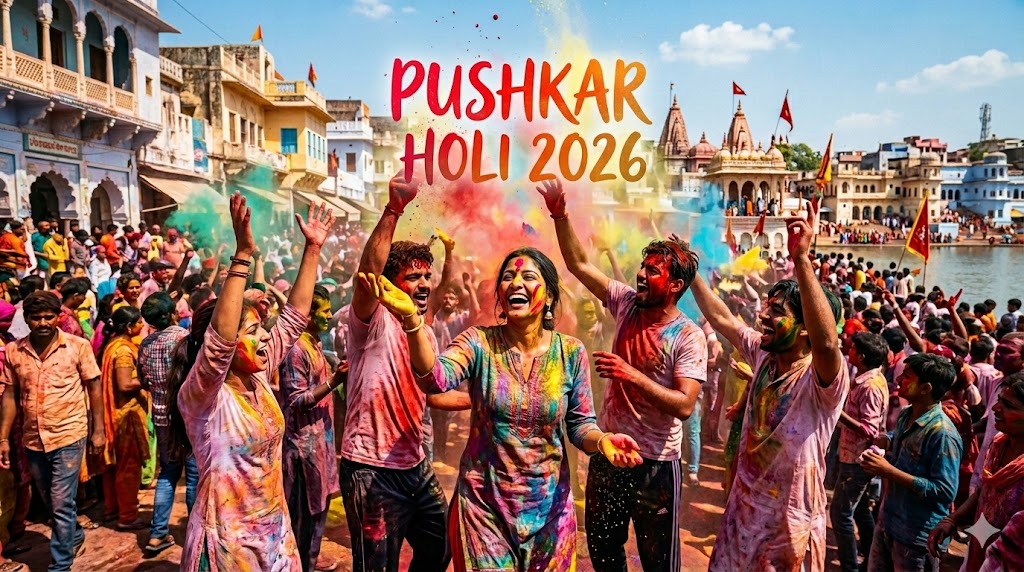
Pushkar Holi 2026 took place on March 3–4, with the main celebrations centered around Brahma Chowk (the main square near the lake) and the open grounds outside town. Two formats coexisted: traditional street Holi (free, organic, participated in by locals and wandering travelers) and ticketed festival events like HoliPurim and Rang Rave (with music, DJ sets, and paid entry).
Pushkar’s Holi is a genuine dual experience — you can immerse in the local festival at no cost, or opt for the curated party events. Both happen simultaneously and within a short walk of each other. Next Holi in Pushkar: March 2–3, 2027. Book accommodation at least 2 months ahead — Holi fills Pushkar’s guesthouses faster than almost any other date.
Pushkar in April–October 2026: The Overlooked Months
Most visitors think of Pushkar as a winter or festival destination. The April–October window has real appeal if you’re willing to lean into the heat and the authentic off-season atmosphere.
April: Crowd-Free Ghats and Desert Camel Safaris
By April, the winter tourist rush has fully cleared and Pushkar reverts to its natural pilgrim-town rhythm. The ghats in the early morning are quiet — just local priests performing puja, a few devotees bathing, and the sunrise reflecting off the lake. This is Pushkar at its most meditative.
Camel safaris into the surrounding desert are best done before the temperature peaks — a 6am departure covers the dunes and reaches a viewpoint for sunrise before the heat arrives. Most operators are based on the main market road and can be booked the day before. Standard rates: ₹500–1,500 per person for a 2–3 hour morning safari.
May–June: Hot but Authentically Local
Temperatures reach 40–45°C in May and June — but for travelers willing to adapt their schedule, this is one of the most genuine ways to experience Pushkar. With almost no foreign tourists, you’re moving through a functioning pilgrimage town rather than a curated travel destination. Priests at the ghats have time to talk. Market vendors are unhurried. The lake, when it holds water in May (levels vary by year), reflects the empty ghats in the early morning.
Practical strategy for summer: All ghats and the Brahma Temple by 6–8am. Shelter and chai until 10am. Explore the covered Sadar Bazaar (shaded) mid-morning. Long lunch and rest from noon. Resume at 5pm for sunset aarti at Brahma Ghat.
October–November: The Build-Up to Pushkar Camel Fair
October sees Pushkar shift gears. Hotels start booking up. Camel traders from across Rajasthan, Gujarat, and Haryana begin arriving in the weeks before the fair. By late October, the grounds outside the main town fill with tent camps, livestock enclosures, and the infrastructure for one of the world’s most extraordinary gatherings.
The pre-fair period (late October) offers a unique window — the traders and their camels are already here, the grounds are filling, but the main tourist crowds haven’t arrived. It’s possible to walk through the livestock grounds and watch trading happen without the fair’s peak-time density.
Pushkar Camel Fair 2026 — Complete Planning Guide
The Pushkar Camel Fair (Pushkar Mela) is one of the largest livestock fairs in the world and one of India’s most visually spectacular annual events. Tens of thousands of camels, horses, and cattle are traded. Folk musicians and acrobats perform across the fair grounds. Hot air balloons launch at dawn over the desert. And the Kartik Purnima (full moon) rituals on the lake create one of the most striking scenes in Indian travel.
Pushkar Camel Fair 2026 dates: Approximately November 2–12, 2026 (confirm exact dates via the Rajasthan Tourism official site closer to October, as the lunar calendar determines the final dates). The peak trading days are usually the first 5 days; the religious culmination (Kartik Purnima) closes the fair.
What to Expect at the Fair
- Camel trading ground: The main livestock area is 2 km from the town center — camels decorated with elaborate embroidery, horses groomed for show, cattle traders negotiating in a visual cacophony of colour and sound
- Camel races and contests: Formal races, camel beauty contests, and turban-tying competitions run on designated fair days
- Folk performances: Kalbelia dancers, Rajasthani folk musicians, acrobats, and puppet shows throughout the fair grounds
- Hot air balloon rides: Multiple operators offer dawn balloon flights over the fair and the Aravalli hills — book 1–2 months ahead for fair dates (₹8,000–12,000 per person)
- Kartik Purnima: The full moon night sees thousands of pilgrims bathe in Pushkar Lake — an extraordinary religious spectacle viewed from any of the 52 ghats
Booking Accommodation for the Fair
This is non-negotiable: book 4–6 months ahead for Pushkar Camel Fair accommodation. The entire town — and the tent cities that spring up around it — fills completely. Options range from basic guesthouses (₹1,500–4,000/night during fair) to luxury heritage hotels and tented camps (₹8,000–30,000/night).
StayVista has property options near Pushkar that offer private villa-style stays with comfortable bedrooms and amenities — ideal for families or small groups who want to attend the fair but prefer privacy and space over the crowded guesthouses in town. These typically need to be booked 3–4 months ahead for fair dates.
Complete Guide to Pushkar’s 52 Ghats
Pushkar Lake has 52 ghats — stone steps leading to the water’s edge — each with its own presiding deity and ritual significance. The lake itself is considered so sacred that bathing in it during Kartik Purnima is believed to wash away sins accumulated over a lifetime.
The Most Important Ghats
Brahma Ghat (also called Gau Ghat) — The most sacred of the 52, where Lord Brahma himself is believed to have performed the first puja after the lake was created. Sunrise aarti here is the most attended. Best time: 5:30–7am for sunrise puja | Evening aarti: 7–7:30pm
Varaha Ghat — Named after the Varaha (boar) avatar of Lord Vishnu, this ghat has a Varaha temple on its steps and is one of the few ghats with a functional temple directly accessible from the water’s edge.
Gandhi Ghat (Gau Ghat) — Named so because Mahatma Gandhi’s ashes were immersed here. A quiet and reflective spot, slightly away from the busiest pilgrim activity.
Saraswati Ghat and Koti Tirtha Ghat — On the northern edge of the lake, these are quieter and less frequently visited — good for solo reflection and photography without the priest-soliciting common at busier ghats.
Practical note on the ghats: Priests at the ghats frequently offer to perform puja for visitors — this is legitimate but comes with an expectation of payment (₹100–500 is typical for a brief ceremony). Agree on the amount beforehand to avoid misunderstanding. Photography at the ghats is generally allowed from the steps; photographing actively bathing pilgrims requires their consent.
Sunrise and Sunset Aarti at the Ghats
Sunrise aarti: 5:30–6:30am (timing varies by season) | The ghats are lit with diyas, priests perform morning rituals, and the lake reflects the first light. Arrive at Brahma Ghat by 5:15am for the best position.
Sunset aarti: 6:30–7:30pm (varies by season) | The evening aarti draws a larger crowd and is more theatrical — lamps, flowers floated on the water, and the Aravalli hills silhouetted against the sunset behind the lake.
Brahma Temple: India’s Only Brahma Temple
The Brahma Temple in Pushkar is the only functional temple dedicated to Lord Brahma (the creator deity of the Hindu trinity) in all of India. Brahma temples exist elsewhere, but this is the only one where he is the presiding deity and where the main rituals are performed in his honour. The reason for this rarity relates to a curse — according to mythology, Brahma was cursed by his wife Savitri to be worshipped only in Pushkar after conducting a yajna (fire ritual) without waiting for her.
The temple dates back over 2,000 years in its original form, though the current structure is largely 14th century. The main deity — a four-headed Brahma idol — sits inside a relatively modest pink stone shikhara (tower). Despite the global rarity of Brahma temples, the actual structure is smaller and less ornate than many temples of lesser significance in Rajasthan. The significance is entirely devotional.
Entry: Free (camera/phone cameras allowed in premises, not in inner sanctum) | Timings: 6am–1pm and 3–8:30pm | Best time to visit: 6–8am for opening darshan with minimal crowds | Dress code: Remove footwear; cover shoulders and knees | Distance from Pushkar Lake: 500 metres (10-minute walk through the market) | Ideal for: All visitors, particularly those with an interest in rare Hindu pilgrimage sites
Pro tip: The temple sees its heaviest crowds during Kartik Purnima (Camel Fair) and during festival days. For a quiet, personal darshan, visit on weekday mornings in the April–September off-season.
What to Do in Pushkar Beyond the Ghats and Temples
Camel Safari into the Desert
The desert around Pushkar offers some of Rajasthan’s most accessible camel safari terrain — sand dunes within 30 minutes of town, with views of the Aravalli hills and the occasional glimpse of the lake. Most operators offer 2–4 hour morning safaris (best for watching sunrise over the dunes) and full-day options that include a packed lunch in the desert.
Price: ₹500–1,500 per person for a 2–3 hour morning safari | ₹2,000–4,000 for a full-day with meals | Best time: 5:30–9am (sunrise safari) or 3:30–6:30pm (sunset) | Where to book: Most hotels can arrange; market-side operators near Brahma Ghat are plentiful — negotiate before committing
Sadar Bazaar — Pushkar’s Market Street
Pushkar’s main market street (Sadar Bazaar) is one of the best shopping destinations in Rajasthan for textiles, tie-dye fabrics, silver jewellery, and handmade goods without the aggressive sales pressure of Jaipur’s larger markets. The ban on meat and alcohol keeps the street atmosphere notably calmer than other Rajasthan bazaars. Look for: Rajasthani block-print fabric, hand-embroidered camel-leather goods, mala beads and rudraksha items, and the distinctive Pushkar rose petals (used in garlands for ghat puja).
Savitri Temple — Hilltop View and Ropeway
The Savitri Temple sits on a hill overlooking Pushkar — reached either by a 30-minute hike (1,600 steps) or a ropeway (cable car) installed in 2018. The temple is dedicated to Savitri, Brahma’s first wife, and sits at the highest point overlooking the lake. The view of Pushkar from the top — the circular lake, the 52 ghats, the pink desert town, the Aravalli hills — is the best panoramic viewpoint in the area.
Ropeway timings: 8am–6pm | Ropeway fare: ₹111 per person one-way, ₹151 return | Hike time: 25–35 minutes | Best time to visit: Sunrise (hike up early) or late afternoon for sunset from the top | Entry to temple: Free
Planning Your Pushkar Itinerary
One Day in Pushkar
5:15am — Brahma Ghat for sunrise aarti
6:30am — Walk the lake circuit (5 km around all 52 ghats) or select 5–6 key ghats
8am — Brahma Temple for morning darshan
9am — Breakfast at a rooftop café overlooking the lake
10am — Sadar Bazaar shopping
12pm — Lunch and rest (avoid the midday heat April–September)
3pm — Ropeway up to Savitri Temple
5pm — Sunset from Savitri Temple hill
7pm — Evening aarti at Brahma Ghat
Two Days: Add Ajmer and a Desert Safari
Day 2: Early morning camel safari (5:30–8:30am), then drive to Ajmer (11 km) to visit Ajmer Sharif Dargah (one of India’s most important Sufi shrines). Return to Pushkar for evening. The Pushkar–Ajmer combination is the classic Rajasthan day plan for this region.
How to Reach Pushkar
From Jaipur: 145 km — approximately 2.5 hours by car on NH58. Jaipur Junction (main station) to Ajmer is a 2-hour train journey; Ajmer to Pushkar is 11 km by taxi (₹300–400) or shared jeep (₹30–50 per person).
From Delhi: 420 km — 6–7 hours by car. Overnight trains from Hazrat Nizamuddin to Ajmer Cantonment (7–8 hours). Delhi to Pushkar by bus takes 8–9 hours (RSRTC services from ISBT Kashmere Gate).
From Udaipur: 280 km — approximately 4.5 hours by car.
Within Pushkar: The town is small enough to walk entirely. Auto-rickshaws are available for the ghat circuit or trips to the Savitri Temple base. Pushkar is a sacred town — it is officially alcohol-free and non-vegetarian restaurants are absent in the main areas near the ghats.
Where to Stay in Pushkar
Pushkar has guesthouses ranging from ₹600/night budget rooms near the ghats to heritage haveli conversions (₹4,000–8,000/night) with rooftop lake views. Most budget and mid-range accommodation is concentrated between Brahma Ghat and Sadar Bazaar. For a more private, spacious stay outside the town centre — especially suitable for families or groups — StayVista has options in the Pushkar–Ajmer belt that offer the comforts of a villa with easy day access to the ghats and markets.
Frequently Asked Questions
When is the Pushkar Camel Fair 2026?
The Pushkar Camel Fair 2026 is expected to run approximately November 2–12, 2026, culminating with Kartik Purnima (the full moon) on the final day. Exact dates are set by the lunar calendar and confirmed by Rajasthan Tourism — check the official Rajasthan Tourism website (tourism.rajasthan.gov.in) for final dates closer to October 2026.
Is the Brahma Temple really the only one in India?
Yes. The Pushkar Brahma Temple is the only significant functioning temple in India where Lord Brahma is the primary deity. While small shrines to Brahma exist in some other temples, this is the only dedicated Brahma temple of religious significance. Its rarity is rooted in Hindu mythology — a curse from Brahma’s wife Savitri is said to have limited his worship to Pushkar alone.
What is the best time to visit Pushkar?
The ideal window is October–March when temperatures are between 10–28°C. November is peak season (Camel Fair), with December–January being the coolest and most pleasant for exploring on foot. April–June is hot (35–44°C) but offers authentic local atmosphere with minimal tourists. July–September (monsoon) brings occasional rain, lower tourist numbers, and a greener Aravalli landscape.
How many ghats does Pushkar have?
Pushkar has 52 ghats around the sacred Pushkar Lake. The most important for religious rituals are Brahma Ghat, Varaha Ghat, and Gau Ghat. Walking the full lake circuit (all 52 ghats) takes approximately 1.5–2 hours at a relaxed pace.
Is Pushkar alcohol-free?
Yes. Pushkar is a sacred pilgrimage town where alcohol sale and consumption is officially prohibited. Meat is also not served in most restaurants, particularly near the ghats. This is enforced — don’t attempt to bring alcohol into the town. The food scene is exclusively vegetarian and quite good, with several rooftop cafés offering Rajasthani thali, Israeli-influenced café food (a Pushkar culinary quirk from decades of backpacker culture), and fresh lassi.
Can I do a day trip to Pushkar from Jaipur?
Technically yes — 145 km, 2.5 hours each way. In practice, a day trip doesn’t allow time for a sunrise aarti (the main experience), a full ghat walk, the Brahma Temple, and the Savitri Temple. A night’s stay in Pushkar makes far more sense and adds the ghat aarti experiences that are the highlight of a Pushkar visit. The overnight adds significant depth for minimal extra cost.