

Villa or Homestay in Coorg: What Actually Differs on Price, Privacy, Food and Hosting

Coorg isn’t short of places to sleep. Kodagu district — Coorg’s official name — has roughly 4,000 homestays alone (NewsKarnataka, 2025), plus a fast-growing stock of private villas. That abundance is exactly the problem. “Villa” and “homestay” get used almost interchangeably in listings, yet they’re different products with different pricing logic, different privacy trade-offs, and very different food.
This guide separates the two on the four things that actually change your trip: what you’ll pay, how much of the place is yours, who cooks, and who looks after you. For planning the trip itself, see our [INTERNAL-LINK: complete Coorg travel guide → Coorg destination pillar page].
TL;DR: Homestays in Coorg usually price per head with meals included; villas price per night for the whole home — so groups of six-plus often pay less per person in a villa. Homestays win on hosted warmth and Kodava home cooking; villas win on privacy, pools and space. With Kodagu drawing a record 45.72 lakh tourists in 2024 (Kodagu Tourism Department), book either one early.
In this Blog
What’s the Real Difference Between a Villa and a Homestay in Coorg?
Alternative stays — homestays, villas and apartments together — grew 24% in Indian bookings in 2023 (MakeMyTrip India Travel Trends Report, 2024). The short answer: a homestay is a hosted stay in or beside the owner’s home, while a villa is an entire private house handed over to you, staff included.
That single structural difference drives everything else. In a homestay, the family is present. They cook, they chat, they point you to the waterfall the blogs missed. In a villa, the owner is absent by design. You get the pool, the lawn and the living room to yourselves, with a caretaker or chef working around you rather than living with you.
Here’s the at-a-glance version:
| Homestay | Private Villa | |
|---|---|---|
| Pricing logic | Per head, meals often included | Per night, whole property |
| Who else is there | Host family, often other guests | Only your group, plus staff |
| Food | Fixed home-cooked menu | On-request menu or private chef |
| Best group size | Couples, solo, 2–4 travellers | 6–20, families, celebrations |
| Hosting style | Personal, involved | Professional, on-call |
One more distinction worth naming, because listings blur it constantly: some Coorg properties call themselves homestays while functioning as small resorts — eight rooms, a reception desk, no family in sight. Others call themselves villas but rent room by room. The label on the listing isn’t the contract. What matters is whether you’re buying the whole property or a room in it, and whether a host lives on site.
Neither model is “better”. They’re built for different trips — and the rest of this article shows where each one earns its rate. If you’re still choosing where in Coorg to base yourself, our breaks down the localities.
How Much Does a Villa Cost vs a Homestay in Coorg?
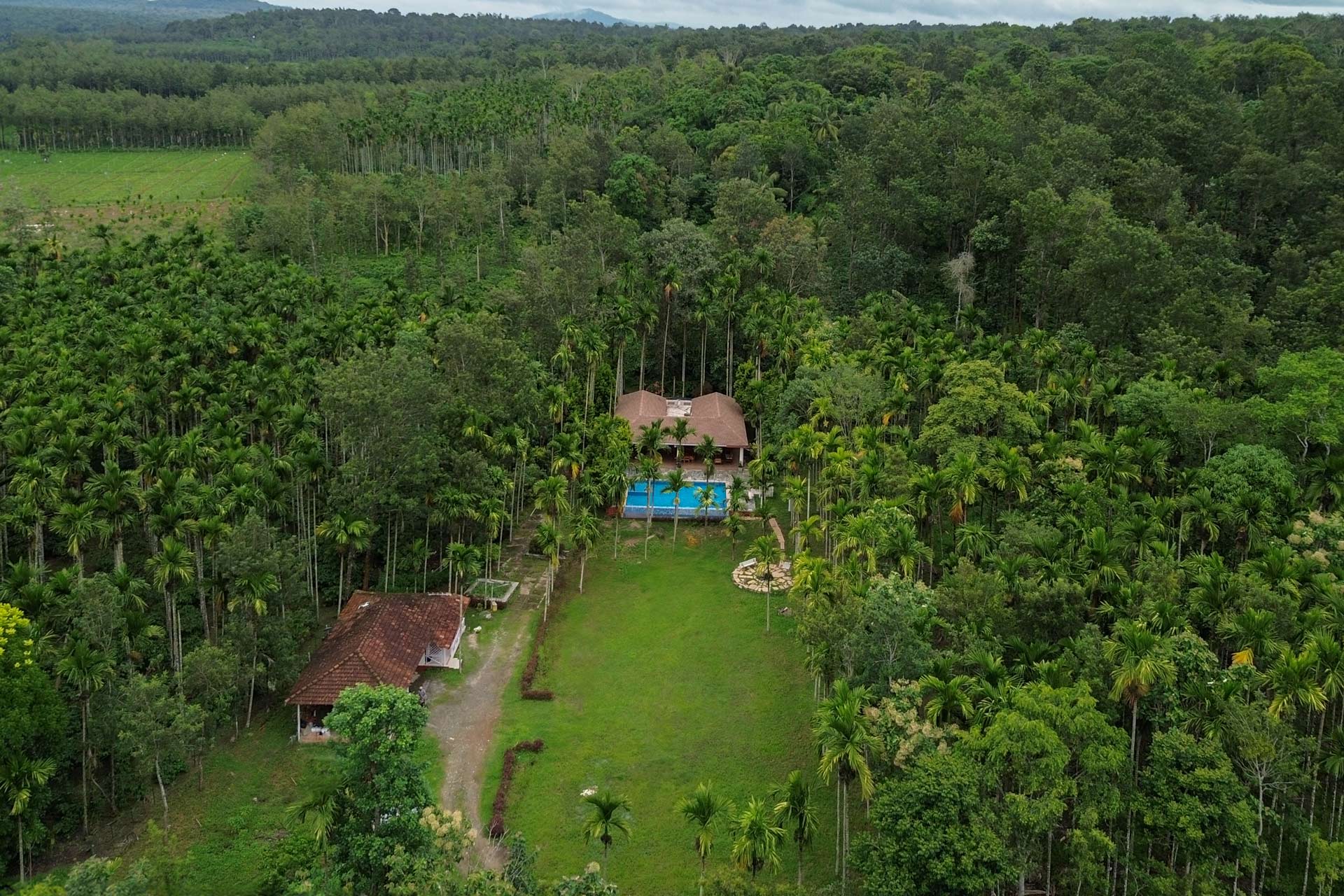
Around 20% of Indian family travellers now search for villa stays priced above ₹10,000 per night, while budget travellers cluster under ₹2,500 (MakeMyTrip, 2024). In Coorg, that split shows up as two different pricing models — and comparing them per night alone will mislead you.
Homestays typically charge per person. Depending on season and room, expect roughly ₹1,500–₹3,500 a head per night on most listing platforms, usually with breakfast and often dinner folded in. Villas charge for the entire property.<!– [ORIGINAL DATA] –>
Our data: Across StayVista’s Coorg portfolio, full private homes list from about ₹6,000 a night for compact two-bedroom stays to ₹30,000+ for large estate villas with pools and staff — with per-person costs dropping sharply once six or more guests share the home.
Run the arithmetic before you assume villas are the expensive option. Eight friends paying ₹2,500 each at a homestay spend ₹20,000 a night — the price band of a full four-bedroom villa with a chef. Below four guests, the maths flips back and homestays almost always win.
Why does demand keep pushing these rates up? Family travel bookings surged 64% year on year in the same MakeMyTrip report, and larger groups are precisely the segment villas serve.
Season swings both models, but not equally. Homestay per-head rates move modestly — a family cooking for six guests instead of four has limited room to reprice. Villa rates are far more elastic: the same four-bedroom home can list at monsoon lows in July and double over Dasara or a December long weekend. If you’re flexible on dates, that volatility works in your favour. Book a villa mid-week in the monsoon and you’ll often pay homestay money for a private pool.
One caution on comparing rates: homestay prices usually include food, villa prices usually don’t. Add your meal plan to the villa quote before deciding.
Which Offers More Privacy: A Villa or a Homestay?
India’s vacation rental market is projected to grow from USD 2.39 billion in 2025 to USD 3.22 billion by 2029 (Statista via Media India Group, 2025), and privacy is the engine of that growth. A villa gives you the whole property; a homestay gives you a private room within someone’s world.
Be honest about which trip you’re on. Celebrating an anniversary, travelling with in-laws, or planning late nights of music and cards? Shared verandahs and a host family’s routine will chafe. A villa’s privacy is architectural, not negotiated — the pool is yours at midnight, breakfast happens when you wake, and nobody’s schedule brushes against yours.
Homestay privacy varies far more than listings admit. Some Coorg homestays are detached cottages on a coffee estate where you’ll barely see the hosts. Others are bedrooms across the corridor from the family kitchen, with meal times fixed and common areas genuinely common. The photos rarely tell you which one you’re getting; the reviews usually do.
There’s also a group-dynamics angle most comparisons skip. In a homestay, you share the property with whoever else booked that weekend — strangers at your breakfast table can be a delight solo and an intrusion with family. A villa removes that variable entirely, which is why multigenerational groups increasingly default to them.
What’s the Food Like in Coorg Homestays and Villas?
Food isn’t a side consideration here: 87% of Indian travellers say local cuisine influences their holiday choices (Airbnb survey via Business Insider India, 2017) — a pattern that has only deepened since. In Coorg, the homestay-versus-villa choice is genuinely a food decision.
Homestays are the stronghold of real Kodava cooking. Pandi curry with kadambuttu, akki rotti at breakfast, bamboo-shoot curry in season, honey from the estate’s own hives — cooked by the family, to the family’s recipe, at the family’s meal times. The menu is fixed, and that’s the charm. You eat what the household eats, and it’s usually the best meal of the trip.
Villas trade that fixed authenticity for control. A caretaker-cook or private chef prepares what your group requests — Kodava dishes if you ask, but equally pasta for the kids, a barbecue by the pool, or Jain meals for grandparents. Kitchens are typically yours too, so self-catering a morning of filter coffee and toast is entirely normal.
What we see at StayVista: the first question large-group bookers ask about a Coorg home is almost never about the pool — it’s “does the caretaker cook, and can he do a barbecue?” Food flexibility, not luxury, is what pulls big families toward villas.
Who Hosts You — and How Do You Vet Them?
Hosting is where the gap is widest, and where due diligence matters most. Of Kodagu’s roughly 4,000 homestays, only 2,229 were officially registered with the district administration as of March 2025, and around 500 have shut down (NewsKarnataka, 2025). The homestay association itself puts unauthorised operators at over 2,000 (Kodagu Express, 2025).
What does that mean practically? A registered homestay run by a resident Kodava family is one of travel’s great hosting experiences — estate walks with the owner, planter’s stories over dinner, directions no app has. An unregistered one may be a converted building with absentee owners and a teenage caretaker. Same word, wildly different product. Ask for the Karnataka Tourism registration number before you pay a bank transfer to anyone.
Villas run on a different model: professional hosting. A managed villa comes with a trained caretaker, housekeeping, and a company accountable for the stay — standardised, but consistent. The owner isn’t your host; the operator is. That’s precisely what a platform brings, and it’s why we’re transparent about [INTERNAL-LINK: how StayVista verifies and manages every home → StayVista trust/how-it-works page].
The honest trade-off: homestays offer deeper hosting with higher variance, villas offer shallower hosting with near-zero variance. Pick by how much you’re willing to gamble.
Why Coorg’s Tourism Boom Should Change Your Booking Maths
Kodagu drew a record 45.72 lakh tourists in 2024, up from 43.99 lakh in 2023 and just 27.29 lakh in 2022 (Kodagu Tourism Department via Kodagu Express, 2025). That’s a two-thirds jump in two years — for a district that produces 35% of India’s coffee across quiet estate country (Kodagu District Administration, 2025).
Here’s the squeeze few travellers notice: demand is at record highs exactly as the district cracks down on unregistered homestays — so legitimate supply is tightening while arrivals climb. The practical consequences: book quality stays 4–6 weeks out for peak windows (October–February, long weekends, Dasara), expect homestay per-head rates to keep firming, and treat suspiciously cheap “homestays” on long weekends as the red flag they usually are.
What Should You Check Before Booking Either One?
Vacation rentals are the fastest-growing segment of India’s online accommodation market at a 17.66% CAGR, with villas and bungalows growing 12.1% annually (Mordor Intelligence, 2025). Fast growth means uneven quality, so the same five checks apply whichever you pick.
Confirm what “estate stay” actually means. Half of Coorg’s inventory advertises a coffee estate. Sometimes that’s 40 acres you can walk; sometimes it’s a neighbour’s plantation visible from the balcony. Ask for the acreage and whether estate walks are included.
Pin down the drive. Coorg’s distances are deceptive — 30 km on the map can be 90 minutes on hill roads, and the last kilometre to an estate property is often unpaved. Ask specifically whether a sedan can reach the gate, or whether you’ll be parking and walking with luggage.
Get the food arrangement in writing. For homestays, confirm which meals are included and whether there’s a vegetarian option — some Kodava households cook predominantly non-vegetarian. For villas, confirm whether the caretaker cooks, who buys ingredients, and what a barbecue costs extra.
Check power and connectivity honestly. Estate properties lose power in monsoon. Ask about an inverter or generator, and don’t assume mobile data works — patchy coverage is normal in South Coorg’s interior. If someone in your group needs to take calls, verify this before booking.
Read the recent reviews, not the ratings. A four-year-old five-star average tells you nothing about the current caretaker. Sort by newest and read for the same three words repeated: clean, responsive, accurate.
So Which Should You Book?
If Kodava food and a host’s local knowledge are the point of your trip, book a registered homestay; if privacy, space and control matter more, book a villa — and above six guests, the villa usually costs less per person anyway. That’s the whole decision, compressed.
By traveller type:
- Couples and solo travellers — homestay, ideally an estate stay. Best food-to-price ratio in Coorg.
- Families with kids or grandparents — villa. Own kitchen, own timings, no strangers at breakfast.
- Friends’ groups of 6–15 — villa, almost without exception. Split the per-night rate and you’ll beat per-head homestay pricing.
- Celebrations and reunions — villa with staff. Homestay hosts understandably don’t want your birthday playlist at 1 a.m.
- First-time Coorg visitors on a short trip — either works; prioritise location over type.
Frequently Asked Questions
Per person for small groups, yes — homestay rates of roughly ₹1,500–₹3,500 a head usually include meals. But family travel bookings grew 64% in 2023 (MakeMyTrip, 2024), and for those larger groups a whole villa often costs less per person than per-head homestay pricing.
Ask for its Karnataka Tourism registration number before paying. Only 2,229 of Kodagu’s roughly 4,000 homestays were officially registered as of March 2025 (NewsKarnataka, 2025), so verification is the single best filter.
Most managed villas include a caretaker who cooks on request, with ingredients billed separately or a per-meal charge. Across StayVista’s Coorg homes — listed from about ₹6,000 to ₹30,000+ a night — larger properties typically offer full meal service, barbecues included. Confirm the food arrangement before booking, not at check-in.
Four to six weeks ahead for October–February, Dasara and long weekends. Kodagu’s arrivals hit a record 45.72 lakh in 2024 (Kodagu Tourism Department, 2025), and registered stays now sell out well before peak dates. Monsoon (June–September) offers the best rates and the greenest hills.
The Bottom Line
The villa-versus-homestay question in Coorg comes down to four honest trade-offs:
- Price: homestays win under four guests; villas win at six-plus once you split the nightly rate.
- Privacy: villas, by design — the whole property is yours.
- Food: homestays for fixed, authentic Kodava cooking; villas for a kitchen that answers to you.
- Hosting: homestays are deeper but variable; managed villas are consistent and accountable.
With arrivals at record highs and the district tightening homestay regulation, the worst option is deciding late. Choose your side of the trade-off, then book early.