
Mumbai’s Monsoon Is Late: 11 Rain-Cooled Escapes 2-4 Hours Away
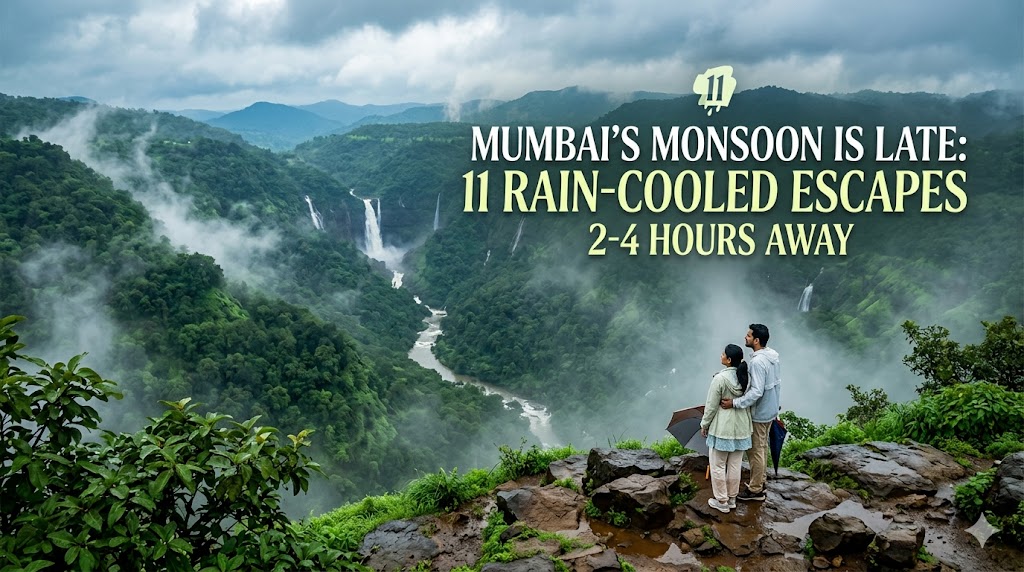
Mumbai has logged barely 13mm of rain this June against a monthly normal of 526mm, and the city is still sweating through 35°C afternoons. The southwest monsoon is one of the most delayed on record. But here’s the part most people miss: the rain has already arrived a couple of hours inland. You don’t have to wait it out.
Mumbai’s 2026 monsoon is badly delayed – just 13.1mm of rain versus a 526.3mm June normal (Skymet), and onset may slip past June 22. But the Western Ghats and Konkan are already wet. These 11 escapes – Karjat, Lonavala, Matheran, Bhandardara, Mahabaleshwar and more – sit 1.5 to 5 hours away and are already misty and green. Go now, before the city catches up.
So where exactly is it raining, why does the rain reach the hills before it reaches us, and which getaway suits a one-day dash versus a full weekend? Below are 11 of the best places to visit near Mumbai in monsoon – sorted by drive time, with the live rain status for each. Let’s get into it.
In this Blog
Quick Info: Mumbai Monsoon 2026 at a Glance
| Question | Short answer |
|---|---|
| Normal Mumbai onset | June 11 (missed in 2026) |
| Expected pre-monsoon showers | Around June 18-19 |
| Likely full onset | Last week of June (~June 22-23) |
| Current Mumbai temperature | ~35°C max / 29°C min |
| Closest already-rainy escape | Karjat / Karnala (~1.5 hrs) |
| Best for a weekend | Mahabaleshwar, Bhandardara, Igatpuri |
Why Is Mumbai’s Monsoon So Delayed in 2026?
Mumbai’s monsoon is running late because the system has stalled near South Konkan since June 8, with no northward movement along the Western Ghats for over a week (Skymet, 2026). The normal onset date is June 11. As of mid-June, the city had recorded just 13.1mm at Santacruz against a 526.3mm monthly normal – and Colaba was drier still at 5mm.
Several things ganged up. The Arabian Sea branch of the monsoon stayed weak, dry air kept intruding over the Konkan coast, and westerly winds never gained the strength to push the system inland. An emerging El Nino-like pattern slowed the whole advance (Dynamite News, citing IMD, 2026). Here’s the frustrating part: the monsoon has actually been marching ahead over east and northeast India – it’s the Arabian Sea coast that stalled, which is why Maharashtra and even Gujarat are still waiting (The Bridge Chronicle, 2026).
How rare is this? Forecasters warn the onset may match or even cross the June 25, 2023 record – which would make 2026 one of the most delayed monsoon arrivals in Mumbai’s recorded history (Skymet, 2026). Meanwhile, the heat just keeps building, because there’s no rain to break it.
When Will It Actually Rain in Mumbai?
IMD expects light pre-monsoon showers over Mumbai around June 18-19, with a proper, widespread onset likely only in the last week of June – around June 22-23 (NewsX, citing IMD, 2026). In plain terms: the next few days bring teasing drizzle, not the real thing. The dependable rain is still a week off for the city.
The coast tells a different story. Rainfall activity has already picked up along the Konkan – Sindhudurg, Ratnagiri, and Raigad saw heavy spells between June 14 and 16. Harnai in Raigad logged 174mm and Ratnagiri district 210mm while Mumbai sat at 13mm. The rain isn’t missing. It’s just south and inland of you.
For a wider, all-India view of where the season has touched down first, our team tracks it in our guide to where the first monsoon rains have already arrived across India. This article zooms in on what matters to a Mumbaikar right now: where to drive this weekend.
What the Delay Means for Mumbai: Heat, and Now Water Cuts
The late monsoon isn’t just uncomfortable – it’s straining the city’s water supply. Mumbai’s seven lakes have fallen to roughly 10-11% of total capacity, and the BMC enforced a 10% water cut from May 15, with curbs being weighed on swimming pools, vehicle washing, and construction sites (Free Press Journal, 2026). Authorities plan to review the cuts after June 20, depending on the rain.
Current reserves, topped up from Upper Vaitarna and Bhatsa, can sustain the city for about another month and a half – but evaporation in this heat eats up to 10% of that. So the delay is doing double damage: hotter days at home and tighter taps. It’s one more reason a couple of cool, green days inland feel less like a luxury and more like a sensible reset.
Why the Rain Reaches the Ghats Before Mumbai (and Which Spots Get It First)
The Western Ghats get drenched before Mumbai because of orographic lift – moist sea air slams into the windward Sahyadris, is forced upward, cools, and dumps its rain on the hills first. Add the monsoon stalling over South Konkan since June 8, and the result is simple: the high ground a couple of hours away is already wet while the coastal city stays dry.
There’s a predictable order to it, too. The southern Ghats around Mahabaleshwar usually begin roughly 10-14 days after the Kerala onset. Lonavala, Khandala, and Matheran follow within the same week. Igatpuri, Nashik, and the northern Sahyadris come last, about 14-18 days after Kerala. So if you want a guaranteed soaking right now, lean south and high.
We use this cascade to plan our own team trips. Right now, our hosts in Igatpuri and Lonavala are already messaging photos of mist rolling over the valley at breakfast – while half of us are still stuck in a sticky Mumbai office. That gap is the whole opportunity.
The Rain Tracker: how far, and how wet, right now
| Escape | Distance from Mumbai | Drive time | Rain status (mid-June 2026) |
|---|---|---|---|
| Karjat | ~62 km | ~1.5 hrs | Pre-monsoon showers |
| Karnala | ~60 km | ~1.5 hrs | Overcast, early showers |
| Lonavala-Khandala | ~83 km | ~2 hrs | Misty, first rains |
| Pawna Lake | ~120 km | ~2.5 hrs | Cool & green |
| Matheran | ~90 km | ~2.5 hrs (+ toy walk) | Misty |
| Kolad | ~120 km | ~2.5 hrs | River rising |
| Igatpuri | ~120 km | ~2.5 hrs | Showers starting |
| Malshej Ghat | ~130 km | ~3 hrs | Waterfalls flowing |
| Tamhini Ghat | ~150 km | ~3.5 hrs | Heavy green, wet |
| Bhandardara | ~165 km | ~4 hrs | Cool, early rain |
| Mahabaleshwar-Panchgani | ~260 km | ~5 hrs | Already raining |
11 Rain-Cooled Escapes Near Mumbai (Already Green and Misty)
We’ve ordered these roughly nearest to farthest, and tagged each one so you can match it to your plan – a one-day dash, a lazy two-day reset, or a full weekend. Every entry has the practical details you actually need: distance, what to do, who it suits, and a pro tip from people who go often.
1. Karjat – the closest green reset (~1.5 hrs)
Best for: 1-day trips and families | Type: riverside & waterfalls
Karjat is the quickest way out of the heat – barely 62km and an easy 1.5-hour drive, which is why it’s the default when you want rain without a road trip. The Ulhas river swells through monsoon, the rice paddies turn electric green, and small waterfalls appear along the trekking trails to Kondana Caves and Peb Fort. It’s also Bollywood’s backyard, with ND Studios nearby.

How to reach: ~62 km via the old Mumbai-Pune road; Karjat is on the Central Railway line. Time required: a full day, or an overnight.
Best time: after the first heavy spell, when the river is full.
Pro tip: river-crossing and rappelling outfits run only after the water rises – call ahead, and never enter rivers during active rain.
2. Karnala – fort and birds without the crowds (~1.5 hrs)
Best for: 1-day trips and easy treks | Type: fort-trek & bird sanctuary
Karnala is the underrated close one – about 60km down the Mumbai-Goa highway. The Karnala Fort trek is short and doable in a morning, with misty Sahyadri views opening up near the top. The Karnala Bird Sanctuary around it comes alive in the wet months, and the forest smells of rain the moment you step in. Perfect if you want a hill without the four-hour drive.
How to reach: ~60 km via NH-66; nearest town Panvel.
Entry: Karnala Bird Sanctuary charges a nominal forest department fee.
Timings: roughly 6 am-6 pm.
Ideal for: beginner trekkers, birders, and families.
Pro tip: the fort trail gets slippery – wear grippy shoes and start early to beat the afternoon downpour.
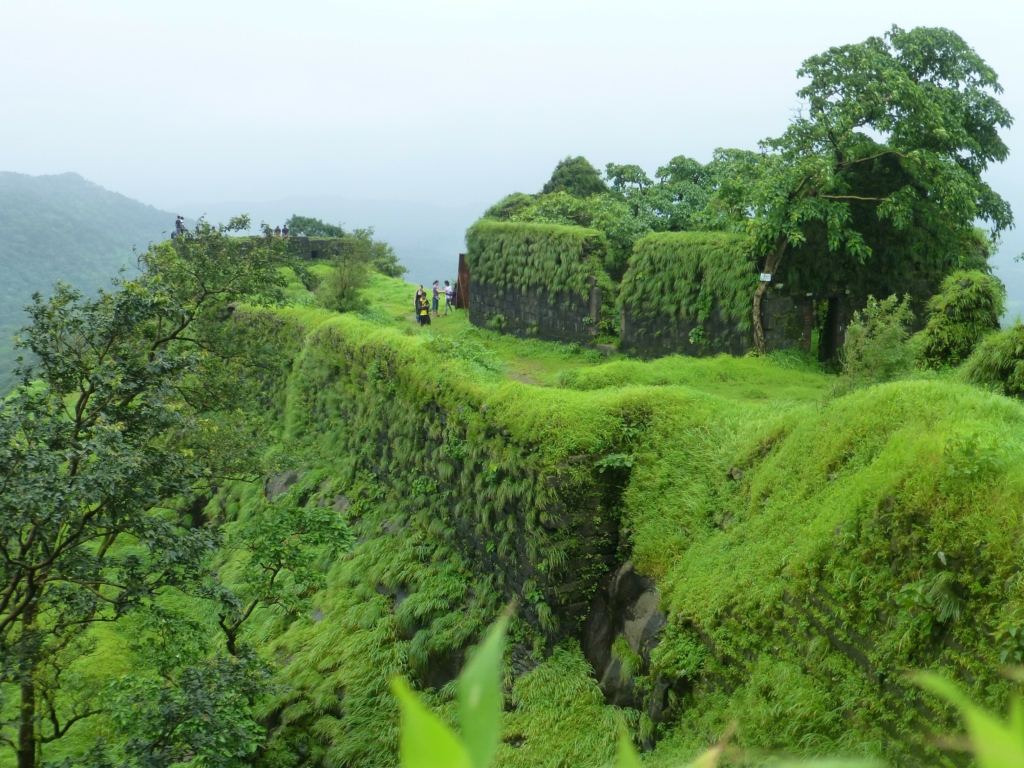
3. Lonavala & Khandala – the monsoon classic (~2 hrs)
Best for: weekends and couples | Type: hill station & waterfalls
Some places earn their reputation. Lonavala and Khandala, the twin hill stations about 83km from Mumbai, turn into a wall of green the moment the rain hits. Lakes brim over, Kune Falls thunders, and viewpoints like Tiger’s Leap and Duke’s Nose vanish into cloud. It’s the easiest weekend the city has, which is also why it gets busy – go on a weekday if you can.
How to reach: ~83 km via the Mumbai-Pune Expressway; frequent trains to Lonavala.
Time required: a weekend.
Best time: midweek mornings for the viewpoints before the fog and crowds roll in.
Ideal for: couples, families, first-timers.
Pro tip: book a valley-facing stay on higher ground – the mist views from a balcony beat fighting for parking at Tiger’s Leap.

4. Matheran – walk in the rain, car-free (~2.5 hrs)
Best for: weekends and slow travel | Type: vehicle-free hill station
Matheran is Asia’s only vehicle-free hill station, perched at about 2,625 feet, and that single rule changes everything. No horns, no exhaust – just red-earth paths, 38-plus viewpoints, and the sound of rain on the forest canopy. You park at Dasturi Naka and walk (or take the toy train when it runs). In the monsoon, the whole place feels washed clean.
How to reach: ~90 km to Dasturi Naka, then a 30-45 min walk or pony ride to the centre.
Time required: overnight or a weekend.
Best time: early morning for Panorama Point.
Ideal for: couples, walkers, anyone craving quiet.
Pro tip: the toy train service can pause during heavy rain – check status before you go, and carry shoes you don’t mind getting muddy.
5. Pawna Lake – lakeside camping in the cool (~2.5 hrs)
Best for: 2-day trips and friends on a budget | Type: lakeside camping
Pawna Lake is where Mumbai and Pune crowds go to swap traffic for tents. Ringed by the Sahyadris about 120km out, the lake fills up through the season, and the surrounding forts – Tikona, Lohagad, Visapur – sit wrapped in cloud. Lakeside camps run bonfire-and-barbecue nights, and the sunrise over the water is the kind of thing you don’t get in the city.
How to reach: ~120 km via the Expressway, exit near Kamshet.
Cost: camping packages are budget-friendly and usually include dinner and breakfast.
Time required: one or two days.
Ideal for: groups of friends, budget travellers.
Pro tip: during peak rain, the lakeshore can flood – pick a camp on higher ground and confirm they’re operating before you drive out.

6. Kolad – white water while the river rages (~2.5 hrs)
Best for: 1-2 day adventure trips | Type: river rafting
Kolad is the adventure pick. When the Kundalika river is in full monsoon flow, the rafting here is genuinely thrilling – rapids, splash, and dense green on both banks, roughly 120km from Mumbai in Raigad. It pairs well with a stop at the nearby Tamhini stretch or a quiet riverside stay. If your idea of escaping the heat involves getting completely soaked on purpose, this is it.
How to reach: ~120 km via NH-66 and Pen.
Best time: rafting season ramps up once the dam release and rains kick in – typically late June onward.
Time required: a day for rafting, more for a stay.
Ideal for: friends, adventure seekers, older kids.
Pro tip: always raft with a licensed operator and a guide; the river is powerful in spate and not for casual swimming.
7. Igatpuri – lush Sahyadri quiet (~2.5 hrs)
Best for: weekends and couples | Type: hill station & lakes
Igatpuri sits in the northern Sahyadris about 120km from Mumbai, and it’s where the green gets almost ridiculous in the wet season. Waterfalls line the ghat roads, the Vaitarna reservoir fills up, and the famous Vipassana centre draws people looking to genuinely switch off. It’s far enough to feel like a real getaway, close enough for a relaxed weekend.
How to reach: ~120 km via NH-160 (Kasara ghat); on the Central Railway line.
Time required: a weekend.
Best time: all season once the rains settle in.
Ideal for: couples, families, slow weekends.
Pro tip: a lake-facing villa here pays off – you wake up to mist on the water. (More on where to stay below.)
8. Malshej Ghat – roadside waterfalls and flamingos (~3 hrs)
Best for: 1-day scenic drives | Type: ghat & waterfalls
Malshej Ghat is the drive that becomes the destination. About 130km from Mumbai, this mountain pass throws waterfalls right onto the road, and the cloud sits so low you’ll feel like you’re driving through it. Migratory birds, including flamingos, show up in the season. There’s not much to “do” in the checklist sense – the point is the scenery and the rain on your windshield.
How to reach: ~130 km via Kalyan-Murbad.
Time required: a long day trip, or a stop en route to a stay.
Best time: peak monsoon for the roadside falls.
Ideal for: road-trippers, photographers, couples.
Pro tip: visibility drops fast in fog – drive slow, use low beams, and don’t stop on blind curves for photos.
9. Tamhini Ghat & Devkund – the greenest stretch (~3.5 hrs)
Best for: adventure day trips | Type: waterfall trek
Tamhini Ghat is arguably the most lavishly green corner of the Western Ghats near Mumbai, and the Devkund waterfall hidden within it is the prize – a plunge pool framed by cliffs, reached by a moderate trek. It’s about 150km out toward Mulshi. This is for travellers who want the rain experience to come with a bit of effort and a serious payoff.
How to reach: ~150 km via Mulshi/Pune side; the Devkund trek starts near Bhira.
Time required: a full day for the trek.
Best time: after steady rain, with a guide.
Ideal for: fit travellers, friends, adventure lovers.
Pro tip: Devkund is closed or risky in flash-flood conditions – go only with local guides and never swim when the water is high or muddy.
10. Bhandardara – dams, valleys and stillness (~4 hrs)
Best for: weekends and couples | Type: lake, dam & trekking
Bhandardara rewards the longer drive. About 165km from Mumbai, it gathers the Wilson Dam, the Arthur Lake, Randha Falls in full roar, and the dramatic Sandhan Valley nearby. The fireflies that make it famous are tailing off by mid-June, but the monsoon green and waterfalls more than make up for it. It stays far quieter than Lonavala, which is exactly the point.
How to reach: ~165 km via Igatpuri/Ghoti.
Time required: a weekend.
Best time: after the dam fills and the falls are flowing.
Ideal for: couples, nature lovers, trekkers.
Pro tip: stay overnight – the round trip in a day is exhausting, and early mornings here are spectacular when the valley is full of cloud.
11. Mahabaleshwar & Panchgani – the season’s safest bet (~5 hrs)
Best for: full weekends and families | Type: hill station & viewpoints
Mahabaleshwar is the one place on this list almost guaranteed to already be raining – the southern Ghats get the monsoon first. At around 4,400 feet and 260km from Mumbai, it packs in 30-plus viewpoints, the Venna Lake, Lingmala and Dhobi waterfalls, and the strawberry farms it’s famous for. Neighbouring Panchgani adds Table Land and a gentler pace. Yes, it’s a five-hour drive – but it’s the surest soaking you’ll find.
How to reach: ~260 km via the Expressway and Wai.
Time required: a full weekend.
Best time: the whole monsoon; viewpoints are best in breaks between showers.
Ideal for: families, couples, longer breaks.
Pro tip: some viewpoints close in heavy rain for safety – keep the plan flexible and prioritise Arthur’s Seat and Lingmala when the clouds lift. For a tighter plan, see our note on a one-day Mahabaleshwar route within the wider Maharashtra monsoon circuit.

Bonus: the best monsoon waterfalls near Mumbai
If chasing waterfalls is the whole plan, group your trip around these: Lingmala and Dhobi Falls (Mahabaleshwar), Devkund (Tamhini), Kune Falls (Lonavala), and Thoseghar Falls near Satara, which only truly come alive in the rains. All are at their best after a few days of steady downpour – and all demand caution, because rocks near falls get lethally slippery.

1-Day, 2-Day & Weekend Itineraries from Mumbai
Not sure how much time to commit? Here’s how the picks map to the time you’ve got. For a one-day dash, Karjat or Karnala are unbeatable – leave by 7 am, beat the heat, be home by night. For a two-day reset, Pawna Lake camping or an Igatpuri lake stay give you a full evening and a misty morning. For a proper weekend, point the car at Mahabaleshwar or Bhandardara, where the longer drive earns you guaranteed rain and far fewer crowds.
A quick reality check on monsoon driving: ghat roads flood and fog up, and landslides do happen on the worst days. Check the forecast the morning you leave, drive in daylight, keep fuel topped up, and don’t push on if visibility collapses. The rain will still be there tomorrow. For more options sorted by distance, our guide to weekend getaways near Mumbai under five hours and our roundup of weekend trips from Mumbai within 300 km both go deeper.
Where to Stay: Rain-View Villas Near Mumbai
Half the joy of a monsoon escape is watching the rain from somewhere dry and comfortable – ideally a valley-facing balcony with chai in hand. A private villa beats a crowded hotel here, because the view is yours and so is the silence. A few StayVista homes we’d point you to right now:
- Pearl Lakeview Mansion, Igatpuri – a 5BHK overlooking the Upper Vaitarna reservoir, with a lake-facing infinity pool and a home theatre for the rainy evenings. Sleeps up to 20, under three hours from Mumbai. Ideal for a big-group monsoon weekend.
- Lake Arches, Igatpuri – a 4BHK by the lake with an outdoor infinity pool and a gazebo built for watching the mist roll in.
- Aqua and Sage, Karjat – a 4BHK with a private pool and riverside lawns, just 1.5 hours out for the quickest possible reset.
- V Square, Lonavala – a 4BHK with a sprawling lawn, private pool, and valley views, in the heart of Mumbai’s favourite monsoon town.
For more curated options, browse our edit of the best villas in Lonavala for the monsoon and our pool villas across Lonavala and Karjat.

Frequently Asked Questions
The monsoon stalled near South Konkan from June 8 with no movement along the Western Ghats for over a week, while a weak Arabian Sea branch and an El Niño-like pattern slowed the advance (Skymet, 2026). Mumbai logged just 13.1mm against a 526.3mm normal.
IMD expects light pre-monsoon showers around June 18-19, with a widespread onset likely only in the last week of June, around June 22-23 (NewsX, citing IMD, 2026). The forecast can shift, so check the latest IMD bulletin before you travel.
South Konkan and the southern Western Ghats are wettest first. Ratnagiri district recorded 210mm and Harnai in Raigad 174mm between June 14-16, while Mumbai sat at 13mm. The closest reliably cool spots are Karjat and Karnala, about 1.5 hours away.
The southern Ghats around Mahabaleshwar usually get rain first – roughly 10-14 days after the Kerala onset. Lonavala, Khandala, and Matheran follow within the same week, and Igatpuri and Nashik come last, about 14-18 days after Kerala. Lean south for the surest rain.
The standouts are Lingmala and Dhobi Falls in Mahabaleshwar, Devkund near Tamhini Ghat, Kune Falls in Lonavala, and Thoseghar near Satara. All hit full flow after a few days of steady rain. Keep a safe distance – rocks near waterfalls turn dangerously slippery in the wet.
Karjat and Karnala are the closest at around 1.5 hours. For budget travel, Pawna Lake camping is hard to beat – tent packages usually bundle dinner and breakfast for far less than a hotel weekend, and the lakeside setting in the rain is a genuine experience.
Yes. With the rains late, Mumbai’s seven lakes dropped to around 10-11% of capacity, and the BMC imposed a 10% water cut from May 15, weighing further curbs on pools, vehicle washing, and construction (Free Press Journal, 2026). Cuts are due for review after June 20, once the monsoon’s progress is clearer.
Generally yes, with care. Ghat roads can flood, fog reduces visibility, and landslides occur on the heaviest days. Travel in daylight, check the morning forecast, keep your fuel topped up, drive slowly on ghats, and postpone if heavy-rain warnings are active for your route.
Families do well in Mahabaleshwar, Karjat, and Lonavala – gentle activities and easy access. Couples tend to prefer Matheran’s car-free quiet, Bhandardara’s stillness, or a private valley-view villa in Igatpuri. Adventure-minded friends should head to Kolad for rafting or Tamhini for the Devkund trek.
The Bottom Line: Don’t Wait for the Rain – Drive to It
Mumbai will catch up. The pre-monsoon drizzle should arrive around June 18-19, and the real rain by the last week of June. But right now, the smartest move isn’t to sit in the heat refreshing the weather app – it’s to point the car inland, where the season has already started.
- Closest fix: Karjat or Karnala, ~1.5 hours, doable in a day.
- Surest rain: Mahabaleshwar, where the southern Ghats get the monsoon first.
- Best for groups on a budget: Pawna Lake camping.
- Quietest reset: Matheran or Bhandardara.
Pick your distance, check the morning forecast, and book a stay where you can watch the rain come down in comfort. The monsoon’s late to Mumbai – but it’s right on time, just a couple of hours away. For a head start on the all-India picture, see where the first monsoon rains have already landed across India, then find your rain-view weekend stay near Mumbai.