
Saga Dawa 2026: The Holiest Buddhist Festival, Rituals & Where to Witness It in Sikkim and Ladakh
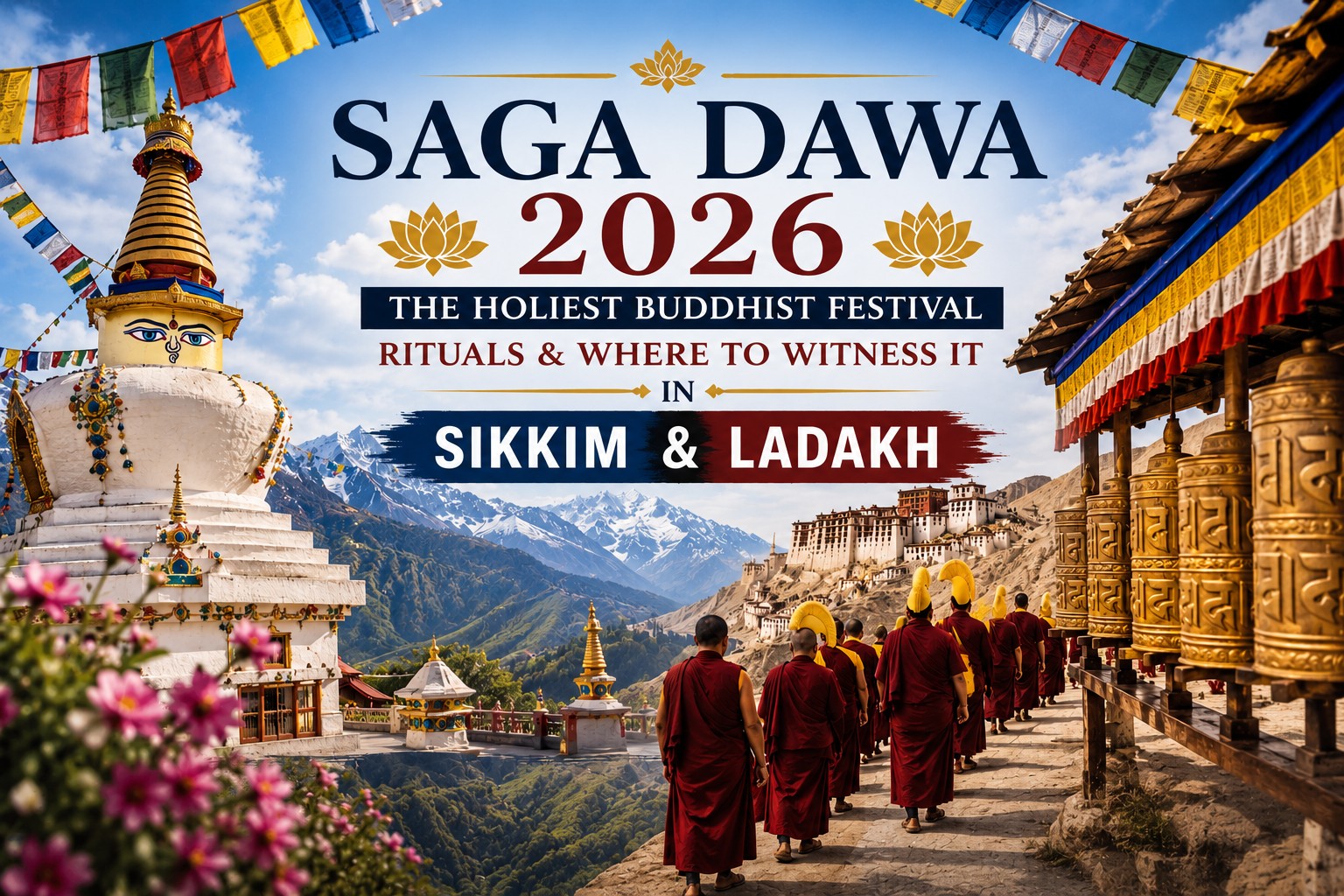
Saga Dawa festival is the holiest Buddhist festival of the Tibetan calendar, commemorating Buddha’s birth, enlightenment, and parinirvana, all three events believed to have occurred on the same full-moon day. In 2026, Saga Dawa Düchen (the principal day) falls on Sunday, 31 May 2026, with the full sacred month running from approximately 16 May to 14 June 2026. The best places in India to witness it are Tsuklakhang Monastery in Gangtok (Sikkim) and Hemis, Thiksey, and Spituk Monasteries in Ladakh.
In this Blog
Quick Info Table
| Detail | Information |
| Saga Dawa Düchen 2026 date | Sunday, 31 May 2026 (full moon of the 4th Tibetan lunar month) |
| Sacred month duration | ~16 May 2026 to 14 June 2026 |
| Religion | Tibetan / Vajrayana Buddhism |
| Also known as | Saka Dawa, Buddha Purnima (in Indian Buddhist tradition), Vesak (in Theravada tradition) |
| Best places in India | Gangtok (Sikkim), Leh (Ladakh), Tawang (Arunachal Pradesh), Bylakuppe (Karnataka) |
| State holiday in | Sikkim |
| Ideal trip duration | 4–6 days |
| Nearest airports | Pakyong (Sikkim), Kushok Bakula Rimpochee (Leh) |
What Is Saga Dawa?
Saga Dawa is the most sacred month in the Tibetan Buddhist calendar, dedicated to the three pivotal events in the life of Gautama Buddha: his birth, his enlightenment under the Bodhi tree, and his parinirvana (passing into final nirvana). According to Tibetan tradition, all three events occurred on the same day – the full moon of the fourth lunar month – making this the single most meritorious day of the year for Buddhists.
The name itself translates roughly to “Month of the Fourth” in Tibetan, with “Saga” referring to the star constellation visible in this period and “Dawa” meaning month. The day of the full moon is called Saga Dawa Düchen (“the great occasion of Saga Dawa”), and observant Buddhists believe that the karmic merit – both positive and negative – of any action performed during this month is multiplied by 100,000.
Worth quoting: Saga Dawa is the only festival in the Buddhist calendar that simultaneously honours the birth, enlightenment, and final passing of the Buddha- a triple commemoration that no other Buddhist holiday observes together.
This is why pilgrims from across Sikkim, Ladakh, Tibet, Bhutan, and Nepal undertake long journeys, perform acts of generosity, refrain from eating meat, and circumambulate sacred sites throughout the month.
When Is Saga Dawa 2026? Exact Dates and Calendar Context
Saga Dawa 2026 begins on the new moon of the fourth Tibetan lunar month (around 16 May 2026) and concludes on the new moon ending that month (around 14 June 2026). The festival’s climactic day, Saga Dawa Düchen, falls on the full moon — Sunday, 31 May 2026.
In 2026, the Tibetan Buddhist Saga Dawa Düchen aligns with Buddha Purnima as observed in the Indian mainland — both fall on 31 May 2026. This convergence is unusual: the Tibetan and Hindu Purnimanta calendars use different lunar reckoning systems, so the two festivals more often fall a day or two apart. In Sikkim and Ladakh, 31 May 2026 is the day on which monasteries hold their grand processions.
The Spiritual Significance: Why This Festival Matters
Saga Dawa carries weight that goes well beyond a single day of observance. Three layers of meaning sit on top of one another:
- The Buddha’s birth in Lumbini, in present-day Nepal, around 563 BCE.
- His enlightenment under the Bodhi tree at Bodh Gaya in Bihar, after six years of meditation and ascetic practice.
- His parinirvana at Kushinagar in Uttar Pradesh, marking his release from the cycle of rebirth.
For practitioners of Vajrayana Buddhism, the dominant school in Sikkim, Ladakh, Bhutan, and Tibet – the month is treated as a continuous spiritual retreat. Lay Buddhists adopt vegetarian diets, monks intensify their meditation schedules, and entire communities organise public acts of merit such as releasing captive fish and birds, sponsoring butter-lamp offerings, and donating food to monasteries.
Worth quoting: Buddhists believe any virtuous act performed during the month of Saga Dawa generates 100,000 times the karmic merit of the same act on an ordinary day, which is why the festival is sometimes called the “Bumgyur Dawa” – the “month of multiplication.”
Rituals and Practices Observed During Saga Dawa
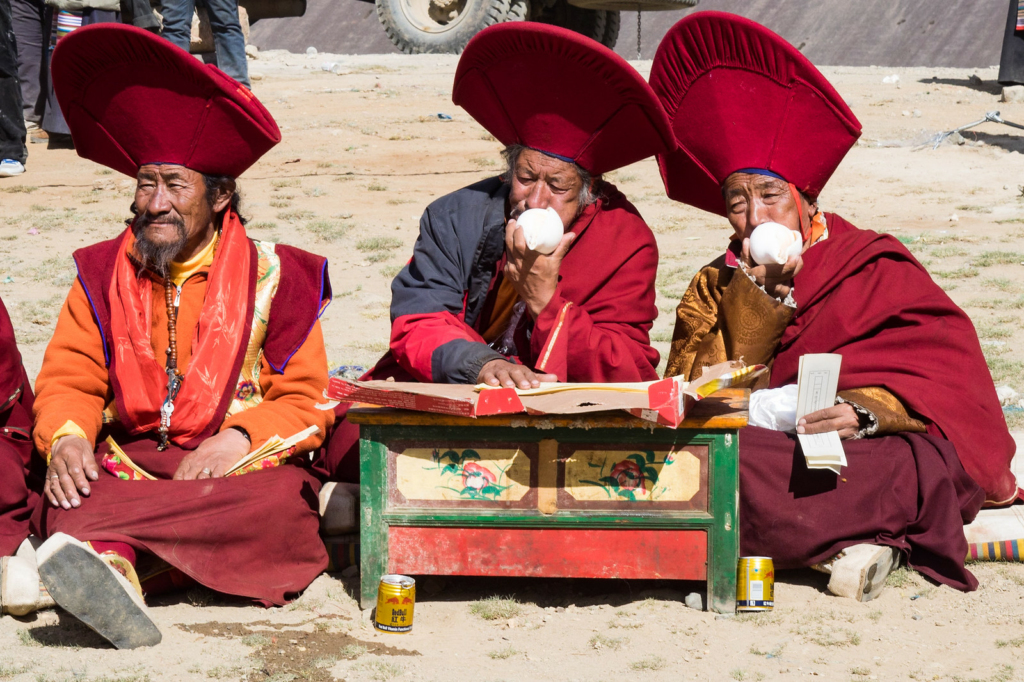
The festival is participatory rather than performative. If you visit a monastery in Gangtok or Leh during Saga Dawa, you will not just watch — locals will gently invite you to join the kora, accept tea, and add a butter lamp to the shrine. Here are the core rituals you can expect:
1. Kora (Circumambulation)
Pilgrims walk clockwise around stupas, monasteries, and sacred mountains while reciting mantras — most commonly Om Mani Padme Hum. In Gangtok, devotees circle the Tsuklakhang Monastery and the Do-drul Chorten; in Leh, the kora goes around the Shanti Stupa and the old town circuit known as the Tsemo kora.
- What you’ll need: comfortable shoes, a water bottle, modest clothing covering shoulders and knees.
- Pro tip: Join the dawn kora — between 5:30 AM and 7:00 AM — for the calmest, most meditative experience before tour buses arrive.
2. The Grand Holy Book Procession (Pang Lhabsol-style Parade)
In Sikkim, monks carry the Kangyur — the 108-volume collection of Buddha’s direct teachings — from the Tsuklakhang Monastery through the streets of Gangtok. The procession includes traditional Sikkimese music, the long dungchen horns, and lay devotees who bow as the scriptures pass.
- Timing: Procession typically starts at 8:00 AM from Tsuklakhang and concludes by midday.
- Entry fee: Free; public event.
- Pro tip: Position yourself near the Ridge Park area for the best procession photos with mountain backdrops.
3. Tsethar (Releasing Animals)
Devotees buy live fish from markets and release them into rivers, or free birds and goats from slaughter. This is one of the most visible Saga Dawa practices in both Sikkim and Ladakh, and is considered the single most meritorious act one can perform during this month.
4. Butter Lamp Offerings
Monasteries light hundreds — sometimes thousands — of butter lamps. Visitors are usually welcome to sponsor a lamp for a small donation (typically ₹50–₹200 per lamp).
5. Fasting and Vegetarianism
Most Buddhist households across Sikkim and Ladakh observe strict vegetarianism for the entire month. Some practitioners undertake the Nyungne fast, a two-day silent retreat where the second day involves complete abstention from food, water, and speech.
6. Reciting Mantras and Reading Scriptures
The Kangyur and Tengyur are read aloud at monasteries throughout the month. Lay devotees recite Om Mani Padme Hum and the Vajra Guru mantra — often using prayer wheels and malas (108-bead rosaries).
7. Charity and Dana
Donations of food, money, robes, and medicine to monasteries and the poor are intensified during this month. In Ladakh, it’s common to see families distributing tea and bread (khambir) to pilgrims walking the kora.
Where to Experience Saga Dawa in Sikkim
Sikkim observes Saga Dawa as a public state holiday, and the celebrations in Gangtok are among the most accessible in India for travellers who don’t want to undertake the long journey to Ladakh or Tibet.
Tsuklakhang Monastery, Gangtok
- What happens: The seat of the Royal Chapel and the starting point of the Holy Book Procession. Hundreds of monks gather here before the parade begins.
- Location: Inside the former Royal Palace complex, near the Ridge.
- Entry fee: Free (donations welcomed).
- Timings: 7:00 AM – 4:00 PM on Saga Dawa Düchen.
- How to reach: A 10-minute walk uphill from MG Marg. Taxis from the city centre cost ₹100–₹150.
- Time required: 2–3 hours including the procession start.
- Ideal for: First-time visitors, families, photography enthusiasts.
- Pro tip: Reach by 7:00 AM to secure a viewing spot near the monastery courtyard before the procession assembles.
Do-drul Chorten
- What happens: Devotees circumambulate the chorten throughout the day. The 108 prayer wheels around the stupa are spun by a continuous stream of pilgrims.
- Location: Near the Namgyal Institute of Tibetology, Gangtok.
- Entry fee: Free.
- Timings: 5:00 AM – 7:00 PM.
- How to reach: 3 km from MG Marg; ₹150 by taxi.
- Time required: 1–1.5 hours.
- Ideal for: Quiet reflection and ritual observation.
- Pro tip: Carry a thin shawl — mornings in Gangtok in early June hover around 14–16°C.
Rumtek Monastery
- What happens: Special prayers and mask performances by Karma Kagyu monks. Smaller and more contemplative than Gangtok’s main events.
- Location: 24 km from Gangtok.
- Entry fee: ₹20 (Indian nationals), ₹100 (foreign nationals).
- Timings: 6:00 AM – 6:00 PM.
- How to reach: 1-hour drive from Gangtok; shared taxis ₹250 per person.
- Time required: Half a day with travel.
- Ideal for: Travellers interested in the Karmapa lineage and Tibetan Buddhist art.
Phodong and Labrang Monasteries (North Sikkim)
- What happens: Local processions and butter-lamp ceremonies in a far quieter, more village-like setting.
- Location: 38 km north of Gangtok, in Mangan district.
- Entry fee: Free; donations welcomed.
- How to reach: Shared jeep from Gangtok (₹350) or private taxi (₹2,500 return).
- Ideal for: Travellers who want to escape Gangtok’s crowds and see how rural Sikkimese communities mark the festival.
Where to Experience Saga Dawa in Ladakh
Ladakh celebrates Saga Dawa with a region-wide intensity that’s hard to match. Because June is also the start of Ladakh’s main tourist season, this is one of the rare moments when high-altitude pilgrimage culture and traveller-friendly logistics align.
Hemis Monastery
- What happens: Special pujas, mask dances, and large-scale butter-lamp offerings. Note: the famous Hemis Tsechu festival is separate (held in late June/early July), but Saga Dawa rituals here are deeply moving.
- Location: 45 km southeast of Leh.
- Entry fee: ₹100.
- Timings: 8:00 AM – 1:00 PM and 2:00 PM – 6:00 PM.
- How to reach: Shared taxi from Leh ₹400 per seat; private taxi ₹3,000 return.
- Time required: A full day including travel.
- Ideal for: Photographers, culture-focused travellers.
- Pro tip: Hemis sits at 3,600 m; acclimatise in Leh for at least 48 hours before visiting.
Thiksey Monastery
- What happens: Saga Dawa morning prayers begin before sunrise. The 12-storey monastery — often called “Mini Potala” — fills with chanting monks and visiting pilgrims.
- Location: 19 km southeast of Leh.
- Entry fee: ₹50.
- Timings: Morning prayers begin at 6:30 AM; visit between 7:00 AM – 7:00 PM.
- How to reach: ₹250 by shared taxi from Leh; 30-minute drive.
- Time required: 2–3 hours.
- Ideal for: Travellers wanting to attend a real Vajrayana morning prayer service.
- Pro tip: Arrive at 6:15 AM to witness the conch-horn call that opens the prayer ceremony.
Spituk Monastery and the Leh City Kora
- What happens: Devotees from across Leh form a continuous circumambulation route covering Spituk, the Shanti Stupa, the Leh Palace, and the old town — a route of roughly 6 km.
- Spituk entry fee: ₹50.
- Timings: Best walked between 5:30 AM and 9:00 AM.
- How to reach: Spituk is 8 km from Leh; taxi ₹300 one way.
- Time required: 3–4 hours for the full kora circuit.
- Ideal for: Walkers, photographers, slow-travel enthusiasts.
Shanti Stupa, Leh
- What happens: Massive butter-lamp lighting at dusk on Saga Dawa Düchen. Hundreds of lamps line the stupa terraces against the backdrop of the Stok range.
- Entry fee: Free.
- Timings: Lamps lit from 7:00 PM onwards.
- Time required: 1.5 hours.
- Pro tip: Carry a thermal jacket — June nights at 3,600 m can drop below 8°C.
Diskit and Likir Monasteries
- Location: Diskit (Nubra Valley, 120 km from Leh); Likir (52 km west of Leh).
- What to expect: Smaller, intimate Saga Dawa observances away from the main tourist circuit.
- Best for: Travellers already on multi-day Nubra or Sham Valley itineraries.
Suggested Itineraries for Saga Dawa 2026
4-Day Sikkim Itinerary (28 – 31 May 2026)
- Day 1 (28 May): Arrive Bagdogra → drive to Gangtok (4 hrs). Evening at MG Marg.
- Day 2 (29 May): Rumtek Monastery + Do-drul Chorten + Namgyal Institute.
- Day 3 (30 May): Day trip to Tsomgo Lake or Phodong Monastery; evening prayer attendance at Tsuklakhang.
- Day 4 (31 May – Saga Dawa Düchen): Pre-dawn arrival at Tsuklakhang, watch the Holy Book Procession, afternoon kora at Do-drul Chorten, depart in evening or stay a fifth night.
6-Day Ladakh Itinerary (27 May – 1 June 2026)
- Day 1 (27 May): Arrive Leh. Rest day for acclimatisation.
- Day 2 (28 May): Leh Palace, Shanti Stupa, central market.
- Day 3 (29 May): Thiksey morning prayers + Shey + Stok Palace.
- Day 4 (30 May): Hemis Monastery + Stakna.
- Day 5 (31 May – Saga Dawa Düchen): Pre-dawn kora around old Leh, Spituk Monastery, evening butter-lamp ceremony at Shanti Stupa.
- Day 6 (1 June): Departure.
Distances and Practical Travel Information
| Route | Distance | Time | Mode |
| Bagdogra Airport → Gangtok | 124 km | 4–4.5 hrs | Taxi / shared cab |
| Pakyong Airport → Gangtok | 31 km | 1 hr | Taxi |
| New Jalpaiguri Railway → Gangtok | 148 km | 4.5–5 hrs | Taxi |
| Delhi → Leh (flight) | — | 1 hr 25 min | Direct flight |
| Manali → Leh (road) | 428 km | 12–14 hrs | SUV (open mid-June onwards) |
| Srinagar → Leh (road) | 418 km | 11–12 hrs | SUV (open from May) |
| Leh → Hemis | 45 km | 1 hr | Taxi |
| Leh → Thiksey | 19 km | 30 min | Taxi |
| Gangtok → Rumtek | 24 km | 1 hr | Taxi |
Important note for Ladakh travellers: As of 31 May 2026, the Srinagar–Leh highway typically opens by mid-May, while the Manali–Leh route opens later (often early June). For Saga Dawa on 31 May, flying into Leh is the most reliable option. [VERIFY: 2026 road opening dates with BRO before booking road journeys.]
Where to Stay During Saga Dawa 2026
Both Gangtok and Leh fill up quickly during the Saga Dawa period — Leh especially, because it coincides with the start of peak season. Booking 6–8 weeks in advance is strongly recommended.
For travellers who want comfort, privacy, and a base that feels like home rather than a transit hotel, StayVista offers curated homestays in Sikkim and luxury cottages in nearby Himalayan destinations. Our Gangtok homestays — many with floor-to-ceiling Kanchenjunga views — are ideal for families and small groups who want a quiet retreat after long days at the monasteries.
A few StayVista properties our team recommends for a Saga Dawa trip:
- Sikkim homestays near Gangtok with private balconies overlooking the valley — perfect for the early-morning kora rituals.
- Pelling stays for travellers extending the trip westward to see Pemayangtse Monastery and the Khecheopalri Lake area.
- Darjeeling and Kalimpong homestays as practical pre- or post-Sikkim base stations, especially if you’re flying into Bagdogra.
Where to stay matters more during festival weeks. A homestay host who can wake you at 4:30 AM, brew butter tea, and point you to the right monastery gate is worth more than a five-star concierge.
What to Pack for Saga Dawa Travel
| Item | Why |
| Layered clothing (fleece + windproof jacket) | Mornings can drop to 8–14°C in both Sikkim and Ladakh |
| Comfortable walking shoes | Kora routes involve 4–8 km of walking |
| Modest clothing (covering shoulders and knees) | Required inside monasteries |
| Refillable water bottle | Hydration is critical above 3,000 m |
| Diamox or equivalent (consult doctor) | For Ladakh’s altitude |
| Sun hat, SPF 50 sunscreen, sunglasses | UV is intense at high altitudes even in cool weather |
| Small denominations of cash (₹10, ₹20, ₹50, ₹100) | For butter-lamp offerings and donation boxes |
| Headlamp or torch | For pre-dawn kora walks |
Etiquette: How to Participate Respectfully
- Walk clockwise around stupas, monasteries, and prayer wheels — never anti-clockwise.
- Remove shoes before entering monastery prayer halls.
- Ask before photographing monks, ritual objects, and especially the Kangyur procession.
- Don’t point with your feet at altars, monks, or images of the Buddha.
- Donate quietly — donation boxes near butter-lamp racks and main altars are the appropriate channel.
- Avoid loud conversation inside monastery courtyards during prayer sessions.
- Don’t release exotic or non-native species if you participate in tsethar — buy local fish from monastery-supervised programmes only.
Frequently Asked Questions
Saga Dawa Düchen 2026 falls on Sunday, 31 May 2026. The full sacred month runs from approximately 16 May to 14 June 2026, according to the Tibetan lunar calendar.
They commemorate the same events — Buddha’s birth, enlightenment, and parinirvana — but use different calendars. Buddha Purnima follows the Hindu Purnimanta calendar, while Saga Dawa follows the Tibetan lunar calendar. In 2026, the two festivals happen to coincide on the same day, 31 May — an alignment that does not occur every year.
Yes, but only in Sikkim, where it is observed as a state-wide gazetted holiday. In Ladakh, while it is not formally a government holiday, most local businesses, monasteries, and schools observe the day informally.
For accessibility and grandeur, Tsuklakhang Monastery in Gangtok is the most rewarding destination because of its Holy Book Procession. For atmosphere and scale, Hemis and Thiksey Monasteries in Ladakh offer the most immersive experience.
Absolutely. Monasteries in Sikkim and Ladakh welcome visitors of any background to attend prayer sessions, walk the kora, light butter lamps, and observe rituals. Respect the etiquette guidelines above, and ask permission before photographing.
Most observant Buddhists eat only vegetarian food during the entire month, and many also abstain from onion, garlic, and alcohol. Restaurants in Gangtok and Leh expand their vegetarian menus during this period — finding a Buddhist-style vegetarian thali is easy.
The Manali–Leh highway typically opens by early June each year, depending on snow conditions. For Saga Dawa Düchen on 31 May 2026, the safer route is via Srinagar (usually open from mid-May) or by flight directly to Leh.
At least 6–8 weeks in advance, especially for Leh (where Saga Dawa coincides with peak season). Gangtok is slightly more flexible but still fills quickly for the festival weekend.
Why Saga Dawa is a must visit
Saga Dawa is one of the few festivals in India where the act of participating — walking a kora at dawn, lighting a butter lamp, releasing a fish into a river — is more rewarding than watching from the sidelines. If 2026 is the year you’ve been considering a trip to Sikkim or Ladakh, planning it around 1 June 2026 transforms an ordinary mountain holiday into a quiet, meaningful pilgrimage.
Whether you choose the Kanchenjunga-facing balconies of a Gangtok homestay or a cottage closer to Pelling, the right base makes all the difference. Explore StayVista’s Sikkim collection to find a property that lets you start your day with the monks — and end it with the mountains.