

What Is the ISKCON Rasa Museum Delhi 2026 — Timings, Entry Fee, Exhibits & Best Time to Visit?
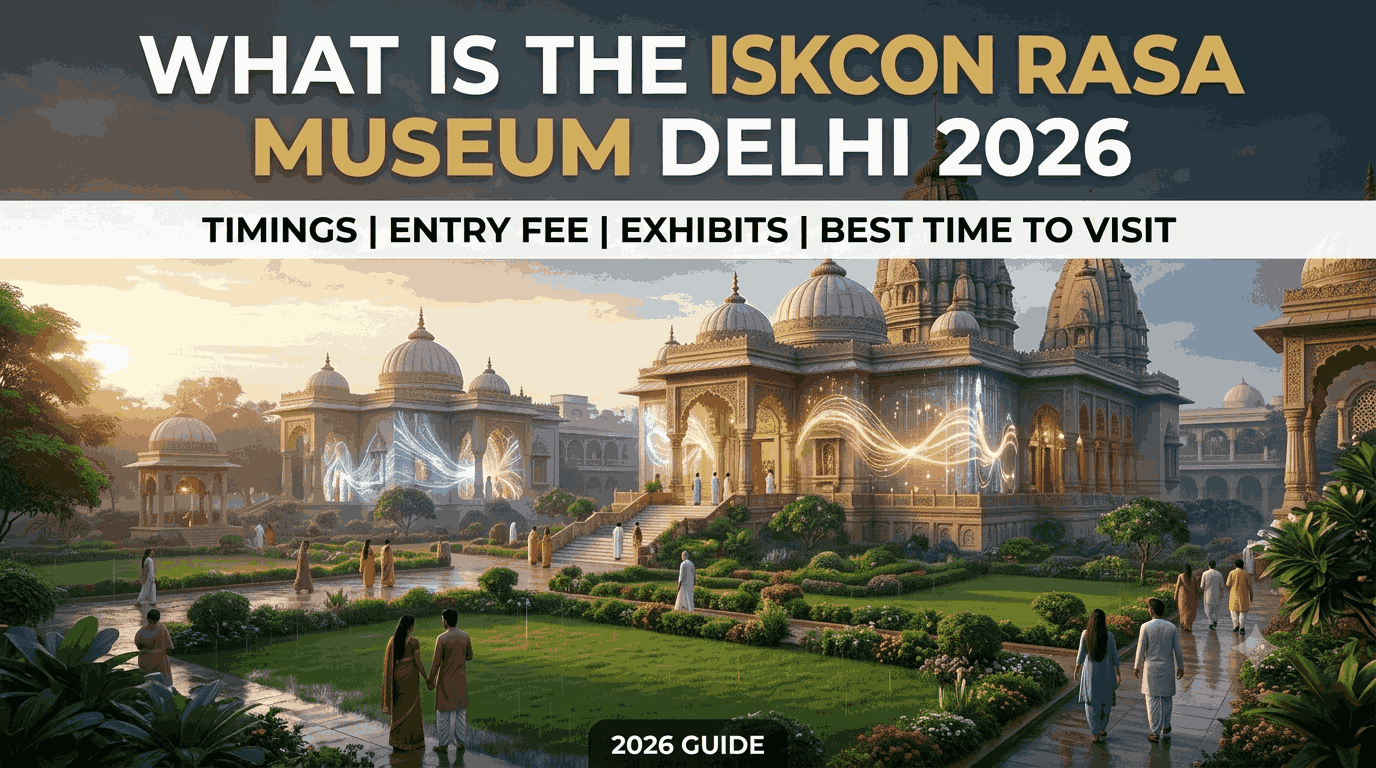
The ISKCON Rasa Museum in Delhi is a 13,500 sq ft immersive Vedic heritage museum inside the Sri Sri Radha Parthasarathi temple at East of Kailash, South Delhi. Entry is free. It opens within temple hours, roughly 4:30 AM to 9 PM, and uses virtual reality to retell the Ramayana and Mahabharata.
The redeveloped “Rasa – An Ocean of Nectar” wing was inaugurated in April 2026 during ISKCON’s 60th anniversary. Built for ₹14 crore with a ₹4 crore Ministry of Culture grant, it draws 30,000+ visitors monthly (ISKCON News, 2026). Admission is free; the best months to visit are October to March.
Delhi’s spiritual map gained a new landmark in 2026. The ISKCON temple at East of Kailash — already one of South Delhi’s most visited shrines — now houses a fully reimagined museum that swaps glass display cases for headsets, projection mapping, and walk-through soundscapes. For anyone planning a trip, the practical questions come first: when does it open, what does it cost, and what’s actually inside? Here’s a clear, fact-checked guide.
In this Blog
What is the ISKCON Rasa Museum and why does it matter in Delhi?
The Rasa Museum is ISKCON Delhi’s 13,500 sq ft immersive gallery that presents Vedic literature through virtual reality and light-and-sound storytelling. The redeveloped “Rasa – An Ocean of Nectar” wing was inaugurated in April 2026 as part of ISKCON’s 60th anniversary (ISKCON News, 2026). It matters because few Indian temples pair traditional darshan with technology on this scale.
The original museum dates back to 2001, but the 2026 redevelopment changed its character entirely. The project cost roughly ₹14 crore and received a ₹4 crore grant from the Ministry of Culture, Government of India — a signal that the central government now treats immersive Vedic storytelling as part of mainstream cultural tourism.

That backing isn’t symbolic. The Tourism and Culture Minister attended the inauguration alongside the Ambassador of Belgium to India, framing the museum as a bridge between heritage and high-tech experience design.
According to ISKCON’s own figures, the museum already attracts more than 30,000 visitors each month, and the temple complex sees over 10,000 footfalls on a typical day (Today’s Traveller, 2026). For a free attraction, those numbers put it among the busiest cultural venues in South Delhi.
Most “Vedic museums” in India lean on static dioramas and printed panels. Rasa is unusual because the central draw is a VR narrative experience rather than an artefact collection — closer to a planetarium show than a traditional gallery.
What are the ISKCON Delhi Museum timings in 2026?
The museum is accessible within the temple’s daily hours, which run from the 4:30 AM Mangala Arati until roughly 9:00 PM, with the main hall closed between 1:00 PM and 4:00 PM (Delhi Tourism, 2026). Plan museum visits for mid-morning or evening to avoid the afternoon closure.
The day at ISKCON East of Kailash follows the standard ISKCON aarti schedule. Devotees arrive before dawn for Mangala Arati; the complex then stays active through the morning, pauses in the early afternoon, and reopens for evening programs.
Here’s a simple breakdown of when to plan your visit:
- Morning slot (9:00 AM–12:30 PM): Quietest for the museum; good light for the complex
- Afternoon closure (1:00 PM–4:00 PM): Main hall shut — avoid arriving here
- Evening slot (4:30 PM–8:30 PM): Livelier, with aarti and the most energy
- Mangala Arati (4:30 AM): For early-rising devotees, not casual museum visitors
A practical tip from visitors who’ve timed it well: arrive by around 9:30 AM on a weekday if your priority is the VR show without crowds. Weekend evenings and festival days can mean long queues, since the museum sits inside an active place of worship, not a standalone ticketed venue.
Because show slots and the museum’s internal schedule can shift around festivals and maintenance, confirm the current museum show timing at the temple reception or helpdesk on the day you visit. Is it worth calling ahead? For a festival weekend, yes.
Is the ISKCON Delhi Museum entry free in 2026?
Yes. Entry to the ISKCON temple and the Rasa Museum is free for all visitors, with no ticket required (Delhi Tourism, 2026). The temple sustains its programs through voluntary donations, which can be made in cash or online, but payment is never a condition of entry.
This is one of the museum’s biggest draws. A comparable VR-led cultural experience at a commercial venue would typically carry a ticket price, yet ISKCON keeps Rasa open to everyone at no cost — funded instead by its ₹14 crore investment and the Ministry of Culture grant.
According to ISKCON Delhi, admission is free and donations remain entirely optional, supporting temple upkeep, prasadam distribution, and educational programs (ISKCON News, 2026). Visitors who wish to contribute can do so at on-site counters or through the temple’s official payment gateway.
A few visitor notes worth knowing:
- No entry fee for the temple or museum
- Donations are voluntary — suggested amounts may be displayed, but are not mandatory
- Guided tours and spiritual counselling may be arranged separately; ask at reception
- Photography rules vary by hall, so check signage near the VR exhibits
What Vedic heritage exhibits are inside the Rasa Museum?
The Rasa Museum’s centrepiece is “Rasa – An Ocean of Nectar,” a VR and light-and-sound show that walks visitors through the Ramayana and Mahabharata, plus the Dasha Avatar and Krishna’s pastimes (ISKCON News, 2026). It also displays an 800 kg Srimad Bhagavad Gita — described as the world’s largest sacred book.
The 13,500 sq ft space is built around immersive technology rather than static artefacts. Interactive storytelling, projection mapping, and virtual reality replace traditional glass cases, letting visitors move through scenes from the epics rather than read about them on panels.
The thematic exhibits span the core of Gaudiya Vaishnava and broader Vedic teaching:
- The Ramayana — retold through immersive VR sequences
- The Mahabharata — including the setting of the Bhagavad Gita
- Dasha Avatar — the ten incarnations of Vishnu
- Krishna’s vibhutis — his divine manifestations and pastimes
- Lord Chaitanya’s pastimes and Srila Prabhupada’s story
- Philosophical concepts — Dharma, Bhakti, Karma, Jiva, and Paramatma
The 800 kg Bhagavad Gita, printed in Italy, anchors the collection as a physical showpiece amid the digital displays (Today’s Traveller, 2026). For families, the mix of VR spectacle and tangible artefact tends to hold both children and adults.
How do you reach the ISKCON Rasa Museum by metro?
The nearest metro station is Nehru Place on the Violet Line (Line 6), a short 5–10 minute walk from the temple at East of Kailash; Kailash Colony station is a convenient alternative (Maps of India, 2026). From Nehru Place, follow Hare Krishna Marg toward the hilltop white spire.
The temple sits on Hare Krishna Hills in the Sant Nagar area of East of Kailash, South Delhi. The distinctive white spire is visible from the approach road, making it easy to find on foot.
Your transport options:
- Metro (recommended): Nehru Place (Violet Line), then a 5–10 minute walk
- Alternate metro: Kailash Colony (Violet Line), also within walking distance
- Bus: Routes including 392, 427, 429, and 433 stop nearby
- Taxi / auto: Ask for “ISKCON Temple, East of Kailash” or “Hare Krishna Hills”
- Car: On-site parking is available at the complex
Some online guides wrongly list Rithala metro (Red Line) as the nearest station. Rithala serves a different ISKCON temple in North-West Delhi. For the Rasa Museum at East of Kailash, you want Nehru Place on the Violet Line.
What is the best time to visit ISKCON Delhi Museum?
The best months to visit are October to March, when Delhi’s weather is cool and comfortable for exploring the open-air temple complex (Delhi Tourism, 2026). Within the day, mid-morning and early evening avoid both the afternoon hall closure and peak festival crowds.
Delhi summers (April–June) are intensely hot, and the monsoon (July–September) brings humidity, so the winter window is genuinely more pleasant for a complex that involves outdoor walking between halls.
Timing also depends on what you want from the visit:
- For calm and clear VR slots: weekday mornings, October–March
- For festive atmosphere: Janmashtami, Diwali, and Holi — but expect huge crowds
- For comfortable weather: any cool, dry day between October and March
Janmashtami is the single biggest day here. ISKCON reports that the temple can draw close to 300,000 devotees on Sri Krishna Janmashtami (Today’s Traveller, 2026). The midnight aarti is spectacular — but it is the opposite of a quiet museum visit.
So which is “best”? If you want the exhibits without the crush, a winter weekday morning wins. If you want the spiritual energy at full volume, plan around a festival and accept the crowds.
Where to stay near the ISKCON Rasa Museum in Delhi?
The ISKCON Rasa Museum sits in East of Kailash, South Delhi — one of the city’s best-connected neighbourhoods for accommodation, with Greater Kailash, Nehru Place, and Lajpat Nagar all within a short drive. For travellers who want a private, home-like base rather than a standard hotel, StayVista operates a range of luxury homestays and villas across Delhi NCR.
Staying in a private villa or homestay suits families, groups, and anyone combining the museum with a longer Delhi or weekend-getaway itinerary. Here are a few StayVista options worth knowing, grouped by how far they sit from the temple.
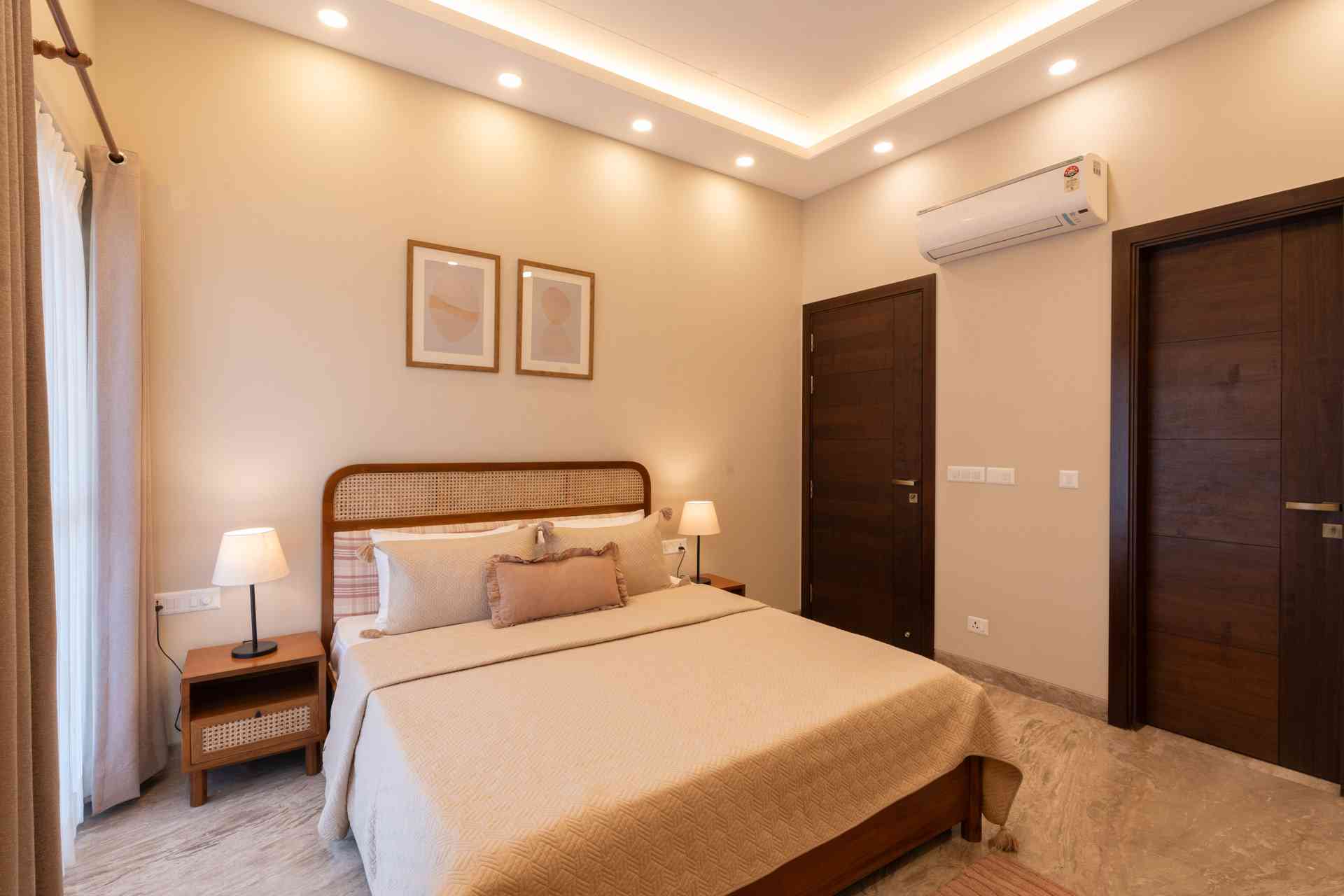
Comfort Room @ StayVista Residences at GK-1 Villa
A practical note: traffic between South Delhi and the Gurgaon/Sohna belt can be heavy on weekends, so if your main goal is the museum, an in-city homestay near Greater Kailash will save you the most time.
Frequently Asked Questions
The museum is accessible within temple hours, from the 4:30 AM Mangala Arati until around 9:00 PM, with the main hall closed between 1:00 PM and 4:00 PM (Delhi Tourism, 2026). Visit mid-morning or evening for the best experience.
Yes. Entry to both the ISKCON temple and the Rasa Museum is free for all visitors, with no ticket required. Donations are voluntary and support temple programs, but they are never a condition of entry (ISKCON News, 2026).
The redeveloped “Rasa – An Ocean of Nectar” wing was inaugurated in April 2026 as part of ISKCON’s 60th anniversary celebrations. The original museum first opened in 2001, but the 2026 version added immersive VR exhibits (ISKCON News, 2026).
Nehru Place station on the Violet Line is the nearest, a 5–10 minute walk from the temple at East of Kailash. Kailash Colony station is a close alternative (Maps of India, 2026). It is not near Rithala metro.
The museum features a VR show on the Ramayana and Mahabharata, the Dasha Avatar, Krishna’s pastimes, and an 800 kg Srimad Bhagavad Gita across 13,500 sq ft (Today’s Traveller, 2026). It uses light, sound, and interactive storytelling.
October to March is best, when Delhi’s weather is cool and comfortable for the open-air complex. Avoid the harsh April–June summer and the July–September monsoon (Delhi Tourism, 2026). Weekday mornings are quietest for the museum
The museum draws more than 30,000 visitors a month, while the temple complex sees over 10,000 footfalls on a typical day. On Janmashtami, attendance can approach 300,000 devotees (Today’s Traveller, 2026).
Guided tours and spiritual counselling can usually be arranged on-site; ask at the temple reception or helpdesk. Since the museum sits within an active place of worship, availability varies by day and around festivals, so confirming in advance is recommended.
Final Takeaways
The ISKCON Rasa Museum is one of South Delhi’s most accessible cultural experiences of 2026 — free, technology-driven, and rooted in Vedic heritage. Here’s what to remember:
- Free entry, open within temple hours (4:30 AM–9 PM, hall closed 1–4 PM)
- 13,500 sq ft of VR-led exhibits on the Ramayana, Mahabharata, and more
- Nearest metro: Nehru Place (Violet Line), 5–10 minutes’ walk
- Best time: October–March; weekday mornings for calm, festivals for atmosphere
- 30,000+ monthly visitors, backed by a ₹4 crore Ministry of Culture grant
Whether you come for darshan, the VR storytelling, or simply a cool-season morning out in South Delhi, the museum rewards a planned visit. Confirm show timings on the day, travel by metro, and aim for the October–March window.