

Yamuna Pushkaram 2026: Dates, 7 Sacred Ghats & Rituals Guide
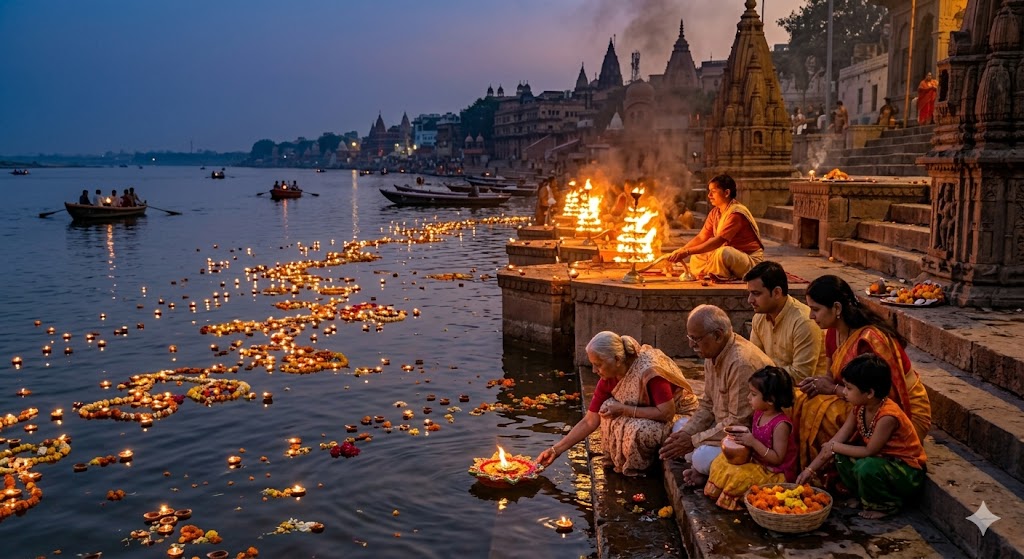
For the first time since 2014, the Yamuna becomes a teertha of liberation — and for only 12 days. Yamuna Pushkaram 2026 runs from 2 June to 13 June, after which it won’t return until roughly 2038. If you’ve been waiting for the right Pushkaram to do the snan, the tarpan and the pind daan for your ancestors, this is the window.
Most pages telling you about it leave out the details that actually matter: the exact most auspicious days, the dawn snan timing, which ghat in which city is the right one for you, and the honest read on early-June heat at Mathura, Vrindavan, Agra, and Prayagraj (Triveni Sangam). This guide pulls that together with sourced facts, a 1,376 km river-journey view of the seven sacred ghats, and where to base yourself near each.
Yamuna Pushkaram 2026 runs 2–13 June 2026 — the first since 2014 — held once every 12 years when Jupiter (Guru / Brihaspati) enters Cancer (Karka Rashi). The holiest snan (holy dip) is at dawn on Day 1 (2 June) and the closing day (13 June), ideally during Brahma Muhurat (~4:30–6:00 AM). Pilgrims gather at Yamuna ghats in Prayagraj (Triveni Sangam), Mathura (Vishram Ghat), Vrindavan (Keshi Ghat), Delhi (Nigambodh Ghat) and Agra for snan, pitru tarpan and pind daan. Entry to all ghats is free.
In this Blog
Yamuna Pushkaram 2026 — Quick Info
| Detail | Info |
|---|---|
| Dates (Adi Pushkaram) | 2–13 June 2026 (12 days) |
| Most auspicious dip | Day 1 (2 June) & closing day (13 June), at dawn |
| Held every | 12 years (last: 19–30 June 2014) |
| Zodiac / planet | Jupiter (Guru) enters Cancer (Karka Rashi) |
| Best snan time | Brahma Muhurat, ~4:30–6:00 AM |
| Main ghats | Prayagraj (Triveni Sangam), Mathura (Vishram Ghat), Vrindavan (Keshi Ghat), Delhi (Nigambodh Ghat), Agra |
| Entry fee | Free at all ghats |
| Nearest railheads | Mathura Jn · Agra Cantt · Prayagraj Jn |
| Nearest airports | Delhi (IGI), Agra, Prayagraj (Bamrauli) |
| Ideal duration | 1 day (Braj) · 2–3 days (Braj + Taj) · 4–5 days (Braj + Sangam + Varanasi) |
When is Yamuna Pushkaram 2026?
Yamuna Pushkaram 2026 takes place from 2 June to 13 June 2026 — the 12-day Adi Pushkaram window that begins the moment Jupiter (Guru) enters Cancer (Karka Rashi). The single holiest day for the snan is Day 1, 2 June, ideally at dawn during Brahma Muhurat (approximately 4:30 to 6:00 AM). The closing day, 13 June, carries equivalent merit and tends to be quieter than Day 1.
Across the 12 days, every dawn is considered auspicious, but the punya is graded: the first day, the last day, and the madhya (middle) day are most prized. If you’re travelling from far, target one of those three.
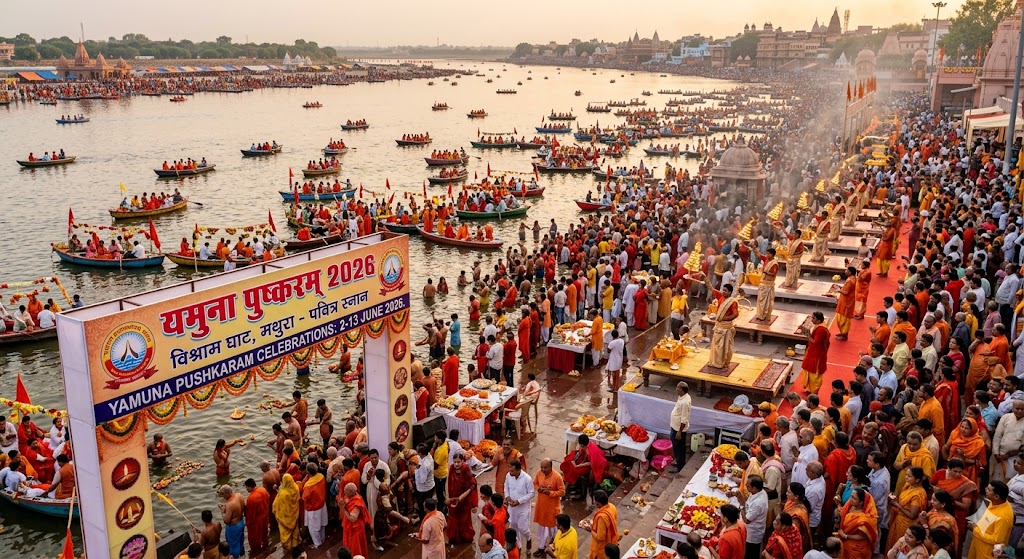
Adi vs Antya Pushkaram — what’s the difference?
Adi Pushkaram is the opening 12 days when Jupiter first enters the river’s governing zodiac — that’s 2–13 June 2026 for the Yamuna. Antya Pushkaram is the closing window at the very end of Jupiter’s roughly year-long transit out of Cancer; it falls about a year later. Both Adi and Antya carry the highest spiritual significance, with Adi drawing the largest crowds because it marks the beginning of the cycle.
Best time of day for the holy dip
The pre-sunrise Brahma Muhurat — about 96 minutes before sunrise to 48 minutes before sunrise — is the most auspicious window. In early June at Mathura, that’s roughly 4:00 to 5:00 AM; by 5:30 AM the ghats begin to fill, and by 7:00 AM the heat starts pushing pilgrims off the steps.
Yamuna Pushkaram 2026 runs 2–13 June 2026, the first since 2014, held when Jupiter enters Cancer (Karka Rashi). Day 1 (2 June) and Day 12 (13 June) are the most auspicious for the snan, with Brahma Muhurat (~4:30–6:00 AM) the holiest time of day.
Why is Yamuna Pushkaram celebrated every 12 years?
Pushkaram is celebrated on each of India’s 12 sacred rivers once every ~12 years — tied to Jupiter’s roughly 12-year orbit through the zodiac. The Yamuna’s turn comes when Jupiter enters Cancer (Karka Rashi), which is why Yamuna Pushkaram last occurred in 2014 (Wikipedia: Yamuna Pushkaram) and returns in 2026.
The cycle comes from the Pushkara legend: a devotee, granted a boon by Lord Brahma, takes the form of Pushkara and enters whichever river Jupiter’s current sign governs, charging its waters with the power to wash away sin and liberate ancestors. The river–zodiac mapping is fixed; only the dates shift each cycle, because Jupiter’s exact transit timing varies.
The 12 rivers and their zodiac signs:
| Jupiter’s sign | River |
|---|---|
| Aries (Mesha) | Ganga |
| Taurus (Vrishabha) | Narmada |
| Gemini (Mithuna) | Saraswati |
| Cancer (Karka) | Yamuna |
| Leo (Simha) | Godavari |
| Virgo (Kanya) | Krishna |
| Libra (Tula) | Kaveri |
| Scorpio (Vrishchika) | Bhima |
| Sagittarius (Dhanus) | Tamiraparani |
| Capricorn (Makara) | Tungabhadra |
| Aquarius (Kumbha) | Sindhu |
| Pisces (Meena) | Pranhita |
Why are 2026’s dates different from 2014’s?
The previous Yamuna Pushkaram fell on 19–30 June 2014; 2026’s window opens 17 days earlier, on 2 June. That’s not an inconsistency — Jupiter’s exact transit date shifts each cycle. Each Pushkaram begins the moment Jupiter formally enters the new zodiac, and that timing moves by days or weeks every 12 years.
The Pushkaram cycle is tied to Jupiter’s ~12-year orbit; the Yamuna’s turn comes when Jupiter enters Cancer (Karka Rashi). The last Yamuna Pushkaram was 19–30 June 2014; the 2026 edition runs 2–13 June.
Why is the Yamuna sacred?
In Hindu belief, the Yamuna is the goddess Yami, daughter of the sun god Surya and his wife Saranyu, and twin sister of Yama, the lord of death (Wikipedia: Yamuna in Hinduism). She is, in effect, the Lady of Life to Yama’s Lord of Death, which is why a Pushkaram dip in her waters is believed to wash away sin and grant moksha to ancestors. During the 12 days, the river’s spiritual potency is at its peak.
The Yamuna is also the river of Krishna’s childhood. The Mathura–Vrindavan ghats are where Krishna is said to have played, slain the serpent Kaliya (Kaliya Ghat, Vrindavan), and danced the Raas Leela, which is why these ghats, more than any others, draw devotional pilgrims during the Pushkaram. The Krishna emotional pull is the reason Vrindavan’s small Keshi Ghat fills as densely as the much larger Triveni Sangam.
The Yamuna’s sacred geography
The Yamuna travels 1,376 km from the Yamunotri Glacier (~4,500 m, Uttarakhand) to the Triveni Sangam at Prayagraj, where it merges with the Ganga (Wikipedia: Yamuna). It is the longest tributary of the Ganga, supplies an estimated 70% of Delhi’s drinking water, and roughly 57 million people depend on its waters. The Pushkaram ghats are spread along this entire journey — from the Himalayan source shrine to the urban ghats of Delhi, Mathura, Vrindavan, and Agra, down to the holiest confluence at Prayagraj.
The Yamuna is the goddess Yami, daughter of Surya and twin sister of Yama, and the river of Krishna’s childhood at Mathura and Vrindavan. The river runs 1,376 km from the Yamunotri Glacier to the Triveni Sangam at Prayagraj.
7 sacred ghats for the holy dip in Yamuna Pushkaram 2026
The Yamuna’s Pushkaram ghats are spread across its 1,376 km course. Below are the seven that matter most — ranked by spiritual weight and ease of access. Everyone is free; the difference is in atmosphere, crowd, and how easily you can pair the visit with darshan or a Taj sunrise.
1. Triveni Sangam, Prayagraj — the holiest confluence
The confluence of the Yamuna, the Ganga, and the mythical Saraswati at Prayagraj is the single most sacred dipping point of the entire Pushkaram. A dip here on Day 1 or the closing day is considered the highest punya a pilgrim can earn during the 12 days. Shared and private boats run from Sangam Ghat out to the actual confluence point, where the colour of the Yamuna’s darker water visibly meets the lighter Ganga.
- Entry fee: Free at the ghat; small charge for the boat to the confluence point — ₹100–300 per person on a shared boat, ₹1,500–2,000 for a private round trip (expect surge pricing on the 2 June and 13 June peak days)
- Timings: Open through the day; best dip 4:30–6:30 AM
- Best time during Pushkaram: Dawn on 2 June or 13 June
- How to reach: ~7 km from Prayagraj Jn; ~12 km from Prayagraj (Bamrauli) Airport; auto/cab to Sangam Ghat
- Time required: 2–3 hours (including boat to the confluence and back)
- Ideal for: Serious pilgrims, those performing pind daan and tarpan
- Pro tip: Take a shared boat to the actual sangam point for the dip rather than bathing at the ghat steps — the confluence water is the religiously prescribed spot.
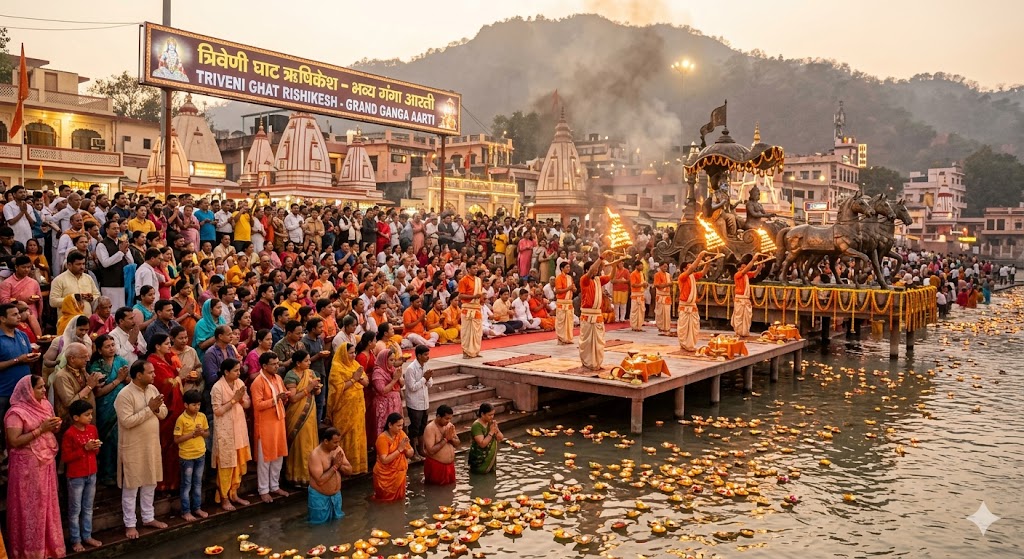
2. Vishram Ghat, Mathura — Krishna’s city, the principal ghat
Vishram Ghat is the main ghat of Mathura — Krishna’s birth city — and the site where pilgrims traditionally rest (vishram) after the parikrama of the 24 sacred ghats. The evening Yamuna Aarti at Vishram Ghat is one of the most atmospheric in north India and pulls large pilgrim crowds during Pushkaram. The ghat sits near Dwarkadhish Temple, which makes a dawn dip followed by darshan an easy morning circuit.
- Entry fee: Free
- Timings: Ghat open through the day; aarti at sunset (~7:00 PM in June)
- Best time during Pushkaram: Dawn snan (~4:30 AM) on 2 June; aarti on any evening of the 12 days
- How to reach: ~3.5 km from Mathura Jn; ~50 km from Agra; ~180 km / 3.5 hrs from Delhi via the Yamuna Expressway
- Time required: 1.5–2 hours for the dip + temple; 3 hours if you stay for the aarti
- Ideal for: Krishna devotees, families, and pilgrims, combining Mathura’s temples with the dip
- Pro tip: Arrive by 5 AM for the dawn dip and Dwarkadhish darshan, exit by 8 AM before the heat builds. Return at 6 PM for the aarti — the boat-borne diya rituals are best seen from the ghat steps.
3. Keshi Ghat, Vrindavan — the river of Raas Leela
Keshi Ghat is the most photographed ghat in Vrindavan, with red-sandstone steps and pavilions that look almost unchanged from medieval prints. It marks the spot where Krishna is said to have slain the Keshi demon. Crowds peak around the evening aarti — quieter than Vishram Ghat at dawn, which makes it a better option if you want a more contemplative morning dip.
- Entry fee: Free
- Timings: Open through the day; evening deepdaan (lamp offering) at sunset
- Best time during Pushkaram: Dawn Snan on any of the 12 days
- How to reach: ~10–12 km from Mathura Jn; auto-rickshaw or e-rickshaw from Mathura; ~4 km from Banke Bihari Temple
- Time required: 1.5–2 hours (paired with Banke Bihari darshan)
- Ideal for: Couples, photographers, and Krishna devotees who want the quieter Braj experience
- Pro tip: The railed northern steps are noticeably safer for elders than the main flight. Combine a 5 AM dip here with a 7 AM Banke Bihari mangala aarti — both are calmer than the mid-morning crowd peak.
4. Nigambodh Ghat, Delhi — the capital’s Yamuna ghat
Nigambodh Ghat, behind the Red Fort near Kashmere Gate, is Delhi’s principal Yamuna ghat and one of the oldest continuously used in the city. For NCR pilgrims who don’t want a multi-city trip, this is the practical choice — a pre-dawn auto, a dawn dip, and back home before the heat.
- Entry fee: Free
- Timings: Open through the day; best snan time 4:30–6:00 AM
- Best time during Pushkaram: Dawn on Day 1 or the closing day
- How to reach: ~1.5 km from Kashmere Gate Metro Station; ~22 km from IGI Airport; well-served by auto and app cabs
- Time required: 1–1.5 hours
- Ideal for: Delhi-NCR pilgrims short on time; first-time Pushkaram pilgrims testing the experience close to home
- Pro tip: Go pre-dawn; the ghat warms up fast, and the riverfront is significantly less clean here than at Mathura or Vrindavan. Carry your own water and a change of clothes in a sealed bag.
5. Yamuna ghats, Agra — paired with the Taj sunrise
Agra’s Yamuna ghats — including Dussehra Ghat and the ghats near Etmadpur — sit on the river immediately behind the Taj Mahal. A Pushkaram dip here pairs uniquely well with a sunrise visit to the Taj, which makes Agra the most travel-friendly ghat for first-time Pushkaram pilgrims who also want a cultural experience.
- Entry fee: Free at the ghats. Taj Mahal: ₹50 base / ₹250 with mausoleum (Indian), ₹1,100 base / ₹1,300 with mausoleum (foreign); closed Fridays (ASI ticketing)
- Timings: Ghats open through the day; Taj opens 30 min before sunrise
- Best time during Pushkaram: Dawn snan, then 6:30 AM Taj entry
- How to reach: ~7 km from Agra Cantt; ~13 km from Agra Airport; ~60 km / 1 hr from Mathura via the Yamuna Expressway
- Time required: 1–1.5 hrs for the dip; 4–5 hrs with the Taj
- Ideal for: Pilgrim-tourists, families combining devotion with the Taj
- Pro tip: Do the dip first (5 AM) and the Taj after (6:30–10 AM); both are best done before mid-morning heat. Carry sunscreen and water — June in Agra is brutal by 10 AM.
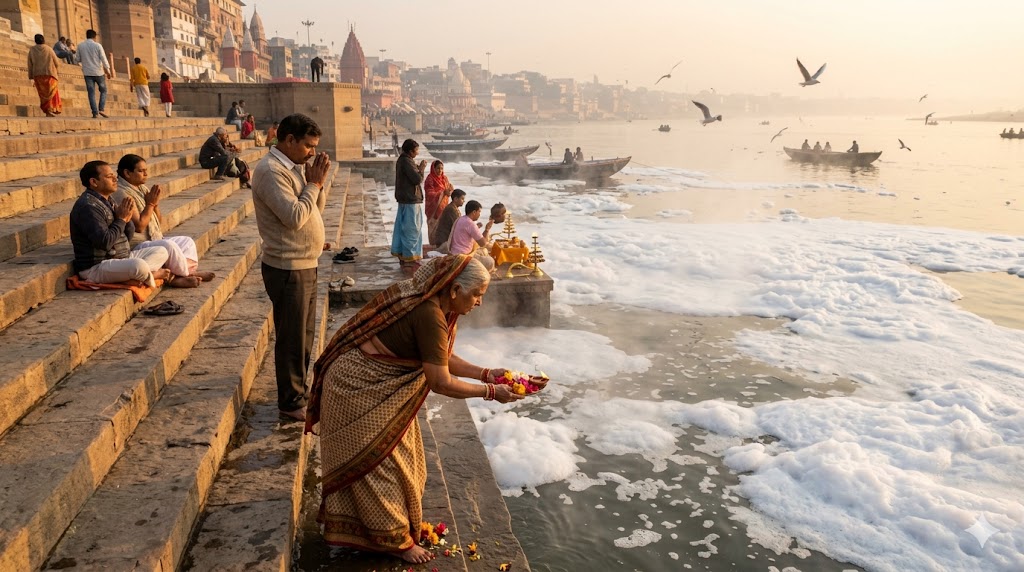
6. Yamunotri, Uttarakhand — the Himalayan source
Yamunotri, the source shrine of the river at ~3,293 m in Uttarakhand, is technically a Yamuna Pushkaram ghat — but it’s a Char Dham pilgrimage in its own right and requires a ~6 km uphill trek from Janki Chatti. We mention it for pilgrims already on the Char Dham circuit; it is not a quick Pushkaram day trip.
- Entry fee: Free temple entry
- Timings: Temple opens ~6:30 AM; opened for the 2026 yatra on 19 April 2026 (Akshaya Tritiya)
- Best time during Pushkaram: Any of the 12 days; early June is peak yatra season
- How to reach: 6 km trek (~3–4 hours uphill) from Janki Chatti; pony and palki available; Janki Chatti is reached by road from Barkot, ~210 km from Dehradun (nearest airport + railhead)
- Time required: 1 full day from Janki Chatti; 2–3 days from Dehradun
- Ideal for: Pilgrims combining the Yamuna Pushkaram with the Char Dham Yatra
- Pro tip: The Char Dham e-pass is mandatory in 2026 — register free at registrationandtouristcare.uk.gov.in (Aadhaar required; biometric check at the Janki Chatti checkpoint). Check Uttarakhand Tourism advisories 48 hours before travel — early June weather can be unpredictable.
7. Etawah & Kalpi ghats — quieter midstream alternatives
Etawah and Kalpi sit on the Yamuna between Agra and Prayagraj, with smaller riverside ghats used by local pilgrims. For families travelling between Agra and the Sangam, these are practical mid-route dip points — and they’re far less crowded than the marquee ghats.
- Entry fee: Free
- Timings: Open through the day; dawn dip recommended
- Best time during Pushkaram: Any morning of the 12-day window
- How to reach: Etawah Jn (~5 km from the ghats) is on the Delhi–Kanpur–Howrah main line; Kalpi is ~50 km south of Jalaun
- Time required: 1–1.5 hours
- Ideal for: Locals along the route; pilgrims wanting the merit without the crowds
- Pro tip: Doctrinally, a snan during Pushkaram earns the same punya whether you’re at the Sangam or at a quiet Kalpi ghat. If avoiding crowds matters more than location, these are the picks.
What rituals are performed during the Yamuna Pushkaram?
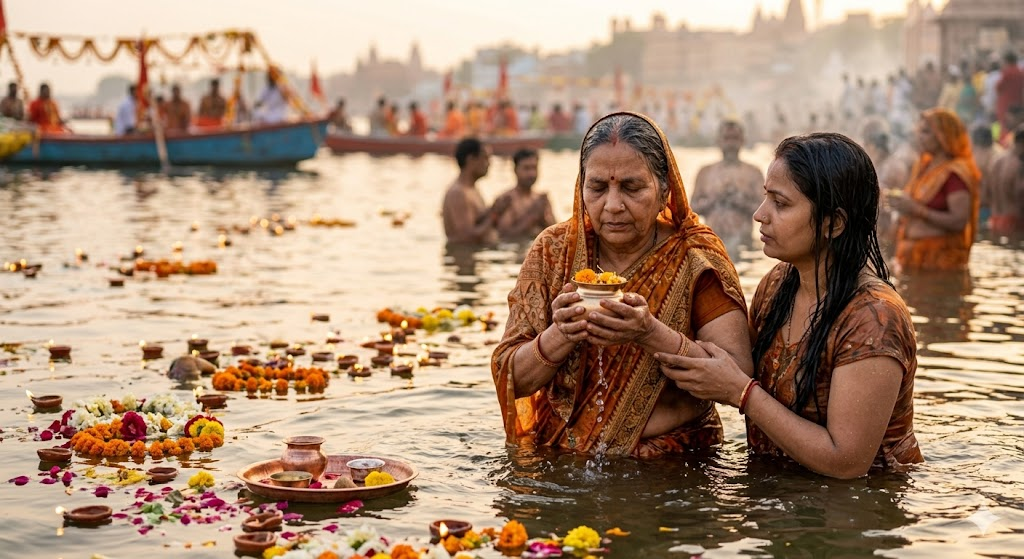
The core ritual is the Pushkara Snan — a pre-sunrise holy dip — followed by Pitru Tarpan (offering water and sesame to ancestors), Pind Daan (rites for departed souls), Surya Arghya (offering water to the rising sun), the Yamuna Aarti, and Daan (charity). Bathing during these 12 days is believed to erase sins and liberate ancestors toward moksha.
The recommended sequence
- Dawn snan — three dips facing east, ideally between 4:30 and 6:00 AM
- Pitru Tarpan — water mixed with black sesame (til) offered to ancestors at the ghat
- Surya Arghya — water offered to the rising sun from cupped palms
- Temple darshan — Dwarkadhish (Mathura), Banke Bihari (Vrindavan), or the Sangam temples (Prayagraj)
- Pind Daan — formal ancestral rites performed with a purohit (especially at Vishram Ghat, Mathura, and the Sangam, Prayagraj)
- Daan — annadanam (food charity), vastra daan (clothing) or gau daan (cow donation) at the ghat or a nearby temple
What to carry
- Two sets of clothes (dry change in a sealed bag)
- A small brass lota (water vessel)
- Black sesame seeds (til) for tarpan
- Cash in small denominations for daan
- ID + StayVista booking confirmation
- For elders: non-slip footwear, a folding stool, ORS sachets, sun hat
- A reusable water bottle (1 L per person, minimum)
Finding a genuine purohit
For pind daan and tarpan, the most reliable purohits are at Vishram Ghat (Mathura) and Sangam Ghat (Prayagraj). Expect to pay ₹500–₹2,500 depending on the depth of the ritual; agree on the rate before the sankalpa begins. If you’re at Vrindavan’s Keshi Ghat, the purohits nearer the older temple cluster are generally more practised than the touts that approach pilgrims at the main steps.
During Yamuna Pushkaram, the core ritual sequence is Pushkara Snan at dawn, Pitru Tarpan with water and black sesame, Surya Arghya to the rising sun, temple darshan, Pind Daan with a purohit, and Daan (charity). All are best performed during Brahma Muhurat (4:30–6:00 AM).
How big will the crowds be? Heat, safety & best snan times
Expect very large crowds at Prayagraj, Mathura, and Vrindavan on 2 June (Day 1) and 13 June (closing day) — past river Pushkarams have drawn enormous turnouts, with the 2015 Godavari Maha Pushkaram seeing roughly 105 million pilgrims combined across Andhra Pradesh and Telangana (Wikipedia: Godavari Maha Pushkaram). Yamuna 2026 will not match those numbers — Godavari Maha Pushkaram is a once-in-144-years event — but the two peak days will be heavily crowded. Go at dawn, avoid the two peak days if you can, and be off the ghats well before the 40–44°C mid-morning heat.
The early-June reality
By 9 AM the Braj belt — Mathura, Vrindavan, Agra — sits at 38–40°C, and by noon it is 40–44°C. This is also the river’s lowest, most silted pre-monsoon flow: the water level is low and visibly polluted at the heavily used urban ghats. The honest read:
- Dip at dawn — pre-sunrise, even on a non-peak day, is the only comfortable window
- Choose cleaner upstream ghats where possible — Keshi Ghat (Vrindavan) and the Sangam (Prayagraj) are noticeably cleaner than Nigambodh (Delhi) or the most urbanised Mathura ghats
- Off the steps by 8 AM — by then the heat begins to push elders into distress; plan your darshan or breakfast indoors after that
- Hydrate — carry a 1 L bottle per person; the dehydration risk is real
Safety notes
- Stone ghat steps are slippery near the waterline — non-slip footwear matters, even briefly
- For elders, the railed sections at Keshi Ghat (north steps) and Vishram Ghat (south side) are safer than the central flights
- The Sangam at Prayagraj is a confluence with currents; stay near the shore unless on a boat
- Keep valuables in a waterproof pouch — pickpocketing increases on peak days
Past river Pushkarams have drawn enormous crowds — Godavari Maha Pushkaram 2015 saw roughly 105 million pilgrims combined across Andhra Pradesh and Telangana. For Yamuna 2026, dip at dawn during Brahma Muhurat and exit the ghats before the 40–44°C mid-morning Braj-belt heat sets in.
How to plan a Yamuna Pushkaram trip (1-day or weekend)
If you’re in Delhi-NCR, Yamuna Pushkaram is an easy 1-day or weekend trip to Mathura–Vrindavan (~3.5 hrs / 180 km from Delhi); pair it with Agra for a classic Braj + Taj weekend, or extend through Prayagraj to Varanasi for the most complete pilgrim arc.
1-day plan (Delhi-NCR)
- 2:30 AM — Leave Delhi-NCR via the Yamuna Expressway
- 5:30 AM — Dawn snan at Vishram Ghat, Mathura; tarpan and arghya
- 7:00 AM — Dwarkadhish Temple darshan; breakfast in Mathura
- 9:00 AM — Drive to Vrindavan; Banke Bihari mangala aarti; Keshi Ghat visit
- 12:00 PM — Lunch indoors at the homestay or a Vrindavan AC restaurant
- 5:00 PM — Return drive to Delhi-NCR (back by 9 PM)
Weekend plan — Braj + Taj
- Day 1: Drive to Mathura early; dawn snan at Vishram Ghat → Dwarkadhish → Vrindavan ghats and temples → overnight in Mathura/Vrindavan
- Day 2: Pre-dawn drive to Agra (1 hr); dip at the Agra Yamuna ghats → 6:30 AM Taj Mahal sunrise visit → late breakfast → drive back to Delhi (or onward to Prayagraj if you’re extending)
Multi-city pilgrim route — Yamuna + the Ganga extension
The most complete Yamuna Pushkaram circuit follows the river itself: Delhi (Nigambodh) → Mathura–Vrindavan → Agra → Prayagraj (Triveni Sangam, where the Yamuna meets the Ganga) → optional closing leg to Varanasi for a Ganga dip and the Dashashwamedh Ghat evening aarti. The full circuit is best done over 4–5 days. See “Where to Stay” below for a single-property anchor at each end — Vrindara Niwas in Mathura, Vintage Varanasi by the Ganges in Varanasi.
Leave-by times to make the dawn snan
| Origin | Target ghat | Leave by | Reach by | Drive |
|---|---|---|---|---|
| Delhi-NCR | Vishram Ghat, Mathura | 2:30 AM | 5:30 AM | ~3 hrs |
| Gurgaon (Sohna) | Vishram Ghat, Mathura | 2:00 AM | 5:30 AM | ~3.5 hrs |
| Agra | Vishram Ghat, Mathura | 4:00 AM | 5:30 AM | ~1.5 hrs |
| Jaipur | Vishram Ghat, Mathura | 1:00 AM | 5:30 AM | ~4.5 hrs |
| Prayagraj | Triveni Sangam | 3:30 AM | 4:30 AM | ~30 min |
From Delhi-NCR, Yamuna Pushkaram works as a 1-day trip (3.5 hrs to Mathura) or a 2-day Braj + Taj weekend. The full Yamuna-to-Ganga pilgrim arc — Delhi → Mathura–Vrindavan → Agra → Prayagraj → Varanasi — takes 4–5 days; Prayagraj → Varanasi is ~125 km / ~3 hrs.
Where to stay near the Yamuna ghats
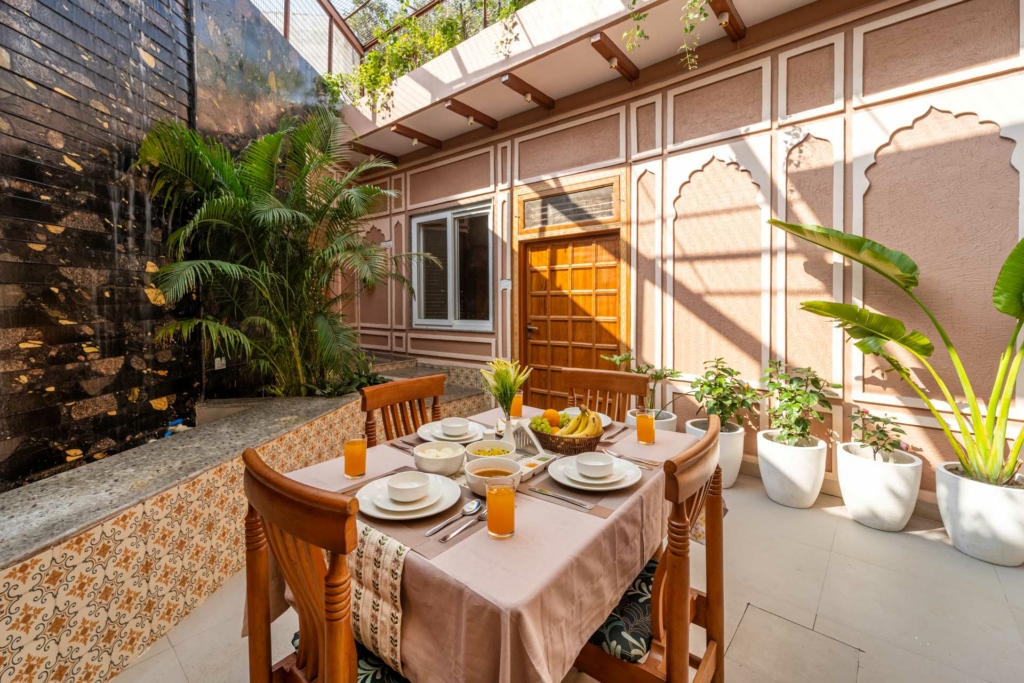
The most comfortable bases for Yamuna Pushkaram are Vrindavan/Mathura (closest to the main ghats), Agra (for the Braj + Taj pairing), and Delhi-NCR / Gurgaon (for NCR families doing a one-day pilgrimage). For pilgrims extending downstream from Prayagraj to Varanasi’s Ganga ghats, we have heritage stays on the riverfront — a real alternative to crowded dharamshalas in the June heat.
Mathura / Vrindavan — closest to Vishram & Keshi Ghats
- Vrindara Niwas — 4 BHK heritage stay in central Mathura with a rooftop terrace overlooking the old city skyline. Bookable as the full 4 BHK or as smaller 2- and 3-room configurations for pilgrim couples and small families. The right base for a 5 AM dip at Vishram Ghat and an early Dwarkadhish darshan.
- 2 Rooms @ Vrindara Niwas — the 2-room partial-booking option within Vrindara Niwas; right-sized for a family of four.
- Vrindara Villa — our second Braj property, Mathura side, useful for pilgrim groups doing the full Mathura–Vrindavan ghat-and-temple loop.
Agra — for the Braj + Taj weekend
- Verdant Acres — 6 BHK villa ~10 minutes from Agra Fort and ~25 minutes from the Taj Mahal (East Gate Road); lawns, BBQ, and bonfire — sized for multi-family pilgrim groups combining a sunrise Taj visit with a Yamuna ghat dip.
- Amore @ Verdant Acres — 2 BHK partial booking within the same Verdant Acres compound; the right size for a couple or family of four.
- Paradiso @ Verdant Acres — third configuration of the Verdant Acres estate; mid-size option for groups of 6–8.
Delhi-NCR / Gurgaon — one-day pilgrimage base
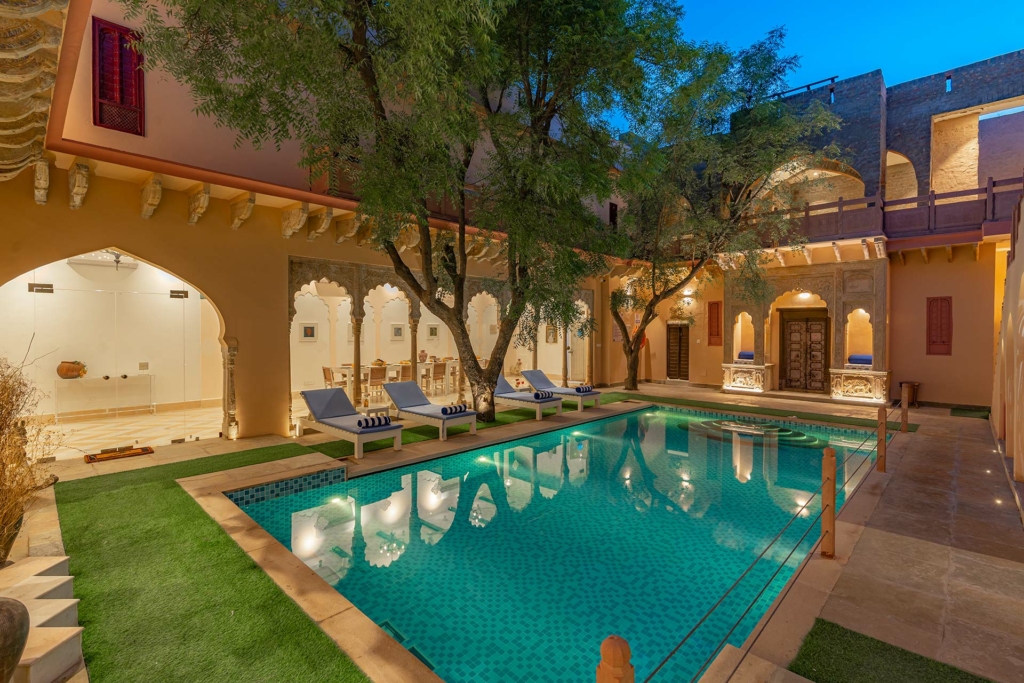
- Khohar Haveli — restored 18th-century haveli in Sohna at the foot of the Aravallis; bookable from 3 BHK up to 13 BHK, with a seasonal outdoor pool and complimentary breakfast. Ideal for large family groups assembling before the 2:30 AM Mathura drive.
- Bliss in the Woods — 4 BHK villa in Dhauj (~7 km from Gurgaon centre) with private outdoor pool, lawns, BBQ and bonfire — a quiet base for a 4 AM departure to Mathura via the Yamuna Expressway.
- Bagaan Villa — farm-stay format near a Gurgaon golf course with a private pool and garden views; a comfortable day-trip launching pad.
Extend your pilgrimage to Varanasi — Ganga ghats (~125 km / ~3 hrs from Prayagraj)
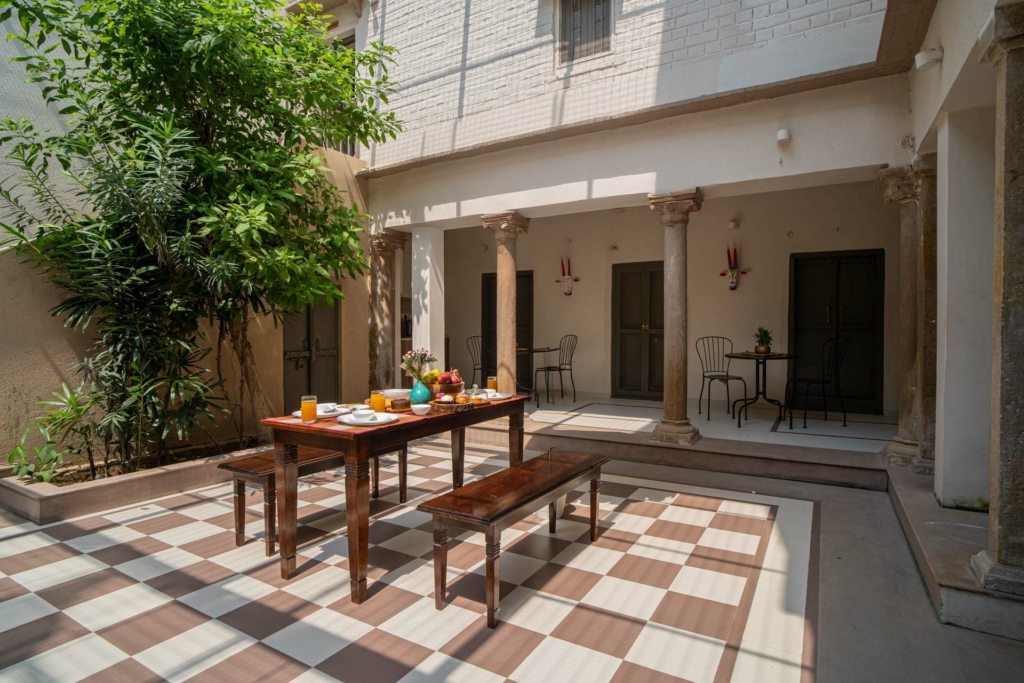
- Vintage Varanasi by the Ganges — 4 BHK heritage-design villa on the Varanasi riverfront near Assi Ghat, at the southern end of the city’s ghat sequence [VERIFY exact Assi Ghat distance with our property team]. The natural closing stay for pilgrims who finish at the Triveni Sangam and continue downstream to bathe at Varanasi’s Ganga ghats and attend the Dashashwamedh Ghat evening aarti.
- The Ganga House — 4 BHK in the Trilochan Ghat area; ~15-minute walk from Manikarnika Ghat and ~1.2 mi from Dashashwamedh Ghat (note: 5–7 min walk from the main road — no vehicle access right to the door).
- Serenity by the Ganges — up to 6 BHK (also bookable as smaller 3 BHK configurations) opposite Garhwa Ghat Road, on the Ganges banks; alfresco dining and river views.
A note on Prayagraj
StayVista does not currently maintain permanent inventory near Triveni Sangam (the Mahakumbh 2025 tent pop-up has been retired). For pilgrims taking the Sangam dip, the cleanest plan is Vrindavan/Mathura for the Braj nights → a same-day road run to Prayagraj for the Sangam snan → onward 125 km to Varanasi for the closing stay at Vintage Varanasi by the Ganges.
For Yamuna Pushkaram 2026, the most useful StayVista bases are Vrindara Niwas (central Mathura, 4 BHK heritage), Verdant Acres (6 BHK Agra villa near the Taj), Khohar Haveli (Sohna, 3–13 BHK with pool) and Vintage Varanasi by the Ganges (4 BHK near Assi Ghat) for the optional Ganga-extension closing stay.
FAQ — Yamuna Pushkaram 2026
Yamuna Pushkaram 2026 runs 2–13 June 2026 — the 12-day Adi Pushkaram window. The holiest dip is at dawn on Day 1 (2 June) and the closing day (13 June).
The Pushkaram cycle tracks Jupiter’s roughly 12-year orbit through the zodiac. The Yamuna’s turn comes when Jupiter enters Cancer (Karka Rashi) — last in 2014, next in 2026.
Cancer (Karka Rashi). Each of the 12 sacred rivers has its own zodiac sign — Ganga–Aries, Narmada–Taurus, Saraswati–Gemini, Yamuna–Cancer, and so on.
The principal ghats are Triveni Sangam (Prayagraj), Vishram Ghat (Mathura), Keshi Ghat (Vrindavan), Nigambodh Ghat (Delhi), and the Yamuna ghats at Agra. Entry is free at all of them.
Pushkara Snan (dawn dip), Pitru Tarpan (water and sesame for ancestors), Pind Daan (ancestral rites), Surya Arghya (water to the rising sun), Yamuna Aarti, and Daan (charity). All are ideally done during Brahma Muhurat, roughly 4:30–6:00 AM.
The previous Yamuna Pushkaram was 19–30 June 2014. The next one after 2026 is expected around 2038, when Jupiter again enters Cancer.
Adi Pushkaram is the opening 12 days when Jupiter first enters the river’s zodiac (2–13 June 2026 for the Yamuna). Antya Pushkaram is the closing window at the end of Jupiter’s transit out of the sign, about a year later. Both Adi and Antya carry the highest spiritual significance.
The wrap-up
Yamuna Pushkaram 2026 is the river’s first 12-day window of liberation in twelve years, and it won’t return until roughly 2038. A few practical things to carry on the trip:
- Aim for the dawn dip on 2 June or the closing day on 13 June — both carry the highest punya
- Choose cleaner upstream ghats like Keshi Ghat (Vrindavan) and the Triveni Sangam (Prayagraj) over the most urban stretches
- Be off the ghats by 8 AM — the Braj-belt heat reaches 40–44°C by mid-morning
- Carry black sesame, a lota, a sealed change of clothes, ID, and small-denomination cash for daan
- Base yourself in Mathura, Vrindavan, Agra, or — for the Ganga extension closing stay — Varanasi near Assi Ghat
Plan your Yamuna Pushkaram 2026 stay across Mathura, Agra, and Varanasi with StayVista — heritage villas and homestays a few minutes from the ghats, with AC, family-sized layouts, and a quiet base to retreat to after the dawn snan.