
Char Dham by Bus & Road 2026: Complete Route, Fare & Booking Guide from Delhi, Haridwar, Rishikesh & Dehradun
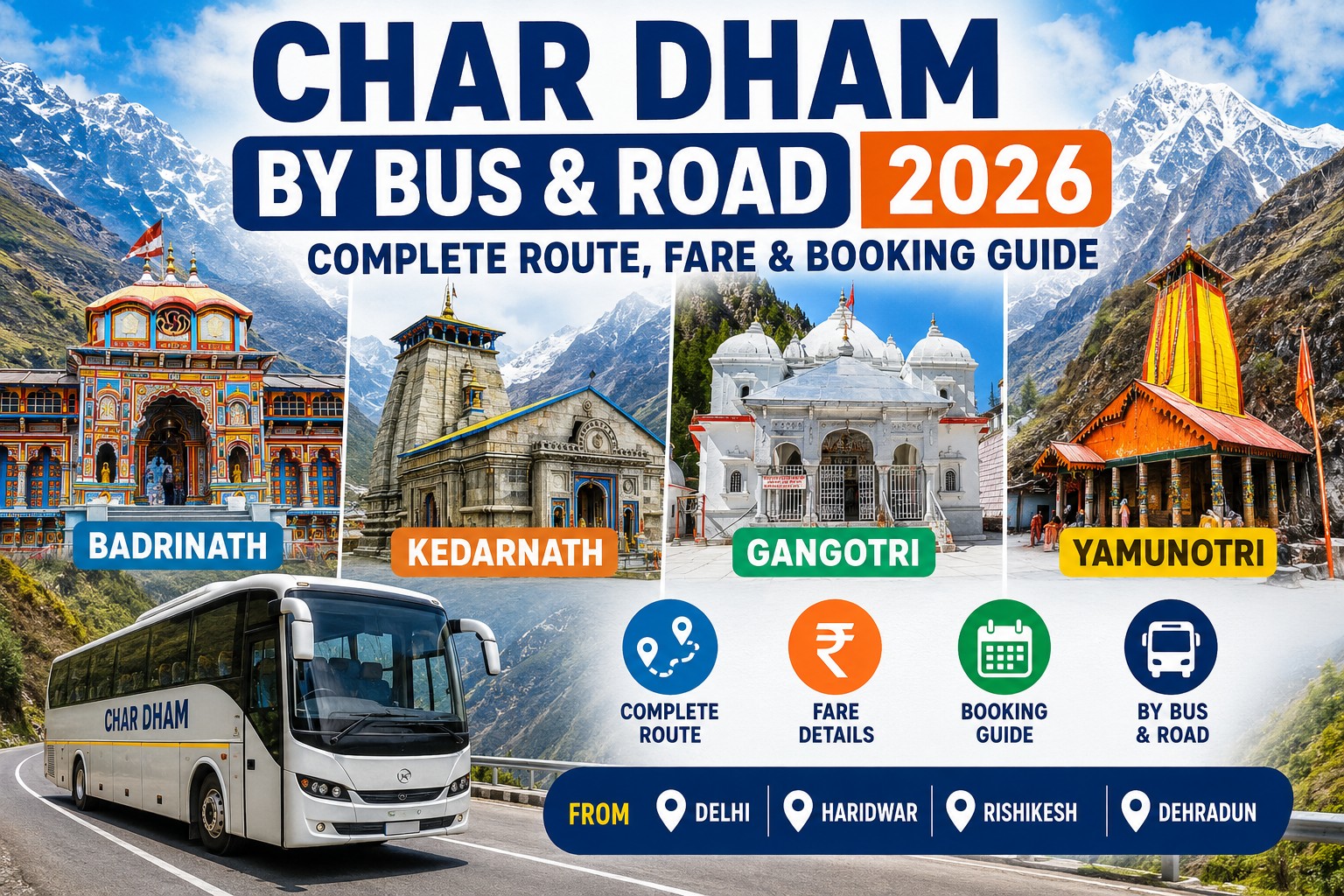
More than 41,12,995 pilgrims completed the Char Dham circuit in 2025. And contrary to what the helicopter packages suggest, the vast majority travelled by road – on Uttarakhand Roadways buses, GMVN packages, private Volvos, and shared sumos that snake through the Himalayan switchbacks day and night.
The trouble is that bus routes, fares and operator choices for Char Dham are scattered across the UTC portal, redBus listings, and a dozen route blogs that rarely agree on numbers. Nobody has bothered to compare Delhi, Haridwar, Rishikesh and Dehradun as starting points side by side — even though that one decision changes your trip cost, time, and comfort more than anything else.
This guide does that comparison. Every route, every operator, every fare verified for the 2026 yatra season, plus a practical answer to a question no booking site addresses: where should you stop the night before your 4 AM departure?
Over 41 lakh pilgrims travelled Char Dham in 2025 – most by road. From Delhi, Badrinath is ~558 km (13–19 hours by bus) via Haridwar–Rishikesh–Joshimath. Book UTC tickets on utconline.uk.gov.in; registration is mandatory before boarding. We recommend breaking your journey in Rishikesh the night before your yatra.
In this Blog
Quick reference: the yatra window at a glance
| What | Detail |
| 2026 yatra window | 19 April 2026 – 13 November 2026 |
| Best months for road travel | May, June, mid-September, October |
| Months to avoid | July, August (monsoon landslides) |
| Total circuit by bus | 11–13 days from Delhi (return) |
| Registration | Mandatory — registrationandtouristcare.uk.gov.in |
| Fastest road entry to circuit | Delhi → Dehradun via expressway (2.5 hours by car) |
| Recommended pre-yatra base | Rishikesh (8–10 hours to Kedarnath) |
When does Char Dham 2026 open and why do most yatris travel by road?
The 2026 Char Dham Yatra opened on Akshaya Tritiya, 19 April 2026, with Yamunotri and Gangotri doors swinging open first, followed by Kedarnath on 22 April and Badrinath on 23 April. The yatra runs through 13 November 2026, with peak crowds in May, June and October.
Helicopter packages move only about 40,000–55,000 pilgrims a season – a fraction of the 41-lakh footfall. The rest go by road because helicopter sorties are weather-dependent, capped, and routinely cost ₹75,000–₹1,80,000 per person for a full circuit. Road yatras start at ₹12,000 per person for budget UTC travel and remain the most accessible way to do all four shrines.
2026 opening dates by dham
| Dham | Opening date | Likely closing |
| Yamunotri | 19 April 2026 (Akshaya Tritiya) | Early November 2026 |
| Gangotri | 19 April 2026 (Akshaya Tritiya) | Early November 2026 |
| Kedarnath | 22 April 2026 | Late October 2026 |
| Badrinath | 23 April 2026 | 13 November 2026 (tentative) |
The Char Dham All-Weather Road project is now 75% complete, with 629 km of 825 km drivable across 53 packages at a project cost of ₹12,000 crore. Expect single-lane sections near Joshimath and Pipalkoti where construction continues. For full opening dates, registration steps and budget breakdown, see our complete Char Dham Yatra 2026 guide.
How far is each Char Dham and what does the bus cost?
From Delhi by bus, Badrinath is the farthest dham at 558 km (13–19 hours), followed by Gangotri at 501 km, Yamunotri at 485 km, and Kedarnath at 470 km. Rishikesh is the closest practical hub – only 227 km from Kedarnath and 295 km from Badrinath.
Master route table — origin city to each dham
| Route | Distance | Bus time | UTC ordinary | Volvo / AC | Private |
| Delhi → Yamunotri (Janki Chatti) | 485 km | 12–14 hr | — | ₹950+ | ₹1,200+ |
| Delhi → Gangotri | 501 km | 16–20 hr | — | ₹950+ | ₹1,200+ |
| Delhi → Kedarnath (Sonprayag) | 470 km | 14–16 hr | ₹600 | ₹900+ | ₹1,100+ |
| Delhi → Badrinath | 558 km | 13–19 hr | ₹700 | ₹1,000+ | ₹1,200+ |
| Haridwar → Badrinath | 320 km | 11–12 hr | ₹500 | — | ₹900+ |
| Rishikesh → Kedarnath | 227 km | 8–10 hr | ₹400 | — | ₹700 |
| Dehradun → Kedarnath | 254 km | 9–11 hr | ₹450 | — | ₹750 |
| Dehradun → Badrinath | 337 km | 9–12 hr | ₹550 | — | ₹900 |
Sources: Yatra.com distance data, euttaranchal route guides, redBus Char Dham hub, MakeMyTrip Volvo fares. Fares verified May 2026 — recheck before booking.
How do you reach Char Dham by bus from Delhi?
There is no single Char Dham circuit bus from Delhi. Pilgrims either take a UTC direct service to Sonprayag (Kedarnath road head) or Joshimath (Badrinath road head), or they break the journey at Haridwar, Rishikesh or Dehradun and continue on hill-route buses operated by UTC and the Garhwal Motor Owners Union (GMOU).
Most yatris choose the second option. The reason is simple: a single 16-hour overnight Delhi–Sonprayag run leaves you exhausted at 4,000 feet of altitude, with another four hours of yatra logistics ahead. Breaking the journey in Rishikesh or Haridwar costs ₹1,500–₹4,000 for the overnight halt but pays back in arrival comfort.
Delhi to the gateway hubs — first-leg options
- Delhi → Haridwar: ~229 km, 6–7 hours. UTC ordinary ₹229, AC seater ₹349, Volvo semi-sleeper ₹489, Volvo AC 2+2 ₹607, premium ₹945 (MakeMyTrip, 2026). Departures: ISBT Kashmiri Gate (main), Anand Vihar.
- Delhi → Rishikesh: ~243 km, 6.5–7.5 hours. ₹300–₹950 by class.
- Delhi → Dehradun: ~250 km, 2.5 hours by car on the new Delhi–Dehradun Expressway or 5–6 hours by bus. ₹400–₹1,050.
- Delhi → Sonprayag (Kedarnath): UTC operates a direct service from ISBT Kashmiri Gate. Daily, evening departure. ~14–16 hours, ~₹600–₹700.
The Delhi–Dehradun Expressway is the biggest change to road yatra logistics in a decade. It cuts the first leg from Delhi to a Char Dham gateway to 2.5 hours by car — making it possible to leave Delhi at 7 AM, reach Rishikesh by noon, attend the evening Ganga Aarti, and start your yatra at 4 AM the next morning. That itinerary was a two-day affair before April 2026.
Which bus routes run from Haridwar, Rishikesh and Dehradun to each dham?
This is where most route guides fall apart — they give you Delhi-origin numbers and stop. But once you arrive in Haridwar or Rishikesh, you’re picking from different operators on shorter, steeper routes where fares and frequencies change. Here’s the breakdown that no competitor compiles in one place.
From Haridwar to all four dhams
| Route | Distance | Bus time | Primary operators | Approx fare |
| Haridwar → Yamunotri (Janki Chatti) | 210 km | 8–9 hr | UTC, GMOU | ₹450–₹700 |
| Haridwar → Gangotri | 265 km | 10–11 hr | UTC, GMOU | ₹500–₹800 |
| Haridwar → Kedarnath (Sonprayag) | 245 km | 9–10 hr | UTC, GMOU, private | ₹450–₹750 |
| Haridwar → Badrinath | 320 km | 11–12 hr | UTC, GMOU | ₹500–₹900 |
Haridwar Bus Stand sits next to the railway station and runs as the most active yatra terminal in the region. The Garhwal Motor Owners Union (GMOU) is the cooperative that handles a large share of dham-bound hill routes and is the operator most yatris use after Haridwar — though almost no booking site explains this.
From Rishikesh to all four dhams
| Route | Distance | Bus time | Primary operators | Approx fare |
| Rishikesh → Yamunotri (Janki Chatti) | 190 km | 7–8 hr | UTC, GMOU | ₹400–₹650 |
| Rishikesh → Gangotri | 245 km | 9–10 hr | UTC, GMOU | ₹450–₹750 |
| Rishikesh → Kedarnath (Sonprayag) | 227 km | 8–10 hr | UTC, GMOU, private | ₹400–₹700 |
| Rishikesh → Badrinath | 295 km | 10–11 hr | UTC, GMOU | ₹450–₹850 |
Rishikesh is the shortest road-time hub to all four dhams — the reason most experienced yatris use it as their pre-yatra base. The Rishikesh Yatra Bus Terminal handles dham-bound departures from 3 AM onwards during peak season. What to see in Rishikesh on your stopover covers the evening you have before your 4 AM call.
From Dehradun to all four dhams
| Route | Distance | Bus time | Primary operators | Approx fare |
| Dehradun → Yamunotri (Janki Chatti) | 170 km | 7 hr | UTC, private | ₹400–₹700 |
| Dehradun → Gangotri | 245 km | 9–10 hr | UTC | ₹450–₹750 |
| Dehradun → Kedarnath (Sonprayag) | 254 km | 9–11 hr | UTC, private | ₹450–₹750 |
| Dehradun → Badrinath | 337 km | 9–12 hr | UTC, private | ₹550–₹900 |
Dehradun is the shortest road-time hub to Yamunotri specifically (170 km via the Mussoorie–Barkot road) and works well if your yatra starts at the Yamunotri end of the circuit. Outside that, it has fewer dedicated dham-bound buses than Haridwar or Rishikesh. The best time to visit Dehradun overlaps cleanly with the yatra window.
How do you book Uttarakhand Roadways (UTC) buses online?
Book UTC tickets at utconline.uk.gov.in or via the Pathik UTC Traveller app (Google Play Store). Registration is required before your first booking, and Aadhaar verification is checked at boarding on most yatra routes.
- Visit utconline.uk.gov.in — click “Register / Sign Up”
- Enter name, mobile number, email; verify the mobile OTP
- Log in and click “Book Ticket”
- Enter origin (e.g., Delhi ISBT), destination (e.g., Sonprayag or Haridwar), date of journey, and bus type
- Pick your seat from the seat map; enter passenger details (carry the same Aadhaar at boarding)
- Pay by UPI, debit/credit card or net banking
- Download the e-ticket PDF or screenshot it — you’ll need it at the depot
For cancellation, use the same portal under “My Bookings”. Refund timelines vary by bus class — ordinary tickets refund within 7 days, AC/Volvo within 10–14 days. Note that we deliberately keep this section brief because the official UTC portal is the authoritative source — bookmark it directly and you’ll always have current fares and schedules.
UTC vs GMVN vs private Volvo — which operator should you pick?
Uttarakhand Transport Corporation (UTC) operates roughly 1,143 buses covering 3.5 lakh km daily, making it India’s largest hill-state bus fleet (UTC, Government of Uttarakhand, 2025). UTC ordinary fares from Delhi to Haridwar start at ₹229; AC Volvo services range ₹489–₹945 depending on class. But UTC is not your only option, and choosing between operators changes your trip significantly.
Operator comparison at a glance
| Feature | UTC (Uttarakhand Roadways) | GMVN (Garhwal Mandal) | Private Volvo |
| Fleet | ~1,143 buses | ~50–80 yatra buses | 100s via redBus, MMT |
| Best for | Budget pilgrims, point-to-point | Packaged yatra (transport + lodging) | Families, seniors, comfort |
| Booking | utconline.uk.gov.in / Pathik app | gmvnl.in package portal | redBus, MakeMyTrip, EaseMyTrip |
| Fare (Delhi–Haridwar) | ₹229–₹349 | Bundled in package (₹15,000–₹25,000 full Char Dham) | ₹489–₹945 |
| AC availability | Limited (select Volvo routes) | Mostly non-AC | Full AC, semi-sleeper, sleeper |
| Seat selection | Basic seat map | None (allotted) | Full seat map with preview |
Our recommendation for first-time yatris travelling with elderly family: a private Volvo to Haridwar plus a GMVN package onward is often the right combination. Budget pilgrims should stick to UTC throughout — the savings across 12 days add up to ₹6,000–₹9,000 per person.
Is Char Dham registration mandatory in 2026?
Yes. Every pilgrim must register on registrationandtouristcare.uk.gov.in before travelling to Char Dham in 2026. In 2025, over 22 lakh pilgrims registered online – including 25,000 international travellers from 185 countries. Bus operators verify registration at multiple checkpoints between Rishikesh and the shrines.
Registration is free. You’ll need a government ID (Aadhaar or passport), a passport-size photo, contact details, and your travel dates per dham. Carry both digital and printed copies – mobile signal drops past Rudraprayag, and a printed yatra registration is what gets you through the Sonprayag checkpoint.
A health declaration may be requested at high-altitude entries (Sonprayag for Kedarnath, Govindghat for Hemkund). For the step-by-step registration walkthrough and document checklist, see our Char Dham 2026 complete guide.
Which months are best for a Char Dham road yatra in 2026?
May, June, mid-September and October are the safest months for a road yatra. In 2025, monsoon disruptions forced 55 zero-pilgrim days in the first four months alone – making July and August the highest-risk window for road-based Char Dham travel.
Month-by-month for 2026
- April (from 19 April): Yatra opens. Crisp weather, cold nights at high altitude. Crowds light.
- May: Peak season starts, school holidays trigger heavy demand. Book 3–4 weeks ahead.
- June: The best month for road travel. Long daylight hours, no monsoon yet, manageable crowds.
- July–August: Monsoon. Landslides closed the Char Dham highway for extended stretches in 2025. Avoid if you can.
- September (mid to end): Reopening of the second peak. Fewer crowds, clear skies.
- October: Last good month. Snowfall begins at higher altitudes by late October.
- Early November: Yatra closing (Yamunotri/Gangotri close ~4–5 Nov, Kedarnath ~26 Oct, Badrinath ~13 Nov).
During peak May and June, reserve your Rishikesh stay at least 3 weeks ahead. Bus seats from Haridwar to Sonprayag/Badrinath sell out 4–7 days in advance on the UTC portal during these months.
Where should you stay before starting your Char Dham yatra?
Rishikesh is the natural pre-yatra base for most Char Dham road travellers. Most circuits start at 4–5 AM from Rishikesh or Haridwar, and a rested night before that departure is the single biggest factor in completing the full circuit comfortably — especially for elderly travellers facing altitude gain over the next 72 hours. Our team has hosted Char Dham yatris at our Rishikesh villas across four yatra seasons, and the same pattern shows up every time: families that skip the pre-yatra rest stop struggle most in Kedarnath.
If you’re flying into Delhi from another city
Skip the late-night Delhi-to-Rishikesh bus the day you land. After a flight, a 6-hour overnight bus to Rishikesh is the worst possible start to a yatra. Better plan:
- Land in Delhi, stay the night at a serviced residence in Gurgaon or Delhi NCR
- Sleep, eat properly, finalise your packing
- Travel to Rishikesh the next morning via the Delhi–Dehradun Expressway (2.5 hours by car)
- Recommended NCR stay: StayVista Residences at DLF, Gurgaon — proximity to the expressway entry point at Akshardham makes this practical
If you’re Delhi-based
Skip the pre-yatra Delhi stay; head straight to Rishikesh. Leave Delhi by 7 AM, arrive Rishikesh by lunchtime, attend the evening Triveni Ghat Ganga Aarti, eat an early dinner, and sleep by 9 PM for a 4 AM departure. Recommended Rishikesh stay options: our Rishikesh villa collection — ideal for multi-generational groups and families travelling with elderly parents.
What to do in Rishikesh the evening before
- Triveni Ghat Ganga Aarti at sunset (start ~6 PM)
- Carbo-load dinner — most villas can arrange a quiet, early meal
- Pack: layers, walking shoes, ID, registration printout, medicines, cash for remote stretches
- Sleep by 9 PM — see our notes on what to do near our Rishikesh villas for a calm pre-yatra evening
Planning Char Dham 2026 with family? Our team has hosted yatris at our Rishikesh villas for the past 4 seasons. Browse pre-yatra stay options in our Rishikesh villa collection — multi-room villas suited for families travelling with elders.
What should you carry and watch out for on a Char Dham bus yatra?
Carry warm layers, government ID, a printed yatra registration, and cash – and expect single-lane construction stretches near Joshimath and Pipalkoti where the Char Dham All-Weather Road project is still finishing. Drivers slow to crawl through these, so build a buffer of 1–2 hours into every road estimate above. The Rudraprayag–Joshimath stretch is the most landslide-prone during monsoon and the first to close after any heavy rain.
Altitude matters more than most yatris expect. Kedarnath sits at 3,583 m, Badrinath at 3,300 m, Gangotri at 3,100 m, Yamunotri’s Janki Chatti at 2,650 m. Pilgrims flying in from sea-level cities like Mumbai or Chennai face real risk of altitude sickness on the Kedarnath leg specifically – the 16 km trek from Gaurikund to the shrine starts at 1,980 m and tops out at 3,583 m.
Carry checklist
- Warm layers (yes, even in June – nights drop to 5–8°C at the shrines)
- Portable oxygen can (optional, recommended for Kedarnath if you have any cardiac/respiratory history)
- Basic medicines — Diamox (for AMS, after consulting your doctor), painkillers, ORS, bandages
- Government ID + yatra registration printout (digital signal drops past Rudraprayag)
- Cash — UPI is patchy beyond Sonprayag and Joshimath
- Sturdy walking shoes for Kedarnath, Yamunotri and Hemkund treks
For senior citizens above 60 with any cardiac history, get a medical fitness certificate before the Kedarnath leg specifically — the trek is the highest-risk segment of the entire circuit. The helicopter alternative for Kedarnath is well-documented in our IRCTC HeliYatra Kedarnath guide if you want to skip the trek.
Frequently asked questions
Yes. UTC, GMVN and private operators run direct and connecting services from Delhi to Haridwar, Rishikesh and Dehradun, with onward buses to all four dhams. The full circuit by bus typically takes 11–13 days return from Delhi.
UTC ordinary buses cost around ₹600–₹700 for the Delhi to Badrinath leg; private Volvo and AC services range ₹900–₹1,200 depending on class. The journey covers 558 km and typically takes 13–19 hours including halts.
UTC operates a direct service from ISBT Kashmiri Gate to Sonprayag, which is the road head for Kedarnath. There is no direct Delhi-to-Kedarnath bus because Kedarnath itself is reached by a 16 km trek or pony ride from Gaurikund (3 km past Sonprayag).
Plan for 11–13 days from Delhi return, including travel, darshan and a buffer day for weather. By helicopter, the same circuit can be done in 5–6 days. Most road itineraries do Yamunotri first, then Gangotri, Kedarnath and Badrinath last.
Rishikesh, for most road yatras. It has the shortest road time to all four dhams (Kedarnath 227 km, Badrinath 295 km, Yamunotri 190 km, Gangotri 245 km), excellent pre-yatra stay options, and direct connectivity from Delhi via the Delhi–Dehradun Expressway.
Yes. Every pilgrim must register at registrationandtouristcare.uk.gov.in before travel. In 2025, over 22 lakh pilgrims registered online. Bus operators check registration at multiple yatra checkpoints.
UTC (Uttarakhand Roadways) is the state transport corporation – you buy a point-to-point ticket. GMVN (Garhwal Mandal Vikas Nigam) sells packaged yatra tours bundling transport, lodging and meals across the full circuit, typically ₹15,000–₹25,000 per person.
UTC ordinary tickets start at ₹229, AC seater ₹349, Volvo semi-sleeper ₹489, Volvo AC 2+2 ₹607, and private premium services range up to ₹945. The 229 km journey takes 6–7 hours.
Yes, with medical clearance for the high-altitude shrines — especially Kedarnath (3,583 m) and Badrinath (3,300 m). Helicopter packages from IRCTC are also available for the Kedarnath leg — see our IRCTC HeliYatra Kedarnath guide.
UTC ordinary buses + GMVN dharamshalas + shared sumos for the final 50 km hill stretches. Budget per person works out to roughly ₹12,000–₹18,000 for 12 days. Skip helicopter and stick to road for both directions to keep it under ₹15,000.
Plan your 2026 Char Dham road yatra
Road remains the most accessible way to do Char Dham in 2026. Book early for May–June, avoid the July–August monsoon, and register before you board any bus past Rishikesh. The operator math is straightforward: UTC for budget pilgrims, GMVN for families wanting a packaged experience, private Volvo for comfort-seekers travelling with elders.
The decision that quietly determines how much you enjoy the yatra is where you sleep the night before. Rishikesh, 8–10 hours from Kedarnath, is the natural base – arrive a day early, attend the Ganga Aarti, sleep properly, and leave at 4 AM rested. Browse our Rishikesh villa collection for pre-yatra stays. For full registration and itinerary guidance, our Char Dham 2026 complete guide covers the rest. Safe yatra.