
Grahan Village Trek from Kasol: 2-Day Guide, Best Season & Homestay Tips
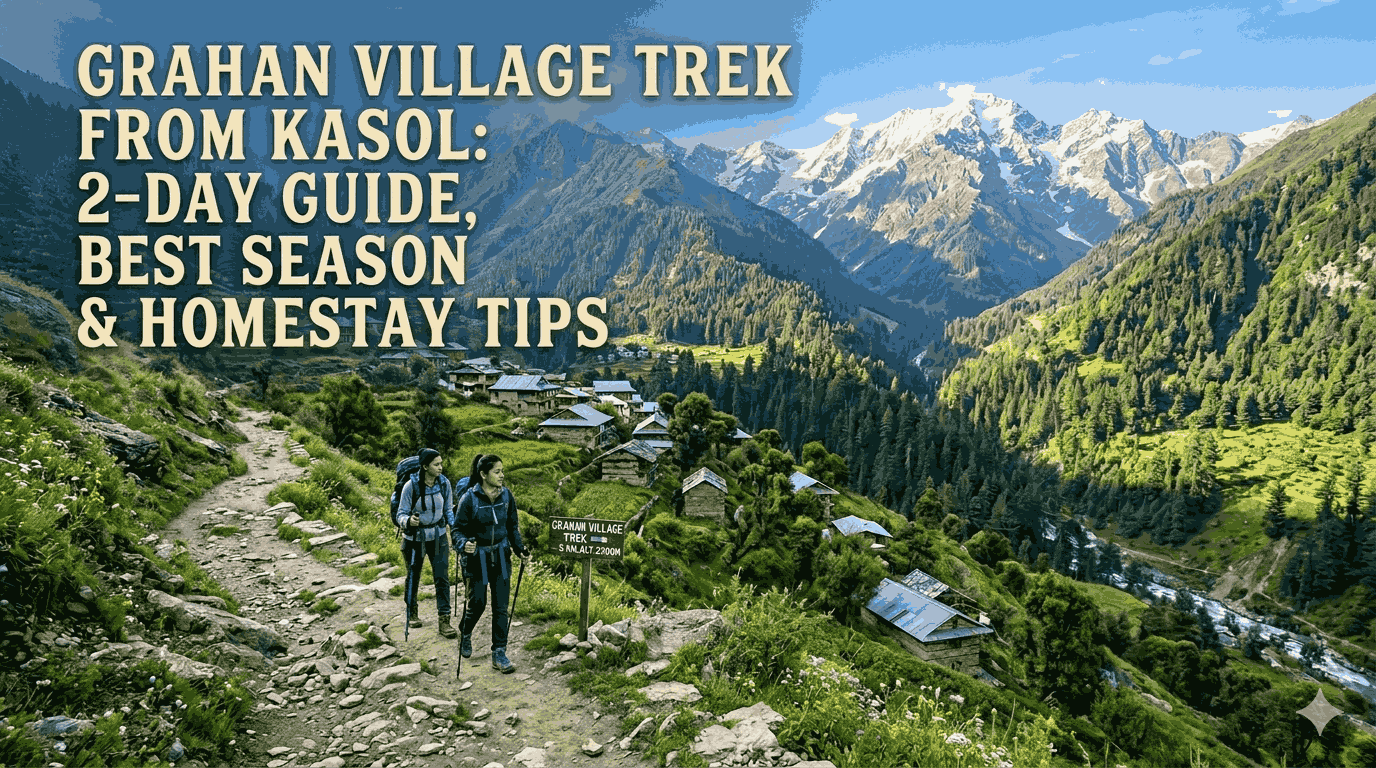
The Grahan Village Trek from Kasol is a 9 km, easy-to-moderate 2-day walk to a 2,347 m off-grid village in Parvati Valley. Best months: March–June and September–November.
Grahan Village Trek from Kasol: Grahan Village (2,347 m / 7,700 ft) sits 9 km uphill from Kasol along the Grahan Nallah in Himachal’s Parvati Valley. The one-way trek takes 4–6 hours on an easy-to-moderate gradient, with the only steep stretch in the final 1.5 km. No permit, no entry fee, no mobile network, cash-only. Best months: March–June and September–November. Avoid July–August — Parvati Valley recorded four cloudbursts in 24 hours on 25 June 2025 (Down To Earth) and access roads were disrupted again in February 2026.
In this Blog
Why Grahan, and Why Walk Up From Kasol?
Grahan Village is a 9 km uphill walk from Kasol — the only Parvati Valley settlement of any size that still has no motorable road, no ATM, and no mobile network. About 300 people live in 30-odd wooden houses along a single ridge at 2,347 metres. Some of those houses are 200 years old. Local legend says the founding families walked here from somewhere near Malana about five centuries ago.
That combination — easy trail, real village, full off-grid — is why the trek has quietly become Parvati Valley’s most-recommended first overnight trek. It’s harder than the half-day walk to Chalal, easier than Kheerganga, and a fraction of the distance of Sar Pass. You can do it on a long weekend from Delhi.This guide pulls together what we get asked most by guests staying at our Kasol villas and our wider Himachal villa collection: how far is it really, when should I go, where do I sleep, is it safe in 2026, and how do I plan a 2-day, 1-night trip end-to-end?
What Are the Key Stats for the Grahan Village Trek?
| Detail | Number |
| Distance (one way) | 9 km from Kasol |
| Total trek (return) | ~18 km over 2 days |
| Altitude | 2,347 m / 7,700 ft |
| Difficulty | Easy to easy-moderate |
| Best months (2026) | March–June, September–November |
| Months to avoid | July, August (monsoon, cloudburst risk) |
| Permit / entry fee | None required |
| Mobile network | Zero signal past the second bridge |
| ATM in Grahan | None — withdraw cash in Kasol |
| Recommended duration | 2 days / 1 night |
Sources: AdventureNation, TrailHikers, Banbanjara field guides, and StayVista host check-ins (2025–26).
How Do You Reach Grahan Village From Kasol?

Grahan Village is 9 km from Kasol, reached on foot along the Grahan Nallah. There is no motorable road into the village. The walk takes 4–6 hours on the way up and 3–4 hours on the way down (consensus of AdventureNation, TrailHikers, 2025–26 itineraries). You leave Kasol on the south side of the river, cross the iron bridge over the Parvati, and follow the side stream up.
The Route, Step by Step
- Kasol bus stand → iron bridge → Chalal village (2 km). This first stretch is easy and flat — same trail the day-walkers from Kasol take.
- Chalal → second wooden bridge over Grahan Nallah (~3 km). The trail leaves the Parvati and turns up the Grahan side stream. Pine forest takes over.
- Second bridge → ascending forest → final climb (~3.5 km). The gradient is gentle for most of this stretch. The last 1.5 km is the steep one — a switchback climb that delivers you straight into the village.
Pro tip: trail markers shift after the second wooden bridge. Before the bridge, you’re following blue paint splashes on rocks and trees. After it, the markers become red arrows on rocks, and they’re easier to miss when the light drops. Solo trekkers lose the path here more than anywhere else on the route. If you haven’t seen a marker in 10 minutes, backtrack.
Getting to Kasol First
| From Delhi | Overnight Volvo to Bhuntar. From Bhuntar to Kasol (32 km), seat; shared taxi/sumo. |
| From Chandigarh | HRTC/Volvo bus to Bhuntar. Or self-drive: 305 km via NH-3. |
| Nearest airport | Bhuntar / Kullu–Manali (KUU), 32 km from Kasol. |
| Nearest railway | Joginder Nagar (140 km) or Chandigarh (305 km). |
| Best Kasol base | For comfort either side of the trek, see our Kasol villas, or check whether Kasol is the right base for you at all. |
Pro tip: peak season (May–June, October) sees shared-taxi prices push toward the top.The HRTC bus is the most reliable budget option and runs roughly every 30 minutes from Bhuntar bus stand toward Manikaran — ask the conductor to drop you at Kasol.
The Grahan Village trek from Kasol covers 9 km one-way along the Grahan Nallah, gaining roughly 700 m of altitude to reach the village at 2,347 m (7,700 ft). The starting point is the iron bridge at the Kasol bus stand; the village is the trail’s terminus, with no road access (consensus of AdventureNation, TrailHikers, Banbanjara, 2025–26).
How Difficult Is the Grahan Village Trek?
Grahan is rated easy to easy-moderate. Around 85% of the 9 km is a gentle gradient through pine forest — a path most reasonably fit travellers will walk in conversation. The only demanding section is the last ~1.5 km, a steep switchback climb into the village. There’s no scrambling, no exposure, no fixed ropes, and no high-altitude risk in any serious sense.
Our rough fitness rule: if you can climb 5–6 flights of stairs without stopping, you can complete Grahan. No prior trekking experience needed. We’ve sent honeymooning couples up, families with 10-year-olds, and parents in their late 50s. The descent is usually harder on the knees than the climb is on the lungs — trekking poles help.
What Quietly Makes It Harder
- Altitude (2,347 m). Mild headache or breathlessness is possible if you’ve flown in directly from Mumbai or Bengaluru. Spend one night in Kasol (1,640 m) before the trek to acclimatise.
- Monsoon trail erosion. Parts of the path wash out in heavy rain. The stretch above the second bridge is particularly affected.
- River crossings without railings. The wooden bridge across the Grahan Nallah is solid, but smaller tributaries cross the trail in short wooden plank crossings. Wet shoes are guaranteed in monsoon.
How Grahan Compares to Other Parvati Valley Walks
| Trek | Distance (one way) | Altitude | Difficulty | Days |
| Chalal day walk | 2 km | 1,710 m | Very easy | Half-day |
| Grahan Village | 9 km | 2,347 m | Easy–moderate | 2D/1N |
| Tosh Village | ~1 km from road head | 2,400 m | Very easy | 1–2 nights |
| Kheerganga | 12 km | 2,950 m | Moderate | 2D/1N |
| Sar Pass | ~50 km (full loop) | 4,220 m | Moderate–hard | 5 days |
Distances and altitudes per Indiahikes, Himachal Tourism, and tour-operator field data, 2025–26.
Grahan is one of the easiest overnight treks in Parvati Valley — 9 km of mostly gentle pine-forest path with a steep final 1.5 km. It’s more demanding than the Chalal day walk but markedly easier than Kheerganga or Sar Pass, which makes it the most-recommended first overnight trek for beginners visiting Kasol (StayVista travel desk, 2026).
What Is the Best Time to Visit Grahan Village?
The best months for the Grahan trek are March to June and September to November. Avoid July and August — Parvati Valley experienced four cloudbursts in 24 hours on 25 June 2025 (Down To Earth) and a landslide blocked the Manikaran–Barshaini road in February 2026 (The Logical Indian). Always check road and weather status 48 hours before you drive in.
Month by Month
| Month | Conditions | Verdict |
| March | Cold mornings (3–8°C), trail dry, fewer trekkers | Best for first-timers |
| April | Meadows starting to bloom, days 12–18°C | Excellent |
| May | Warmest pre-monsoon, longest daylight, peak crowd | Peak season |
| June (1–20) | Hot in Kasol, pleasant in Grahan | Good — but watch weather alerts |
| Late June–August | Monsoon, cloudbursts, landslides documented | Avoid |
| September | Post-monsoon green, clear skies returning | Excellent for photographers |
| October | Cool days, golden light, low rain risk | Best month overall |
| November | Cold, fewer crowds, possible first snow | Best for solo travellers |
| December–February | Snow on trail beyond second bridge | Winter trek only with guide and microspikes |
Sources: Himachal Tourism seasonal guidance, IMD station data for Kullu district (2024–26), and StayVista host check-ins.
2025–26 Safety Advisories You Should Know
The Parvati Valley has had a difficult two years on the weather front. We’re flagging the documented incidents here because no other Grahan guide on the search results page mentions them, and they directly affect when you should and shouldn’t trek:
- 25 June 2025: Four cloudbursts in 24 hours across Kullu Valley — Manikaran, Banjar, Sainj and Solang were all hit (Down To Earth).
- 17 August 2025: A cloudburst in the Manikaran Valley near Rashol destroyed three houses, a pedestrian bridge, and three water mills (The Tribune).
- 24 February 2026: A landslide blocked the Manikaran–Barshaini road, stranding travellers and cutting access to Kasol for a short period (The Logical Indian).
Our practical rule of thumb for 2026: check the Kullu district administration’s updates and the Himachal Tourism portal 48 hours before you leave. If there’s been heavy rain anywhere in the Kullu–Parvati belt in the previous 72 hours, push the trip back a few days. For context on Himachal’s wider monsoon patterns, see our piece on monsoon weather in Parvati Valley.
On the safety question more broadly: solo trekkers on the r/SoloTravel_India and r/himachal communities consistently flag Grahan as one of the safer Parvati Valley overnights when done in the right season, with weekend foot traffic high enough that no one walks the trail truly alone (2025 community thread consensus).
The Grahan Village trek is open year-round but safest between March–June and September–November. Travellers should avoid July and August following a documented cluster of cloudbursts across Parvati Valley in 2025, including four cloudbursts in 24 hours on 25 June 2025 (Down To Earth). Winter trekking (December–February) requires microspikes and a local guide because the section above the second bridge holds snow.
What Does the 2-Day Grahan Village Trek Itinerary Look Like?

The Grahan Village trek follows a 2-day, 1-night plan: leave Kasol bus stand at 8 am, reach the village by 1 pm via the 9 km pine-forest trail, stay overnight in a wooden homestay at 2,347 m, and descend in 3–4 hours the next morning. A round-trip day-hike is possible but misses the off-grid village evening that defines the trek.
Two days is the right length. One day is possible if you’re fit and you start at first light, but you’ll miss the entire point — which is the evening in the village. Three days is overkill unless you’re using Grahan as a base for further exploration of the Grahan-Khanjer meadows above.
Day 1 — Kasol to Grahan Village (Trek + Homestay)
- 6:00–7:00 am — Wake up in Kasol. Eat a carb-heavy breakfast. Moondance Cafe, Evergreen Cafe, or your StayVista host’s kitchen all work. Top up water bottles.
- 8:00 am — Start trek from Kasol bus stand. Cross the iron bridge to the Chalal side.
- 8:30–9:00 am — Reach Chalal. This is your last chance to buy bottled water and a packet of Maggi for the ascent.
- 10:00 am — Second wooden bridge over the Grahan Nallah. Trail markers change here from blue paint to red arrows on rocks. Adjust your eyes.
- 11:30 am–1:00 pm — Reach Grahan Village. The last 1.5 km feels longer than it is.
- 1:00–2:00 pm — Check into homestay. Drop bag. Eat rajma-chawal or siddu (the local Kullvi steamed bread).
- 3:00–6:00 pm — Walk around the village. See the Bhairavnath shrine (photography is not allowed inside). Sit by the apple orchards.
- 7:00 pm onwards — Bonfire at the homestay (only outside monsoon). Simple Himachali thali for dinner. Sleep early — the silence is genuinely something.
Day 2 — Grahan to Kasol (Descent + Optional Add-Ons)
- 7:00 am — Sunrise from the village ridge. Worth setting an alarm for.
- 8:30 am — Breakfast. Local apple jam, parathas, chai.
- 10:00 am — Start the descent. Easier on the knees if you carry trekking poles. Watch your footing on the steep first 1.5 km.
- 12:30–1:30 pm — Back in Kasol.
- Optional Day 2 add-ons: Manikaran Sahib Gurudwara hot springs (4 km from Kasol, free entry, 24-hour darshan); Chalal sunset walk; a half-day extension to Tosh village (1.5 hr drive from Kasol).
| Time required | 2 days, 1 night minimum. Day-trip possible for very fit trekkers starting by 6 am but not recommended. |
| Ideal for | First-time overnight trekkers, couples, friend groups of 4–8, solo travellers, families with kids 10+. |
| Cash to carry | No ATM in Grahan, no card machines, no UPI signal. |
| Power | Power bank of 10,000 mAh+ is non-negotiable. Homestays have electricity but it cuts. |
| Pro tip | Pack one set of completely dry clothes inside a sealed plastic bag inside your backpack. After 9 km of forest sweat, dry clothes at the homestay are the single best thing you can do for yourself. |
Where Do You Stay on the Grahan Village Trek and What Does It Cost?
Grahan Village has roughly 30–50 traditional wooden homes, of which around a dozen operate as homestays. Rates run ₹300–₹600 per room per night, usually with a basic dinner and breakfast thrown in. Cash only. Booking is loose — phone the homestay from Kasol the morning of your trek, or just walk up and ask.
What to Expect Inside a Grahan Homestay
- Twin or triple rooms with thick local blankets and wood-panelled walls.
- Shared bathrooms. Hot water arrives in a bucket on request.
- No Wi-Fi at most stays. A few now offer patchy satellite Wi-Fi — useful for one quick “I’m alive” message, not for streaming.
- Meals: rajma-chawal, dal, sabzi, siddu, occasionally trout. Vegetarian by default; ask in advance if you want meat.
- Alcohol is banned in the village. Don’t carry it up.
Named Grahan Homestays Worth Calling First
The names that come up most often in 2024–25 trekker accounts are Ghanshyam’s Place, Blue Heaven Homestay (the first guesthouse you reach as you enter the village from the trail), Howling Owl Homestay, Ravi Homestay, and Manisha Homestay & Cafeteria. Most of these have active Facebook or Instagram pages — search the homestay name on either platform and you’ll find current photos and contact details from the family running the place.
We don’t publish phone numbers in this guide because Grahan homestay contacts change frequently as new families convert rooms each season. Better to reach out via the homestay’s own Facebook or Instagram page, or simply walk up — there’s almost always a room available outside peak weekends in May, June and October.
Two Ways to Plan Your Stay
- Trek-only (1 night in Grahan). Best for purist trekkers who want the off-grid village night as the main event.
- Kasol-base + Grahan overnight (recommended for most travellers). Sleep in a comfortable villa or homestay in Kasol on nights 1 and 3. Walk up to Grahan on day 2, stay one night, descend on day 3, sleep back in Kasol that night. Best for couples and families who want hot water and a private bathroom either side of the trek.
From conversations with our Kullu and Manali host network, Grahan is the single most-asked-about side trek from our Parvati Valley properties — even more than Kheerganga. Most guests ask about it within an hour of check-in.
Luxury Villas to Base Your Grahan Trek
Casa Bella

The Manor

Amritalaya

Do You Need a Permit or Network for the Grahan Village Trek?
The Grahan Village trek requires no permit, no entry fee, and no guide because the village sits outside Great Himalayan National Park (GHNP) boundaries. Mobile network drops to zero beyond the second wooden bridge, there’s no ATM in the village, and alcohol is community-banned.
Grahan is one of the few Parvati Valley walks that needs no permit, no entry fee, and no guide. It’s also one of the very few places left in the Indian Himalayas where your phone is fully useless. Here’s everything you need to know before you go.
| Permit / entry fee | None required. Grahan sits outside the Great Himalayan National Park (GHNP) boundary, so there’s no forest entry fee and no compulsory guide. Foreign nationals don’t need any extra registration. |
| Mobile network | Zero signal. Jio, Airtel and Vi all go dead beyond the second wooden bridge. Some homestays now have intermittent satellite Wi-Fi (~30% uptime, useful for a single message). |
| ATM | None in Grahan. None on the trail. Withdraw cash at the SBI ATM near Kasol bus stand, or in Bhuntar before you arrive. |
| Electricity | Patchy. Power cuts at the village level are common. 10,000 mAh power bank minimum. |
| Alcohol | Banned in the village. The community enforces this firmly. Drink in Kasol if you want to, not in Grahan. |
| Photography | Avoid photographing the Bhairavnath shrine interior or villagers’ homes without asking. The exterior is fine. |
| Guides | Optional in summer, useful in winter (December–February) when the trail is snowed and microspikes are needed. |
| Insurance | Recommended. Most adventure-travel policies cover trekking up to 5,000 m — Grahan sits well under that. |
| What to carry | Power bank, microspikes (winter only), trekking poles, headlamp, dry bag. |
Grahan vs Tosh vs Kheerganga — Which Parvati Trek Should You Pick?
Among Parvati Valley’s four most-walked routes, Grahan (9 km, 2,347 m) is the easiest true overnight trek and the best first choice for beginners. Kheerganga (12 km, 2,950 m) is moderately harder but delivers hot springs at the top. Tosh involves almost no walking. Sar Pass (50 km, 4,220 m) is for trained multi-day trekkers only.
If you’re choosing between Parvati Valley’s four most-searched walks, this is the short answer: Grahan is the best first overnight trek, Kheerganga is the best for hot springs, Tosh is for people who don’t want to trek at all, and Sar Pass is for people training for bigger things.
| Trek | Distance (one way) | Altitude | Days | Difficulty | Best for |
| Grahan Village | 9 km | 2,347 m | 2D / 1N | Easy–moderate | First overnight trek; off-grid village stay |
| Chalal | 2 km | 1,710 m | Half-day | Very easy | Day walk from Kasol |
| Tosh Village | Drive + 1 km walk | 2,400 m | 1–2 nights | Very easy | Scenic stay without the trek |
| Kheerganga | 12 km | 2,950 m | 2D / 1N | Moderate | Hot springs at altitude; slightly fitter trekkers |
| Sar Pass | ~50 km loop | 4,220 m | 5 days | Moderate–hard | Trained multi-day trekkers |
Sources: Indiahikes, BMC trek grades, Himachal Tourism, and StayVista host inputs (2025–26).
For a broader call on whether Kasol is even the right base for you, our piece on how Kasol compares to Tosh and Manali walks through costs, crowds and vibe for each. And if you’re already planning Grahan, it pairs naturally with the other offbeat villages in Parvati Valley we cover in our regional guide. Trekkers extending the trip further can also dip into our list of other North India treks to pair with Grahan.
What Should You Pack for the Grahan Village Trek?
The Grahan Village trek packing list centres on three categories: layered clothing (thermal base, fleece, waterproof shell — Grahan mornings sit below 10°C even in May), ankle-supporting waterproof trekking shoes for stream crossings, and a 10,000 mAh power bank because village electricity is intermittent.
Pack light — you’re walking 9 km uphill — but pack right. A 30-litre day-pack is plenty. Here’s the kit list we hand to StayVista guests heading up.
- Layers (always): thermal base layer, fleece mid-layer, waterproof shell. Even in May, Grahan mornings sit below 10°C.
- Footwear: ankle-supporting waterproof trekking shoes. The trail has stream crossings.
- Backpack: 30L day-pack, with rain cover.
- Essentials: headlamp, water bottle (1L minimum), basic first aid kit, ORS sachets, sunscreen, sunglasses.
- Smart additions: trekking poles, dry bag (July–September), small towel.
- Winter add-ons (December–February): microspikes, gloves, extra socks, balaclava.
- Skip: hairdryers, formal wear, glass bottles, heavy DSLR if you have a phone with a decent camera.
Why pack a power bank, not a charger: village electricity cuts at unpredictable times. A 10,000 mAh power bank gets a typical phone through two full days, which is exactly the buffer you need.
Grahan Village Trek — Frequently Asked Questions
The Grahan Village trek is 9 km one way from Kasol, taking 4–6 hours uphill and 3–4 hours on the descent. Most trekkers do it as a 2-day, 1-night plan with an overnight homestay in the village. A round-trip day-hike is possible for fit trekkers starting by 6 am, but it isn’t recommended.
Grahan Village sits at 2,347 metres (7,700 feet) above sea level. The trek from Kasol involves a gain of around 700 m of altitude across 9 km, which is gentle enough that altitude sickness is rare. Travellers flying in from sea level should still spend one acclimatisation night in Kasol (1,640 m) before starting up.
Grahan is rated easy to easy-moderate, and it’s the most-recommended first overnight trek in Parvati Valley. About 85% of the 9 km is a gentle gradient through pine forest. Only the final 1.5 km is a steep climb. Anyone who can climb 5–6 flights of stairs without stopping can complete it. No technical skills required.
March–June and September–November are the best months for the Grahan trek. Avoid July and August due to documented cloudburst and flash-flood risk in Parvati Valley — four cloudbursts hit Kullu Valley in 24 hours on 25 June 2025, per Down To Earth. December–February is doable as a winter trek but only with microspikes and a local guide.
No permit is required for the Grahan Village trek. Grahan sits outside the Great Himalayan National Park (GHNP) boundary, so there’s no forest entry fee, no registration counter, and no compulsory guide. Foreign nationals don’t need any additional travel permits beyond their standard Indian tourist visa.
Yes — roughly a dozen homestays operate in Grahan Village, usually inclusive of dinner and breakfast. There’s no online booking platform. Reach out via the homestay’s Facebook or Instagram page, or walk up on arrival. Cash only. Named stays travellers mention most often in 2024–25 accounts include Ghanshyam’s Place, Blue Heaven Homestay, Howling Owl, Ravi Homestay and Manisha Homestay & Cafeteria.
No. There is zero cellular signal in Grahan Village. Jio, Airtel and Vi all stop working past the second wooden bridge on the trail. A few homestays now offer intermittent satellite Wi-Fi, but uptime is roughly 30%. Tell people back home you’ll be off-grid for 36 hours before you start walking.
Yes — Grahan Village is widely regarded as one of the safest treks in Parvati Valley for solo female travellers. The trail sees steady weekend foot traffic in season, and the village community is tight-knit and welcoming. Avoid trekking alone in monsoon or after dark, and start the descent by mid-morning so you’re back in Kasol before sunset.
Technically yes — a fit trekker starting by 6 am can complete Grahan as an up-and-down day-hike. In practice, we don’t recommend it. The whole point of Grahan is the off-grid village stay; turning around the moment you reach the village misses the experience and adds a tough descent on already-tired legs.
Where to Stay When You Get Back
Quick recap: 9 km, 2,347 m, 4–6 hours up, 3–4 hours down, 2 days and 1 night, no permit, no network, March–June and September–November for the best weather, and a clear “no” on July and August in 2026.
Most trekkers we host arrive in Kasol a day before the trek and stay one night after. The post-descent shower, a hot meal that isn’t rajma-chawal, and a proper bed are non-negotiables after 18 km on the legs. If you’re planning the same, our Kasol villas sit a short walk from the trailhead and our hosts can connect you directly with Grahan homestays. If you’re extending into Manali or Kullu after the trek, browse our wider Himachal villa collection for the same network of properties covered in the table above.
Wherever you sleep — up in Grahan or back in Kasol — the trek is the kind of small, easy, off-grid weekend that explains why people keep going back to Parvati Valley year after year. For travellers who want to stretch the trip further, we also recommend pairing it with the best summer treks in the Himalayas for a longer mountain run.