

20 Best Places to Visit in India in July 2026 (Monsoon Guide)
Last updated: June 2026
The best places to visit in India in July 2026 split into two camps — rain-free Himalayan escapes (Ladakh, Spiti Valley, and the Valley of Flowers in peak bloom) and lush, waterfall-rich monsoon destinations (Coorg, Munnar, Mahabaleshwar, Meghalaya, Wayanad). July is peak season in the high Himalaya and peak monsoon everywhere else, so it’s one of the most scenic — and most varied — months to travel. The all-India monsoon is forecast below normal in 2026 (~90% of the long-period average), which generally means steadier roads, but always check local advisories before hill travel.
In this Blog
India in July at a glance
| Two ways to go | Rain-shadow (Ladakh, Spiti) for dry sun, or the Western Ghats for green-and-misty monsoon |
| July highlight | Valley of Flowers in peak bloom (mid-July–mid-August) |
| Weather | Peak monsoon across most of India; dry in Ladakh/Spiti; 15–32°C |
| July events | Valley of Flowers bloom · Amarnath Yatra (3 Jul–28 Aug 2026) · Behdienkhlam, Meghalaya |
| Ideal duration | 4–8 days depending on region |
Is July a good time to travel in India?
Yes — July is one of the most rewarding months, as long as you pick the right region for the experience you want. It’s the heart of the southwest monsoon, so the Western Ghats and the Northeast are at their greenest, waterfalls run at full power, and tourist crowds thin out. At the same time, the Himalayan rain-shadow belt — Ladakh and Spiti — is dry, sunny and at peak season, and the Valley of Flowers hits its famous bloom in mid-July.
For 2026, the IMD forecasts a below-normal monsoon nationally (around 90% of the long-period average), which usually means fewer washouts and steadier hill roads than a heavy year — though Uttarakhand and Himachal interiors still demand caution in peak spells. Match the month to the map and July rarely disappoints. For the safety lens, see our safe places to visit in monsoon guide, and for the live picture, the pre-monsoon rain tracker.
July travel safety — quick rules
– Uttarakhand/Himachal hills: landslide-prone in peak rain — travel by day, keep buffer days, follow the IMD forecast.
– Western Ghats waterfalls/treks: view from official points; base treks close in heavy rain.
– Ladakh/Spiti: the risk is altitude, not rain — acclimatise slowly.
– Valley of Flowers: day-visit only (gate 7 AM, last entry 2 PM); a daily cap of 300 means permits can sell out.
20 best places to visit in India in July
Rain-free Himalayan escapes
1. Leh–Ladakh, Ladakh

July is peak Ladakh season — the high passes are open, skies are blue and the rain that drenches the rest of India barely reaches this Himalayan rain-shadow desert.
Best time: June–September; July is prime.
How to reach: Fly to Leh (KBR); or the Manali–Leh / Srinagar–Leh highways.
Time required: 6–8 days (acclimatise 2 days).
Ideal for: Bikers, road-trippers, photographers.
Safety note: Altitude, not rain — hydrate and ascend slowly.
Pro tip: Book Pangong and Nubra inner-line permits ahead; July weekends are busy.
2. Spiti Valley, Himachal Pradesh

A cold desert in the rain-shadow, Spiti stays dry and otherworldly in July while the lower Himalayas are awash — think 1,000-year-old monasteries and moonscape valleys.
Best time: Late June–September.
How to reach: Via Shimla–Kinnaur (steadier in rain) or Manali (Kunzum Pass); nearest airport Bhuntar.
Time required: 7–9 days.
Ideal for: Adventurers, slow travellers.
Safety note: Prefer the Shimla approach in heavy monsoon. See Spiti in July 2026.
3. Valley of Flowers, Uttarakhand

This UNESCO-listed alpine meadow erupts into a carpet of wildflowers in July — the single most July-specific reason to travel in India.
Entry permit: ₹200 (Indian, 3 days) / ₹800 (foreign); under-12 free.
Open: 1 June–31 Oct; gate 7 AM, last entry 2 PM (day-visit only); daily cap 300.
Best time: Mid-July to mid-August for peak bloom.
How to reach: Trek from Govindghat → Ghangaria (base); nearest railhead Rishikesh.
Ideal for: Trekkers, nature lovers.
Pro tip: Apply early on the official portal. Full guide: Valley of Flowers trek 2026.
4. Almora, Uttarakhand

A gentle Kumaon hill town with Himalayan views, colonial-era lanes and pine forests — greener and quieter in July, away from the landslide-prone high routes.
Best time: July for misty greenery.
How to reach: ~90 km from Kathgodam railhead; nearest airport Pantnagar.
Time required: 2–3 days.
Ideal for: Couples, slow travellers, writers.
Safety note: Stick to the main Kathgodam–Almora road in heavy rain.
Pro tip: Day-trip to Jageshwar’s cedar-shaded temples.
The Northeast (peak monsoon, peak green)
5. Mawsynram & Cherrapunji, Meghalaya

The wettest place on Earth is, paradoxically, a brilliant July pick — everything here is built for rain, and the waterfalls and living-root bridges are unforgettable.
Best time: July for full-power falls (September for clearer views).
How to reach: ~60 km from Shillong; nearest airport Guwahati.
Time required: 2–3 days.
Ideal for: Rain lovers, photographers.
Pro tip: July brings the Behdienkhlam festival — see our Behdienkhlam 2026 guide. Carry a heavy poncho.
6. Tawang, Arunachal Pradesh

High, remote and spectacular, Tawang offers monasteries, glacial lakes and alpine air — a peaceful break from the plains, with lighter rain than the Meghalaya belt.
Best time: July (carry rain gear for the approach).
How to reach: Via Guwahati → Tezpur → Bomdila (long mountain drive); permits (ILP) required.
Time required: 5–6 days.
Ideal for: Adventurers, culture seekers.
Safety note: The Sela Pass road can be slow in rain — plan buffer days.
Western Ghats — Maharashtra
7. Mahabaleshwar, Maharashtra

Among the safest, best-served monsoon hill stations near Mumbai and Pune, with mist-wrapped viewpoints and full waterfalls all July.
Best time: July–September.
How to reach: ~120 km from Pune, ~260 km from Mumbai (NH-48).
Time required: 2 days.
Ideal for: Couples, families, weekenders.
Safety note: Viewpoints get slippery — grippy shoes, stay behind railings. See Mahabaleshwar in monsoon.
8. Panchgani, Maharashtra

Mahabaleshwar’s quieter twin, Panchgani’s tabletop plateau and valley views are at their lush best in July, with an easygoing, family-friendly pace.
Best time: July–September.
How to reach: ~100 km from Pune; ~5 km from Mahabaleshwar.
Time required: 1–2 days.
Ideal for: Families, couples.
Safety note: Table Land can be fog-bound — mind the edges.
Pro tip: Pair with a Mahabaleshwar weekend.
9. Igatpuri, Maharashtra

A waterfall-and-fort paradise on the Mumbai–Nashik line, Igatpuri turns electric green in July, with the Sahyadris at their most dramatic.
Best time: July–August.
How to reach: Igatpuri railway station; ~45 km from Nashik, ~120 km from Mumbai.
Time required: 1–2 days.
Ideal for: Trekkers, couples, weekenders.
Safety note: Don’t enter waterfalls/dams in spate. See Igatpuri in monsoon 2026.
Western Ghats — the South
10. Coorg (Kodagu), Karnataka

Karnataka’s coffee country is reliably green and well-connected in July, with full waterfalls and estate stays made for rain-walks.
Best time: July–September.
How to reach: ~250 km from Bengaluru; nearest airport Mangaluru (~140 km).
Time required: 3 days.
Ideal for: Couples, families.
Safety note: Stick to Madikeri–Virajpet main roads in heavy rain. See monsoon in Coorg.
11. Chikmagalur, Karnataka

Coorg-like greenery with fewer crowds — coffee estates, misty hills and good main-road access, best enjoyed as an estate stay in July rather than a high-trek base.
Best time: July for the estates.
How to reach: ~245 km from Bengaluru; nearest railhead Kadur (~40 km).
Time required: 2–3 days.
Ideal for: Couples, slow travellers.
Safety note: Mullayanagiri treks are often closed/risky in peak monsoon.
12. Agumbe, Karnataka

The “Cherrapunji of the South” is one of India’s wettest spots and a July rainforest dream — sunsets (on clear evenings), waterfalls and king-cobra country.
Best time: July for the full monsoon mood.
How to reach: ~95 km from Udupi; nearest airport Mangaluru.
Time required: 1–2 days.
Ideal for: Nature lovers, photographers.
Safety note: Roads are slick and remote — daytime travel; leeches on trails (carry salt).
13. Munnar, Kerala

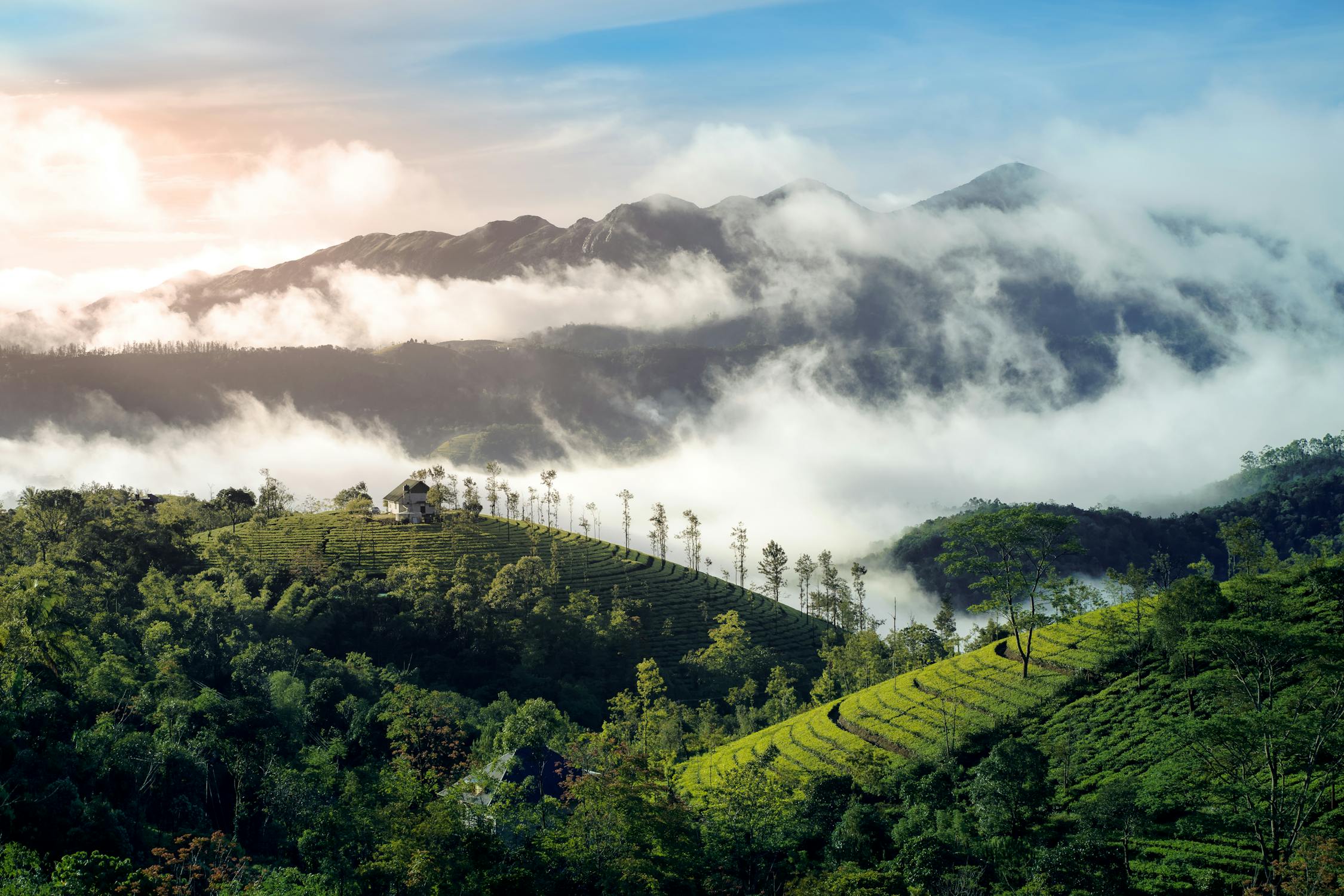
Kerala’s tea capital is electric-green in July, with mist, waterfalls and the best-maintained ghat roads in the Western Ghats.
Entry (Eravikulam NP): ₹125 (Indian adult); 8 AM–4 PM (open in monsoon, weather-dependent).
How to reach: ~110 km from Kochi (3.5 hrs).
Time required: 2–3 days.
Ideal for: Couples, families.
Safety note: Skip Top Station after heavy showers. See Munnar in monsoon.
14. Wayanad, Kerala (go, with care)

Spice estates, caves and waterfalls make Wayanad a July beauty — to be enjoyed responsibly after the 2024 landslides.
Best time: July, in lulls between heavy spells.
How to reach: ~95 km from Kozhikode; NH-766 from Bengaluru (mind the Bandipur 9 PM–6 AM night ban).
Ideal for: Nature lovers (cautious).
Safety note: The Mundakkai–Chooralmala landslide belt is a restricted no-go zone — base in Vythiri/Kalpetta. See Wayanad monsoon guide.
15. Valparai, Tamil Nadu

A tea-estate hill station reached by 40 hairpin bends, Valparai is lush, offbeat and wildlife-rich (look for Nilgiri tahr and lion-tailed macaques) in July.
Best time: July for greenery.
How to reach: ~65 km from Pollachi; nearest airport Coimbatore (~100 km).
Time required: 2 days.
Ideal for: Offbeat travellers, wildlife lovers.
Safety note: The ghat road is foggy — drive slowly, by day.
16. Kodaikanal, Tamil Nadu

Gentler monsoon rain than the west-facing Ghats keeps Kodaikanal’s lake, forests and viewpoints pleasant through July.
Best time: July–September.
How to reach: ~80 km from Kodai Road railhead; nearest airport Madurai (~120 km).
Time required: 2 days.
Ideal for: Couples, families.
Pro tip: Cycle around the lake between showers.
17. Yercaud, Tamil Nadu

A small, serene Shevaroy-hills retreat near Salem — coffee slopes, an orchid garden and a calm lake, far quieter than Ooty or Kodai in July.
Best time: July for cool greenery.
How to reach: ~35 km from Salem (railhead); nearest airport Coimbatore (~110 km).
Time required: 1–2 days.
Ideal for: Couples, budget travellers, slow weekends.
Pro tip: The ghat road has 20 hairpins — go gently in rain.
Coast & Rajasthan
18. South Goa

Monsoon Goa is green, cheap and serene, and the quieter south — Palolem, Agonda, the spice farms — is lovely in July, with dramatic seas and full Dudhsagar Falls.
Best time: July for off-season calm and lowest tariffs.
How to reach: Manohar (Mopa)/Dabolim airports; Madgaon railhead.
Time required: 3–4 days.
Ideal for: Couples, budget travellers.
Safety note: Swim only on flagged beaches; seas are rough.
19. Udaipur, Rajasthan

Light July showers transform the City of Lakes — brimming lakes, green Aravallis and palace views without any flooding risk.
Entry (City Palace museum): ₹300–₹400 (adult); 9:30 AM–5:30 PM.
How to reach: Maharana Pratap Airport (22 km); Udaipur City station (4 km).
Time required: 2–3 days.
Ideal for: Couples, families, heritage lovers. See Udaipur in monsoon.
20. Mount Abu, Rajasthan

Rajasthan’s only hill station enjoys moderate July rain and cool air, with Nakki Lake and the marble Dilwara Temples easy to enjoy.
Entry (Dilwara Temples): Free; tourist hours 12 PM–5 PM (no photography inside).
How to reach: Nearest railway Abu Road (28 km); Udaipur airport (~185 km).
Time required: 2 days.
Ideal for: Families, couples, budget travellers. See Mount Abu in monsoon.
Ladakh vs Spiti in July: which should you pick?
Both are rain-shadow deserts that stay dry in July, but they suit different travellers. Ladakh is the bigger, more set-up destination — easy to fly into (a direct flight to Leh saves days), with marquee sights like Pangong Tso, Nubra Valley and Hemis Monastery, decent hotels and reliable permits. It’s ideal if you want iconic landscapes without a punishing road journey. Spiti, reached only by long mountain drives via Shimla or Manali, is rawer, quieter and more rugged — ancient monasteries at Key and Tabo, villages like Kibber and Langza, and far fewer tourists. Choose Ladakh for comfort, accessibility and bucket-list scenery; choose Spiti for solitude, road-trip romance and an unfiltered Himalayan-desert experience. Either way, July’s dry weather and open passes make it the prime window — just budget two days to acclimatise, since both sit above 3,000 m.
July weather in India: a region-by-region snapshot
July is peak monsoon for most of the country, but the picture varies sharply by region:
| Region | July weather | Go for |
|---|---|---|
| Ladakh & Spiti (rain-shadow) | Dry, sunny, cool days, cold nights | High-altitude road trips, monasteries |
| Western Ghats (Maharashtra, Karnataka, Kerala) | Heavy rain, lush, full waterfalls | Hill stations, coffee/tea estates, waterfalls |
| Northeast (Meghalaya, Arunachal) | Heaviest rain in India | Living-root bridges, waterfalls, festivals |
| Uttarakhand & Himachal hills | Moderate-to-heavy; landslide risk | The Valley of Flowers; cautious hill travel |
| Rajasthan (Udaipur, Mount Abu) | Light, pleasant showers | Lakes, palaces, the desert’s greenest month |
| Coast (Goa, Konkan, Kerala) | Wet, dramatic, rough seas | Off-season calm, low tariffs, waterfalls |
The takeaway: if you want sun, head to the rain-shadow Himalayas; if you want the monsoon’s green drama, the Western Ghats and Northeast deliver it best.
What to pack for India in July
Pack for one of two very different trips. For the rain belt (Ghats, Northeast, coast): quick-dry clothing, a sturdy poncho plus a compact umbrella, waterproof footwear with grip, a dry bag for electronics, mosquito repellent, and salt or anti-leech protection for forest trails. For the high Himalaya (Ladakh, Spiti, Valley of Flowers): warm layers, a windproof jacket, sunglasses and high-SPF sunscreen (UV is intense at altitude), a refillable water bottle, and any altitude medication your doctor advises. A power bank is worth carrying everywhere, as monsoon power cuts and remote stretches are common. Whatever your destination, keep your itinerary flexible — July rewards travellers who can wait out a heavy spell or a blocked pass with a spare day.
July events worth planning around
- Valley of Flowers bloom (mid-July–mid-August) — the alpine meadow at its most colourful.
- Amarnath Yatra 2026 (3 July–28 August) — the Himalayan pilgrimage in J&K; advance registration and a health certificate are mandatory via the Shri Amarnathji Shrine Board.
- Behdienkhlam, Meghalaya (July) — the Jaintia community’s dramatic monsoon festival.
Distances & how to plan
- Want dry sun: fly to Leh or drive to Spiti — the rain-shadow belt ignores the monsoon.
- Want green-and-misty: the Western Ghats — Coorg/Chikmagalur (from Bengaluru), Munnar (from Kochi), Mahabaleshwar/Igatpuri (from Mumbai/Pune).
- Want a trek: the Valley of Flowers, in peak bloom.
For the full picture, see 18 best places to visit in India during monsoon (2026); to dodge the rain entirely, 15 best places to visit in India without rain in July & August 2026.
Suggested July itineraries
- Rain-free week (7–8 days): Leh–Ladakh loop, or Shimla → Spiti circuit.
- Trekker’s July (5–6 days): Rishikesh → Govindghat → Ghangaria → Valley of Flowers (+ Hemkund Sahib).
- Green weekend (2–3 days): Mahabaleshwar–Panchgani (West) or Coorg/Chikmagalur (South).
Where to stay in July (StayVista)
- Maharashtra Sahyadris (for Mahabaleshwar/Igatpuri/Panchgani): The Boulevard Villa, Lonavala and Santoni Farms, Karjat — private-pool villas in the rain belt.
- Coorg: Coffee & Mist — an estate-style stay for monsoon rain-walks.
- Wayanad: Princess of Wayanad — a safe Vythiri–Kalpetta-side base.
Planning a July escape? Browse StayVista’s monsoon homes across the Sahyadris and Coorg, or a dry-side stay if you’re Ladakh- or Spiti-bound. (CTA 1 of 3.)
FAQ: travelling in India in July
Which is the best place to visit in India in July?
For dry, sunny weather, Ladakh and Spiti Valley are the best July destinations. For monsoon scenery, Coorg, Munnar, Mahabaleshwar and Meghalaya are superb, and the Valley of Flowers is in peak bloom from mid-July.
Is July a good month to travel in India?
Yes. July is peak season in the Himalayan rain-shadow (Ladakh, Spiti) and peak monsoon elsewhere, bringing lush greenery, full waterfalls, fewer crowds and lower prices — just plan hill travel around the forecast.
Where can I go in July to avoid the rain?
Ladakh and Spiti Valley lie in the Himalayan rain-shadow and stay largely dry in July. Rajasthan (Udaipur, Mount Abu) sees only light showers.
When is the Valley of Flowers in bloom?
The Valley of Flowers is open 1 June–31 October, with peak bloom from mid-July to mid-August. It’s a day-visit only (gate 7 AM, last entry 2 PM), with a daily cap of 300 visitors.
Is it safe to travel to the hills in July?
Yes, if you choose well-managed destinations and avoid landslide-prone interior routes during heavy-rain alerts. Uttarakhand and Himachal interiors need the most caution; check the IMD forecast before you travel.
Which places to avoid in July?
Avoid steep, landslide-prone hill roads in peak rain (parts of interior Himachal and Uttarakhand) and the restricted Mundakkai–Chooralmala zone in Wayanad.
Conclusion
July is really two trips in one: a dry, sun-soaked Himalayan adventure in Ladakh, Spiti and the blooming Valley of Flowers, or a green, waterfall-soaked monsoon escape in the Western Ghats and the Northeast. Pick your camp, plan around the forecast, and July rewards you with India at its most dramatic — and least crowded. A comfortable StayVista home in the hills makes the rains (or the high-desert sun) all the more memorable.